
Inhaltsangabe
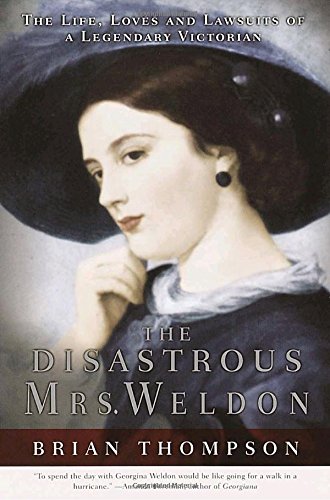
Presents the colorful, vivid biography of Georgina Weldon, a Victorian eccentric whose outrageous, scandalous life led to financial disaster, betrayal by her parents, and the threat of involuntary incarceration in a mental institution but whose determination helped overturn England's infamous Lunacy laws. Reprint.
Die Inhaltsangabe kann sich auf eine andere Ausgabe dieses Titels beziehen.
Über die Autorin bzw. den Autor
Brian Thompson has written for the stage, radio, television, and is the author of four novels. He divides his time between Oxford, England, and the South of France.
Auszug. © Genehmigter Nachdruck. Alle Rechte vorbehalten.
1
Georgina Weldon was never quite the performer and entertainer nor the grand lady or talked-about social lioness she so fondly invented for her readers. Her story starts with parents and a childhood of such a cranky nature they must be examined with the care she gave to later episodes of her life. Her troubles started the day she was born, when she was presented with a mask fashioned for her by parents who were the kind that could not distinguish easily between the truth and a lie.
She came into the world on May 24, 1837. All day long the London streets were filled with people, running to see the Life Guards pass by or hanging on the Hyde Park railings to gawp or jeer at the rich. The greatest aristocratic houses in England were represented by the comings and goings of their lumbering and oversprung coaches, issuing from the squares about Mayfair and Belgravia. In the tens of thousands that milled about on foot there was that strange unvoiced sense of the exceptional that sometimes characterizes how mobs behave. Londoners normally turned out in such numbers only to riot or exhibit their feral curiosity--a fortnight earlier, for example, twenty thousand had gathered at Newgate to watch the murderer Greenacre hanged. Today the mood was different. The word "sightseer" was a brand-new coinage and exactly suited the occasion. Placid and orderly citizens of all classes wandered down the Mall to inspect the newly completed but untenanted Buckingham Palace, where it was said few of the thousand windows would open and many of the doors were jammed in their frames by green timber and shoddy workmanship. Directly in front of the palace squatted the enormous and foreign-looking Marble Arch, on top of which was to have stood an equestrian statue of George IV, a piece of triumphalism only averted by his death and the colossal overspend on the whole project.
There were many such examples of the new and the bold to gaze on. London, in its West End, was being almost entirely remodeled. Ancient lanes and houses had been pulled down and green fields obliterated. Behind Buckingham Palace the ingenious Mr. Cubitt was bringing soil from his excavation of St. Katherine's Dock at Tower Bridge along a canal that cut up from the Thames to the site of the present Victoria station. His purpose was to fill the marshy land round about and complete the building of Belgravia for his client, Lord Grosvenor. It was the showpiece of property development in the entire city. Filling marshes and leveling huge tracts were becoming commonplace in that part of London. Thomas Cubitt's plans for neighboring Pimlico involved the wholesale tearing up of ancient market gardens: farms, even rivers, were not to stand in his way. Though it was true the speculation in property was running into something of a slump, the check was only temporary. The scale of new building in the capital was greater than anything seen before. For a brief moment this sunny Wednesday, London stood still and took stock of itself.
For the nobility it was an important working day, and most of those who peered from their coaches were in court dress. They were summoned in celebration of Princess Victoria's eighteenth birthday, which began with the formalities of an audience in the Drawing Room at Kensington Palace. It was an occasion of the greatest significance, for under the constitutional arrangements made for her the Princess at last burst free from the clutches of her mother, the regent. Those people of rank who attended the young Victoria that morning witnessed a telling little piece of theater. One of the many visitors she received was the Lord Chamberlain, who had ridden from Windsor with a letter from the King. The Duchess of Kent held out her hand to receive it on behalf of her daughter. Lord Conyngsby ignored the gesture and very pointedly gave the letter direct to the Princess. What was long promised had now become fact: the next monarch would be this almost unknown, unmarried young woman. As everyone understood, her accession was not far off. George IV had been fifty-eight when at last he became King, and his brother William IV succeeded him at age sixty-five. The taint of madness and scandal hung over both reigns. If God should spare Victoria, Britain could anticipate a profoundly different future.
As soon as she was old enough to understand, Georgina's father harped on the connection between these great events and her own birth. There was nothing particularly teasing about it either. Both parents made so much of the coincidence that she confessed later, "it filled my childish fancy with a vague idea of superiority and relationship with the Royal Family." Such ideas, which are normally no more than a harmless family joke, are supposed to wane with the passing of time; unfortunately, this one stuck. Georgina was to live her whole life with the unquantifiable feeling of superiority derived from that day. Encouraged by her manically snobbish parents, she was, she believed, blessed by greatness in some way: at the very least born to a rank in society that furnished its own recommendations and needed no apology or explanation. She was a full part of the old aristocratic supremacy, and the same gentle zephyrs that blew on Victoria's reign would also fill her sails. When things turned out rather differently--and it would be hard to imagine two less compatible Victorian histories than those of the monarch and her subject--then the fault lay not in her, but in other people.
It was certainly a wonderful day on which to be born. All England was en fate. The King lay at Windsor, unloved and unregarded, while at Kensington Palace his niece received twenty-two loyal addresses delivered by hand from every part of the country. In the evening hundreds of noble guests attended a state ball, where there was much quizzing of the short and excitable Victoria, who showed her gums rather a lot when she laughed. Once again, the King was conspicuous by his absence. Wellington had attended George IV in his last days and with his usual brutal candor let it be known around the room that the brother was in even worse plight. Lit by hundreds of candles, the noblest in the land gossiped on the white and gilt chairs set for their comfort. The sole topic of conversation was the future Queen.
Morgan Thomas and his heavily pregnant wife, Louisa, rode around London in their carriage that balmy May day, soaking up the atmosphere. Far from being at the center of things, they had no part to play and were not invited indoors to any great house: they were faces in the crowd. True, Morgan had a stare that could shatter glass and a coat in the old-fashioned color described as "King's blue." His wife wore a bonnet in which a plume danced as proudly as any other lady's, but their carriage would have given them away. There was a useful phrase in vogue to describe the aristocratic predominance: men and women of rank spoke of themselves as the Upper Ten Thousand. Morgan and his wife liked to believe they, too, were in that number--not angling to be admitted but already there and secure in their tenure. It was the deepest and most cherished of their fantasies. As evening approached, they crossed the river and rattled home to rural Clapham, where Georgina was born at a quarter to ten in the last of the summer light. For a few days and weeks there was anxiety in the nursery, for the Thomases already had a child, the sickly infant Cordelia. She died thirteen weeks later and was buried in Clapham Parish.
Georgina was destined to bear three surnames, but the first of these, Thomas, under which she was registered, is tied to a childhood that resolutely failed to budge from its anchorage in less progressive times. Her father was a William IV man, a Tory of the old stripe. At the time of her birth, Morgan Thomas was thirty-five years old and as reactionary as any man in...
„Über diesen Titel“ kann sich auf eine andere Ausgabe dieses Titels beziehen.
Weitere beliebte Ausgaben desselben Titels

Suchergebnisse für The Disastrous Mrs. Weldon: The Life, Loves and Lawsuits...

Beispielbild für diese ISBN
The Disastrous Mrs. Weldon : The Life, Loves and Lawsuits of a Legendary Victorian
Anbieter: Better World Books: West, Reno, NV, USA
Verkäuferbewertung 5 von 5 Sternen

Zustand: Fine. Used book that is in almost brand-new condition. May contain a remainder mark. Better World Books: Buy Books. Do Good. Artikel-Nr. 47803694-75
Gebraucht kaufen
EUR 10,58
Versand gratis
Versand innerhalb von USA
Versand innerhalb von USA
Anzahl: 1 verfügbar
Beispielbild für diese ISBN
The Disastrous Mrs. Weldon : The Life, Loves and Lawsuits of a Legendary Victorian
Anbieter: Better World Books: West, Reno, NV, USA
Verkäuferbewertung 5 von 5 Sternen
Zustand: Good. Pages intact with minimal writing/highlighting. The binding may be loose and creased. Dust jackets/supplements are not included. Stock photo provided. Product includes identifying sticker. Better World Books: Buy Books. Do Good. Artikel-Nr. 3460079-6
Gebraucht kaufen
EUR 10,58
Versand gratis
Versand innerhalb von USA
Versand innerhalb von USA
Anzahl: 1 verfügbar
Beispielbild für diese ISBN
The Disastrous Mrs. Weldon : The Life, Loves and Lawsuits of a Legendary Victorian
Anbieter: Better World Books: West, Reno, NV, USA
Verkäuferbewertung 5 von 5 Sternen
Zustand: Very Good. Pages intact with possible writing/highlighting. Binding strong with minor wear. Dust jackets/supplements may not be included. Stock photo provided. Product includes identifying sticker. Better World Books: Buy Books. Do Good. Artikel-Nr. 38631214-6
Gebraucht kaufen
EUR 10,58
Versand gratis
Versand innerhalb von USA
Versand innerhalb von USA
Anzahl: 1 verfügbar
Beispielbild für diese ISBN
The Disastrous Mrs. Weldon: The Life, Loves and Lawsuits of a Legendary Victorian
Anbieter: ThriftBooks-Dallas, Dallas, TX, USA
Verkäuferbewertung 5 von 5 Sternen
Paperback. Zustand: Very Good. No Jacket. May have limited writing in cover pages. Pages are unmarked. ~ ThriftBooks: Read More, Spend Less. Artikel-Nr. G0767906357I4N00
Gebraucht kaufen
EUR 12,67
Versand gratis
Versand innerhalb von USA
Versand innerhalb von USA
Anzahl: 1 verfügbar
Foto des Verkäufers
The Disastrous Mrs. Weldon: The Life, Loves and Lawsuits of a Legendary Victorian
Anbieter: WeBuyBooks, Rossendale, LANCS, Vereinigtes Königreich
Verkäuferbewertung 5 von 5 Sternen
Zustand: Good. Most items will be dispatched the same or the next working day. A copy that has been read but remains in clean condition. All of the pages are intact and the cover is intact and the spine may show signs of wear. The book may have minor markings which are not specifically mentioned. Artikel-Nr. rev8666284576
Gebraucht kaufen
EUR 22,64
EUR 6,64 Versand
Versand von Vereinigtes Königreich nach USA
Versand von Vereinigtes Königreich nach USA
Anzahl: 1 verfügbar