
Verwandte Artikel zu Spanish Lessons: Beginning a New Life in Spain
Inhaltsangabe
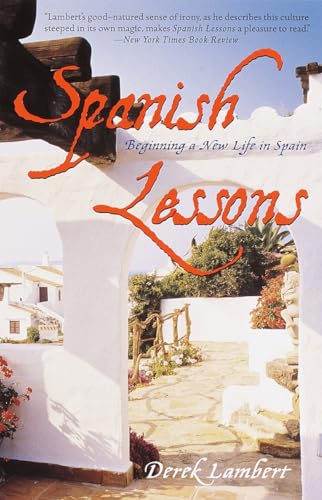
In the shrewd, comical spirit of Peter Mayle and Bill Bryson, Derek Lambert discovers the charms and idiosyncrasies of Spain as he experiences the rewards and frustrations of beginning a new life there.
As Lambert and his wife set about restoring their moldering casita on Spain’s Mediterranean Costa Blanca and learning to live the life of Spanish villagers, he introduces us to a nation far removed from the matadors, tapas bars, and sangria swillers. He uncovers the “real” Spain–a nation of passionate, eccentric, often contradictory, but always enchanting people. Unpredictable, often hilarious, and animated by colorful characters, Spanish Lessons presents an intimate and delightful portrait of off-the-tourist-track Spain.
Die Inhaltsangabe kann sich auf eine andere Ausgabe dieses Titels beziehen.
Über die Autorin bzw. den Autor
Derek Lambert has contributed to newspapers and magazines worldwide. He is also the author of several novels. He lives in the province of Alicante, Spain with his wife and son.
Von der hinteren Coverseite
In the shrewd, comical spirit of Peter Mayle and Bill Bryson, Derek Lambert discovers the charms and idiosyncrasies of Spain as he experiences the rewards and frustrations of beginning a new life there. [set as a headline]
As Lambert and his wife set about restoring their moldering "casita on Spain's Mediterranean Costa Blanca and learning to live the life of Spanish villagers, he introduces us to a nation far removed from the matadors, "tapas bars, and sangria swillers. He uncovers the "real" Spain-a nation of passionate, eccentric, often contradictory, but always enchanting people. Unpredictable, often hilarious, and animated by colorful characters, "Spanish Lessons presents an intimate and delightful portrait of off-the-tourist-track Spain.
Auszug. © Genehmigter Nachdruck. Alle Rechte vorbehalten.
ONE
A Taste of Oranges
The two civil guards wore black tricorn hats, capes, and olive-green uniforms. And although mounted on angular bicycles, they looked as sinister as their predecessors had in the civil war that tore Spain apart in the 1930s.
It was late December, and the citrus trees that covered most of the plain separating the Mediterranean from the mountains on the Costa Blanca of Spain were heavy with oranges, lemons, and grapefruit. The trees looked so beguiling that Diane and I stole a couple of oranges. We were eating them, juice trickling down our chins, in our venerable, chocolate-brown Jaguar, when the two Guardia Civil stopped beside us.
Maybe pinching oranges was a heinous crime in Spain. Tales were still rife after the death of the dictator General Francisco Franco of foreigners being imprisoned for years without trial for unspecified offenses. I imagined us lying on straw mattresses in fetid cells miles apart, while rats snatched food from our eating bowls.
Or perhaps we would be deported and declared persona non grata, a preferable scenario but nonetheless depressing, because it would mean that the vision we had shared when we first met in Africa would be aborted before it even got off the ground.
Diane, a Canadian airline stewardess with blond hair and eyes the color of the sea before a storm, had told me on our first date in Nairobi that having experienced a couple of scary landings, she wanted to quit flying and start a new life. So did I. I was a journalist in my forties, a foreign correspondent, and I wanted to become a novelist: our meeting was convened by the gods.
But supposing the gods had now turned against us, snitched on us to the Guardia . . .
Diane offered the two of them a brilliant, please-fasten-your-seatbelt smile while I stuffed incriminating orange peel into a plastic bag. "What can we do for you?" she asked. She had been brought up in Paris and Rome, had studied Spanish, and in any case picked up languages as easily as children catch measles.
One of the Guardia, young with a downy mustache, dis-mounted. "Are you lost?" he asked in English, peering into the aristocratic but doddery old Jaguar as I tried to back-heel the plastic bag under the driver's seat.
"No," Diane said, "we're just admiring the view."
It was worth admiring. Lizard-gray mountains on one side of the citrus plantations, the sea beckoning in the cold sunlight on the other. Here and there a field of leafless grapevines; almond and olive trees and carobs with trunks like fairytale witches.
The Guardia, who seemed to have exhausted his English, produced a creased booklet from beneath his cape and read from it: "I am so pleased you are admiring our territory."
Diane tried a few phrases in Valenciano, the regional language that confuses tourists who have studied orthodox Spanish, but he held up one hand and again consulted his phrase book. "Please, I do not understand, I am from the north." His colleague, a sad-looking cabo, a corporal, who looked like a long-ago Hollywood actor, Adolph Menjou, joined him.
"Do you have any papers?" he asked—"papers," a disturbingly general term that could embrace anything from a visa to a last will and testament.
Diane told him in English: "We might settle in the area."
True enough—we were looking for a village so ordinary that it would bring us into contact with people remote from the clichŽs of Spain—flamenco, sangria, and bullfights—and would define the changes that had taken place since Franco's death in 1975, so that I could write about them one day.
Her statement perturbed the cabo. He spoke with one hand, flapping and clenching it. Endless complications, his hand said. Bureaucracy, papers . . .
Diane searched for some sort of ID in the chaotic contents of her purse. Ballpoint pens, lipsticks, coins, a comb, a chocolate bar . . . The cabo suggested that we get out of the car. A preliminary to being frisked, handcuffed?
Diane found her passport and handed it to him. Fishing rights in international waters hadn't yet exacerbated relations between the two countries, and a Canadian passport still commanded respect. He flicked through it, handed it back, and saluted.
He stabbed a finger toward me. "Your husband does not speak too much."
Conceding that Diane was better at placating irate policemen, I had kept out of it. Not only that; she was much more fluent in Spanish than I was, and although I was studying manfully I preferred to converse in English even with any Spaniards who spoke only on the level of "Me Tarzan, you Jane."
"He's very shy," Diane said, and burst into helpless laughter. Reticence had never been my strong suit.
The younger officer, thinking perhaps that she was weeping, laid a hand on her shoulder. The cabo, suspecting that he was in the presence of an unstable neurotic woman and a deaf-mute, took a step back.
"In the orchards," he said in English, "one person one orange is allowed. More"—he cut across his throat with one finger. "If you want to eat a good meal this place is very pleasing." He handed Diane a grubby visiting card and both men pedaled away, capes flowing behind them.
We embraced, our visions of a home here still intact. We drove to a village perched in the hills and gazed beyond the citrus trees to the sea, fishing boats perched on its rim. The church clock tolled and the chimes rang through narrow streets that smelled of whitewash and grilling sardines. Hunger stirred. We each drank a glass of rough wine in a bar so dark that I couldn't tell whether I was being served by a man or a woman—at five pesetas a glass, who cared?—and headed for the restaurant recommended by the cabo. In my experience, policemen anywhere in the world knew the best establishments in which to take on ballast.
When we reached the address on the card, a shack with a cane roof beside a sandy beach ankle deep in seaweed, it was shut. We decided to hang around. After a while a door opened, a bead curtain parted, and a woman in black, wearing slippers, bunched cheeks squeezing her eyes, confronted us.
What did we want? She had already paid her rent and she didn't want to buy a carpet or an encyclopedia from traveling salesmen, her tone implied.
"We're very hungry," Diane said in English.
The woman's face softened. The period after the Civil War and World War II, when Spain was ostracized by much of the world because it was ruled by Fascists, was known as the Years of Hunger.
"Are you American?" she asked Diane. So many families had fled to the United States and Britain after the Civil War ended in 1939 that, happily for me, a grasp of English was not uncommon.
"Canadian."
The woman shrugged. What mattered was that we were foreigners and could not be turned away. "The restaurant is closed for the winter," she said. "But I can give you lamb chops and rice." My stomach whined.
After she had poured us a pitcher of beer at the bar, she rolled up the slatted blinds. Sunshine lit a faded photograph of a football team and a statue of a madonna with a chipped face. A skinny black cat wrapped itself around my legs. White plastic tables and chairs covered with a patina of dust stood where they had been abandoned at the end of summer.
As the smell of the chops grilling reached us, an orchestra played in my stomach and I drowned it with beer.
Watched through slitted yellow eyes by the cat, a canary sang in a cage.
The woman placed hunks of toasted bread on the table and we fell on them, spreading them with alioli, a thick sauce...
„Über diesen Titel“ kann sich auf eine andere Ausgabe dieses Titels beziehen.
Suchergebnisse für Spanish Lessons: Beginning a New Life in Spain

Beispielbild für diese ISBN
Spanish Lessons: Beginning a New Life in Spain
Anbieter: World of Books (was SecondSale), Montgomery, IL, USA
Verkäuferbewertung 5 von 5 Sternen

Zustand: Good. Item in good condition. Textbooks may not include supplemental items i.e. CDs, access codes etc. Artikel-Nr. 00096930223
Gebraucht kaufen
EUR 4,51
Versand gratis
Versand innerhalb von USA
Versand innerhalb von USA
Anzahl: 2 verfügbar
Beispielbild für diese ISBN
Spanish Lessons: Beginning a New Life in Spain
Anbieter: Wonder Book, Frederick, MD, USA
Verkäuferbewertung 5 von 5 Sternen
Zustand: Very Good. Very Good condition. A copy that may have a few cosmetic defects. May also contain light spine creasing or a few markings such as an owner's name, short gifter's inscription or light stamp. Artikel-Nr. O11J-00304
Gebraucht kaufen
EUR 6,33
Versand gratis
Versand innerhalb von USA
Versand innerhalb von USA
Anzahl: 1 verfügbar
Beispielbild für diese ISBN
Spanish Lessons : Beginning a New Life in Spain
Verlag:
Crown Publishing Group, The, 2001
ISBN 10: 0767904168
ISBN 13: 9780767904162
Gebraucht
Softcover
Anbieter: Better World Books: West, Reno, NV, USA
Verkäuferbewertung 5 von 5 Sternen
Zustand: Good. Pages intact with minimal writing/highlighting. The binding may be loose and creased. Dust jackets/supplements are not included. Stock photo provided. Product includes identifying sticker. Better World Books: Buy Books. Do Good. Artikel-Nr. 863317-6
Gebraucht kaufen
EUR 6,47
Versand gratis
Versand innerhalb von USA
Versand innerhalb von USA
Anzahl: 1 verfügbar
Beispielbild für diese ISBN
Spanish Lessons : Beginning a New Life in Spain
Verlag:
Crown Publishing Group, The, 2001
ISBN 10: 0767904168
ISBN 13: 9780767904162
Gebraucht
Softcover
Anbieter: Better World Books, Mishawaka, IN, USA
Verkäuferbewertung 5 von 5 Sternen
Zustand: Very Good. Pages intact with possible writing/highlighting. Binding strong with minor wear. Dust jackets/supplements may not be included. Stock photo provided. Product includes identifying sticker. Better World Books: Buy Books. Do Good. Artikel-Nr. 4379596-75
Gebraucht kaufen
EUR 6,47
Versand gratis
Versand innerhalb von USA
Versand innerhalb von USA
Anzahl: 1 verfügbar
Beispielbild für diese ISBN
Spanish Lessons: Beginning a New Life in Spain
Verlag:
Crown Publishing Group (NY), 2001
ISBN 10: 0767904168
ISBN 13: 9780767904162
Gebraucht
Paperback
Anbieter: ThriftBooks-Atlanta, AUSTELL, GA, USA
Verkäuferbewertung 5 von 5 Sternen
Paperback. Zustand: Good. No Jacket. Pages can have notes/highlighting. Spine may show signs of wear. ~ ThriftBooks: Read More, Spend Less. Artikel-Nr. G0767904168I3N00
Gebraucht kaufen
EUR 7,14
Versand gratis
Versand innerhalb von USA
Versand innerhalb von USA
Anzahl: 1 verfügbar
Beispielbild für diese ISBN
Spanish Lessons: Beginning a New Life in Spain
Anbieter: WorldofBooks, Goring-By-Sea, WS, Vereinigtes Königreich
Verkäuferbewertung 5 von 5 Sternen
Paperback. Zustand: Very Good. The book has been read, but is in excellent condition. Pages are intact and not marred by notes or highlighting. The spine remains undamaged. Artikel-Nr. GOR007628033
Gebraucht kaufen
EUR 3,45
EUR 6,50 Versand
Versand von Vereinigtes Königreich nach USA
Versand von Vereinigtes Königreich nach USA
Anzahl: 2 verfügbar
Beispielbild für diese ISBN
Spanish Lessons: Beginning a New Life: Beginning a New Life in Spain
Anbieter: Bahamut Media, Reading, Vereinigtes Königreich
Verkäuferbewertung 4 von 5 Sternen

Paperback. Zustand: Very Good. This book is in very good condition and will be shipped within 24 hours of ordering. The cover may have some limited signs of wear but the pages are clean, intact and the spine remains undamaged. This book has clearly been well maintained and looked after thus far. Money back guarantee if you are not satisfied. See all our books here, order more than 1 book and get discounted shipping. Artikel-Nr. 6545-9780767904162
Gebraucht kaufen
EUR 4,06
EUR 8,11 Versand
Versand von Vereinigtes Königreich nach USA
Versand von Vereinigtes Königreich nach USA
Anzahl: 2 verfügbar
Beispielbild für diese ISBN
Spanish Lessons: Beginning a New Life: Beginning a New Life in Spain
Anbieter: AwesomeBooks, Wallingford, Vereinigtes Königreich
Verkäuferbewertung 5 von 5 Sternen
Paperback. Zustand: Very Good. Spanish Lessons: Beginning a New Life: Beginning a New Life in Spain This book is in very good condition and will be shipped within 24 hours of ordering. The cover may have some limited signs of wear but the pages are clean, intact and the spine remains undamaged. This book has clearly been well maintained and looked after thus far. Money back guarantee if you are not satisfied. See all our books here, order more than 1 book and get discounted shipping. Artikel-Nr. 7719-9780767904162
Gebraucht kaufen
EUR 13,40
EUR 4,78 Versand
Versand von Vereinigtes Königreich nach USA
Versand von Vereinigtes Königreich nach USA
Anzahl: 2 verfügbar
Beispielbild für diese ISBN
Spanish Lessons
Anbieter: Revaluation Books, Exeter, Vereinigtes Königreich
Verkäuferbewertung 5 von 5 Sternen
Paperback. Zustand: Brand New. 272 pages. Spanish language. 8.00x5.25x0.75 inches. In Stock. Artikel-Nr. x-0767904168
Neu kaufen
EUR 21,03
EUR 11,61 Versand
Versand von Vereinigtes Königreich nach USA
Versand von Vereinigtes Königreich nach USA
Anzahl: 2 verfügbar