
Verwandte Artikel zu Matters of Life and Death: Finding the Words to Say...
Inhaltsangabe
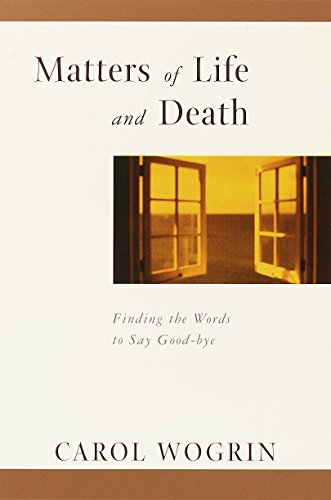
Plenty of books explore the emotions of coping with grief and a loved one’s death. But as psychologist Carol Wogrin has observed, there is little advice for those at a loss for words witnessing the process of dying. Matters of Life and Death discusses the importance of communicating with the terminally ill both through talking and nonverbal expression and offers suggestions for what to say to offer comfort, both emotional and physical.
Brimming with constructive advice for opening up, Matters of Life and Death helps allay the fears that often silence friends and relatives in the face of death. Helping readers manage their fears–the fear of saying the wrong thing, of upsetting others, of facing overwhelming feelings–this book is a beautiful prescription for conveying a heartfelt message when it matters the most.
Die Inhaltsangabe kann sich auf eine andere Ausgabe dieses Titels beziehen.
Über die Autorin bzw. den Autor
Carol Wogrin
Von der hinteren Coverseite
Plenty of books explore the emotions of coping with grief and a loved one's death. But as psychologist Carol Wogrin has observed, there is little advice for those at a loss for words witnessing the process of dying." Matters of Life and Death discusses the importance of communicating with the terminally ill both through talking and nonverbal expression and offers suggestions for what to say to offer comfort, both emotional and physical.
Brimming with constructive advice for opening up," Matters of Life and Death helps allay the fears that often silence friends and relatives in the face of death. Helping readers manage their fears-the fear of saying the wrong thing, of upsetting others, of facing overwhelming feelings-this book is a beautiful prescription for conveying a heartfelt message when it matters the most.
Aus dem Klappentext
Plenty of books explore the emotions of coping with grief and a loved one s death. But as psychologist Carol Wogrin has observed, there is little advice for those at a loss for words witnessing the process of dying. Matters of Life and Death discusses the importance of communicating with the terminally ill both through talking and nonverbal expression and offers suggestions for what to say to offer comfort, both emotional and physical.
Brimming with constructive advice for opening up, Matters of Life and Death helps allay the fears that often silence friends and relatives in the face of death. Helping readers manage their fears the fear of saying the wrong thing, of upsetting others, of facing overwhelming feelings this book is a beautiful prescription for conveying a heartfelt message when it matters the most.
Auszug. © Genehmigter Nachdruck. Alle Rechte vorbehalten.
One
Talking with Dying People: What Do You Say, What Do You Do?
The most essential thing in life is to develop an unafraid, heartfelt communication with others, and it is never more important than with a dying person. --SOGYAL RINPOCHE
Death is a guaranteed part of all our lives--the deaths of people we love, as well as our own death. The question is not whether we face death or not, but rather, how we face it. Despite the fact that death is an inevitable experience for everyone, many of us still, when confronted with an impending death, unconsciously react with avoidance to our strong feelings of fear and sadness. Few of us have learned to develop a facility for talking about death, or talking with dying people.
The Value of Saying Goodbye
Grieving begins as soon as you get the news about a serious illness or the impending death of someone you love, and continues long after their death. The art of saying goodbye really begins at this time of first knowing the person you love will be leaving your world.
Our relationships with people who are dying are different, and do have a special poignancy that others don't. You may have only a week to say goodbye, or you may have years, but it is your acute awareness that their life is now time-limited, and your relationship with them also time-limited, that gives you both the opportunity to interact differently.
One of the most important tasks in moving through the grief process is shifting from interacting with the dying person in your external world, to holding them entirely in your internal world--in your thoughts, memories, and feelings, and in your very identity. Saying goodbye, in words and actions, helps clarify your feelings about what a particular relationship has meant to you, and lays the groundwork for the process of making this shift. When you take the time, and make the effort to say a conscious goodbye, you will know the person you love better, and you will know yourself better.
Why Is It Important to Say Goodbye,
In Words or Actions?
When hit with a loss as large as a death, you inevitably are left with many difficult feelings--sadness, anger, regret, sometimes depression. The grief process, which involves making sense of these feelings, coping with them, and reworking them, always takes a lot of time. The specific feelings you have, and the intensity of the different feelings, will be partially determined by the way you use the time you have when the person you care about is dying. Saying goodbye, in words or in actions, can give you the opportunity to share your love for another clearly and deliberately.
Generally, when you are careful and conscious in what you say and do in the final years, months, and days of a person's life, you will have fewer regrets after they die; you won't be agonizing over what you should or could have said in the past. A thoughtful goodbye can also give you the opportunity to resolve old conflicts that have long gone unaddressed, and leave the relationship feeling more complete.
Relationships are built on experiences shared between two people. It is only logical that you need an ending to a relationship that takes place between yourself and another person. When you don't take the opportunity to say goodbye, you will likely be left with the challenge of working through a relational process entirely on your own. This is a much more difficult task.
Being able to join and support a person in their final phase of life, and talk with them about what their life has been, who they have been to you, and how they will remain with you is of vital importance in working through this process. This joining and sharing will take different forms in different relationships, depending on the personalities involved.
Many of your thoughts and feelings after a death--whether or not you feel regret at things left unsaid or unexpressed--have to do with aspects of your own behavior that involved a choice for you. Usually, after someone close to you dies, you think about who you were in the relationship, what you did or didn't do, say, give, or what you did and didn't share while you had the chance.
You may be so used to avoiding awkward or highly charged emotional situations that you find yourself completely overwhelmed by strong feelings when you learn someone you love is going to die. This is normal. But if you respond to those feelings by withdrawing or freezing up emotionally, you will not be able to talk to the dying person. You may miss the last opportunity of a lifetime.
The Power of Secrets
Honesty is an important aspect of relationships, and certainly necessary if we want to be close to someone. This is especially true when we are dealing with times as significant as the impending end of someone's life--the final opportunity to be close to him. However, all too often during this emotionally difficult time, the importance of honesty seems to be forgotten, and people act instead on their desire to "protect" loved ones from emotional pain. Rarely does this approach actually help the person. Usually, they are left more isolated and alone.
Mr. Johnson
Years ago, I had an experience that impressed upon me the extent to which well-intended secrets can cause pain at the end of life. During college, I worked the night shift in a community hospital as a nurse's aide. In this role I was usually assigned to the jobs that the unit nurses least wanted to do.
On this particular night, Mr. Johnson was dying. Mr. Johnson had, reportedly, always been a very proud and private man. He was quite elderly, was bleeding from his intestines, and due to complex medical problems, little could be done to stop it. The previous afternoon, his daughters, with the encouragement of his doctor, had made the decision to withhold this information from him. They believed they could shield him from unnecessary distress by withholding the information that he was dying. The doctor said his death would be fairly rapid, so it seemed kind to spare him this devastating news.
His daughters left at the end of visiting hours, as they were required to do in those days. With "cheerful" assurances, they told him they would see him tomorrow. When I came on duty near midnight, I was apprised of the situation and assigned to spend the night at his bedside. I was given very specific instructions on what not to say. He was not to be told that he was dying. Worse still, he was not told that he was bleeding, since he was, of course, bright enough to understand the consequence of uncontrolled bleeding.
All night long, Mr. Johnson was on and off the bedpan, thinking his bowels were very loose. During the first half of the night, he got increasingly angry at the fact that no one would give him anything to treat his condition. I stood mute as he yelled at me. The nurses, who were all uncomfortable with the situation, avoided the room like the plague. As the night progressed and he got weaker, he could not always make it to the bedpan. His anger turned to shame. Had he known he was bleeding, the situation would have been much more tolerable. Adults don't feel shame when they can't control bleeding. They do feel ashamed when they can't control their bowels. He became quieter, more apologetic, and more withdrawn each time I cleaned him up. I could offer no true support, because I was little other than a witness to his loss of control. At eight o'clock in the morning, after an active and productive life, Mr. Johnson died, ashamed and alone.
Even at the time, I understood what a tragedy this was. Mr. Johnson was a competent man. He had led a life with much to be proud of. He had daughters who loved and respected him. Out of love, their own fears of death, and feelings of helplessness, they followed advice that they believed would make his final hours easier. The result was cruelly...
„Über diesen Titel“ kann sich auf eine andere Ausgabe dieses Titels beziehen.
Suchergebnisse für Matters of Life and Death: Finding the Words to Say...

Beispielbild für diese ISBN
Matters of Life and Death: Finding the Words to Say Goodbye
Verlag:
Harmony/Rodale/Convergent, 2001
ISBN 10: 0767903951
ISBN 13: 9780767903950
Gebraucht
Softcover
Anbieter: World of Books (was SecondSale), Montgomery, IL, USA
Verkäuferbewertung 5 von 5 Sternen

Zustand: Good. Good condition ex-library book with usual library markings and stickers. Artikel-Nr. 00099085094
Gebraucht kaufen
EUR 5,25
Versand gratis
Versand innerhalb von USA
Versand innerhalb von USA
Anzahl: 2 verfügbar
Beispielbild für diese ISBN
Matters of Life and Death: Finding the Words to Say Goodbye
Anbieter: Wonder Book, Frederick, MD, USA
Verkäuferbewertung 5 von 5 Sternen
Zustand: Good. Good condition. A copy that has been read but remains intact. May contain markings such as bookplates, stamps, limited notes and highlighting, or a few light stains. Artikel-Nr. N15G-01085
Gebraucht kaufen
EUR 6,21
Versand gratis
Versand innerhalb von USA
Versand innerhalb von USA
Anzahl: 1 verfügbar
Beispielbild für diese ISBN
Matters of Life and Death: Finding the Words to Say Goodbye
Anbieter: Wonder Book, Frederick, MD, USA
Verkäuferbewertung 5 von 5 Sternen
Zustand: Very Good. Very Good condition. A copy that may have a few cosmetic defects. May also contain light spine creasing or a few markings such as an owner's name, short gifter's inscription or light stamp. Artikel-Nr. E06A-04244
Gebraucht kaufen
EUR 6,21
Versand gratis
Versand innerhalb von USA
Versand innerhalb von USA
Anzahl: 1 verfügbar
Beispielbild für diese ISBN
Matters Of Life And Death: Finding the Words to Say Goodbye
Anbieter: Robinson Street Books, IOBA, Binghamton, NY, USA
Verkäuferbewertung 4 von 5 Sternen

Paperback. Zustand: Very Good. Prompt Shipment, shipped in Boxes, Tracking PROVIDEDVery good minor creasing. Artikel-Nr. bing925r0176
Gebraucht kaufen
EUR 12,00
EUR 8,19 Versand
Versand innerhalb von USA
Versand innerhalb von USA
Anzahl: 1 verfügbar
Beispielbild für diese ISBN
Matters Of Life And Death: Finding the Words to Say Goodbye
Anbieter: Robinson Street Books, IOBA, Binghamton, NY, USA
Verkäuferbewertung 4 von 5 Sternen
Paperback. Zustand: Very Good. Prompt Shipment, shipped in Boxes, Tracking PROVIDEDVery good minor creasing. Artikel-Nr. bing925r0177
Gebraucht kaufen
EUR 12,00
EUR 8,19 Versand
Versand innerhalb von USA
Versand innerhalb von USA
Anzahl: 1 verfügbar
Beispielbild für diese ISBN
Matters of Life and Death: Finding the Words to Say Goodbye
Anbieter: Revaluation Books, Exeter, Vereinigtes Königreich
Verkäuferbewertung 5 von 5 Sternen
Paperback. Zustand: Brand New. 189 pages. 7.75x5.25x0.50 inches. In Stock. Artikel-Nr. x-0767903951
Neu kaufen
EUR 17,48
EUR 11,67 Versand
Versand von Vereinigtes Königreich nach USA
Versand von Vereinigtes Königreich nach USA
Anzahl: 2 verfügbar
Beispielbild für diese ISBN
Matters of Life and Death: Finding the Words to Say Goodbye
Anbieter: Ria Christie Collections, Uxbridge, Vereinigtes Königreich
Verkäuferbewertung 5 von 5 Sternen
Zustand: New. In. Artikel-Nr. ria9780767903950_new
Neu kaufen
EUR 16,60
EUR 13,17 Versand
Versand von Vereinigtes Königreich nach USA
Versand von Vereinigtes Königreich nach USA
Anzahl: Mehr als 20 verfügbar