
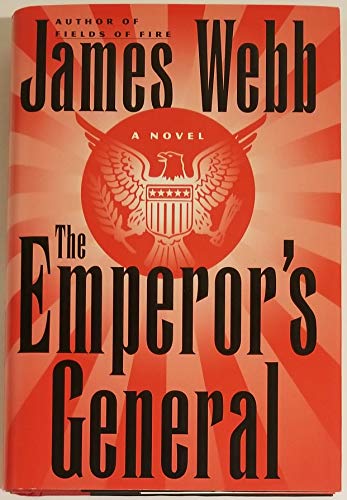
Verwandte Artikel zu The Emperor's General: A Novel / James Webb.
Inhaltsangabe
An evocation of ego, greed, and imperial politics in post-World War II Japan follows a young captain involved in a plot between General MacArthur and the Japanese emperor to seize total control
Die Inhaltsangabe kann sich auf eine andere Ausgabe dieses Titels beziehen.
Über die Autorinnen und Autoren
James Webb, combat marine and author of four bestselling novels, is an attorney and Emmy Award-winning journalist who has served as Secretary of the Navy, Assistant Secretary of Defense, and full committee counsel to the U.S. Congress. He lives in Virginia.
James Webb has served as secretary of the navy, assistant secretary of defense, and full committee counsel to the U.S. Congress.
Aus dem Klappentext
tselling author of <b>Fields of Fire</b> comes a provocative novel of historical intrigue, gripping drama, and haunting romance suffused with the mystery and seduction of the Orient.<br><br>1997. Jay Marsh, Wall Street millionaire and grand old man of the diplomatic corps, takes a sentimental journey to the scene of his first triumphs and agonies, Manila, where as a brash young captain during World War Two he served as aide-de-camp and confidant to General Douglas MacArthur. Marsh sees beyond the glittery capital of today to the horrifying days of 1945. The retreating Japanese army had devastated everything in its wake. The city was set ablaze and one hundred thousand innocents were slaughtered. Marsh was forced to leave behind his Filipino fiancée and accompany MacArthur to Japan. Now, as the senior statesman stands in the serene garden of the ambassador's residence, his mind reels back in time. . . . <br><br>In
Auszug. © Genehmigter Nachdruck. Alle Rechte vorbehalten.
For two days we zigzagged north and west up from Hollandia, making a snaking column one hundred miles long. The sea was heavy with us, frothing in our wakes. Two fleets of warships plowed the waters--aircraft carriers, battleships, cruisers, destroyers, oilers, cargo ships, personnel carriers, minesweepers, landing craft--seven hundred of them belching their smoke and churning their screws, heading unknowingly into perhaps the greatest naval battle of all time. Two hundred thousand soldiers waited puking and nervous in the holds and on the decks of the transport ships, ready to be offloaded and thrown against enemy positions in yet another steaming jungle. At night they cleaned their weapons, said their prayers, and wrote letters home. We were heading for Leyte.
I had embarked as the junior member of General MacArthur's staff on the cruiser USS Nashville. Our journey filled me with an almost superstitious dread. I did not like warships and in fact had enlisted in the army to be away from them. They too-often sank, and when they did they brought their sailors with them, making cold, steel, barnacled coffins deep in the yeasty surges of the still-volcanic, ever-erupting Pacific. For those of us who had not aspired to military careers, such unhappy conclusions had been the subject of much conversation in the uncertain days that followed Pearl Harbor. Viewing our choices, the war boiled down to different ways of dying. Would it be worse to sink and drown, or to fall like a shot quail from the air, or merely to crumple into the sweet grass from a bullet or artillery round?
In January 1942 I had weighed these options and finally acquiesced to facing death in the dirt. Luckily for me, the army took note of my ability to speak passing Japanese. Starved for such talent, they had sent me to language school instead of infantry training. I was then shipped immediately to the Pacific, where I spent five months as an interrogator-translator and then was ordered to MacArthur's staff. I was a good staff officer, something of a natural diplomat, enthusiastically obedient and always thorough. A recent top college athlete, I carried myself with a rugged self-confidence that seemed to accentuate my obeisance. MacArthur and his top generals had grown to like and trust me completely.
But behind my smiling facade was a profound sense of unworthiness. Every morning as I reported to the General's headquarters for my day's orders, I reminded myself that if it had not been for this stroke of luck by which I had learned to speak Japanese, my war would have been more predictable and far more dangerous. Indeed, my younger brother had taken the more traditional family route, his eight years of school and dumbifying Arkansas dialect ensuring him a role as an infantry private. As with my father and his father before him, he had turned into a brave and competent soldier. And he had died in June 1944, in a little town I had never heard of, during the invasion of France.
No, I was not born to this. I had never even seen a city until the age of fourteen, when one bleak rainwinter morning my mother awakened and announced to us that my dead father had come to her in a dream and told her that we should leave Arkansas and go to California. The corn shucks in my makeshift mattress rustled under me as I rubbed my eyes awake, watching her busily pack four cotton bags. It was obvious, watching her lined and furious face, that Daddy had meant for us to leave that very day.
My father's grave lay in a small cemetery just above a thickly wooded cow pasture, marked only by a favorite rock. We visited it together before we departed. Mother said a prayer for all of us and then promised Daddy that she wouldn't leave him buried in this lonesome field, that she would move him to California once things got better. He had been dead less than a year and I could still feel his presence, warm as a woolen sweater and filled with a knowing kindness that had irreplaceably disappeared from my life when they lowered his pine coffin into the hole.
As I stood over his grave for perhaps the last time, my father seemed alive again. Two hundred yards in front of me a thin herd of cattle grazed on winter grass. Off in the distance a squirrel gun went off, bagging someone's lucky supper. I tried to listen to his voice. I thought I heard him tell me that he had made a big mistake by staying in this cruel backwater place, that if he had only left instead of fighting its ugly reality, he would never have been laid into an early grave. I looked at the plain jagged rock of a tombstone that would not long remember him and I decided that he had told Mother the same thing in her dream the night before.
I had never seen even a picture that was as beautiful as the California coast. The morning after our bus arrived in Santa Monica I stood on the vast pier and smelled the salt air and the seafood cooking and watched the lazy pace of people walking and fishing, and I looked back toward the bluffs at the waves breaking over the sand and then the rows of lofty palm trees that disappeared northward toward Malibu and I will admit I cried. It had been beyond my capacity even to imagine such beauty and contentment. I was ragged and longhaired and laughed at but I felt my father's warmth surround me, and I vowed that I would never let my mother leave.
There were schools. I was smart. And just as important, at least for me, I discovered that I had a knack for carrying this nearly weightless leather object called a football and knocking people over when they tried to bring me to the ground. Mother objected fiercely, arguing that I should be working, but I found it to be great fun. Three years later she was stunned beyond amazement to find that top universities throughout the state were vying for the right to pay my way through college, asking only that I continue to show up in the afternoons after classes and play for a while with the other boys and on the weekends do the same before large crowds.
I chose the University of Southern California because it was near Mother and I could still help her on the weekends. She found work in a defense plant, and after mobilization worked twelve-hour shifts as a riveter, her small size ideal for climbing into the narrow nose sections of military aircraft. My brother was studying to become an electrician, knowing he would soon be called into the army.
Life was good in California, and the coming war only helped us.
Just off the campus, on a side street near Exposition Park, a Japanese family ran a grocery store, specializing in fresh fruits and vegetables brought in from the valley by other Asian immigrants. I was nineteen, in my second year at Southern Cal, when I first saw Kozuko. She was standing in front of her father's store, arranging a sidewalk display of fruits and vegetables. She was wearing a full white apron, tied tight around her tiny waist. A red bandanna pulled her hair away from her face and clutched it long and flowing down the center of her back. Her face was downturned, frowning from some inner debate. She went about her work with such a proud and careful delicacy that she might have been placing lush, exotic flowers into a grand vase. But when she looked up and saw me, she smiled.
I was enormously shy, still conscious of my full-voweled Arkansas accent and my unvarnished social etiquette. Southern Cal had actually increased this shyness, despite my quick notoriety on the football field. It was a high-tuition, sophisticated school, and I was not yet sufficiently facile to turn my ragged journey into a party joke. I finally smiled back. I had no reason to talk to her other than my awkward appreciation of her beauty, but I finally mumbled that I wanted to learn to speak Japanese. She told me she wanted to speak better English. We agreed to teach each other. And within two weeks, over the...
„Über diesen Titel“ kann sich auf eine andere Ausgabe dieses Titels beziehen.
Suchergebnisse für The Emperor's General: A Novel / James Webb.

Beispielbild für diese ISBN
The Emperor's General
Anbieter: World of Books (was SecondSale), Montgomery, IL, USA
Verkäuferbewertung 5 von 5 Sternen

Zustand: Acceptable. Item in acceptable condition! Textbooks may not include supplemental items i.e. CDs, access codes etc. Artikel-Nr. 00080312135
Gebraucht kaufen
EUR 3,91
Versand gratis
Versand innerhalb von USA
Versand innerhalb von USA
Anzahl: 1 verfügbar
Beispielbild für diese ISBN
The Emperor's General
Anbieter: World of Books (was SecondSale), Montgomery, IL, USA
Verkäuferbewertung 5 von 5 Sternen
Zustand: Very Good. Item in very good condition! Textbooks may not include supplemental items i.e. CDs, access codes etc. Artikel-Nr. 00085531016
Gebraucht kaufen
EUR 3,91
Versand gratis
Versand innerhalb von USA
Versand innerhalb von USA
Anzahl: 2 verfügbar
Beispielbild für diese ISBN
The Emperor's General
Anbieter: World of Books (was SecondSale), Montgomery, IL, USA
Verkäuferbewertung 5 von 5 Sternen
Zustand: Good. Item in very good condition! Textbooks may not include supplemental items i.e. CDs, access codes etc. Artikel-Nr. 00078468016
Gebraucht kaufen
EUR 3,91
Versand gratis
Versand innerhalb von USA
Versand innerhalb von USA
Anzahl: 3 verfügbar
Beispielbild für diese ISBN
The Emperor's General
Verlag:
Broadway (edition First Edition), 1999
ISBN 10: 0767900766
ISBN 13: 9780767900768
Gebraucht
Hardcover
Erstausgabe
Anbieter: BooksRun, Philadelphia, PA, USA
Verkäuferbewertung 5 von 5 Sternen
Hardcover. Zustand: Very Good. First Edition. It's a well-cared-for item that has seen limited use. The item may show minor signs of wear. All the text is legible, with all pages included. It may have slight markings and/or highlighting. Artikel-Nr. 0767900766-11-1
Gebraucht kaufen
EUR 5,31
Versand gratis
Versand innerhalb von USA
Versand innerhalb von USA
Anzahl: 1 verfügbar
Beispielbild für diese ISBN
The Emperor's General
Anbieter: Wonder Book, Frederick, MD, USA
Verkäuferbewertung 5 von 5 Sternen
Zustand: Very Good. Signed Copy . Very Good dust jacket. Inscribed by author on front endpage. Artikel-Nr. SB03H-01948
Gebraucht kaufen
EUR 6,21
Versand gratis
Versand innerhalb von USA
Versand innerhalb von USA
Anzahl: 1 verfügbar
Beispielbild für diese ISBN
The Emperor's General
Anbieter: Wonder Book, Frederick, MD, USA
Verkäuferbewertung 5 von 5 Sternen
Zustand: Very Good. Very Good condition. Very Good dust jacket. A copy that may have a few cosmetic defects. May also contain light spine creasing or a few markings such as an owner's name, short gifter's inscription or light stamp. Artikel-Nr. G01B-01113
Gebraucht kaufen
EUR 6,21
Versand gratis
Versand innerhalb von USA
Versand innerhalb von USA
Anzahl: 1 verfügbar
Beispielbild für diese ISBN
The Emperor's General
Anbieter: Wonder Book, Frederick, MD, USA
Verkäuferbewertung 5 von 5 Sternen
Zustand: Good. Good condition. Very Good dust jacket. A copy that has been read but remains intact. May contain markings such as bookplates, stamps, limited notes and highlighting, or a few light stains. Artikel-Nr. O05J-01012
Gebraucht kaufen
EUR 6,21
Versand gratis
Versand innerhalb von USA
Versand innerhalb von USA
Anzahl: 1 verfügbar
Beispielbild für diese ISBN
The Emperor's General
Anbieter: Better World Books, Mishawaka, IN, USA
Verkäuferbewertung 5 von 5 Sternen
Zustand: Very Good. Former library copy. Pages intact with possible writing/highlighting. Binding strong with minor wear. Dust jackets/supplements may not be included. Includes library markings. Stock photo provided. Product includes identifying sticker. Better World Books: Buy Books. Do Good. Artikel-Nr. 39079538-20
Gebraucht kaufen
EUR 6,28
Versand gratis
Versand innerhalb von USA
Versand innerhalb von USA
Anzahl: 1 verfügbar
Beispielbild für diese ISBN
The Emperor's General
Anbieter: Better World Books, Mishawaka, IN, USA
Verkäuferbewertung 5 von 5 Sternen
Zustand: Very Good. Pages intact with possible writing/highlighting. Binding strong with minor wear. Dust jackets/supplements may not be included. Stock photo provided. Product includes identifying sticker. Better World Books: Buy Books. Do Good. Artikel-Nr. 38517656-6
Gebraucht kaufen
EUR 6,28
Versand gratis
Versand innerhalb von USA
Versand innerhalb von USA
Anzahl: 1 verfügbar
Beispielbild für diese ISBN
The Emperor's General
Anbieter: ThriftBooks-Atlanta, AUSTELL, GA, USA
Verkäuferbewertung 5 von 5 Sternen
Hardcover. Zustand: Very Good. No Jacket. Former library book; May have limited writing in cover pages. Pages are unmarked. ~ ThriftBooks: Read More, Spend Less. Artikel-Nr. G0767900766I4N10
Gebraucht kaufen
EUR 6,87
Versand gratis
Versand innerhalb von USA
Versand innerhalb von USA
Anzahl: 1 verfügbar