
Verwandte Artikel zu Salt and Pepper: 135 Perfectly Seasoned Recipes
Inhaltsangabe
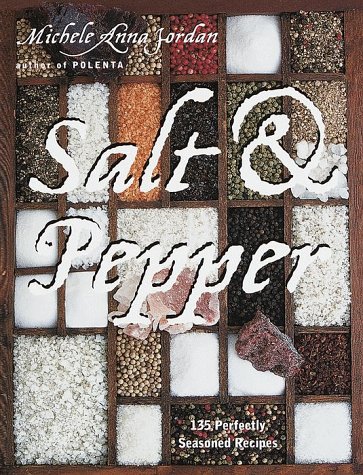
A collection of one hundred recipes from a respected chef uses a wide range of salts and peppercorns, including red Hawaiian alea salt and Indian Malabar peppercorns, and offers unique insights on the history of these seasonings.
Die Inhaltsangabe kann sich auf eine andere Ausgabe dieses Titels beziehen.
Über die Autorin bzw. den Autor
Michele Anna Jordan is an award-winning writer, cooking teacher, restaurant critic, and radio personality. She is the author of nine cookbooks, including Polenta and California Home Cooking. She lives in San Francisco and Sonoma County, California.
Aus dem Klappentext
ap-dances naked on your table, makes you blush with delight. Pepper taps you on the shoulder and invites you behind closed doors. Both are shameless in the endless pleasure they impart."
--from the Introduction
In her new book, Michele Anna Jordan celebrates the world's most ubiquitous ingredients, common salt and pungent pepper (black, white, and green). After reading Salt & Pepper, never again will you take these pantry staples for granted. Jordan explores the history and lore of salt and pepper, their importance in our culture, and their essential contributions to the pleasures of the table. In addition to its intriguing, evocative narrative, Salt & Pepper explains traditional techniques for cooking in salt crusts and doughs, and offers an astonishing variety of classic and innovative recipes, from Onandaga Salt Potatoes and Salt Cod Chowder to Steak au Poivre Rouge, Green Peppercorn Mustard, and Roasted Strawberries with Black Pepper. Tasti
Auszug. © Genehmigter Nachdruck. Alle Rechte vorbehalten.
Salt: Magical Salt
"I love you more than salt," the mythical young princess says to her father. Her older sisters, articulate in their hyperbole--more than gold, they tell the king, more than my own life, as much as God--are rewarded with riches and kingdoms of their own. The arrogant king, devastated to be so poorly valued by his favorite child, condemns her to a life of loneliness and poverty in exile.
The king's next meal is flat and tasteless, and so is the next, and the next, and the next. For thirty days, his food lacks flavor. You might conclude that it is sadness and loss that eclipse his pleasure, but it is not. He summons his chef and demands an explanation.
"You value salt so little, your majesty," the chef explains coyly, "that I no longer use it in your food."
You can see where this is going. The princess is returned from exile, reunited with her secret fiancé--the wily chef, of course--and given a lavish wedding and riches that far surpass those granted her sisters. The king's food sparkles with taste and savor once again.
I was told the story by a cooking student, a woman from India who remembered it from childhood, when she had likely heard it from an English nanny; there are many versions of this tale throughout Europe. Common salt is more essential than we like to admit, each version cautions us.
Another scene: It is Halloween, the eve of el Dia de los Muertos, and a young Mexican girl is boiling an egg. After it is cooked, she runs it under a cool spigot, holding the hot egg even as it burns her impatient hands. When at last it is cool, she removes the shell and carefully breaks the egg in half, revealing the round yellow yolk, the kernel of life at the core, which she quickly discards. She lifts the lid of a nearby box of salt and takes as big a pinch as her fingers can hold, depositing it in the hollow of the egg. She continues, pinch after salty pinch, until the center of the egg is filled. She fits the halves together and tiptoes silently to the bedroom she shares with her sister, where she awaits the stroke of midnight.
Eventually, the hour comes, she puts the egg with its hidden seed, its talismanic treasure, into her mouth, chewing and swallowing quickly so that the jewel of salt does not burst and leave her parched, for she must not take a drink. Her sister wakes and calls her name, but she pretends to be asleep. To speak would break the spell. Who will it be? Who will appear in her dreams and offer her a quenching drink of water? Her life's mate, the story goes, and she falls asleep imagining his face.
Ah, magical salt. It seasons our tales, and spices up our language, each word, every phrase a nod to a single truism: Life is tasteless without salt.
Pepper: The King of Spice
Salt is indispensable. The earth is cloaked in salt; a salty tide moves within us, too, every moment lapping at the edges of our cells. Without it, we die.
Pepper is superfluous. Salt's culinary spouse is expendable, entirely unnecessary for existence (the ideal marriage, one partner frivolous, one keeping the house afloat). It is a gift, a luxury that we have come to take utterly for granted. "Saltandpepper" is nearly a single word in our kitchen vocabulary and the thought of doing without the pepper part is all but inconceivable. But should something occur to put pepper absolutely out of reach, we could live. We would mourn its loss, and with every bite be aware of its absence. But we would live.
In the end, we might get over the loss of pepper without too lengthy a struggle. We have no innate physical longing for it, as we do for salt. We delight in the presence of pepper in our food, but the memory of its taste would fade in a single generation; we cannot pass sensory knowledge to our children, we can only entice them with descriptions, always inadequate when it comes to taste, completely ineffective when it comes to smell. No one would believe our stories.
If pepper vanished, it soon would become myth, an enchanting mystery, a tale of the King of Spices who one day walked off into the wilderness and vanished, the Atlantis of spice, nothing more than a tantalizing rumor. Sure, they would think, and what is the moral of this tale? The King would be replaced by . . . allspice? long pepper? coriander? All have been used as we now use pepper--that is, in almost everything--at one time or another.
But don't worry about pepper vanishing--there is plenty, millions of vines of it wrapping themselves around the earth, a savory circumference, an equator of savor and taste and heat, a lusty belt around our middle.
Perfect Deviled Eggs
It's important to know how to make perfect deviled eggs, a classic American appetizer and picnic dish. A purist, I eschew additions such as pickle relish, capers, minced onions, or olives, but think a strong jolt of aromatic black pepper is essential. Once you've mastered the purity of these flavors, there are, however, some delicious variations, one in which green peppercorns are used along with black, and one made with the intoxicating smoked salt imported from Denmark. Because the egg whites tend to wobble on their rounded bottoms, it's best to serve them on top of greens, such as a bunch of flat-leaf parsley, spread over the plate, or a bed of arugula.
6 large fresh eggs
1/3 to 1/2 cup mayonnaise
3 tablespoons Dijon mustard
Dash of Tabasco Sauce
2 teaspoons black peppercorns, crushed
3/4 teaspoon kosher salt
Place the eggs in a single layer in a medium saucepan and add water until it is at least 1 inch above them. Set over medium heat, bring to a boil, and cook for 12 minutes. Remove from the heat, let cool for 2 or 3 minutes, and then transfer the eggs to a cold-water bath, changing the water two or three times as it warms. When the eggs have cooled to room temperature, carefully peel them, rinse them, dry them on a tea towel, and cut them in half lengthwise. Scoop out the yolks and set the whites on a platter.
Press the yolks through a potato ricer into a bowl or place them in the bowl and mash them with a fork. Mix in 1/3 cup of the mayonnaise, the mustard, Tabasco, pepper, and salt. If the mixture seems a little dry, add the remaining mayonnaise. Fill the centers of the egg whites with the egg yolk mixture, cover with plastic wrap, and refrigerate for at least 30 minutes before serving.
Variations:
Dissolve 1/2 teaspoon smoked salt (see Resources, page 216) in 1/2 teaspoon lemon juice and use it in place of the kosher salt.
Reduce the quantity of black peppercorns to 1 teaspoon, add 1 teaspoon crushed dried green peppercorns, and 1 teaspoon green peppercorns in brine (drained); top each stuffed egg with 2 or 3 brined green peppercorns.
Serves 4 to 6
Shrimp Roasted on Rock Salt
Shrimp roasted on a bed of hot salt are succulent, tender, fragrant, and not at all salty; the salt serves to transfer heat efficiently, not to flavor the shrimp. They can be served simply, with just a squeeze of lemon, or with this sweet-and-sour sauce studded with peppercorns.
2 to 3 pounds rock salt
12 large shrimp in their shells
3 tablespoons unsalted butter
2 tablespoons honey
2 teaspoons crushed black peppercorns
1 tablespoon lemon juice (more or less, to taste)
Pinch of salt
Lemon wedges, for garnish
Preheat the oven to 400°F. Select a heavy pan with a lid that is large enough to hold the shrimp in a single layer. It should be at least 2-inches deep. Add rock salt to form a 1-inch bed in the pan. Set the pan in the oven and heat for 30 minutes. When the salt is very hot, set the shrimp on top, cover, and roast for 2 minutes. Turn the shrimp, cover the pan again, and roast for 2 minutes more, until the shrimp turn pink and...
„Über diesen Titel“ kann sich auf eine andere Ausgabe dieses Titels beziehen.
Suchergebnisse für Salt and Pepper: 135 Perfectly Seasoned Recipes

Beispielbild für diese ISBN
Salt and Pepper
ISBN 10: 0767900278
ISBN 13: 9780767900270
Gebraucht
Hardcover
Anbieter: World of Books (was SecondSale), Montgomery, IL, USA
Verkäuferbewertung 5 von 5 Sternen

Hardback. Zustand: Good. Children can celebrate and learn about Lunar New Year with this new title in the>Bright Baby Touch & Feel>series from Priddy Books. With a mixture of interesting photographs and charming illustrations, this book is a first introduction to the Lunar New Year festival. Babies will love to explore the touch and feel tactiles on every spread as they turn the pages of this bright and vibrant book. Each page features a word and image associated with Lunar New Year, making this the perfect gift for any young child celebrating with their family. Also available in this series: Bright Baby Touch & Feel Eid, Bright Baby Touch and Feel Passover, Bright Baby Touch and Feel Hanukkah, Bright Baby Touch & Feel Merry Christmas, Bright Baby Touch and Feel Easter, Bright Baby Touch and Feel Fall, Bright Baby Touch and Feel Spring, Bright Baby Touch and Feel Winter, and>Bright Baby Touch and Feel Summer. Artikel-Nr. 00098746068
Gebraucht kaufen
EUR 5,28
Versand gratis
Versand innerhalb von USA
Versand innerhalb von USA
Anzahl: 2 verfügbar
Beispielbild für diese ISBN
Salt and Pepper: 135 Perfectly Seasoned Recipes
Anbieter: BooksRun, Philadelphia, PA, USA
Verkäuferbewertung 5 von 5 Sternen
Hardcover. Zustand: Very Good. 1. With dust jacket. It's a well-cared-for item that has seen limited use. The item may show minor signs of wear. All the text is legible, with all pages included. It may have slight markings and/or highlighting. Artikel-Nr. 0767900278-8-1-29
Gebraucht kaufen
EUR 5,29
Versand gratis
Versand innerhalb von USA
Versand innerhalb von USA
Anzahl: 1 verfügbar
Beispielbild für diese ISBN
Salt and Pepper: 135 Perfectly Seasoned Recipes
Anbieter: Wonder Book, Frederick, MD, USA
Verkäuferbewertung 5 von 5 Sternen
Zustand: Very Good. Very Good condition. Very Good dust jacket. A copy that may have a few cosmetic defects. May also contain light spine creasing or a few markings such as an owner's name, short gifter's inscription or light stamp. Artikel-Nr. Z11A-03684
Gebraucht kaufen
EUR 5,98
Versand gratis
Versand innerhalb von USA
Versand innerhalb von USA
Anzahl: 1 verfügbar
Beispielbild für diese ISBN
Salt and Pepper: 135 Perfectly Seasoned Recipes
Anbieter: Wonder Book, Frederick, MD, USA
Verkäuferbewertung 5 von 5 Sternen
Zustand: As New. Like New condition. Like New dust jacket. A near perfect copy that may have very minor cosmetic defects. Artikel-Nr. B03C-01403
Gebraucht kaufen
EUR 5,98
Versand gratis
Versand innerhalb von USA
Versand innerhalb von USA
Anzahl: 1 verfügbar
Beispielbild für diese ISBN
Salt and Pepper: 135 Perfectly Seasoned Recipes
Anbieter: ThriftBooks-Atlanta, AUSTELL, GA, USA
Verkäuferbewertung 5 von 5 Sternen
Hardcover. Zustand: As New. No Jacket. Pages are clean and are not marred by notes or folds of any kind. ~ ThriftBooks: Read More, Spend Less. Artikel-Nr. G0767900278I2N00
Gebraucht kaufen
EUR 7,14
Versand gratis
Versand innerhalb von USA
Versand innerhalb von USA
Anzahl: 1 verfügbar
Beispielbild für diese ISBN
Salt and Pepper: 135 Perfectly Seasoned Recipes
Anbieter: ThriftBooks-Atlanta, AUSTELL, GA, USA
Verkäuferbewertung 5 von 5 Sternen
Hardcover. Zustand: Very Good. No Jacket. May have limited writing in cover pages. Pages are unmarked. ~ ThriftBooks: Read More, Spend Less. Artikel-Nr. G0767900278I4N00
Gebraucht kaufen
EUR 7,14
Versand gratis
Versand innerhalb von USA
Versand innerhalb von USA
Anzahl: 1 verfügbar
Beispielbild für diese ISBN
Salt and Pepper : 135 Perfectly Seasoned Recipes for the Cook's Best Friends
Anbieter: Better World Books, Mishawaka, IN, USA
Verkäuferbewertung 5 von 5 Sternen
Zustand: Very Good. 1st Edition. Former library copy. Pages intact with possible writing/highlighting. Binding strong with minor wear. Dust jackets/supplements may not be included. Includes library markings. Stock photo provided. Product includes identifying sticker. Better World Books: Buy Books. Do Good. Artikel-Nr. 2909732-6
Gebraucht kaufen
EUR 7,22
Versand gratis
Versand innerhalb von USA
Versand innerhalb von USA
Anzahl: 1 verfügbar
Foto des Verkäufers
Salt and Pepper: 135 Perfectly Seasoned Recipes
Anbieter: Southampton Books, Sag Harbor, NY, USA
Verkäuferbewertung 5 von 5 Sternen
Hardcover. Zustand: Like New. First Edition. First Edition, First Printing. Published by Broadway, 1999. Octavo. Hardcover. Book is like new. Dust jacket is like new. Artikel-Nr. 539595
Gebraucht kaufen
EUR 9,22
EUR 4,47 Versand
Versand innerhalb von USA
Versand innerhalb von USA
Anzahl: 1 verfügbar
Foto des Verkäufers
Salt & Pepper: 135 Perfectly Seasoned Recipes
Verlag:
Broadway Books, 1999
ISBN 10: 0767900278
ISBN 13: 9780767900270
Gebraucht
Hardcover
Erstausgabe
Anbieter: Southampton Books, Sag Harbor, NY, USA
Verkäuferbewertung 5 von 5 Sternen
Hardcover. Zustand: Like New. Zustand des Schutzumschlags: Like New. First Edition. First Edition, First Printing. Not price-clipped ($25.00 price intact). Published by Broadway, 1999. Octavo. Hardcover. Book is like new. Dust jacket is like new. 100% positive feedback. 30 day money back guarantee. NEXT DAY SHIPPING! Excellent customer service. Please email with any questions or if you would like a photo. All books packed carefully and ship with free delivery confirmation/tracking. All books come with free bookmarks. Ships from Sag Harbor, New York. Artikel-Nr. 196204
Gebraucht kaufen
EUR 18,44
EUR 4,47 Versand
Versand innerhalb von USA
Versand innerhalb von USA
Anzahl: 1 verfügbar
Beispielbild für diese ISBN
Salt and Pepper: 135 Perfectly Seasoned Recipes
Anbieter: BennettBooksLtd, Los Angeles, CA, USA
Verkäuferbewertung 5 von 5 Sternen
hardcover. Zustand: New. In shrink wrap. Looks like an interesting title! Artikel-Nr. Q-0767900278
Neu kaufen
EUR 70,54
EUR 6,22 Versand
Versand innerhalb von USA
Versand innerhalb von USA
Anzahl: 1 verfügbar