
Verwandte Artikel zu Once
Inhaltsangabe
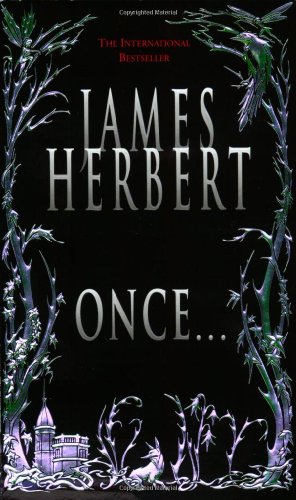
Partially incapacitated by a stroke, Thom Kindred returns to his childhood home of Castle Bracken to recuperate amid the comfort of old memories, but his returned brings to life an ancient evil from which Thom's only chance of escape lies in the magical childhood world of fantasy in which he longer believes. Reprint.
Die Inhaltsangabe kann sich auf eine andere Ausgabe dieses Titels beziehen.
Über die Autorin bzw. den Autor
James Herbert is one of the world's most popular novelists, with books sold in thirty-three foreign languages. He is an international bestselling author hitting number one on the Times of London list, and his novel Others found wide critical acclaim in the United States. He lives in London, England.
Auszug. © Genehmigter Nachdruck. Alle Rechte vorbehalten.
Chapter: First
MEET THOM KINDRED
He'd had no idea how he would feel returning to Castle Bracken after all these years. How long had it been? Sixteen, seventeen years? Yes, seventeen--he'd been ten years old when they had sent him away to boarding school. One month after his mother's death.
Thom used the "spinner" attached to the Jeep's steering wheel, a device that enabled him to turn the wheel using his right hand only, his left arm still weakened from the stroke--the "cerebrovascular accident," as the clinically cold medical profession liked to name it. Because the four-wheel drive had an automatic gearshift, he was able to keep his left foot on the metal rest, which came standard with the model, his stronger right leg taking on the work of accelerating and braking. The Jeep swept into the narrow, hedge-lined lane and picked up speed again.
How much had changed in his absence? he wondered. Not much, not much at all, he was willing to bet. Certainly not as far as the manor house itself was concerned. Built almost four hundred years ago in the Jacobean period, there had been few renovations carried out since, apart from the usual upgrade of facilities--plumbing, mains electricity, and the like--and certainly no additions, except for the banquet, which was not an integral part of the house but a fancy (there were those who misguidedly called it a folly) that had been erected a mile or two from the mansion in a woodland clearing. Thom wondered how he would feel about the place called Little Bracken, the cottage he had once regarded as his only true home. He'd been away a long time and had changed; from what he remembered of his last visit, so had the cottage.
Thom Kindred was twenty-seven years old, lean but not thin, of average height, with thick, tangled mid-brown hair that strayed over his shirt collar at the back. He was blue-eyed and his regular if not handsome features were slightly marred by a two-inch scar on his left cheek, another smaller one descending from his lower lip, both wounds sustained in the car crash almost four months before. He had been lucky that the visible injuries were not worse, airbag and seatbelt combining to protect him from serious harm as the car he was driving ploughed into a fortunately unoccupied bus shelter. The shelter was demolished, his estate car a write-off; but it was the blood clot in a cerebral artery that might have killed him, for the brain reacts badly to having its blood supply cut off, even if only temporarily.
He was unconscious for sixteen hours, drifting in and out for another ten. When eventually he had properly regained consciousness, his left arm and leg were paralyzed and his entire body--not just his head--felt as though they had been pounded by a heavy-duty sledgehammer. The doctors were surprised that he should have suffered a "haemorrhagic infarct" at such a young age (although they assured him it was not entirely rare) and further surprised there had been no warning (this, they further assured him, was not rare at all). Unfortunately, the same doctors could not say whether he would ever walk unaided again, or even if he might regain the use of his left aim and hand, because it would take time to ascertain the damage to brain cells and tissues. Yet he was young and strong, so they remained optimistic. However, for Thom, the wait was frightening; even more so because of his chosen and beloved profession, which required the full use of both hands and arms.
Thom Kindred was a carpenter, a master carpenter, you might say, the kind of caring craftsman who would choose his wood by touching it first, caressing its grain with fingertips, by leaning close and smelling its scent, feeling its dampness or dryness, its strength, sturdiness, its suppleness, softness; only men could Thom sense the wood's "soul." If convinced of its worth he would cut into it, still testing the quality by the resistance offered or the compliance accorded. He valued both hardwoods and softwoods equally, for each had their place and applications; he could even be amazed by their contradictions--some conifers, like the Douglas fir or yew, were softwoods, yet they produce a harder wood than many of their opposites, while balsa, the softest of all, was a hardwood. Thom had an affinity with the material he used that usually came only with years, perhaps several decades, of experience (and even so, that was never guaranteed), a kind of synergy that he discovered when he carved his first piece of wood taken from the forest floor when he was six years old.
Thom was successful enough to own his own workshop situated in a not-yet-fashionable area of North London and he sold exclusively to upmarket stores or individual dealers; he also took on private commissions. Some of his finest pieces had been exhibited in certain art galleries, for his design could be as exquisite as his workmanship. He dealt only in one-offs, nothing was ever reproduced, never made in bulk, and he employed no one but himself, because he was the only person he would trust to carry through his creations with the diligence--and devotion--that he demanded of himself. He even swept his own floors.
Now all this was at risk. The fingers of his left hand had become clumsy and sometimes his whole arm felt numb. He often felt exhausted after only mild but prolonged exertion, and each time he suffered a headache he feared the worst. Yet the medics and, latterly, his physiotherapist had insisted that he was lucky, that it wasn't often such swift progress towards recovery was made after such an intrusive "brain attack." Thom hadn't the knowledge to agree or disagree--what the hell did he know about strokes and their aftermath? He remembered the first few weeks, lying helpless in a hospital bed, his body leaden, his left arm and leg virtually immobile, the frozen numbness of half his face, the incontinence, the slurred speech, the complete exhaustion and confusion; and the indignities--being turned over in bed like a helpless geriatric by brisk nurses, the Convene attached to his penis, there to funnel uncontrolled urine into a plastic bag, the bed baths, and eventually the accompanied trips to the lavatory and the embarrassment of someone watching over him as he defecated. Oh, he'd made good progress for sure, but the fear was always with him, because those same doctors, the neurologists and the haematologists, could not say whether or not another blood clot might form, damming an artery until sheer pressure caused the blood to burst through and flood his brain again, destroying cells and damaging tissues deep inside his head so that this time, recovery--any recovery--might be an impossibility.
He pushed the dread away and slowed the Jeep Cherokee as a sheep suddenly pushed through a gap in the hedge ahead of him. The animal stopped dead in the middle of the lane when it saw the approaching monster, giving out a startled bleat.
"Yeah, you too, dip-sheep," Thom replied with a smile, his mood instantly lightening. Years of living in noisy, overcrowded, Kentish Town had enhanced his appreciation, of the country way of life. He poked his head out the open side window.
"You gonna move for me?" he called down to the puzzled sheep. "I'm not backing up, not for you, not for nobody."
The animal casually turned away and began chewing at the hedgerow on the other side of the narrow lane.
Thom gave a sharp beep on the horn. In another time he might have left his vehicle to force the sheep back through the gap in the hedge physically, maybe even repair the damage to the shrubbery; but it had been a long drive from London and he was anxious not to exert himself too much, particularly after the repeated cautions of his doctor. He was supposed to be convalescing for the next few months, not pushing the butts of wandering sheep.
Easing his foot off the brake, he allowed...
„Über diesen Titel“ kann sich auf eine andere Ausgabe dieses Titels beziehen.
Suchergebnisse für Once

Beispielbild für diese ISBN
Once.
Verlag:
Tor Books (edition First Edition), 2003
ISBN 10: 0765343509
ISBN 13: 9780765343505
Gebraucht
Mass Market Paperback
Erstausgabe
Anbieter: BooksRun, Philadelphia, PA, USA
Verkäuferbewertung 5 von 5 Sternen

Mass Market Paperback. Zustand: Fair. First Edition. The item might be beaten up but readable. May contain markings or highlighting, as well as stains, bent corners, or any other major defect, but the text is not obscured in any way. Artikel-Nr. 0765343509-7-1
Gebraucht kaufen
EUR 4,54
Versand gratis
Versand innerhalb von USA
Versand innerhalb von USA
Anzahl: 1 verfügbar
Beispielbild für diese ISBN
Once.
Anbieter: ThriftBooks-Atlanta, AUSTELL, GA, USA
Verkäuferbewertung 5 von 5 Sternen
Unknown. Zustand: Very Good. No Jacket. May have limited writing in cover pages. Pages are unmarked. ~ ThriftBooks: Read More, Spend Less. Artikel-Nr. G0765343509I4N00
Gebraucht kaufen
EUR 6,53
Versand gratis
Versand innerhalb von USA
Versand innerhalb von USA
Anzahl: 1 verfügbar
Beispielbild für diese ISBN
Once.
Anbieter: ThriftBooks-Dallas, Dallas, TX, USA
Verkäuferbewertung 5 von 5 Sternen
Unknown. Zustand: Very Good. No Jacket. Former library book; May have limited writing in cover pages. Pages are unmarked. ~ ThriftBooks: Read More, Spend Less. Artikel-Nr. G0765343509I4N10
Gebraucht kaufen
EUR 6,53
Versand gratis
Versand innerhalb von USA
Versand innerhalb von USA
Anzahl: 1 verfügbar
Beispielbild für diese ISBN
Once.
Anbieter: ThriftBooks-Dallas, Dallas, TX, USA
Verkäuferbewertung 5 von 5 Sternen
Unknown. Zustand: Good. No Jacket. Pages can have notes/highlighting. Spine may show signs of wear. ~ ThriftBooks: Read More, Spend Less. Artikel-Nr. G0765343509I3N00
Gebraucht kaufen
EUR 6,53
Versand gratis
Versand innerhalb von USA
Versand innerhalb von USA
Anzahl: 1 verfügbar
Beispielbild für diese ISBN
Once.
Verlag:
Tor Publishing Group, 2003
ISBN 10: 0765343509
ISBN 13: 9780765343505
Gebraucht
Softcover
Erstausgabe
Anbieter: Better World Books: West, Reno, NV, USA
Verkäuferbewertung 5 von 5 Sternen
Zustand: Good. 1st. Former library copy. Pages intact with minimal writing/highlighting. The binding may be loose and creased. Dust jackets/supplements are not included. Includes library markings. Stock photo provided. Product includes identifying sticker. Better World Books: Buy Books. Do Good. Artikel-Nr. GRP85850885
Gebraucht kaufen
EUR 6,56
Versand gratis
Versand innerhalb von USA
Versand innerhalb von USA
Anzahl: 1 verfügbar
Beispielbild für diese ISBN
Once.
Verlag:
Tor Publishing Group, 2003
ISBN 10: 0765343509
ISBN 13: 9780765343505
Gebraucht
Softcover
Erstausgabe
Anbieter: Better World Books, Mishawaka, IN, USA
Verkäuferbewertung 5 von 5 Sternen
Zustand: Good. 1st. Pages intact with minimal writing/highlighting. The binding may be loose and creased. Dust jackets/supplements are not included. Stock photo provided. Product includes identifying sticker. Better World Books: Buy Books. Do Good. Artikel-Nr. 2468973-6
Gebraucht kaufen
EUR 6,56
Versand gratis
Versand innerhalb von USA
Versand innerhalb von USA
Anzahl: 1 verfügbar
Beispielbild für diese ISBN
Once.
Verlag:
Tor Publishing Group, 2003
ISBN 10: 0765343509
ISBN 13: 9780765343505
Gebraucht
Softcover
Erstausgabe
Anbieter: Better World Books: West, Reno, NV, USA
Verkäuferbewertung 5 von 5 Sternen
Zustand: Good. 1st. Pages intact with minimal writing/highlighting. The binding may be loose and creased. Dust jackets/supplements are not included. Stock photo provided. Product includes identifying sticker. Better World Books: Buy Books. Do Good. Artikel-Nr. 2468973-6
Gebraucht kaufen
EUR 6,56
Versand gratis
Versand innerhalb von USA
Versand innerhalb von USA
Anzahl: 1 verfügbar