
Verwandte Artikel zu Slatewiper
Inhaltsangabe
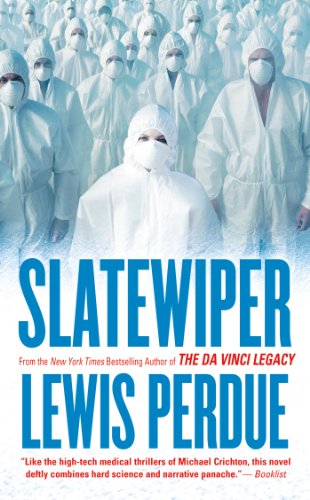
Asked to assist with a formidable epidemic sweeping through Tokyo, Lara Blackwood discovers that her life's work in genetics may have been exploited to transform people into killer life forms. By the author of Daughter of God. Reprint.
Die Inhaltsangabe kann sich auf eine andere Ausgabe dieses Titels beziehen.
Über die Autorin bzw. den Autor
Lewis Perdue studied biology and biophysics at Cornell University. He is also the bestselling author of numerous fiction and nonfiction works, including Daughter of God and The Delphi Betrayal. Perdue lives in Sonoma, California.
Auszug. © Genehmigter Nachdruck. Alle Rechte vorbehalten.
1
Typhoon clouds churned across Tokyo's September skies. Beneath the clouds, down in the unfashionable northern prefecture of Toshima, workers at Otsuka General Hospital struggled through the gathering noontime dusk to clear the sidewalks of the dead and dying before the torrential rains began to fall.
Hundreds of the sickest lay scattered about like cordwood, blanketed by a miasmic stench that rose from suppurating skin abscesses and bloody diarrhea. Some were silent, others moaned in high-pitched whines as loudly as their weakened bodies would allow. The rotting stumps of arms, legs, and fingers attracted flies and showed bare bones. Flesh seemed melted off the skeletons of the dead.
Those in earlier stages of what the newspapers were calling "the Korean Leprosy" sat in stained trousers and skirts, hung their heads between their knees, moaning and coughing. Here and there, entire families gathered, creating microcosms of the crowd with their dead, dying, and walking wounded. Mothers and fathers cradled their children in futile attempts to protect them from a horror that attacked from within.
They matted the sidewalks, the lawns, the ambulance loading ramps; they filled the empty parts of the parking lot, even the spaces between vehicles. The truly fortunate lay thick in the hallways of the emergency room, where medics from the Self-Defense Forces went through the existentially
futile motions of pumping the victims full of antibiotics and intravenous drips.
At the perimeter of the hospital grounds, SDF soldiers garbed in disposable overalls, masks, and rubber gloves worked away at the crowd, loading the live ones onto litters and into olive-drab transports. The gelatinous remains of the dead were scooped up with shovels and placed in a hodgepodge of commandeered makeshift containers: barrels, metal tubs, ice chests, soft drink coolers, even children's plastic wading pools.
Among the carnage walked three men: a white-haired Japanese man, about seventy, wearing a white physician's coat, and two blond Caucasians in jeans and sweatshirts who towered over him. The tall Caucasians each carried a large duffel. All three wore rubber gloves and surgical masks that left only their eyes showing.
The two Caucasians wiped steadily at their eyes that watered against the sharp caustic mist hanging over the hospital grounds. Around them, scores of SDF soldiers walked about spraying a disinfectant solution from large backpack pump applicators normally used for applying lawn chemicals.
The trio moved in lurches, a few steps in one direction and then a stop as the white-coated figure stepped ahead of the two others, turned to them, and blocked their way. They exchanged words, then one of the Caucasians would start off in another direction, leaving the Japanese man scurrying to catch up and repeat the process.
"We really have things well in hand," said the white-coated Japanese man as he stepped into the path of the other two once again. Dr. Yoshichika Iwamoto was chief administrator of Otsuka Hospital, professor at Tokyo University, and former member of the Diet. "You really didn't need to come," he insisted. "It is very kind of you, but so very unnecessary." Like most Japanese doctors, Iwamoto spoke English. Like many of them, he considered it a barbaric tongue.
Iwamoto's face showed none of the internal turmoil stirred up half an hour before when the two U.S. Army doctors had arrived unexpectedly. He wore his shiran kao--his nonchalant face--and tried to explain to them that this was an epidemic, a matter for specialists, that they would only be in the way. To his dismay, they had demonstrated that they were, indeed, experts in this sort of medical emergency, even pulling out published papers the two had coauthored, brought along for just this anticipated problem.
What Iwamoto really wanted to explain to these ill-mannered intruders was that this was a Japanese situation, something like a family emergency to be dealt with as discreetly as possible. That NHK, then other television stations, had broadcast stories since the outbreak of Korean Leprosy a week ago was intolerable. To air one's own dirty linen was disgraceful, unacceptable. He shook his head now as he thought about the broadcasts and the newspaper articles that followed. Soon, there had been attention from foreign journalists--more gaijin. Whatever happened to Japan for the Japanese? Kurata-san would fix that.
The news reports had brought these gaijin doctors. That alone was an insult, evidence of their lack of faith in his ability, in the ability of the entire Japanese race. Big, white, racist bullies who automatically assumed that little wheat-colored people couldn't handle things by themselves and so forced their filthy "help" on them. Iwamoto seethed inside. And their bad manners! They had arrived unannounced; it embarrassed him that they had given him no opportunity to welcome them properly.
They were so arrogant these ketojin, these Americans.
He said a small prayer of thanksgiving that at least they weren't Japanese forcing their help on him. That would create an on, an obligation, a debt that he and the hospital would be duty-bound to repay. Fortunately, gaijin were without virtue, without value. Those without virtue could not create on, nor were they to be afforded the courtesy or protection due true sons of Yamato. Iwamoto knew his only obligation was to rid himself of these two pests as quickly as possible, to keep them from hindering the removal process that was proceeding so efficiently.
They walked along in silence for several steps, making a wide detour around a man who retched convulsively at the edge of the street.
"I'm afraid you will not be comfortable," Iwamoto said hopefully as he stepped ahead of them and stopped their progress once again. "Our sanitary facilities are quite overstressed."
"No problem," said one of the gaijin. "We're Army. We're used to being uncomfortable."
"It's part of regulations," joked the second as he headed off in another direction.
Iwamoto cringed inside as he scurried to catch up with him. How could they be so insensitive as to ignore his distress? How could they miss such obvious communication?
Blocking their path, Iwamoto marshaled his resolve and tried again. "Ah, you see, we have limited supplies and equipment. I am afraid that--"
"Brought our own," the gaijin said almost simultaneously. One slapped the big duffel bag for emphasis, then turned and continued walking in yet another direction.
Desperation welled up hot and sour in Iwamoto's throat as he set out after them again.
In the distance, thunder rolled; stiff winds tore at the trees and rolled off the massive hospital building in chaotic gusts. Looking hopefully at the sky, Iwamoto maneuvered himself in front of them again and stopped. Instead of speaking immediately, he made a point of studying the weather carefully. The two Caucasians looked upward for a moment, then back at him as he spoke.
"These very early typhoons can be serious," he said. "It could be dangerous for you here." He looked expectantly from one white face to the other. "Perhaps you will be needed by your own people at Camp Zama."
The gaijin shook their heads synchronously, as if their necks were linked by gears. Almost as precisely, they turned and resumed their stroll.
Iwamoto made an audible hissing sound as he sucked in wind through pursed lips; he pursued them yet again. The older physician was winded by the time he stopped them again, this time just yards from the entrance to the hospital.
"It's a disgusting disease," Iwamoto said. "The soiling, the rotting, the bloody discharges--the odors."
Pungent antiseptic now masked most of the nauseating stench that earlier had hit the Caucasians like a squirming fist in...
Typhoon clouds churned across Tokyo's September skies. Beneath the clouds, down in the unfashionable northern prefecture of Toshima, workers at Otsuka General Hospital struggled through the gathering noontime dusk to clear the sidewalks of the dead and dying before the torrential rains began to fall.
Hundreds of the sickest lay scattered about like cordwood, blanketed by a miasmic stench that rose from suppurating skin abscesses and bloody diarrhea. Some were silent, others moaned in high-pitched whines as loudly as their weakened bodies would allow. The rotting stumps of arms, legs, and fingers attracted flies and showed bare bones. Flesh seemed melted off the skeletons of the dead.
Those in earlier stages of what the newspapers were calling "the Korean Leprosy" sat in stained trousers and skirts, hung their heads between their knees, moaning and coughing. Here and there, entire families gathered, creating microcosms of the crowd with their dead, dying, and walking wounded. Mothers and fathers cradled their children in futile attempts to protect them from a horror that attacked from within.
They matted the sidewalks, the lawns, the ambulance loading ramps; they filled the empty parts of the parking lot, even the spaces between vehicles. The truly fortunate lay thick in the hallways of the emergency room, where medics from the Self-Defense Forces went through the existentially
futile motions of pumping the victims full of antibiotics and intravenous drips.
At the perimeter of the hospital grounds, SDF soldiers garbed in disposable overalls, masks, and rubber gloves worked away at the crowd, loading the live ones onto litters and into olive-drab transports. The gelatinous remains of the dead were scooped up with shovels and placed in a hodgepodge of commandeered makeshift containers: barrels, metal tubs, ice chests, soft drink coolers, even children's plastic wading pools.
Among the carnage walked three men: a white-haired Japanese man, about seventy, wearing a white physician's coat, and two blond Caucasians in jeans and sweatshirts who towered over him. The tall Caucasians each carried a large duffel. All three wore rubber gloves and surgical masks that left only their eyes showing.
The two Caucasians wiped steadily at their eyes that watered against the sharp caustic mist hanging over the hospital grounds. Around them, scores of SDF soldiers walked about spraying a disinfectant solution from large backpack pump applicators normally used for applying lawn chemicals.
The trio moved in lurches, a few steps in one direction and then a stop as the white-coated figure stepped ahead of the two others, turned to them, and blocked their way. They exchanged words, then one of the Caucasians would start off in another direction, leaving the Japanese man scurrying to catch up and repeat the process.
"We really have things well in hand," said the white-coated Japanese man as he stepped into the path of the other two once again. Dr. Yoshichika Iwamoto was chief administrator of Otsuka Hospital, professor at Tokyo University, and former member of the Diet. "You really didn't need to come," he insisted. "It is very kind of you, but so very unnecessary." Like most Japanese doctors, Iwamoto spoke English. Like many of them, he considered it a barbaric tongue.
Iwamoto's face showed none of the internal turmoil stirred up half an hour before when the two U.S. Army doctors had arrived unexpectedly. He wore his shiran kao--his nonchalant face--and tried to explain to them that this was an epidemic, a matter for specialists, that they would only be in the way. To his dismay, they had demonstrated that they were, indeed, experts in this sort of medical emergency, even pulling out published papers the two had coauthored, brought along for just this anticipated problem.
What Iwamoto really wanted to explain to these ill-mannered intruders was that this was a Japanese situation, something like a family emergency to be dealt with as discreetly as possible. That NHK, then other television stations, had broadcast stories since the outbreak of Korean Leprosy a week ago was intolerable. To air one's own dirty linen was disgraceful, unacceptable. He shook his head now as he thought about the broadcasts and the newspaper articles that followed. Soon, there had been attention from foreign journalists--more gaijin. Whatever happened to Japan for the Japanese? Kurata-san would fix that.
The news reports had brought these gaijin doctors. That alone was an insult, evidence of their lack of faith in his ability, in the ability of the entire Japanese race. Big, white, racist bullies who automatically assumed that little wheat-colored people couldn't handle things by themselves and so forced their filthy "help" on them. Iwamoto seethed inside. And their bad manners! They had arrived unannounced; it embarrassed him that they had given him no opportunity to welcome them properly.
They were so arrogant these ketojin, these Americans.
He said a small prayer of thanksgiving that at least they weren't Japanese forcing their help on him. That would create an on, an obligation, a debt that he and the hospital would be duty-bound to repay. Fortunately, gaijin were without virtue, without value. Those without virtue could not create on, nor were they to be afforded the courtesy or protection due true sons of Yamato. Iwamoto knew his only obligation was to rid himself of these two pests as quickly as possible, to keep them from hindering the removal process that was proceeding so efficiently.
They walked along in silence for several steps, making a wide detour around a man who retched convulsively at the edge of the street.
"I'm afraid you will not be comfortable," Iwamoto said hopefully as he stepped ahead of them and stopped their progress once again. "Our sanitary facilities are quite overstressed."
"No problem," said one of the gaijin. "We're Army. We're used to being uncomfortable."
"It's part of regulations," joked the second as he headed off in another direction.
Iwamoto cringed inside as he scurried to catch up with him. How could they be so insensitive as to ignore his distress? How could they miss such obvious communication?
Blocking their path, Iwamoto marshaled his resolve and tried again. "Ah, you see, we have limited supplies and equipment. I am afraid that--"
"Brought our own," the gaijin said almost simultaneously. One slapped the big duffel bag for emphasis, then turned and continued walking in yet another direction.
Desperation welled up hot and sour in Iwamoto's throat as he set out after them again.
In the distance, thunder rolled; stiff winds tore at the trees and rolled off the massive hospital building in chaotic gusts. Looking hopefully at the sky, Iwamoto maneuvered himself in front of them again and stopped. Instead of speaking immediately, he made a point of studying the weather carefully. The two Caucasians looked upward for a moment, then back at him as he spoke.
"These very early typhoons can be serious," he said. "It could be dangerous for you here." He looked expectantly from one white face to the other. "Perhaps you will be needed by your own people at Camp Zama."
The gaijin shook their heads synchronously, as if their necks were linked by gears. Almost as precisely, they turned and resumed their stroll.
Iwamoto made an audible hissing sound as he sucked in wind through pursed lips; he pursued them yet again. The older physician was winded by the time he stopped them again, this time just yards from the entrance to the hospital.
"It's a disgusting disease," Iwamoto said. "The soiling, the rotting, the bloody discharges--the odors."
Pungent antiseptic now masked most of the nauseating stench that earlier had hit the Caucasians like a squirming fist in...
„Über diesen Titel“ kann sich auf eine andere Ausgabe dieses Titels beziehen.
Suchergebnisse für Slatewiper

Beispielbild für diese ISBN
Slatewiper
Anbieter: World of Books (was SecondSale), Montgomery, IL, USA
Verkäuferbewertung 5 von 5 Sternen

Zustand: Good. Item in good condition. Textbooks may not include supplemental items i.e. CDs, access codes etc. Artikel-Nr. 00099023712
Gebraucht kaufen
EUR 4,59
Versand gratis
Versand innerhalb von USA
Versand innerhalb von USA
Anzahl: 1 verfügbar
Beispielbild für diese ISBN
Slatewiper
Verlag:
Forge Books (edition ), 2004
ISBN 10: 0765340666
ISBN 13: 9780765340665
Gebraucht
Mass Market Paperback
Anbieter: BooksRun, Philadelphia, PA, USA
Verkäuferbewertung 5 von 5 Sternen
Mass Market Paperback. Zustand: Fair. The item might be beaten up but readable. May contain markings or highlighting, as well as stains, bent corners, or any other major defect, but the text is not obscured in any way. Artikel-Nr. 0765340666-7-1
Gebraucht kaufen
EUR 4,60
Versand gratis
Versand innerhalb von USA
Versand innerhalb von USA
Anzahl: 1 verfügbar
Beispielbild für diese ISBN
Slatewiper
Anbieter: Better World Books, Mishawaka, IN, USA
Verkäuferbewertung 5 von 5 Sternen
Zustand: Good. Pages intact with minimal writing/highlighting. The binding may be loose and creased. Dust jackets/supplements are not included. Stock photo provided. Product includes identifying sticker. Better World Books: Buy Books. Do Good. Artikel-Nr. 2908791-6
Gebraucht kaufen
EUR 8,14
Versand gratis
Versand innerhalb von USA
Versand innerhalb von USA
Anzahl: 2 verfügbar
Beispielbild für diese ISBN
Slatewiper
Anbieter: Zardoz Books, Westbury, WILTS, Vereinigtes Königreich
Verkäuferbewertung 4 von 5 Sternen

New Edition. Zustand: fine. 1st edition Forge 2004 paperback, fine In stock shipped from our UK warehouse. Artikel-Nr. 13475
Gebraucht kaufen
EUR 5,95
EUR 23,27 Versand
Versand von Vereinigtes Königreich nach USA
Versand von Vereinigtes Königreich nach USA
Anzahl: 1 verfügbar
Beispielbild für diese ISBN
Slatewiper
Anbieter: SZ Global, Toronto, ON, Kanada
Verkäuferbewertung 5 von 5 Sternen
Paperback. Zustand: New. * FACT: Bioweapons designers are developing deadly, genetically engineered, life-forms triggered by race- and ethnic-related genes. *FACT: DNA analysis shows that the human race has come close to extinction in the past. * QUESTION: Will 'Slatewiper' bring the human race to the brink of extinction again? When Lara Blackwood, a brilliant genetic engineer, receives a call asking for her help in solving a ghastly epidemic in Tokyo, she's happy to do what she can . To her horror she discovers that her life's work has been perverted to produce a revolutionary new genetic weapon that kills by turning people's own ethnic-related chromosomes against them. Humanity's clock is ticking as Lara struggles against staggering odds to expose the conspiracy behind 'Slatewiper'--before a nightmarish terrorist scheme threatens the entire human race with extinction! Artikel-Nr. 9780765340665
Neu kaufen
EUR 19,88
EUR 32,40 Versand
Versand von Kanada nach USA
Versand von Kanada nach USA
Anzahl: 1 verfügbar