
Verwandte Artikel zu Legends Of The Gun Years: Two Gripping Volumes of the...
Inhaltsangabe
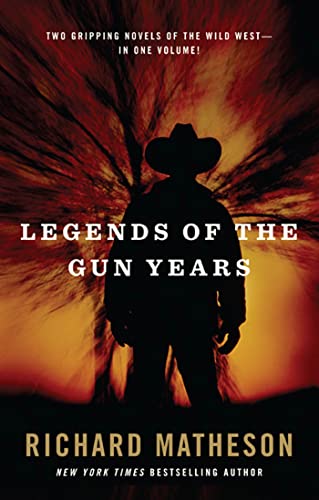
Together in one volume, the epic stories of two legendary gunfighters!
Journal of the Gun Years
Winner of the Spur Award for Best Western Novel
Back East, they told tall tales of Marshal Clay Hauser, the steely-eyed Civil War veteran who became known as the "Hero of the Plains" for his daring exploits in the raucous cow towns of the frontier. But fame proves to be the one enemy he can never outdraw-and a curse that haunts him to his violent end . . . .
The Memoirs of Wild Bill Hickok
James Butler Hickok was a celebrity before there was a Hollywood. As a gunfighter and U.S. marshal, he carved out a legend greater than any fictional hero. Now read the unforgettable story of the man behind the myth.
"Matheson excels at the depiction of one man alone, locked in a desperate struggle against a force or forces greater than himself."
--Stephen King
Die Inhaltsangabe kann sich auf eine andere Ausgabe dieses Titels beziehen.
Über die Autorin bzw. den Autor
Richard Matheson (1926-2013) was The New York Times bestselling author of I Am Legend, Hell House, Somewhere in Time, The Incredible Shrinking Man, Now You See It..., and What Dreams May Come, among others. He was named a Grand Master of Horror by the World Horror Convention, and received the Bram Stoker Award for Lifetime Achievement. He has also won the Edgar, the Spur, and the Writer's Guild awards. In 2010, he was inducted into the Science Fiction Hall of Fame. In addition to his novels Matheson wrote several screenplays for movies and TV, including several Twilight Zone episodes.
Auszug. © Genehmigter Nachdruck. Alle Rechte vorbehalten.
Legends of the Gun Years
By Richard MathesonTom Doherty Associates
Copyright © 1996 RXR, Inc.
All rights reserved.
ISBN: 978-0-7653-2233-3All rights reserved.
Contents
Journal of the Gun Years,
The Memoirs of Wild Bill Hickok,
CHAPTER 1
BOOK ONE
(1864–1867)
* * *
It is my unhappy lot to write the closing entry in this journal.
Clay Halser is dead, killed this morning in my presence.
I have known him since we met during the latter days of The War Between the States. I have run across him, on occasion, through ensuing years and am, in fact, partially responsible (albeit involuntarily) for a portion of the legend which has magnified around him.
It is for these reasons (and another more important) that I make this final entry.
* * *
I am in Silver Gulch acquiring research matter toward the preparation of a volume on the history of this territory (Colorado), which has recently become the thirty-eighth state of our Union.
I was having breakfast in the dining room of the Silver Lode Hotel when a man entered and sat down at a table across the room, his back to the wall. Initially, I failed to recognize him though there was, in his comportment, something familiar.
Several minutes later (to my startlement), I realized that it was none other than Clay Halser. True, I had not laid eyes on him for many years. Nonetheless, I was completely taken aback by the change in his appearance.
I was not, at that point, aware of his age, but took it to be somewhere in the middle thirties. Contrary to this, he presented the aspect of a man at least a decade older.
His face was haggard, his complexion (in my memory, quite ruddy) pale to the point of being ashen. His eyes, formerly suffused with animation, now looked burned out, dead. What many horrific sights those eyes had beheld I could not — and cannot — begin to estimate. Whatever those sights, however, no evidence of them had been reflected in his eyes before; it was as though he'd been emotionally immune.
He was no longer so. Rather, one could easily imagine that his eyes were gazing, in that very moment, at those bloody sights, dredging from the depths within his mind to which he'd relegated them, all their awful measure.
From the standpoint of physique, his deterioration was equally marked. I had always known him as a man of vigorous health, a condition necessary to sustain him in the execution of his harrowing duties. He was not a tall man; I would gauge his height at five feet ten inches maximum, perhaps an inch or so less, since his upright carriage and customary dress of black suit, hat, and boots might have afforded him the look of standing taller than he did. He had always been extremely well-presented though, with a broad chest, narrow waist, and pantherlike grace of movement; all in all, a picture of vitality.
Now, as he ate his meal across from me, I felt as though, by some bizarre transfigurement, I was gazing at an old man.
He had lost considerable weight and his dark suit (it, too, seemed worn and past its time) hung loosely on his frame. To my further disquiet, I noted a threading of gray through his dark blond hair and saw a tremor in his hands completely foreign to the young man I had known.
I came close to summary departure. To my shame, I nearly chose to leave rather than accost him. Despite the congenial relationship I had enjoyed with him throughout the past decade, I found myself so totally dismayed by the alteration in his looks that I lacked the will to rise and cross the room to him, preferring to consider a hasty exit. (I discovered, later, that the reason he had failed to notice me was that his vision, always so acute before, was now inordinately weak.)
At last, however, girding up my will, I stood and moved across the dining room, attempting to fix a smile of pleased surprise on my lips and hoping he would not be too aware of my distress.
"Well, good morning, Clay," I said, as evenly as possible.
I came close to baring my deception at the outset for, as he looked up sharply at me, his expression one of taut alarm, a perceptible "tic" under his right eye, I was hard put not to draw back apprehensively.
Abruptly, then, he smiled (though it was more a ghost of the smile I remembered). "Frank," he said and jumped to his feet. No, that is not an accurate description of his movement. It may well have been his intent to jump up and welcome me with an avid handshake. As it happened, his stand was labored, his hand grip lacking in strength. "How are you?" he inquired. "It is good to see you."
"I'm fine," I answered.
"Good." He nodded, gesturing toward the table. "Join me."
I hope my momentary hesitation passed his notice. "I'd be happy to," I told him.
"Good," he said again.
We each sat down, he with his back toward the wall again. As we did, I noted how his gaunt frame slumped into the chair, so different from the movement of his earlier days.
He asked me if I'd eaten breakfast.
"Yes." I pointed across the room. "I was finishing when you entered."
"I am glad you came over," he said.
There was a momentary silence. Uncomfortable, I tried to think of something to say.
He helped me out. (I wonder, now, if it was deliberate; if he had, already, taken note of my discomfort.) "Well, old fellow," he asked, "what brings you to this neck of the woods?"
I explained my presence in Silver Gulch and, as I did, being now so close to him, was able to distinguish, in detail, the astounding metamorphosis which time (and experience) had effected.
There seemed to be, indelibly impressed on his still handsome face, a look of unutterable sorrow. His former blitheness had completely vanished and it was oppressive to behold what had occurred to his expression, to see the palsied gestures of his hands as he spoke, perceive the constant shifting of his eyes as though he was anticipating that, at any second, some impending danger might be thrust upon him.
I tried to coerce myself not to observe these things, concentrating on the task of bringing him "up to date" on my activities since last we'd met; no match for his activities, God knows.
"What about you?" I finally asked; I had no more to say about myself. "What are you doing these days?"
"Oh, gambling," he said, his listless tone indicative of his regard for that pursuit.
"No marshaling anymore?" I asked.
He shook his head. "Strictly the circuit," he answered.
"Circuit?" I wasn't really curious but feared the onset of silence and spoke the first word that occurred to me.
"A league of boomtown havens for faro players," he replied. "South Texas up to South Dakota — Idaho to Arizona. There is money to be gotten everywhere. Not that I am good enough to make a raise. And not that it's important if I do, at any rate. I only gamble for something to do."
All the time he spoke, his eyes kept shifting, searching; was it waiting?
As silence threatened once again, I quickly spoke. "Well, you have traveled quite a long road since the War," I said. "A long, exciting road." I forced a smile. "Adventurous," I added.
His answering smile was as sadly bitter and exhausted as any I have ever witnessed. "Yes, the writers of the stories have made it all sound very colorful," he said. He leaned back with a heavy sigh, regarding me. "I even thought it so myself at one time. Now I recognize it all for what it was." There was a tightening around his eyes. "Frank, it was drab, and dirty, and there was a lot of...
„Über diesen Titel“ kann sich auf eine andere Ausgabe dieses Titels beziehen.
Suchergebnisse für Legends Of The Gun Years: Two Gripping Volumes of the...

Beispielbild für diese ISBN
Legends of the Gun Years: Two Gripping Volumes of the Wild West
Anbieter: ThriftBooks-Atlanta, AUSTELL, GA, USA
Verkäuferbewertung 5 von 5 Sternen

Paperback. Zustand: Good. No Jacket. Pages can have notes/highlighting. Spine may show signs of wear. ~ ThriftBooks: Read More, Spend Less. Artikel-Nr. G0765322331I3N00
Gebraucht kaufen
EUR 7,72
Versand gratis
Versand innerhalb von USA
Versand innerhalb von USA
Anzahl: 1 verfügbar
Beispielbild für diese ISBN
Legends of the Gun Years: Two Gripping Volumes of the Wild West
Anbieter: ThriftBooks-Atlanta, AUSTELL, GA, USA
Verkäuferbewertung 5 von 5 Sternen
Paperback. Zustand: Very Good. No Jacket. May have limited writing in cover pages. Pages are unmarked. ~ ThriftBooks: Read More, Spend Less. Artikel-Nr. G0765322331I4N00
Gebraucht kaufen
EUR 7,72
Versand gratis
Versand innerhalb von USA
Versand innerhalb von USA
Anzahl: 1 verfügbar
Beispielbild für diese ISBN
Legends of the Gun Years
Anbieter: Revaluation Books, Exeter, Vereinigtes Königreich
Verkäuferbewertung 5 von 5 Sternen
Paperback. Zustand: Brand New. second edition edition. 464 pages. 8.00x5.50x1.25 inches. In Stock. Artikel-Nr. x-0765322331
Neu kaufen
EUR 25,35
EUR 11,94 Versand
Versand von Vereinigtes Königreich nach USA
Versand von Vereinigtes Königreich nach USA
Anzahl: 2 verfügbar