
Verwandte Artikel zu Man Plus
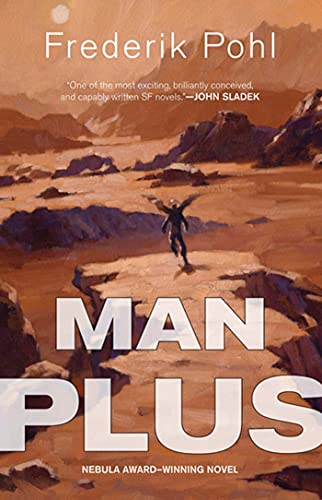
Über die Autorin bzw. den Autor
Frederik George Pohl Jr. (1919 - 2013) was an American science-fiction writer, editor and fan, with a career spanning more than 75 years-from his first published work, the 1937 poem "Elegy to a Dead Satellite: Luna", to the 2011 novel All the Lives He Led and articles and essays published in 2012. From about 1959 until 1969, Pohl edited Galaxy and its sister magazine If; the latter won three successive annual Hugo Awards as the year's best professional magazine. His 1977 novel Gateway won four "year's best novel" awards: the Hugo voted by convention participants, the Locus voted by magazine subscribers, the Nebula voted by American science-fiction writers and the juried academic John W. Campbell Memorial Award. He won the Campbell Memorial Award again for the 1984 collection of novellas Years of the City, one of two repeat winners during the first 40 years. For his 1979 novel Jem, Pohl won a U.S. National Book Award in the one-year category Science Fiction. It was a finalist for three other year's best novel awards. He won four Hugo and three Nebula Awards.
Auszug. © Genehmigter Nachdruck. Alle Rechte vorbehalten.
Man Plus
By Frederik PohlTom Doherty Associates
Copyright © 2004 Frederik Pohl
All rights reserved.
ISBN: 978-0-7653-2178-7All rights reserved.
Contents
Title Page,
Copyright Notice,
1. An Astronaut and His World,
2. What the President Wanted,
3. Man Becoming Martian,
4. Group of Probable Pallbearers,
5. Monster Becoming Mortal Again,
6. Mortal in Mortal Fear,
7. Mortal Becoming Monster,
8. Through Deceitful Eyes,
9. Dash Visits a Bedside,
10. The Batman's Entrechats,
11. Dorothy Louise Mintz Torraway as Penelope,
12. Two Simulations and a Reality,
13. When We Pass the Point of No Return,
14. Missionary to Mars,
15. How the Good News Went from Mars to Earth,
16. On the Perception of Perils,
17. A Day in the Life of a Martian,
18. Man Plus Us,
Books by Frederik Pohl,
About the Author,
Copyright,
CHAPTER 1
An Astronaut and His World
It is necessary to tell you about Roger Torraway. One human being does not seem particularly important, when there are eight billion alive. Not more important than, for example, a single microchip in a memory store. But a single chip can be decisive when it carries an essential bit, and Torraway was important in just that way.
He was a good-looking man, as people go. Famous, too. Or had been.
There had been a time when Roger Torraway hung in the sky for two months and three weeks, along with five other astronauts. They were all dirty, horny and mostly bored. That wasn't what made him famous. That was just "people in the news" stuff, fit for two sentences on the seven o'clock wrap-up on a dull night.
But he did get famous. In Bechuanaland and Baluchistan and Buffalo, people knew his name. Time gave him its cover. He didn't have it all to himself. He had to share it with the rest of his team in the orbiting lab, because they were the ones who got lucky and rescued the Soviet bunch that came back to Earth with no steering jets.
So they were all famous men overnight. Torraway was twenty-eight years old when that happened, and had just married a green-eyed, black-haired teacher of ceramic sculpture. Dorrie on Earth was what made him yearn, and Rog in orbit was what made Dorrie a celebrity herself, which she loved.
It took something special to make an astronaut's wife newsworthy. There were so many of them. They looked so much alike. The newspersons used to think that NASA picked the astronauts' wives out of the entries in Miss Georgia contests. They all had that look, as though as soon as they changed out of their bathing suits they would show you some baton-twirling or would recite "The Female of the Species." Dorrie Torraway was a little too intelligent-looking for that, although she was also definitely pretty enough for that. She was the only one of the astronaut wives to get major space in both Ladies' Home Journal ("Twelve Christmas Gifts You Can Bake in Your Kiln") and Ms. ("Children Would Spoil My Marriage").
Rog was all for the nonfamily. He was all for everything Dorrie wanted, because he was for Dorrie very much.
In that respect, he was a little less like his fellows, who had mostly discovered fine female fringe benefits from the space program. In other ways he was just like them. Bright, healthy, smart, personable, technically trained. The newspersons thought for a while that the astronauts themselves also came from an assembly line somewhere. They were available in a range of twenty centimeters in height and about a dozen years in age, and came in a choice of four shades of skin color, from milk chocolate to Viking. Their hobbies were chess, swimming, hunting, flying, skydiving, fishing and golf. They mingled easily with senators and ambassadors. When they retired from the space program, they found jobs with aerospace companies or with lost causes needing a new publicity image. These jobs paid very well. Astronauts were valuable products. They were not only prized by the publicity media and the Man in the Street. We valued them very highly too.
What the astronauts represented was a dream. The dream was priceless to the Man in the Street, especially if it was a dank, stinking Calcutta street where families slept on the sidewalk and roused themselves at dawn to queue for the one free bowl of food. It was a gritty, grimy world, and space gave it a little bit of beauty and excitement. Not much, but better than none at all.
The astronauts formed a tight little community, all around Tonka, Oklahoma, like baseball families. When each man flew his first mission he joined the major leagues. From then on they were rivals and teammates. They fought one another to get into the line-up, and coached one another from the baselines. It was the dichotomy of the professional athlete. No aging knuckle-baller sitting on the bench and staring at the latest rifle-armed kid felt more sick and angry envy than the back-up man to a planetary landing felt when he watched his Number One suit up.
Rog and Dorrie fit nicely into that community. They made friends easily. They were just oddball enough to be distinctive, not odd enough to worry anyone. If Dorrie didn't want to have children herself, she was nice to the children of the other wives. When Vic Samuelson was out of radio contact for five days on the far side of the sun and Verna Samuelson came taken down with early labor pains, Dorrie took Verna's three infants into her own home. None of them was over five years old. Two of them were still in diapers, and she changed them uncomplainingly while other wives took care of Verna's house and Verna took care of giving birth to her fourth in the NASA hospital. At the Christmas parties Rog and Dorrie never got the drunkest, nor were they ever the first to leave.
They were a nice couple.
They lived in a nice world.
In that they were, they knew, lucky. The rest of the world wasn't all that nice. The little wars chased themselves all over Asia and Africa and Latin America. Western Europe was sometimes strangled by strikes and often crippled by shortages, and when winter came it usually shivered. People were hungry, and a lot of them were angry, and there were very few cities a person would want to walk in alone at night. But Tonka kept itself unpermissive and pretty safe, and astronauts (and cosmonauts and sinonauts) visited Mercury and Mars as well as the moon, swam into the halos of comets and hung in orbit around gas giants.
Torraway himself had flown five major missions. First he flew in one of the shuttle flights to replenish Spacelab, back in the early days after the freeze, when the space program was just getting on its feet again.
Then he spent eighty-one days in the second-generation space station. This was his big moment, the one that got him the cover of Time. The Russkis had fired off a manned mission to Mercury, and it had got there all right and landed all right and taken off for the return trip all right; but nothing after that was all right. The Russians had always had trouble with their stabilizing thrusters — several of the early cosmonauts had set themselves spinning, had not been able to stop, and had vomited helplessly all over the insides of their spacecrafts. This time they had trouble again and used up their attitude-correction reserves.
So they managed to get themselves into a wide-assed elliptical orbit around Earth, but they had no way to get out of it safely. Or to stay in it safely, either. Their control was only approximate by then, and the periterran point was low enough inside the...
„Über diesen Titel“ kann sich auf eine andere Ausgabe dieses Titels beziehen.