
Verwandte Artikel zu The Forge of God
Inhaltsangabe
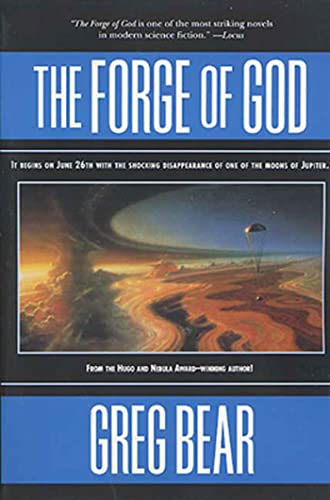
The Forge of God by Greg Bear
On September 28th, a geologist working in Death valley finds a mysterious new cinder cone in very well-mapped area.
On October 1st, the government of Australia announces the discovery of an enormous granite mountain. Like the cinder cone, it wasn't there six months ago....
Something is happening to Planet Earth, and the truth is too terrifying to consider....
Die Inhaltsangabe kann sich auf eine andere Ausgabe dieses Titels beziehen.
Über die Autorin bzw. den Autor
Greg Bear
Auszug. © Genehmigter Nachdruck. Alle Rechte vorbehalten.
The Forge of God
By Bear, GregTor Books
Copyright ©2001 Bear, GregAll right reserved.
ISBN: 9780765301079
1—
September 28-29
Camped beside the mountain that should not have been there, wrapped in cold desert darkness, Edward Shaw could not sleep. He heard steady breathing from the still forms of his two companions, and marveled at their ease.
He had written in his notebook:
* * *
The mound is approximately five hundred meters long and half as wide, perhaps a hundred meters high, (apparently) the basaltic cinder cone of a dead volcano, covered with boulder- and cobble-sized chunks of dark black scoria and surrounded by fine white quartz sand. It is not on our maps nor in the 1991 Geosat directory. The flanks of the cone are steeper than the angle of repose, as much as fifty and sixty degrees. The weathering is haphazard at best—some parts open to the sun and rain are jet black, shiny, and other areas are only mildly rusty. There are no insects on the mound—specifically, lift any rock and you will not find a scorpion or millipede. There are no beer cans.
* * *
Edward, Brad Minelli, and Victor Reslaw had journeyed from Austin, Texas, to combine a little geology with a lot of camping and hiking across the early autumn desert. Edward was the eldest, thirty-three; he was also the shortest and in a close race with Reslaw to lose his hair the fastest. He stood five feet nine inches in his hiking boots, and his slender frame and boyish, inquisitive features made him seem a lot younger, despite the thinning hair. To see objects closer than two feet from his round nose, he wore gold wire-framed round-lensed glasses, a style he had adopted as an adolescent in the late seventies.
Edward lay on his back with his hands clasped behind his head and stared up at the clear steady immensity of the sky. Three days before, dark and gravid clouds had conspired in the flaming sunset to drop a true gully-washer into Death Valley. Their camp had been on high ground, but they had seen basketball-sized boulders slide and roll down freshly gouged channels.
The desert seemed once again innocent of water and change. All around the camp hung a silence more precious than any amount of gold. Not even the wind spoke.
He felt very large in the solitude, as if he might spread his fingers over half the land from horizon to horizon, and gather a mica coat of stars on his fingers. Conversely, in his largeness, he was also a little frightened. This inflated magnitude of self could easily be pricked and shrink to nothing, an illusion of comfort and warmth and high intellectual fever.
Not once in his six-year career as a professor of geology had he found a major error in the U.S. Geological Survey Death Valley charts. The Mojave Desert and Death Valley were the Mecca and Al Medina of western U.S. geologists; they had tramped over the regions for well over a century, drawn by the nakedness and shameless variety of the Earth. From its depths miners had hauled borax and talc and gypsum and other useful, unglamorous minerals. In some places, niter-lined caves wedged several hundred feet into the Earth. A spelunker need descend only twenty or thirty feet to feel the heat; creation still lay close under Death Valley.
There were hundreds of dead volcanoes, black or sullen red on the tan and gray and pink desert, between the resort at Furnace Creek and the small town of Shoshone, yet each one had been charted and was likely featured in some graduate research paper or another.
This mountain was an anomaly.
That was impossible.
Reslaw and Minelli had shrugged it off as an interesting if unique error on the maps; a misplacement, like the discovery of some new island in an archipelago, known to the natives but lost in a shuffle of navigators’ charts; a kind of Pitcairn of volcanic mounds.
But the cinder cone was too close to routes traveled at least once or twice a year. Edward knew that it had not been misplaced. He could not deceive himself as his friends did.
Neither could he posit any other explanation.
* * *
They walked once again around the base of the mound at midmorning. The sun was already high in the flat, still blue sky. It was going to be a hot day. Red-haired, stocky Reslaw sipped coffee from a green-enameled Thermos bottle, a serviceable antique purchased in a rock-and-junk shop in Shoshone; Edward chewed on a granola bar and sketched details in a small black cloth-bound notebook. Minelli trailed them, idly chipping at boulders with a rock pick, his loose, lanky form, unkempt black hair, and pale skin giving him the appearance of a misplaced urban scrounger.
He stopped ten yards behind Edward. “Hey,” he called out. “Did you see this?”
“What?”
“A hole.”
Edward turned back. Reslaw glanced back at them, shrugged, and continued around the mound to the north.
The hole was about a meter wide and slanted upward into the mass of the mound. Edward had not seen it because it began in deep shadow, under a ledge illuminated by the warm rays of the sun. “It’s not a flow tube. Look how smooth,” Minelli said. “No collapse, no patterns.”
“Bad geology,” Edward commented. If the mound is a fake, then this is the first mistake.
“Hm?”
“It’s not natural. Looks like some prospector got here before us.”
“Why dig a hole in a cinder cone?”
“Maybe it’s an Indian cave,” Edward offered lamely. The hole disturbed him.
“Indians with diamond drills? Not likely,” Minelli said with a faint edge of scorn. Edward ignored his tone and stepped on a lava boulder to get a better look up into the darkness. He pulled a flashlight from his belt and squeezed it to shine a beam into the depths. Smooth-bored matte-finish lava walls absorbed the light beyond eight or ten meters; to that point, the tunnel was straight and featureless, inclining upward at about thirty degrees.
“Do you smell something?” Minelli asked.
Edward sniffed. “Yeah. What is it?”
“I’m not sure…”
The odor was faint and smooth and sweet, slightly acrid. It did not encourage further investigation. “Like a lab smell,” Minelli said.
“That’s it,” Edward agreed. “Iodine. Crystalline iodine.”
“Right.”
Minelli’s forehead wrinkled in a mock fit of manic speculation. “Got it,” he said. “This is a junkie rock. A sanitary junkie cinder cone.”
Edward ignored him again. Minelli was infamous for a sense of humor so strange it hardly ever produced anything funny. “Needle mark,” “Minelli explained in an undertone, realizing his failure. “You still think this isn’t a map mistake?”
“If you found a street in New York City, not on any map, wouldn’t you be suspicious?”
“I’d call up the mapmakers.”
“Yeah, well, this place is as crowded as New York City, as far as geologists are concerned.”
“All right,” Minelli conceded. “So it’s new. Just popped up out of nowhere.”
“That sounds pretty stupid, doesn’t it?” Edward said.
“Your idea, not mine.”
Edward backed away from the hole and suppressed a shiver. A new mole and it won’t go away; a blemish that shouldn’t be here.
“What’s Reslaw doing?” Minelli asked. “Let’s find...
September 28-29
Camped beside the mountain that should not have been there, wrapped in cold desert darkness, Edward Shaw could not sleep. He heard steady breathing from the still forms of his two companions, and marveled at their ease.
He had written in his notebook:
* * *
The mound is approximately five hundred meters long and half as wide, perhaps a hundred meters high, (apparently) the basaltic cinder cone of a dead volcano, covered with boulder- and cobble-sized chunks of dark black scoria and surrounded by fine white quartz sand. It is not on our maps nor in the 1991 Geosat directory. The flanks of the cone are steeper than the angle of repose, as much as fifty and sixty degrees. The weathering is haphazard at best—some parts open to the sun and rain are jet black, shiny, and other areas are only mildly rusty. There are no insects on the mound—specifically, lift any rock and you will not find a scorpion or millipede. There are no beer cans.
* * *
Edward, Brad Minelli, and Victor Reslaw had journeyed from Austin, Texas, to combine a little geology with a lot of camping and hiking across the early autumn desert. Edward was the eldest, thirty-three; he was also the shortest and in a close race with Reslaw to lose his hair the fastest. He stood five feet nine inches in his hiking boots, and his slender frame and boyish, inquisitive features made him seem a lot younger, despite the thinning hair. To see objects closer than two feet from his round nose, he wore gold wire-framed round-lensed glasses, a style he had adopted as an adolescent in the late seventies.
Edward lay on his back with his hands clasped behind his head and stared up at the clear steady immensity of the sky. Three days before, dark and gravid clouds had conspired in the flaming sunset to drop a true gully-washer into Death Valley. Their camp had been on high ground, but they had seen basketball-sized boulders slide and roll down freshly gouged channels.
The desert seemed once again innocent of water and change. All around the camp hung a silence more precious than any amount of gold. Not even the wind spoke.
He felt very large in the solitude, as if he might spread his fingers over half the land from horizon to horizon, and gather a mica coat of stars on his fingers. Conversely, in his largeness, he was also a little frightened. This inflated magnitude of self could easily be pricked and shrink to nothing, an illusion of comfort and warmth and high intellectual fever.
Not once in his six-year career as a professor of geology had he found a major error in the U.S. Geological Survey Death Valley charts. The Mojave Desert and Death Valley were the Mecca and Al Medina of western U.S. geologists; they had tramped over the regions for well over a century, drawn by the nakedness and shameless variety of the Earth. From its depths miners had hauled borax and talc and gypsum and other useful, unglamorous minerals. In some places, niter-lined caves wedged several hundred feet into the Earth. A spelunker need descend only twenty or thirty feet to feel the heat; creation still lay close under Death Valley.
There were hundreds of dead volcanoes, black or sullen red on the tan and gray and pink desert, between the resort at Furnace Creek and the small town of Shoshone, yet each one had been charted and was likely featured in some graduate research paper or another.
This mountain was an anomaly.
That was impossible.
Reslaw and Minelli had shrugged it off as an interesting if unique error on the maps; a misplacement, like the discovery of some new island in an archipelago, known to the natives but lost in a shuffle of navigators’ charts; a kind of Pitcairn of volcanic mounds.
But the cinder cone was too close to routes traveled at least once or twice a year. Edward knew that it had not been misplaced. He could not deceive himself as his friends did.
Neither could he posit any other explanation.
* * *
They walked once again around the base of the mound at midmorning. The sun was already high in the flat, still blue sky. It was going to be a hot day. Red-haired, stocky Reslaw sipped coffee from a green-enameled Thermos bottle, a serviceable antique purchased in a rock-and-junk shop in Shoshone; Edward chewed on a granola bar and sketched details in a small black cloth-bound notebook. Minelli trailed them, idly chipping at boulders with a rock pick, his loose, lanky form, unkempt black hair, and pale skin giving him the appearance of a misplaced urban scrounger.
He stopped ten yards behind Edward. “Hey,” he called out. “Did you see this?”
“What?”
“A hole.”
Edward turned back. Reslaw glanced back at them, shrugged, and continued around the mound to the north.
The hole was about a meter wide and slanted upward into the mass of the mound. Edward had not seen it because it began in deep shadow, under a ledge illuminated by the warm rays of the sun. “It’s not a flow tube. Look how smooth,” Minelli said. “No collapse, no patterns.”
“Bad geology,” Edward commented. If the mound is a fake, then this is the first mistake.
“Hm?”
“It’s not natural. Looks like some prospector got here before us.”
“Why dig a hole in a cinder cone?”
“Maybe it’s an Indian cave,” Edward offered lamely. The hole disturbed him.
“Indians with diamond drills? Not likely,” Minelli said with a faint edge of scorn. Edward ignored his tone and stepped on a lava boulder to get a better look up into the darkness. He pulled a flashlight from his belt and squeezed it to shine a beam into the depths. Smooth-bored matte-finish lava walls absorbed the light beyond eight or ten meters; to that point, the tunnel was straight and featureless, inclining upward at about thirty degrees.
“Do you smell something?” Minelli asked.
Edward sniffed. “Yeah. What is it?”
“I’m not sure…”
The odor was faint and smooth and sweet, slightly acrid. It did not encourage further investigation. “Like a lab smell,” Minelli said.
“That’s it,” Edward agreed. “Iodine. Crystalline iodine.”
“Right.”
Minelli’s forehead wrinkled in a mock fit of manic speculation. “Got it,” he said. “This is a junkie rock. A sanitary junkie cinder cone.”
Edward ignored him again. Minelli was infamous for a sense of humor so strange it hardly ever produced anything funny. “Needle mark,” “Minelli explained in an undertone, realizing his failure. “You still think this isn’t a map mistake?”
“If you found a street in New York City, not on any map, wouldn’t you be suspicious?”
“I’d call up the mapmakers.”
“Yeah, well, this place is as crowded as New York City, as far as geologists are concerned.”
“All right,” Minelli conceded. “So it’s new. Just popped up out of nowhere.”
“That sounds pretty stupid, doesn’t it?” Edward said.
“Your idea, not mine.”
Edward backed away from the hole and suppressed a shiver. A new mole and it won’t go away; a blemish that shouldn’t be here.
“What’s Reslaw doing?” Minelli asked. “Let’s find...
„Über diesen Titel“ kann sich auf eine andere Ausgabe dieses Titels beziehen.
Suchergebnisse für The Forge of God

Beispielbild für diese ISBN
The Forge of God
Anbieter: World of Books (was SecondSale), Montgomery, IL, USA
Verkäuferbewertung 5 von 5 Sternen

Paperback. Zustand: Fair. The Forge of God by Greg Bear On September 28th, a geologist working in Death valley finds a mysterious new cinder cone in very well-mapped area. On October 1st, the government of Australia announces the discovery of an enormous granite mountain. Like the cinder cone, it wasn't there six months ago. Something is happening to Planet Earth, and the truth is too terrifying to consider. Artikel-Nr. 00094002570
Gebraucht kaufen
EUR 3,99
Versand gratis
Versand innerhalb von USA
Versand innerhalb von USA
Anzahl: 2 verfügbar
Beispielbild für diese ISBN
The Forge of God
Anbieter: World of Books (was SecondSale), Montgomery, IL, USA
Verkäuferbewertung 5 von 5 Sternen
Paperback. Zustand: Good. The Forge of God by Greg Bear On September 28th, a geologist working in Death valley finds a mysterious new cinder cone in very well-mapped area. On October 1st, the government of Australia announces the discovery of an enormous granite mountain. Like the cinder cone, it wasn't there six months ago. Something is happening to Planet Earth, and the truth is too terrifying to consider. Artikel-Nr. 00100685173
Gebraucht kaufen
EUR 3,99
Versand gratis
Versand innerhalb von USA
Versand innerhalb von USA
Anzahl: 4 verfügbar
Beispielbild für diese ISBN
The Forge of God
Anbieter: ThriftBooks-Phoenix, Phoenix, AZ, USA
Verkäuferbewertung 5 von 5 Sternen
Paperback. Zustand: Good. No Jacket. Pages can have notes/highlighting. Spine may show signs of wear. ~ ThriftBooks: Read More, Spend Less. Artikel-Nr. G0765301075I3N00
Gebraucht kaufen
EUR 6,51
Versand gratis
Versand innerhalb von USA
Versand innerhalb von USA
Anzahl: 1 verfügbar
Beispielbild für diese ISBN
The Forge of God
Anbieter: ThriftBooks-Reno, Reno, NV, USA
Verkäuferbewertung 5 von 5 Sternen
Paperback. Zustand: Fair. No Jacket. Readable copy. Pages may have considerable notes/highlighting. ~ ThriftBooks: Read More, Spend Less. Artikel-Nr. G0765301075I5N00
Gebraucht kaufen
EUR 6,51
Versand gratis
Versand innerhalb von USA
Versand innerhalb von USA
Anzahl: 2 verfügbar
Beispielbild für diese ISBN
The Forge of God
Anbieter: ThriftBooks-Dallas, Dallas, TX, USA
Verkäuferbewertung 5 von 5 Sternen
Paperback. Zustand: Good. No Jacket. Pages can have notes/highlighting. Spine may show signs of wear. ~ ThriftBooks: Read More, Spend Less. Artikel-Nr. G0765301075I3N00
Gebraucht kaufen
EUR 6,51
Versand gratis
Versand innerhalb von USA
Versand innerhalb von USA
Anzahl: 2 verfügbar
Beispielbild für diese ISBN
The Forge of God
Anbieter: ThriftBooks-Phoenix, Phoenix, AZ, USA
Verkäuferbewertung 5 von 5 Sternen
Paperback. Zustand: Fair. No Jacket. Readable copy. Pages may have considerable notes/highlighting. ~ ThriftBooks: Read More, Spend Less. Artikel-Nr. G0765301075I5N00
Gebraucht kaufen
EUR 6,51
Versand gratis
Versand innerhalb von USA
Versand innerhalb von USA
Anzahl: 1 verfügbar
Beispielbild für diese ISBN
The Forge of God
Anbieter: ThriftBooks-Reno, Reno, NV, USA
Verkäuferbewertung 5 von 5 Sternen
Paperback. Zustand: Good. No Jacket. Pages can have notes/highlighting. Spine may show signs of wear. ~ ThriftBooks: Read More, Spend Less. Artikel-Nr. G0765301075I3N00
Gebraucht kaufen
EUR 6,51
Versand gratis
Versand innerhalb von USA
Versand innerhalb von USA
Anzahl: 1 verfügbar
Beispielbild für diese ISBN
The Forge of God
Anbieter: ThriftBooks-Atlanta, AUSTELL, GA, USA
Verkäuferbewertung 5 von 5 Sternen
Paperback. Zustand: Good. No Jacket. Pages can have notes/highlighting. Spine may show signs of wear. ~ ThriftBooks: Read More, Spend Less. Artikel-Nr. G0765301075I3N00
Gebraucht kaufen
EUR 6,98
Versand gratis
Versand innerhalb von USA
Versand innerhalb von USA
Anzahl: 2 verfügbar
Beispielbild für diese ISBN
The Forge of God
Anbieter: ThriftBooks-Dallas, Dallas, TX, USA
Verkäuferbewertung 5 von 5 Sternen
Paperback. Zustand: Good. No Jacket. Former library book; Pages can have notes/highlighting. Spine may show signs of wear. ~ ThriftBooks: Read More, Spend Less. Artikel-Nr. G0765301075I3N10
Gebraucht kaufen
EUR 6,98
Versand gratis
Versand innerhalb von USA
Versand innerhalb von USA
Anzahl: 1 verfügbar
Beispielbild für diese ISBN
The Forge of God
Anbieter: ThriftBooks-Dallas, Dallas, TX, USA
Verkäuferbewertung 5 von 5 Sternen
Paperback. Zustand: Very Good. No Jacket. May have limited writing in cover pages. Pages are unmarked. ~ ThriftBooks: Read More, Spend Less. Artikel-Nr. G0765301075I4N00
Gebraucht kaufen
EUR 6,98
Versand gratis
Versand innerhalb von USA
Versand innerhalb von USA
Anzahl: 1 verfügbar