
Verwandte Artikel zu Younger Next Year: The Exercise Program: Use the Power...
Younger Next Year: The Exercise Program: Use the Power of Exercise to Reverse Aging and Stay Strong, Fit, and Sexy - Softcover
Buch 6 von 9: Younger Next Year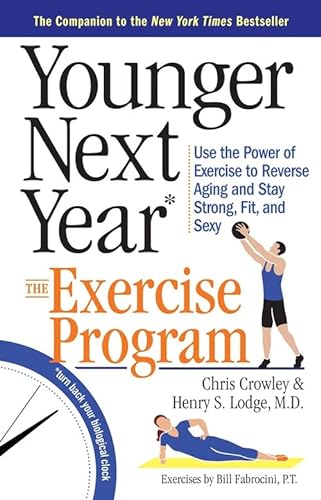
Inhaltsangabe
The definitive exercise book that the one-million-plus readers of the Younger Next Year® series have been waiting for—and the exercise book that takes the intimidation out of starting a workout routine. Based on the science that shows how we can turn back our biological clocks by a combination of aerobics and strength fitness, it’s a guide that will show every reader how to live with newfound vibrancy, strength, endurance, confidence, and joy—and it goes deep enough to be your exercise companion for life, even if you eventually take it to Masters levels.Younger Next Year: The Exercise Program combines the best information from the New York Times bestselling Younger Next Year with the cutting-edge knowledge and workouts from Thinner This Year. Here is the revolutionary 10-minute warm-up (critical for maintaining ankle, shoulder, and hip mobility). The five amazing things aerobic exercise will do for your body, and finding the method that works for you. How to get fit better and quicker with intervals. The importance of “whole-body” strength training and “rebooting the core.” Plus, the Twenty-Five Sacred Exercises that will be the foundation for your strength-training routine for life.
Die Inhaltsangabe kann sich auf eine andere Ausgabe dieses Titels beziehen.
Über die Autorin bzw. den Autor
Henry S. Lodge, MD, FACP, listed variously as “One of the Best Doctors in New York/America/the World,” headed a twenty-doctor practice in Manhattan and was the Robert Burch Family Professor of Medicine at Columbia University Medical Center.
Chris Crowley, a former litigator (Davis Polk & Wardwell), is the coauthor, with Henry S. Lodge, of the Younger Next Year books, and the coauthor, with Jen Sacheck, PhD, of Thinner This Year. Though in his eighties, he fully lives the life, skiing black diamonds and routinely doing thirty-mile bike rides. He and his wife live in Connecticut and New York City.
Von der hinteren Coverseite
A training program for the rest of your life
Science proves that we can turn back our biological clocks through exercise. This is the guide that not only shows you how to start an exercise regimen, but also provides the motivation and know-how to keep it going for life.
Just as important: Here is the guide that shows the right way to exercise. How much aerobics to do. How to calculate heart rate effectively. How hard to hit those intervals. The magic of dynamic warm-ups versus old-style stretching, and the key to pain-free joints for life. How to do crunches to preserve your back.
Plus: The 25 Sacred Exercises, the foundation for a whole-body strength-training regimen by Bill Fabrocini, P.T., illustrated and with step-by-step directions for doing each exercise correctly.
Science proves that we can turn back our biological clocks through exercise. This is the guide that not only shows you how to start an exercise regimen, but also provides the motivation and know-how to keep it going for life.
Just as important: Here is the guide that shows the right way to exercise. How much aerobics to do. How to calculate heart rate effectively. How hard to hit those intervals. The magic of dynamic warm-ups versus old-style stretching, and the key to pain-free joints for life. How to do crunches to preserve your back.
Plus: The 25 Sacred Exercises, the foundation for a whole-body strength-training regimen by Bill Fabrocini, P.T., illustrated and with step-by-step directions for doing each exercise correctly.
Auszug. © Genehmigter Nachdruck. Alle Rechte vorbehalten.
Introduction
Why another exercise book, and why this book specifically? Because your life should be better. Much better. And recent science has revolutionized our understanding of how exercise can reshape your body, your brain, and your life. We explained the why and the how of exercise in our previous Younger Next Year books, and Chris’s book, Thinner This Year.
Chris Crowley is my patient, dear friend, and partner in writing these books. More important, he is the living, breathing, exuberant voice of vibrant aging in America. Chris is out there living all of our dreams, and his whole purpose in life is to pull you into the dream with him.
In this book, we take the best information from Younger Next Year and the innovative exercise programs from Thinner This Year to give you a road map to your best life. And what a life it can be!
In the decade since we wrote the Younger books, new scientific research has only underscored our fundamental message about exercise. A serious exercise program will keep you healthier, more engaged, and living younger for the rest of your life. Physical fitness reverses most of the inflammation of modern life—heart disease, stroke, diabetes, most of arthritis—all of the things that we associate with normal American aging. You become a much better version of yourself, at any age, and you become functionally younger. Not by months, or years, but by decades. A seventy-year-old man or woman who follows our program will have the aerobic capacity of a healthy forty-five-year-old. You really can live twenty-five years younger than your driver’s license says almost all the way through your life.
And your brain will get younger, too. Newer research has shown that there are enormous cognitive benefits of exercise. The data and individual biology vary, but when you are fit, you are 10 percent more cognitively efficient than when you are sedentary. Simply put, your brain does more, and it does it better. Interestingly, sleep does the same thing. So the fit, rested version of you is about 20 percent smarter than the tired, out-of-shape you. And that’s in addition to the health and longevity benefits of exercise. That’s why we think your best life is still waiting for you. With this book in your hands and sweating.
It’s often said, and accurately, that your brain is the most complex, sophisticated object in the known universe—100 billion neurons, each with up to 10,000 connections to other neurons—dwarfing the Internet in information flow and challenging scientists to develop entirely new branches of mathematics to try to understand it. The federal government recently funded the ten-year Brain Initiative to examine the connections and cross talk among all the areas of the brain because that’s where the vast majority of brain processing takes place. This new frontier of brain science is important because our brains work by synthesizing vast amounts of data from many sources. As you read this, your brain is primarily processing the visual information of the text. But it’s also keenly aware of your emotions, physical surroundings, internal chemistry, and your body’s position in space. It’s the fusion of these disparate inputs that creates our consciousness and consciousness rests on a base of physical information.
So what do you do to turn on this most complex object in the universe? Watch TV on the sofa? Putz around online? No. Your brain grows best when it is given challenges that involve many areas at once. And there are only three great challenges that are hard enough to keep the brain healthy and growing. True emotional engagement with others, cognitive and social engagement with tasks that matter, and exercise. Motion. Moving your body through space is unbelievably complicated. We take it for granted, but even simple movement requires the entire brain to coordinate body parts. Movement is at the heart of evolution, it’s key for improving our cognitive and emotional brains.
Let’s look at how exercise transforms your brain for the long haul. One study showed a 40 percent reduction in the risk of Alzheimer’s in people who do some kind of aerobic activity regularly. Other studies, using very careful measurements of brain size on MRI scans, showed that people who exercise for three months grow new brain. And the new brain is not just in the motion areas, where you would expect it, but also in the frontal cortex, the area of the brain that controls executive function (complex thoughts, rational calculations, decision making, etc.).
Just as impressively, you change the brain chemistry of your emotions as well. It has now been shown that exercise is as effective as medication in treating both anxiety and depression. Exercise releases a powerful brain chemistry that in turn creates the energy, optimism, and mood elevation you need in order to engage with life at your best. This is important for many reasons, not least because American longevity is increasing at a stunning rate. Statistically, you are likely to live a long time. The big question in this book is how well will you live that life?
There is a lot of debate over why we are living longer. Modern medicine gets some credit. Cutting the smoking rate in half in the last fifty years has been a major contributor, but whatever is driving this increase in longevity, there is no doubt that it is happening, and in a big way. American life expectancy has been increasing by about four hours a day since the 1970s (that means that every day you live beyond age sixty-five, you add four hours to your life expectancy). Financial planners now tell healthy couples in their sixties to plan on at least one of them living to ninety-five. Even this might be conservative.
Recently I gave a talk about the future of aging, and it was an opportunity for me to pick some very smart brains at Columbia University, which is an international leader in this area. No one knows what’s going to happen, but here’s my take: For the next decade, the increase will continue at around the current rate. In ten to twenty years, we will probably figure out more effective ways to individualize medical care through genomic medicine (using your individual genetics to tailor diagnosis and treatment specifically for you and the genetics of your infection or cancer). In the twenty- to thirty-year range we might (might) be able to alter the fundamental genetics of human longevity. We can already extend the life span of worms tenfold, and add a third to the lives of mice through simple genetic manipulation, so real progress in this area is likely. How much is open to debate, as are a host of ethical and social concerns, but those have never stopped progress.
So congratulations! We got longevity, whether we wanted it or not. Now, what are we going to do with it? The problem with the new longevity is that so many Americans outlive the quality component of their lives by years, and even decades. Some of this is unavoidable, but because 70 percent of our illness and injury is lifestyle related, most of the misery and limitations of aging are self-imposed—the natural outcome of the biology of sedentary living. Some of it is because our expectations are mired in an outdated cultural model: We think aging is going to be grim, and our actions ensure that the prophecy is fulfilled.
If you ask people about growing old, they will give you the standard, gloomy answer, which is some variation of “aging is hard, full of aches, pains, and loss.” Loss of function, loss of friends, loss of purpose—all summed up by the adage “aging is not for sissies.” Not that those things aren’t real, and hard parts of aging, but they are more than offset by surprising positive...
„Über diesen Titel“ kann sich auf eine andere Ausgabe dieses Titels beziehen.
Suchergebnisse für Younger Next Year: The Exercise Program: Use the Power...

Beispielbild für diese ISBN
Younger Next Year: The Exercis
Verlag:
Workman Publishing Company, 2015
ISBN 10: 0761186123
ISBN 13: 9780761186120
Gebraucht
Softcover
Anbieter: World of Books (was SecondSale), Montgomery, IL, USA
Verkäuferbewertung 5 von 5 Sternen

Zustand: Acceptable. Item in acceptable condition! Textbooks may not include supplemental items i.e. CDs, access codes etc. Artikel-Nr. 00110861254
Gebraucht kaufen
EUR 3,66
Versand gratis
Versand innerhalb von USA
Versand innerhalb von USA
Anzahl: 1 verfügbar
Beispielbild für diese ISBN
Younger Next Year: The Exercise Program: Use the Power of Exercise to Reverse Aging and Stay Strong, Fit, and Sexy
Anbieter: World of Books (was SecondSale), Montgomery, IL, USA
Verkäuferbewertung 5 von 5 Sternen
Paperback. Zustand: Very Good. Younger Next Year Exercise Program combines the best information from Younger Next Year with the cutting-edge workouts from Thinner This Year. Here is the 10-minute warm-up (critical for maintaining ankle, shoulder, and hip mobility). The five amazing things aerobic exercise will do for your body, and finding the method that works for you. Artikel-Nr. 00109800115
Gebraucht kaufen
EUR 3,66
Versand gratis
Versand innerhalb von USA
Versand innerhalb von USA
Anzahl: 6 verfügbar
Beispielbild für diese ISBN
Younger Next Year: The Exercise Program: Use the Power of Exercise to Reverse Aging and Stay Strong, Fit, and Sexy
Anbieter: World of Books (was SecondSale), Montgomery, IL, USA
Verkäuferbewertung 5 von 5 Sternen
Paperback. Zustand: Good. Younger Next Year Exercise Program combines the best information from Younger Next Year with the cutting-edge workouts from Thinner This Year. Here is the 10-minute warm-up (critical for maintaining ankle, shoulder, and hip mobility). The five amazing things aerobic exercise will do for your body, and finding the method that works for you. Artikel-Nr. 00099961129
Gebraucht kaufen
EUR 3,66
Versand gratis
Versand innerhalb von USA
Versand innerhalb von USA
Anzahl: Mehr als 20 verfügbar
Beispielbild für diese ISBN
Younger Next Year: The Exercise Program: Use the Power of Exercise to Reverse Aging and Stay Strong, Fit, and Sexy
Verlag:
Workman Publishing Company (edition ), 2015
ISBN 10: 0761186123
ISBN 13: 9780761186120
Gebraucht
Paperback
Anbieter: BooksRun, Philadelphia, PA, USA
Verkäuferbewertung 5 von 5 Sternen
Paperback. Zustand: Fair. The item might be beaten up but readable. May contain markings or highlighting, as well as stains, bent corners, or any other major defect, but the text is not obscured in any way. Artikel-Nr. 0761186123-7-1
Gebraucht kaufen
EUR 4,39
Versand gratis
Versand innerhalb von USA
Versand innerhalb von USA
Anzahl: 1 verfügbar
Beispielbild für diese ISBN
Younger Next Year: The Exercise Program: Use the Power of Exercise to Reverse Aging and Stay Strong, Fit, and Sexy
Verlag:
Workman Publishing Company (edition ), 2015
ISBN 10: 0761186123
ISBN 13: 9780761186120
Gebraucht
Paperback
Anbieter: BooksRun, Philadelphia, PA, USA
Verkäuferbewertung 5 von 5 Sternen
Paperback. Zustand: Very Good. It's a well-cared-for item that has seen limited use. The item may show minor signs of wear. All the text is legible, with all pages included. It may have slight markings and/or highlighting. Artikel-Nr. 0761186123-11-6
Gebraucht kaufen
EUR 4,84
Versand gratis
Versand innerhalb von USA
Versand innerhalb von USA
Anzahl: 1 verfügbar
Beispielbild für diese ISBN
Younger Next Year: The Exercise Program: Use the Power of Exercise to Reverse Aging and Stay Strong, Fit, and Sexy
Anbieter: ThriftBooks-Phoenix, Phoenix, AZ, USA
Verkäuferbewertung 5 von 5 Sternen
Paperback. Zustand: Good. No Jacket. Pages can have notes/highlighting. Spine may show signs of wear. ~ ThriftBooks: Read More, Spend Less. Artikel-Nr. G0761186123I3N00
Gebraucht kaufen
EUR 5,87
Versand gratis
Versand innerhalb von USA
Versand innerhalb von USA
Anzahl: 2 verfügbar
Beispielbild für diese ISBN
Younger Next Year: The Exercise Program: Use the Power of Exercise to Reverse Aging and Stay Strong, Fit, and Sexy
Anbieter: ThriftBooks-Reno, Reno, NV, USA
Verkäuferbewertung 5 von 5 Sternen
Paperback. Zustand: Good. No Jacket. Former library book; Pages can have notes/highlighting. Spine may show signs of wear. ~ ThriftBooks: Read More, Spend Less. Artikel-Nr. G0761186123I3N10
Gebraucht kaufen
EUR 5,87
Versand gratis
Versand innerhalb von USA
Versand innerhalb von USA
Anzahl: 1 verfügbar
Beispielbild für diese ISBN
Younger Next Year: The Exercise Program: Use the Power of Exercise to Reverse Aging and Stay Strong, Fit, and Sexy
Anbieter: ThriftBooks-Dallas, Dallas, TX, USA
Verkäuferbewertung 5 von 5 Sternen
Paperback. Zustand: Good. No Jacket. Pages can have notes/highlighting. Spine may show signs of wear. ~ ThriftBooks: Read More, Spend Less. Artikel-Nr. G0761186123I3N00
Gebraucht kaufen
EUR 5,87
Versand gratis
Versand innerhalb von USA
Versand innerhalb von USA
Anzahl: 2 verfügbar
Beispielbild für diese ISBN
Younger Next Year: The Exercise Program: Use the Power of Exercise to Reverse Aging and Stay Strong, Fit, and Sexy
Anbieter: ThriftBooks-Dallas, Dallas, TX, USA
Verkäuferbewertung 5 von 5 Sternen
Paperback. Zustand: Good. No Jacket. Former library book; Pages can have notes/highlighting. Spine may show signs of wear. ~ ThriftBooks: Read More, Spend Less. Artikel-Nr. G0761186123I3N10
Gebraucht kaufen
EUR 5,87
Versand gratis
Versand innerhalb von USA
Versand innerhalb von USA
Anzahl: 1 verfügbar
Beispielbild für diese ISBN
Younger Next Year: The Exercise Program: Use the Power of Exercise to Reverse Aging and Stay Strong, Fit, and Sexy
Anbieter: ThriftBooks-Atlanta, AUSTELL, GA, USA
Verkäuferbewertung 5 von 5 Sternen
Paperback. Zustand: Good. No Jacket. Former library book; Pages can have notes/highlighting. Spine may show signs of wear. ~ ThriftBooks: Read More, Spend Less. Artikel-Nr. G0761186123I3N10
Gebraucht kaufen
EUR 5,87
Versand gratis
Versand innerhalb von USA
Versand innerhalb von USA
Anzahl: 1 verfügbar