
Verwandte Artikel zu Geek Logik: Easier Living Through Mathematics
Inhaltsangabe
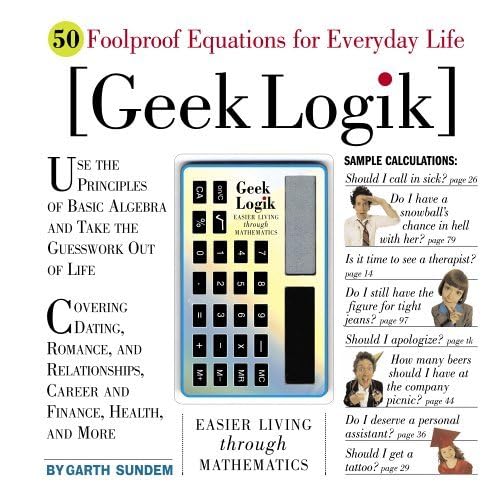
Here for the geek in all of us are fifty foolproof equations that take the guesswork out of life—and the funniest twist on an idea since Richard Smith’s The Dieter’s Guide to Weight Loss During Sex. Call it the algebra oracle: By plugging in the right variables, GEEK LOGIK answers life’s most persistent questions. It covers Dating and Romance, Career and Finance, and everyday decisions like Should I get a tattoo? Can I still wear tight jeans? Is it time to see a therapist? How many beers should I have at the company picnic?
How does it work? Take a simple issue that comes up once or twice a week: Should I call in sick? Fill in the variables honestly, such as D for doctor’s note (enter 1 for “no,” 10 for “yes,” and 5 for “yes, but it’s a forgery”), R for importance of job (1-10, with 10 being “personally responsible for Earth’s orbit around Sun”), Fj for how much fun you have at work (1-10, with 10 being “personal trainer for underwear models”), N for how much you need the money (1-10, with 10 being “I owe the mob”), then do the math, and voilà—if the product, Hooky, is greater than 1, enjoy your very own Ferris Bueller’s Day Off.
Includes a pocket calculator so that prospective geeks can immediately solve the equation on the back cover: Should I buy this book?
How does it work? Take a simple issue that comes up once or twice a week: Should I call in sick? Fill in the variables honestly, such as D for doctor’s note (enter 1 for “no,” 10 for “yes,” and 5 for “yes, but it’s a forgery”), R for importance of job (1-10, with 10 being “personally responsible for Earth’s orbit around Sun”), Fj for how much fun you have at work (1-10, with 10 being “personal trainer for underwear models”), N for how much you need the money (1-10, with 10 being “I owe the mob”), then do the math, and voilà—if the product, Hooky, is greater than 1, enjoy your very own Ferris Bueller’s Day Off.
Includes a pocket calculator so that prospective geeks can immediately solve the equation on the back cover: Should I buy this book?
Die Inhaltsangabe kann sich auf eine andere Ausgabe dieses Titels beziehen.
Von der hinteren Coverseite
For the hopelessly indecisive and brainiacs lacking basic social skills, now you can solve life’s most vexing problems through mathematics.
The opposite sex, office politics, questions about career—even wardrobe. It’s all here, plus a calculator to eliminate any margin of error.
The opposite sex, office politics, questions about career—even wardrobe. It’s all here, plus a calculator to eliminate any margin of error.
Auszug. © Genehmigter Nachdruck. Alle Rechte vorbehalten.
Let’s face it: The world is a confusing place and though your finely honed geek mind might do backflips through molecular biology, life outside a petri dish can be daunting. Wouldn’t it be great if there were clear-cut, numerical answers to life’s important questions? Such as, how many beers should I have at the company picnic? Do I have a snowball’s chance in hell with her? Should I do it myself, or call an expert? Fortunately, scientists have recently found that everything that counts can be counted—and also that most things can be counted on for a good laugh. Geek Logik enables you to take the confusing and often conflicting data in your life, plug it in to algebraic equations, and come up with simple, definite answers. And the equations actually work! Solve these problems and simplify your life.
The Geek Logik system was developed in a laboratory (okay, a dorm room) at Cornell University in 1994. The hypothesis that math might be able to decide common conundrums was first tested with a simple procrastination versus preparedness model in which six test subjects wanted to eat hot wings and play beer pong, but were aware they should quarantine themselves in the Electricity and Magnetism section of the campus library to study (Sundem, Greene, Myers, Sacks, Lam, Bentley et al.; results published 1995, Ithaca Police Blotter). But this decision wasn’t as easy as tallying the wants and shoulds and counting up each column. Certain factors were more or less important depending on their value—as subjects’ grade point averages declined near the lower limit set by their financial aid, they were exponentially more likely to go to the library; as subjects completed successive rounds of beer pong, they were exponentially less likely to study. In addition, variables such as time until next test, current level of preparedness, and likelihood of romantic attention all had to be taken into account.
Lacking basic social skills, the test geeks were confused.
However, after many weekends of research, the study found that the question of library or recreational procrastination eventually boiled down to the numbers— what are the incentives to study and what are the incentives to hang loose, and how do these factors interact? Additionally, subjects found that when they blamed the choice on algebra it was easier to shuck the guilt associated with the then-current decision model known as “thinking about it.” As a side effect, test subjects also found that inclusion in the study drastically reduced their chances of getting into medical school.
Algebra was later applied in the workplace to determine if one should admit incompetence or just fake control, based on variables such as the proficiency you have claimed to your boss, your actual proficiency, and the likelihood of nuclear winter should the task go awry (see page 66). Researchers followed two case studies in depth and found that in entry-level positions your bravado is unlikely to mask your blunders (because dropping the sizzling fajita tray on the local food critic is hard to overlook), while higher up the corporate ladder, nobody really knows what is going on anyway, and the big bluff is exactly the needed skill. However, the choice to fake control can’t just be paired with your rung on the corporate ladder. For example, the repercussions of being discovered made test subjects less likely to bluff in more distinguished positions (because who really cares if you lose your job waiting tables at La Hacienda Muchas Cucarachas, but getting caught taking poetic license with judicial precedent might land you right back waiting tables). Again geeks were initially overwhelmed by the seemingly impossible maze of confusing social norms, but were relieved when they found they could accurately model the decision using basic algebra.
However, like DuPont researchers striving to find the next Gore-Tex and serendipitously stumbling onto the goop that makes fart-cans possible, it wasn’t until math was applied to the realm of relationships and romance, in 2001, that geeks found the most useful application of the technology. Researchers closely followed the relationship of one test geek as he blundered through interactions with his new girlfriend, who happened to be a rock-climbing Aries ex-cheerleader (yes, the geek was in trouble). Initially, the test geek was baffled and saw little connection between his actions and flying kitchenware, but soon he started to notice patterns—honest fashion evaluations (“Does this make me look fat?”) and buying used birthday gifts on eBay elicited flying saucers, while flowers and certain types of poetry reduced their occurrence.
The test geek found he was able to quantify his behaviors and their corresponding responses, transforming the confusing and illogical actions of the opposite sex into a string of definable numbers.
For example, in laboratory testing (okay, a singles bar) researchers found that when ogling an attractive stranger over the thick rims of their taped glasses, they were able to compute their chances using only a bar napkin, Bic pen, and pocket calculator, thus reducing potentially embarrassing human interaction. (Though as Heisenberg described in his study of electron configurations, introducing tools to measure a situation can alter the situation itself—geeks found that whipping out the pocket calculator negatively affected their chances of getting a date.)
As practice caught up with theory, test geeks were able to pass themselves off as normal members of society, evaluating expected responses and then performing at or close to societal norms in situations such as meeting potential in-laws, choosing whether or not to go on a date, and deciding if it was finally time to cut romantic losses and become a monk (or another cloistered being, like a particle physicist).
Geek Logik, for the first time in one place, compiles the findings of this extensive research. (After therapy, human subjects were reintroduced to the wild; the author’s dog was in no way harmed in the course of testing.)
Fortunately, you don’t have to be Stephen Hawking, Carl Sagan, or Albert Einstein to simplify your life using this book. While the equations look a bit complex on the page, once you replace the letters with numbers, algebra becomes arithmetic. And most of the arithmetic is pretty easy. Even the latent geek (who beneath that hip cosmopolitan exterior craves the morning crossword, Jeopardy!, and thinks the IRS is just misunderstood) will easily be able to find the answers to all of life’s important questions. If you need help, check the short refresher chapter “Remember Algebra?” immediately following this introduction.
However, if you like to ponder Zeno’s Paradox as you drift off to sleep at night, you will find levels to these equations deeper than simply feeding in numbers and ending with a decision. The variables in our lives are complex and, like your prescription antipsychotics, interact with one another in intricate and exciting ways— one variable might have a very different effect depending on what else is going on in the equation. Thus, built into each question are myriad points of commonsense “logic” that the true geek can ferret out like a Revenge of the Nerds Easter egg hunt. In the case of a fight with your girlfriend, for instance, the more seriously she takes a mistake, the more likely the equation will advise you to apologize—if you are at fault. However, if it’s not your fault, the bigger the deal she perceives the mistake to be, the less likely you will be to apologize (because confessing to a big mistake you didn’t...
The Geek Logik system was developed in a laboratory (okay, a dorm room) at Cornell University in 1994. The hypothesis that math might be able to decide common conundrums was first tested with a simple procrastination versus preparedness model in which six test subjects wanted to eat hot wings and play beer pong, but were aware they should quarantine themselves in the Electricity and Magnetism section of the campus library to study (Sundem, Greene, Myers, Sacks, Lam, Bentley et al.; results published 1995, Ithaca Police Blotter). But this decision wasn’t as easy as tallying the wants and shoulds and counting up each column. Certain factors were more or less important depending on their value—as subjects’ grade point averages declined near the lower limit set by their financial aid, they were exponentially more likely to go to the library; as subjects completed successive rounds of beer pong, they were exponentially less likely to study. In addition, variables such as time until next test, current level of preparedness, and likelihood of romantic attention all had to be taken into account.
Lacking basic social skills, the test geeks were confused.
However, after many weekends of research, the study found that the question of library or recreational procrastination eventually boiled down to the numbers— what are the incentives to study and what are the incentives to hang loose, and how do these factors interact? Additionally, subjects found that when they blamed the choice on algebra it was easier to shuck the guilt associated with the then-current decision model known as “thinking about it.” As a side effect, test subjects also found that inclusion in the study drastically reduced their chances of getting into medical school.
Algebra was later applied in the workplace to determine if one should admit incompetence or just fake control, based on variables such as the proficiency you have claimed to your boss, your actual proficiency, and the likelihood of nuclear winter should the task go awry (see page 66). Researchers followed two case studies in depth and found that in entry-level positions your bravado is unlikely to mask your blunders (because dropping the sizzling fajita tray on the local food critic is hard to overlook), while higher up the corporate ladder, nobody really knows what is going on anyway, and the big bluff is exactly the needed skill. However, the choice to fake control can’t just be paired with your rung on the corporate ladder. For example, the repercussions of being discovered made test subjects less likely to bluff in more distinguished positions (because who really cares if you lose your job waiting tables at La Hacienda Muchas Cucarachas, but getting caught taking poetic license with judicial precedent might land you right back waiting tables). Again geeks were initially overwhelmed by the seemingly impossible maze of confusing social norms, but were relieved when they found they could accurately model the decision using basic algebra.
However, like DuPont researchers striving to find the next Gore-Tex and serendipitously stumbling onto the goop that makes fart-cans possible, it wasn’t until math was applied to the realm of relationships and romance, in 2001, that geeks found the most useful application of the technology. Researchers closely followed the relationship of one test geek as he blundered through interactions with his new girlfriend, who happened to be a rock-climbing Aries ex-cheerleader (yes, the geek was in trouble). Initially, the test geek was baffled and saw little connection between his actions and flying kitchenware, but soon he started to notice patterns—honest fashion evaluations (“Does this make me look fat?”) and buying used birthday gifts on eBay elicited flying saucers, while flowers and certain types of poetry reduced their occurrence.
The test geek found he was able to quantify his behaviors and their corresponding responses, transforming the confusing and illogical actions of the opposite sex into a string of definable numbers.
For example, in laboratory testing (okay, a singles bar) researchers found that when ogling an attractive stranger over the thick rims of their taped glasses, they were able to compute their chances using only a bar napkin, Bic pen, and pocket calculator, thus reducing potentially embarrassing human interaction. (Though as Heisenberg described in his study of electron configurations, introducing tools to measure a situation can alter the situation itself—geeks found that whipping out the pocket calculator negatively affected their chances of getting a date.)
As practice caught up with theory, test geeks were able to pass themselves off as normal members of society, evaluating expected responses and then performing at or close to societal norms in situations such as meeting potential in-laws, choosing whether or not to go on a date, and deciding if it was finally time to cut romantic losses and become a monk (or another cloistered being, like a particle physicist).
Geek Logik, for the first time in one place, compiles the findings of this extensive research. (After therapy, human subjects were reintroduced to the wild; the author’s dog was in no way harmed in the course of testing.)
Fortunately, you don’t have to be Stephen Hawking, Carl Sagan, or Albert Einstein to simplify your life using this book. While the equations look a bit complex on the page, once you replace the letters with numbers, algebra becomes arithmetic. And most of the arithmetic is pretty easy. Even the latent geek (who beneath that hip cosmopolitan exterior craves the morning crossword, Jeopardy!, and thinks the IRS is just misunderstood) will easily be able to find the answers to all of life’s important questions. If you need help, check the short refresher chapter “Remember Algebra?” immediately following this introduction.
However, if you like to ponder Zeno’s Paradox as you drift off to sleep at night, you will find levels to these equations deeper than simply feeding in numbers and ending with a decision. The variables in our lives are complex and, like your prescription antipsychotics, interact with one another in intricate and exciting ways— one variable might have a very different effect depending on what else is going on in the equation. Thus, built into each question are myriad points of commonsense “logic” that the true geek can ferret out like a Revenge of the Nerds Easter egg hunt. In the case of a fight with your girlfriend, for instance, the more seriously she takes a mistake, the more likely the equation will advise you to apologize—if you are at fault. However, if it’s not your fault, the bigger the deal she perceives the mistake to be, the less likely you will be to apologize (because confessing to a big mistake you didn’t...
„Über diesen Titel“ kann sich auf eine andere Ausgabe dieses Titels beziehen.
Suchergebnisse für Geek Logik: Easier Living Through Mathematics

Beispielbild für diese ISBN
Geek Logik
Anbieter: World of Books (was SecondSale), Montgomery, IL, USA
Verkäuferbewertung 5 von 5 Sternen

Hardback. Zustand: Good. Not sure whose turn it is to take out the rubbish? Don't fight about it; just plug in the variables and see. How much should you spend on your wife's birthday present? Should you play hooky today? This title contains 50 essential equations, a remedial algebra primer, and a calculator. Artikel-Nr. 00039734635
Gebraucht kaufen
EUR 3,85
Versand gratis
Versand innerhalb von USA
Versand innerhalb von USA
Anzahl: 5 verfügbar
Beispielbild für diese ISBN
Geek Logik: 50 Foolproof Equations for Everyday Life
Verlag:
Workman Publishing Company (edition Nov), 2006
ISBN 10: 0761140212
ISBN 13: 9780761140214
Gebraucht
Hardcover
Anbieter: BooksRun, Philadelphia, PA, USA
Verkäuferbewertung 5 von 5 Sternen
Hardcover. Zustand: Very Good. Nov. With dust jacket. It's a well-cared-for item that has seen limited use. The item may show minor signs of wear. All the text is legible, with all pages included. It may have slight markings and/or highlighting. Artikel-Nr. 0761140212-11-6-29
Gebraucht kaufen
EUR 5,34
Versand gratis
Versand innerhalb von USA
Versand innerhalb von USA
Anzahl: 1 verfügbar
Beispielbild für diese ISBN
Geek Logik: 50 Foolproof Equations for Everyday Life
Verlag:
Workman Publishing Company, 2006
ISBN 10: 0761140212
ISBN 13: 9780761140214
Gebraucht
Hardcover
Anbieter: ThriftBooks-Dallas, Dallas, TX, USA
Verkäuferbewertung 5 von 5 Sternen
Hardcover. Zustand: Fair. No Jacket. Readable copy. Pages may have considerable notes/highlighting. ~ ThriftBooks: Read More, Spend Less. Artikel-Nr. G0761140212I5N00
Gebraucht kaufen
EUR 5,95
Versand gratis
Versand innerhalb von USA
Versand innerhalb von USA
Anzahl: 1 verfügbar
Beispielbild für diese ISBN
Geek Logik: 50 Foolproof Equations for Everyday Life
Verlag:
Workman Publishing Company, 2006
ISBN 10: 0761140212
ISBN 13: 9780761140214
Gebraucht
Hardcover
Anbieter: ThriftBooks-Phoenix, Phoenix, AZ, USA
Verkäuferbewertung 5 von 5 Sternen
Hardcover. Zustand: Very Good. No Jacket. May have limited writing in cover pages. Pages are unmarked. ~ ThriftBooks: Read More, Spend Less. Artikel-Nr. G0761140212I4N00
Gebraucht kaufen
EUR 5,95
Versand gratis
Versand innerhalb von USA
Versand innerhalb von USA
Anzahl: 1 verfügbar
Beispielbild für diese ISBN
Geek Logik: 50 Foolproof Equations for Everyday Life
Verlag:
Workman Publishing Company, 2006
ISBN 10: 0761140212
ISBN 13: 9780761140214
Gebraucht
Hardcover
Anbieter: ThriftBooks-Atlanta, AUSTELL, GA, USA
Verkäuferbewertung 5 von 5 Sternen
Hardcover. Zustand: Very Good. No Jacket. May have limited writing in cover pages. Pages are unmarked. ~ ThriftBooks: Read More, Spend Less. Artikel-Nr. G0761140212I4N00
Gebraucht kaufen
EUR 5,95
Versand gratis
Versand innerhalb von USA
Versand innerhalb von USA
Anzahl: 1 verfügbar
Beispielbild für diese ISBN
Geek Logik: 50 Foolproof Equations for Everyday Life
Verlag:
Workman Publishing Company, 2006
ISBN 10: 0761140212
ISBN 13: 9780761140214
Gebraucht
Hardcover
Anbieter: ThriftBooks-Dallas, Dallas, TX, USA
Verkäuferbewertung 5 von 5 Sternen
Hardcover. Zustand: Very Good. No Jacket. May have limited writing in cover pages. Pages are unmarked. ~ ThriftBooks: Read More, Spend Less. Artikel-Nr. G0761140212I4N00
Gebraucht kaufen
EUR 5,95
Versand gratis
Versand innerhalb von USA
Versand innerhalb von USA
Anzahl: 1 verfügbar
Beispielbild für diese ISBN
Geek Logik : 50 Foolproof Equations for Everyday Life
Verlag:
Workman Publishing Company, Incorporated, 2006
ISBN 10: 0761140212
ISBN 13: 9780761140214
Gebraucht
Hardcover
Anbieter: Better World Books, Mishawaka, IN, USA
Verkäuferbewertung 5 von 5 Sternen
Zustand: Good. Pages intact with minimal writing/highlighting. The binding may be loose and creased. Dust jackets/supplements are not included. Stock photo provided. Product includes identifying sticker. Better World Books: Buy Books. Do Good. Artikel-Nr. GRP76408306
Gebraucht kaufen
EUR 6,17
Versand gratis
Versand innerhalb von USA
Versand innerhalb von USA
Anzahl: 1 verfügbar
Beispielbild für diese ISBN
Geek Logik : 50 Foolproof Equations for Everyday Life
Verlag:
Workman Publishing Company, Incorporated, 2006
ISBN 10: 0761140212
ISBN 13: 9780761140214
Gebraucht
Hardcover
Anbieter: Better World Books, Mishawaka, IN, USA
Verkäuferbewertung 5 von 5 Sternen
Zustand: Very Good. Pages intact with possible writing/highlighting. Binding strong with minor wear. Dust jackets/supplements may not be included. Stock photo provided. Product includes identifying sticker. Better World Books: Buy Books. Do Good. Artikel-Nr. GRP69377238
Gebraucht kaufen
EUR 6,17
Versand gratis
Versand innerhalb von USA
Versand innerhalb von USA
Anzahl: 1 verfügbar
Beispielbild für diese ISBN
Geek Logik: 50 Foolproof Equations for Everyday Life
Verlag:
Workman Publishing Company, 2006
ISBN 10: 0761140212
ISBN 13: 9780761140214
Gebraucht
Hardcover
Anbieter: Wonder Book, Frederick, MD, USA
Verkäuferbewertung 5 von 5 Sternen
Zustand: As New. Like New condition. Kit complete. A near perfect copy that may have very minor cosmetic defects. Artikel-Nr. L07C-02275
Gebraucht kaufen
EUR 6,41
Versand gratis
Versand innerhalb von USA
Versand innerhalb von USA
Anzahl: 1 verfügbar
Beispielbild für diese ISBN
Geek Logik: 50 Foolproof Equations for Everyday Life
Verlag:
Workman Publishing Company, 2006
ISBN 10: 0761140212
ISBN 13: 9780761140214
Gebraucht
Hardcover
Anbieter: WorldofBooks, Goring-By-Sea, WS, Vereinigtes Königreich
Verkäuferbewertung 5 von 5 Sternen
Hardback. Zustand: Very Good. The book has been read, but is in excellent condition. Pages are intact and not marred by notes or highlighting. The spine remains undamaged. Artikel-Nr. GOR001654640
Gebraucht kaufen
EUR 3,43
EUR 6,67 Versand
Versand von Vereinigtes Königreich nach USA
Versand von Vereinigtes Königreich nach USA
Anzahl: 2 verfügbar