
Verwandte Artikel zu The Conquest of Gaul (The Barnes & Noble Library...
Inhaltsangabe
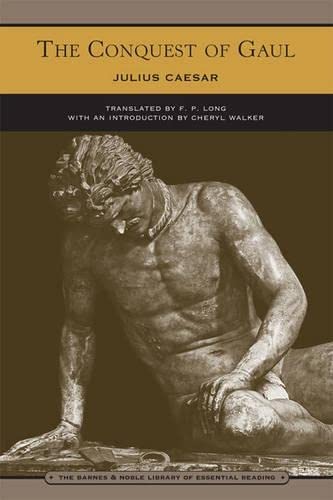
Among the most durable and engaging texts in world literature, Julius CaesarsConquest of Gaul tells how he and his legions conquered much of modern France in less than a decade (58-51 BCE), despite determined resistance. Perhaps the most famous Roman ever, Gaius Julius Caesar created a legacy which has resonated, for good or ill, throughout Western culture. Architect of an imperial system, eponymous sponsor of a reformed calendar system, orator second only to Cicero, conqueror of Gaul: Surely those accomplishments in the diverse fields of politics, applied mathematics, rhetoric, and military science would justify his eminence. Nevertheless, the high literary quality and historical value of this seemingly modest account match its exciting story of diplomatic maneuverings, shifting alliances, and military actions; the final chapters culminate in the revolt of the united Gallic tribes under Vercingetorix, Frances first national hero, and are as compelling as any contemporary spy thriller.
Die Inhaltsangabe kann sich auf eine andere Ausgabe dieses Titels beziehen.
Über die Autorin bzw. den Autor
Julius Caesar
Auszug. © Genehmigter Nachdruck. Alle Rechte vorbehalten.
Introduction
Among the most durable and engaging texts in world literature, Julius Caesar’s Conquest of Gaul tells how he and his legions conquered much of modern France in less than a decade (58-51 BCE), despite determined resistance. Perhaps the most famous Roman ever, Gaius Julius Caesar created a legacy which has resonated, for good or ill, throughout Western culture. Architect of an imperial system, eponymous sponsor of a reformed calendar system, orator second only to Cicero, conqueror of Gaul: Surely those accomplishments in the diverse fields of politics, applied mathematics, rhetoric, and military science would justify his eminence. Nevertheless, the high literary quality and historical value of this seemingly modest account match its exciting story of diplomatic maneuverings, shifting alliances, and military actions; the final chapters culminate in the revolt of the united Gallic tribes under Vercingetorix, France’s first national hero, and are as compelling as any contemporary spy thriller.
Until his assumption of command in the Cisalpine and Transalpine provinces in 58 BCE, Julius Caesar’s life and career had given few indications of the extraordinary man who, at his death in 44 BCE, ruled the Roman Empire and was shortly thereafter elevated to divine status. Born in 100 BCE to a distinguished, although not politically prominent, patrician family, Caesar associated himself from his teens with the great general Marius, the husband of his aunt Julia and the head of a faction (the so-called populares) which struggled against the conservative senators (the so-called Optimates) for control of the Roman State during the 80s BCE. Although the young Caesar flaunted his connections on at least two occasions, the public eulogy he delivered for Julia and his refusal to divorce the daughter of the Marian consul Cornelius Cinna at the request of the dictator Sulla, he survived the proscriptions and assassinations of this brutal era and seems to have enjoyed the standard aristocratic upbringing and early career path of the times: study, travel, riotous living, and scandalous sexual escapades. When in 63 BCE he decided to stand for the office of pontifex maximus, the elective priesthood which was typically awarded as the capstone for the most distinguished senior politician, he did so in the face of strong opposition from other candidates, especially in light of the fact that he had not even held the praetorship, much less the consulship, which was normally a political minimum. On the day of the election, after masterful political scheming and massive bribery, he kissed his mother before setting out and said, “Today, Mother, you will see your son either as high priest or as an exile.” This neck-or-nothing attitude typified Caesar’s political behavior for most of his career; he gambled on himself and his policies for high stakes, and his planning and organizational ability shortened the odds to favor him.
During his praetorship (62 BCE) and consulship (59 BCE) Caesar espoused positions and causes which excited great passion, and his methods alienated the Optimates even more than did his cooperation with Pompey and Crassus (the First Triumvirate). As compensation for his work in establishing Pompey’s settlement in the East and in relieving Crassus’ friends, the tax farmers of Asia, of their legal obligations, Caesar became governor of Cisalpine and Transalpine Gaul for five years (58-53 BCE). From this not uncommon circumstance, Julius Caesar would generate the military forces and political clout which made him, first, a conqueror of the territory from Northern Italy to the far side of the English Channel, then a contender for world dominion in 49 BCE.
Conquest of Gaul is a year-by-year account of this significant period, outlining each year’s military campaigns as if from a slightly detached, albeit Roman, point of view; “Caesar” is the third-person general, the Romans are “our men,” and there is no clear statement of the authorial identity or purpose. Unlike post-retirement memoirs, evidently written up and published directly after the military campaigning season, in between his other responsibilities as provincial judge and governor and as Roman politician and statesman in absentia, each book appears as a largely self-contained unit, dealing with the particular events and characters as they arise. Thus there is no overarching analysis of the whole, no “grand scheme of conquest”: instead, each set of events triggers new factors, draws in new tribes and personnel, redirects and reshapes what seems to be the Roman reaction to foreign policies. From the rather unprepossessing start of the conquest in Caesar’s refusal to allow the Helvetii free passage through the Roman province or through allied territory, we can chart how the Roman presence alters the local balance of power, opens up new possibilities in alliance and confrontation, and inevitably leads to the next boundary skirmish, until only the ocean and the difficulty of logistical support stop his advance in Britain. The revolt of Vercingetorix showcases the fortifications at Alesia, one of the most detailed descriptions of siege warfare and its skirmishing to survive antiquity (7.68-84); the subsequent battle and negotiations provide insight into specific protocols. Although each decision is presented as if according to its particular merits, and nowhere does the phrase “divide and conquer” occur, the continuous advance of Roman interests cannot be denied. Along the way we are treated to descriptions of military valor and cowardice, military ruses and routines, the daily activities of reconnaissance, gathering supplies, and coping with weather and topographical obstacles. At this level of detail it is difficult to deny the plausible historicity of the text; to lie or exaggerate such matters, which are of common knowledge to thousands of participants, particularly when many are in correspondence with friends in the capital, seems pointless.
Like its companion The Civil Wars, Caesar’s Conquest of Gaul belongs technically to the genre of commentarii, a classification here containing elements of autobiography and memoirs, history, journalism, political pamphleteering, even occasional notes on natural history and geography. Yet this brilliant work by a major character on a pivotal event in Western history remains difficult to assess in terms of either authorial agenda or target audience. Without other surviving prototypes of the genre or information of the Gallic campaigns, we are greatly hampered in judging Caesar’s literary originality and accuracy, and his seemingly transparent style allows him to slip unobtrusively away from the reader.
Our scholarly suspicion and skepticism mostly focus on the selection of background material, description of motives, and arrangement. Reflexively and on principle, we cannot imagine that any author/participant, no matter how honest or conscientious, can describe events in a fashion untouched by the “personal baggage” of his own background, position, beliefs, and understanding; even historians who strive for such objectivity usually discover that cultural and linguistic assumptions wreak additional havoc. Caesar seems not to have ascribed to such lofty standards, and he had the added temptation of presenting himself to the Roman reading public in this stark narrative in a peculiarly restricted guise, one which spotlighted his military acumen and his decisive leadership. Yet, despite our skepticism, the lack of evidence precludes us from proving that Caesar in fact lied or distorted consciously what he knew to be true; the numerous examples of Gallic bravery...
„Über diesen Titel“ kann sich auf eine andere Ausgabe dieses Titels beziehen.
Suchergebnisse für The Conquest of Gaul (The Barnes & Noble Library...

Beispielbild für diese ISBN
The Conquest of Gaul (Barnes & Noble Library of Essential Reading)
Verlag:
Barnes & Noble (edition Customer-Specific), 2005
ISBN 10: 0760768951
ISBN 13: 9780760768952
Gebraucht
Paperback
Anbieter: BooksRun, Philadelphia, PA, USA
Verkäuferbewertung 5 von 5 Sternen

Paperback. Zustand: Very Good. Customer-Specific. It's a well-cared-for item that has seen limited use. The item may show minor signs of wear. All the text is legible, with all pages included. It may have slight markings and/or highlighting. Artikel-Nr. 0760768951-11-1
Gebraucht kaufen
EUR 4,33
Versand gratis
Versand innerhalb von USA
Versand innerhalb von USA
Anzahl: 1 verfügbar
Beispielbild für diese ISBN
The Conquest of Gaul (Barnes & Noble Library of Essential Reading)
Anbieter: World of Books (was SecondSale), Montgomery, IL, USA
Verkäuferbewertung 5 von 5 Sternen
Zustand: Very Good. Item in very good condition! Textbooks may not include supplemental items i.e. CDs, access codes etc. Artikel-Nr. 00108881171
Gebraucht kaufen
EUR 4,56
Versand gratis
Versand innerhalb von USA
Versand innerhalb von USA
Anzahl: 1 verfügbar
Beispielbild für diese ISBN
The Conquest of Gaul (Barnes & Noble Library of Essential Reading)
Anbieter: World of Books (was SecondSale), Montgomery, IL, USA
Verkäuferbewertung 5 von 5 Sternen
Zustand: Good. Item in good condition. Textbooks may not include supplemental items i.e. CDs, access codes etc. Artikel-Nr. 00107038278
Gebraucht kaufen
EUR 4,56
Versand gratis
Versand innerhalb von USA
Versand innerhalb von USA
Anzahl: 1 verfügbar
Beispielbild für diese ISBN
The Conquest of Gaul (Barnes & Noble Library of Essential Reading)
Anbieter: ThriftBooks-Dallas, Dallas, TX, USA
Verkäuferbewertung 5 von 5 Sternen
Paperback. Zustand: Very Good. No Jacket. May have limited writing in cover pages. Pages are unmarked. ~ ThriftBooks: Read More, Spend Less. Artikel-Nr. G0760768951I4N00
Gebraucht kaufen
EUR 5,76
Versand gratis
Versand innerhalb von USA
Versand innerhalb von USA
Anzahl: 1 verfügbar
Beispielbild für diese ISBN
The Conquest of Gaul (Barnes & Noble Library of Essential Reading)
Anbieter: ThriftBooks-Dallas, Dallas, TX, USA
Verkäuferbewertung 5 von 5 Sternen
Paperback. Zustand: Very Good. No Jacket. Former library book; May have limited writing in cover pages. Pages are unmarked. ~ ThriftBooks: Read More, Spend Less. Artikel-Nr. G0760768951I4N10
Gebraucht kaufen
EUR 5,76
Versand gratis
Versand innerhalb von USA
Versand innerhalb von USA
Anzahl: 1 verfügbar
Beispielbild für diese ISBN
The Conquest of Gaul (Barnes & Noble Library of Essential Reading)
Anbieter: ThriftBooks-Atlanta, AUSTELL, GA, USA
Verkäuferbewertung 5 von 5 Sternen
Paperback. Zustand: As New. No Jacket. Pages are clean and are not marred by notes or folds of any kind. ~ ThriftBooks: Read More, Spend Less. Artikel-Nr. G0760768951I2N00
Gebraucht kaufen
EUR 5,82
Versand gratis
Versand innerhalb von USA
Versand innerhalb von USA
Anzahl: 1 verfügbar
Beispielbild für diese ISBN
The Conquest of Gaul (Barnes & Noble Library of Essential Reading)
Anbieter: ThriftBooks-Dallas, Dallas, TX, USA
Verkäuferbewertung 5 von 5 Sternen
Paperback. Zustand: Good. No Jacket. Pages can have notes/highlighting. Spine may show signs of wear. ~ ThriftBooks: Read More, Spend Less. Artikel-Nr. G0760768951I3N00
Gebraucht kaufen
EUR 5,82
Versand gratis
Versand innerhalb von USA
Versand innerhalb von USA
Anzahl: 1 verfügbar
Beispielbild für diese ISBN
The Conquest of Gaul (Barnes & Noble Library of Essential Reading)
Anbieter: ThriftBooks-Atlanta, AUSTELL, GA, USA
Verkäuferbewertung 5 von 5 Sternen
Paperback. Zustand: Very Good. No Jacket. May have limited writing in cover pages. Pages are unmarked. ~ ThriftBooks: Read More, Spend Less. Artikel-Nr. G0760768951I4N00
Gebraucht kaufen
EUR 5,82
Versand gratis
Versand innerhalb von USA
Versand innerhalb von USA
Anzahl: 1 verfügbar
Beispielbild für diese ISBN
The Conquest of Gaul (Barnes & Noble Library of Essential Reading)
Anbieter: Wonder Book, Frederick, MD, USA
Verkäuferbewertung 5 von 5 Sternen
Zustand: Very Good. Very Good condition. A copy that may have a few cosmetic defects. May also contain light spine creasing or a few markings such as an owner's name, short gifter's inscription or light stamp. Artikel-Nr. E07I-00335
Gebraucht kaufen
EUR 6,21
Versand gratis
Versand innerhalb von USA
Versand innerhalb von USA
Anzahl: 2 verfügbar
Beispielbild für diese ISBN
The Conquest of Gaul
Verlag:
Barnes & Noble, Incorporated, 2014
ISBN 10: 0760768951
ISBN 13: 9780760768952
Gebraucht
Softcover
Anbieter: Better World Books, Mishawaka, IN, USA
Verkäuferbewertung 5 von 5 Sternen
Zustand: Good. Pages intact with minimal writing/highlighting. The binding may be loose and creased. Dust jackets/supplements are not included. Stock photo provided. Product includes identifying sticker. Better World Books: Buy Books. Do Good. Artikel-Nr. 6075891-6
Gebraucht kaufen
EUR 6,35
Versand gratis
Versand innerhalb von USA
Versand innerhalb von USA
Anzahl: 2 verfügbar