
Verwandte Artikel zu The Civil War (The Barnes & Noble Library of Essential...
Inhaltsangabe
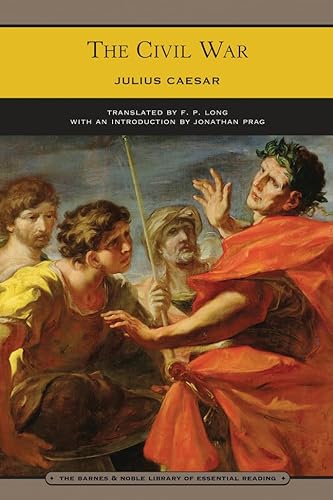
The Civil War is Julius Caesars personal account of his war with Pompey the Great-the war which destroyed the five hundred-year old Roman Republic. Caesar the victor became Caesar the dictator. In three short books, Caesar describes how, in order to defend his dignitas ("honour"), and the libertas ("freedom") of both himself and the Roman people, he marched on Rome, and defeated the forces of Pompey and the Senate in Italy, Spain, and Greece. Caesars "commentaries," written in famously simple prose, with the distinctive use of the third person, offer a unique opportunity to read the victors version of events.
Die Inhaltsangabe kann sich auf eine andere Ausgabe dieses Titels beziehen.
Über die Autorin bzw. den Autor
Gaius Julius Caesar was born on 13 July 100 BC. His family, the Julii, claimed descent from the ancient kings of Rome, and from the goddess Venus. Caesar rapidly carved out an impressive political career, forging an alliance with Pompey and Crassus in 60 BC. The Civil War is Caesars attempt at an explanation of the war that changed the Roman world.
Auszug. © Genehmigter Nachdruck. Alle Rechte vorbehalten.
Introduction
The Civil War is Julius Caesar’s personal account of his war with Pompey the Great—the war which destroyed the five hundred-year old Roman Republic. Caesar the victor became Caesar the dictator, who was assassinated by Brutus on the Ides of March, 44 BC. From the ruin of the Republic arose Caesar’s adopted son, Octavian, later Augustus, the first Roman Emperor. The crossing of the Rubicon by Caesar, in January 49 BC, is, quite simply, one of the most symbolic moments in world history. In three short books, Caesar describes how, in order to defend his dignitas (‘honour’), and the libertas (‘freedom’) of both himself and the Roman people, he marched on Rome, and defeated the forces of Pompey and the Senate in Italy, Spain, and Greece. Caesar’s ‘commentaries’, written in famously simple prose, with the distinctive use of the third person, offer a unique opportunity to read the victor’s version of events, written by one of the greatest figures in world history, the first ‘Caesar’.
Caius Julius Caesar was born on 13 July 100 BC. His family, the Julii, claimed descent from the ancient kings of Rome, and from the goddess Venus (through her son Aeneas). Caesar was the nephew of the general Caius Marius, and in his youth he witnessed the rise of the military warlords of the last years of the Roman Republic, Marius, Sulla, Crassus, and Pompey. He rapidly carved out an impressive political career of his own, forging an alliance with Pompey and Crassus in 60 BC. This won for him a military command in Gaul (southern France), and in ten years of spectacular campaigns he extended Roman rule to the Rhine and the Atlantic—and mounted the first Roman invasion of Britain. But competition for honours with his contemporary Pompey the Great, and the political manoeuvres of other fellow senators, placed Caesar in what he saw as an untenable position. At the start of 49 BC, faced with the choice between political extinction and civil war, Caesar gambled on war and led a single legion of his Gallic veterans across the River Rubicon (which marked the northern boundary of ‘Italy’). The die was cast. The tradition that has built up around Caesar is immense and ambiguous. The reader will not find Caesar’s famous quote in his writings—”I came, I saw, I conquered,” after Zela, in Cilicia, in 47 BC. Although seemingly unfinished and unpublished at his death, the Civil War is instead his own attempt at an explanation of the war that changed the Roman world, a version summed up by the words placed in his mouth by one ancient biographer, Suetonius,: hoc voluerunt, ‘they asked for it!’
For all its apparent simplicity, the Civil War is not an easy work to understand, nor is Caesar an easy man to assess. The death of the regent of Egypt in late 48 BC, and not the death of Pompey (28 September 48 BC), marks the end of book three, and this is not an obvious point of closure. The Civil Wars, for Caesar, dragged on until the Battle of Munda in Spain in 45 BC. The account, as we have it, seems to have been published after Caesar’s death, in 44 BC, by one of his officers, Aulus Hirtius, or so Hirtius himself tells us in the eighth and final book of Caesar’s earlier commentaries on his Gallic Wars (covering 58-50 BC). Hirtius completed Caesars Gallic Wars by writing book eight (52-50 BC), published Caesar’s three books on the Civil War (49-48 BC), and then either he or another wrote the surviving commentaries on the Egyptian, African, and Spanish phases of the Civil Wars (48-45 BC). It is commonly accepted today that Caesar therefore wrote what we have as the Civil War no later than the winter of 48-47 BC, when he was held up in Alexandria (with Cleopatra); but that the events which followed, both in Egypt and Rome, culminating in his adoption of the position of Dictator for Life, rendered publication pointless in his eyes. In other words, his claims (especially at I.7 and 22) to be defending both his dignitas and the freedom of himself and others from the oppression of a factio paucorum (‘the faction of a few’) rang increasingly hollow in his own ears as much as those of others, the more distant became the likelihood of a return to Republican normality.
Such a view requires brief consideration of the genre in which Caesar was writing and his reasons for writing. But to consider these things in turn demands that we examine the context for the Civil War itself. Throughout, the opinions of both contemporaries and later writers overshadow what can be said. When studying the ancient world, the evidence is always less than we would wish; it is particularly rich, comparatively speaking, for this moment in time, but nonetheless, it is highly partial. We have letters to and from the contemporary orator and statesman Marcus Tullius Cicero, who struggled in vain to compose the strife; we have the writings of, and attributed to, the contemporary historian Sallust; we have the anti-Caesarian verse account of the Civil War by the Neronian poet Lucan (also known as the Pharsalia); we have the biographies of Caesar written by Plutarch and Suetonius, c.150 years after his death; and we have the historical accounts of Appian’s Civil Wars and Cassius Dio’s Roman History, written in the second and third centuries AD respectively. On the other hand, we do not have the contemporary history of Asinius Pollio, though it clearly underlies much of what does survive in other writers.
The writing of commentaries on campaigns was by no means a novel practice. It belonged to an age in which the writing of history, understood as the history of men, politics, and action, was commonplace, and had been ever since Thucydides had set forth his version of the Peloponnesian War between Athens and Sparta, in which he had fought. However, commentaries in general were intended as notes for a proper literary history, not as a finished product by themselves. Caesar had already broken the mould with his Gallic Wars, of which Cicero wrote, in 46 BC:
They are like nude figures, straight and beautiful; stripped of all ornament of style as if they had laid aside a garment. His aim was to furnish others with material for writing history, and perhaps he has succeeded in gratifying the inept, who may wish to apply their curling irons to his material; but men of sound judgement he has deterred from writing, since in history there is nothing more pleasing than brevity, clear and correct.
We know that Caesar sent back reports to the Senate and People of Rome on a regular basis. The Gallic War is however something grander, even if still written up a year at a time, in the leisure of the winters between campaigns. These books belong in a culture in which the gloria won through military achievements was all-important, and its emphasis all the more necessary during a prolonged absence from Rome. We must assume the same thing for the Civil War. A shift in style has been suggested between the first two books, covering the year 49 BC, and the third, covering 48 BC. This would fit with annual composition.
Cicero’s praise was written under Caesar the dictator. By contrast, Asinius Pollio, writing shortly after Caesar’s death, thought the commentaries to have been written rather carelessly and with too little regard for the whole truth. The speed of composition and the probable lack of revision by Caesar himself might partly defend Caesar from such an accusation. Scholars have often sought to control Caesar’s account, and although it is true that there are omissions (e.g., a mutiny by his legions, which belongs at II.22.6, but is reported only in later...
„Über diesen Titel“ kann sich auf eine andere Ausgabe dieses Titels beziehen.
Suchergebnisse für The Civil War (The Barnes & Noble Library of Essential...

Beispielbild für diese ISBN
The Civil War (Barnes & Noble Library of Essential Reading)
Anbieter: World of Books (was SecondSale), Montgomery, IL, USA
Verkäuferbewertung 5 von 5 Sternen

Zustand: Good. Item in good condition. Textbooks may not include supplemental items i.e. CDs, access codes etc. Artikel-Nr. 00107408020
Gebraucht kaufen
EUR 4,78
Versand gratis
Versand innerhalb von USA
Versand innerhalb von USA
Anzahl: 1 verfügbar
Beispielbild für diese ISBN
The Civil War (Barnes & Noble Library of Essential Reading)
Anbieter: ThriftBooks-Dallas, Dallas, TX, USA
Verkäuferbewertung 5 von 5 Sternen
Paperback. Zustand: Fair. No Jacket. Readable copy. Pages may have considerable notes/highlighting. ~ ThriftBooks: Read More, Spend Less. Artikel-Nr. G0760768943I5N00
Gebraucht kaufen
EUR 5,76
Versand gratis
Versand innerhalb von USA
Versand innerhalb von USA
Anzahl: 1 verfügbar
Beispielbild für diese ISBN
The Civil War (Barnes & Noble Library of Essential Reading)
Anbieter: ThriftBooks-Atlanta, AUSTELL, GA, USA
Verkäuferbewertung 5 von 5 Sternen
Paperback. Zustand: Good. No Jacket. Pages can have notes/highlighting. Spine may show signs of wear. ~ ThriftBooks: Read More, Spend Less. Artikel-Nr. G0760768943I3N00
Gebraucht kaufen
EUR 5,76
Versand gratis
Versand innerhalb von USA
Versand innerhalb von USA
Anzahl: 1 verfügbar
Beispielbild für diese ISBN
The Civil War (Barnes & Noble Library of Essential Reading)
Anbieter: ThriftBooks-Dallas, Dallas, TX, USA
Verkäuferbewertung 5 von 5 Sternen
Paperback. Zustand: Good. No Jacket. Pages can have notes/highlighting. Spine may show signs of wear. ~ ThriftBooks: Read More, Spend Less. Artikel-Nr. G0760768943I3N00
Gebraucht kaufen
EUR 5,76
Versand gratis
Versand innerhalb von USA
Versand innerhalb von USA
Anzahl: 1 verfügbar
Beispielbild für diese ISBN
The Civil War (Barnes & Noble Library of Essential Reading)
Anbieter: ThriftBooks-Reno, Reno, NV, USA
Verkäuferbewertung 5 von 5 Sternen
Paperback. Zustand: Good. No Jacket. Pages can have notes/highlighting. Spine may show signs of wear. ~ ThriftBooks: Read More, Spend Less. Artikel-Nr. G0760768943I3N00
Gebraucht kaufen
EUR 5,76
Versand gratis
Versand innerhalb von USA
Versand innerhalb von USA
Anzahl: 1 verfügbar
Beispielbild für diese ISBN
The Civil War
Verlag:
Barnes & Noble, Incorporated, 2013
ISBN 10: 0760768943
ISBN 13: 9780760768945
Gebraucht
Softcover
Anbieter: Better World Books: West, Reno, NV, USA
Verkäuferbewertung 5 von 5 Sternen
Zustand: Very Good. Former library copy. Pages intact with possible writing/highlighting. Binding strong with minor wear. Dust jackets/supplements may not be included. Includes library markings. Stock photo provided. Product includes identifying sticker. Better World Books: Buy Books. Do Good. Artikel-Nr. 16362921-75
Gebraucht kaufen
EUR 5,98
Versand gratis
Versand innerhalb von USA
Versand innerhalb von USA
Anzahl: 1 verfügbar
Beispielbild für diese ISBN
The Civil War
Verlag:
Barnes & Noble, Incorporated, 2013
ISBN 10: 0760768943
ISBN 13: 9780760768945
Gebraucht
Softcover
Anbieter: Better World Books, Mishawaka, IN, USA
Verkäuferbewertung 5 von 5 Sternen
Zustand: Good. Pages intact with minimal writing/highlighting. The binding may be loose and creased. Dust jackets/supplements are not included. Stock photo provided. Product includes identifying sticker. Better World Books: Buy Books. Do Good. Artikel-Nr. 6075966-6
Gebraucht kaufen
EUR 5,98
Versand gratis
Versand innerhalb von USA
Versand innerhalb von USA
Anzahl: 2 verfügbar
Beispielbild für diese ISBN
The Civil War (Barnes & Noble Library of Essential Reading)
Anbieter: Wonder Book, Frederick, MD, USA
Verkäuferbewertung 5 von 5 Sternen
Zustand: Very Good. Very Good condition. A copy that may have a few cosmetic defects. May also contain light spine creasing or a few markings such as an owner's name, short gifter's inscription or light stamp. Artikel-Nr. J06B-03776
Gebraucht kaufen
EUR 6,21
Versand gratis
Versand innerhalb von USA
Versand innerhalb von USA
Anzahl: 1 verfügbar
Beispielbild für diese ISBN
Civil War (Barnes & Noble Library of Essential Reading) [Paperback] Julius Caesar; translated by F. P. Long and introduction by Jonathan Prag
Anbieter: Hay-on-Wye Booksellers, Hay-on-Wye, HEREF, Vereinigtes Königreich
Verkäuferbewertung 4 von 5 Sternen

Zustand: Very Good. some shelf wear but the content good throughout. Artikel-Nr. 130164
Gebraucht kaufen
EUR 4,14
EUR 29,17 Versand
Versand von Vereinigtes Königreich nach USA
Versand von Vereinigtes Königreich nach USA
Anzahl: 1 verfügbar