
Verwandte Artikel zu On the Trail of Stardust: The Guide to Finding Micrometeorit...
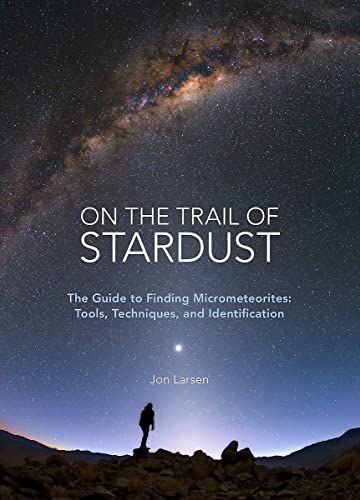
On the Trail of Stardust: The Guide to Finding Micrometeorites: Tools, Techniques, and Identification - Softcover
Inhaltsangabe
On the Trail of Stardust puts the heavens in your hands—in the form of cosmic dust, or micrometeorites. With this handy guide from the author of the international bestseller In Search of Stardust, Jon Larsen, you will learn how to find micrometeorites in your own neighborhood!
Stardust—also known as micrometeorites—is the oldest matter anywhere. Nothing has traveled farther to reach Earth. For a century, scientists have searched everywhere for stardust, but only found it in remote areas like Antarctica and, more recently, outer space. Author and citizen scientist extraordinaire Jon Larsen was the first to find them in populated areas. With this book, you too can discover stardust as near as your own rooftop!
Following his successful debut, In Search of Stardust, Larsen turns his attention from explaining the formation and various kinds of stardust to revealing his methods and techniques for finding micrometeorites in a compact, durable guide. Larsen covers everything from the origins and formation of micrometeorites to assembling the simple array of gear needed to get out there and find stardust in your own neighborhood, rooftop, or rain gutters.
Larsen explains the best places to look and offers step-by-step photo sequences of the techniques he has developed to assemble his collection of 1,500-plus verified micrometeorites (and counting). And you don’t need a multi-million-dollar scanning electron microscope to document your collection; Jon shows how to assemble a serviceable photo setup from easily accessible equipment.
The book is capped off with a field guide of sorts that offers a taxonomy of the various types of micrometeorites, along with sample images, as well as the kinds of man-made and terrestrial spherules that stardust hunters are likely to encounter and how to identify them as imposters.
Once thought to exist only at the bottoms of oceans and atop polar ice, it turns out that stardust is everywhere…and On the Trail of Stardust is your indispensable tool to finding it for yourself.
Die Inhaltsangabe kann sich auf eine andere Ausgabe dieses Titels beziehen.
Über die Autorin bzw. den Autor
A guitarist, composer, record producer, and painter, Jon Larsen began researching micrometeorites in 2009. His breakthrough came in February 2015 with the verification of the world's first micrometeorite discovered in a populated area. In January 2016, Dr. Matthew Genge at the Natural History Museum in London evaluated and verified Jon Larsen's collection of "urban micrometeorites." Larsen resides in As, Norway.
Von der hinteren Coverseite
Stardust―also known as micrometeorites―is the oldest matter anywhere. Nothing has traveled farther to reach Earth. For a century, scientists have searched everywhere for stardust, but only found it in remote areas like Antarctica and, more recently, outer space. Author and citizen scientist extraordinaire Jon Larsen was the first to find them in populated areas. With this book, you too can discover stardust as near as your own rooftop!
Following his successful debut, In Search of Stardust, Larsen turns his attention from explaining the formation and various kinds of stardust to revealing his methods and techniques for finding micrometeorites in a compact, durable guide. Larsen covers everything from the origins and formation of micrometeorites to assembling the simple array of gear needed to get out there and find stardust in your own neighborhood, rooftop, or rain gutters.
Larsen explains the best places to look and offers step-by-step photo sequences of the techniques he has developed to assemble his collection of 1,500-plus verified micrometeorites (and counting). And you don’t need a multi-million-dollar scanning electron microscope to document your collection; Jon shows how to assemble a serviceable photo setup from easily accessible equipment.
The book is capped off with a field guide of sorts that offers a taxonomy of the various types of micrometeorites, along with sample images, as well as the kinds of man-made and terrestrial spherules that stardust hunters are likely to encounter and how to identify them as imposters.
Once thought to exist only at the bottoms of oceans and atop polar ice, it turns out that stardust is everywhere…and On the Trail of Stardust is your indispensable tool to finding it for yourself.
Auszug. © Genehmigter Nachdruck. Alle Rechte vorbehalten.
On the Trail of Stardust
The Guide to Finding Micrometeorites: Tools, Techniques, and Identification
By Jon LarsenThe Quarto Group
Copyright © 2019 Jon Larsen
All rights reserved.
ISBN: 978-0-7603-6458-1All rights reserved.
Contents
Introduction: An Unexpected Discovery, 6,
PART 1 • MICROMETEORITES EVERYWHERE, 10,
What Is a Spherule?, 11,
Searching for the Right Place, 12,
PART 2 • SEVEN STEPS TO HEAVEN, 18,
Cleaning the Sample: Flotation, 20,
Rinsing and Fractioning the Sample, 25,
PART 3 • YOUR PHYSICAL COLLECTION, 34,
Microscopy and Handling, 35,
Curating Your Collection, 40,
Experimental Fieldwork, 46,
PART 4 • WHAT WE FIND IN THE DUST, 50,
The Micrometeorites, 53,
Barred Olivine, 53,
Cryptocrystalline, 56,
Porphyritic Olivine, 60,
Glass, 62,
Scoriaceous, 64,
G-Type, 67,
Other Types, 67,
Extraterrestrial, But Not Micrometeorites, 70,
Ablation Spherules, 70,
Enigmatic Chondrules, 72,
Industrial Spherules, 74,
Magnetic I-Type, 74,
Massive Iron, 76,
Nuggets, Beads & Cores, 78,
From the Welding Shop, 80,
From Sparks, 82,
Nonmagnetic Glass, 83,
From Steam Locomotives, 86,
Mineral Wool, 88,
From Fireworks, 90,
Black Magnetic (Asphalt), 93,
From Roof Tiles & Shingles, 96,
Traces of Man, 98,
Other Types, 101,
Naturally Occurring Spherules, 102,
Rounded Mineral Grains, 102,
Magnetite, 104,
Fulgurites, 106,
Organic Confusion, 109,
Microtektites & Microkrystites, 111,
Lonar Crater Spherules, 114,
Volchovites: A Russian Mystery, 117,
Iberulites, 120,
Ooids & Pisoids, 122,
Pele's Tears, 124,
Road-Dust Crystals, 126,
PART 5 • VERIFY, CLASSIFY, PHOTOGRAPH, 128,
Micrometeorite Verification & Photography, 129,
Origin, Formation, Influx & Classification, 131,
Photographing Micrometeorites, 134,
Further Reading, 139,
Index, 141,
About the Author, 144,
CHAPTER 1
MICROMETEORITES EVERYWHERE
MICROMETEORITES belong to the oldest matter there is. They are mineral remnants from before the planets were formed and may even contain particles older than the sun that have traveled farther than anything else on Earth. We are just beginning to explore these microscopic alien stones, yet they are everywhere.
WHAT IS A SPHERULE?
Most micrometeorites retrieved on Earth are cosmic spherules. A spherule is a rounded object, a solidified melt droplet of stone and/or metal. The sphere is nature's efficient solution for maximum volume and minimum surface. Surface tension while the micrometeorite is still in a liquid state bends the object into a sphere. Raindrops are also formed this way.
In nature, rock can melt and create spherules in three ways: by volcano, lightning, and meteorite. On an uninhabited world, we would only have to distinguish these three types of naturally occurring spherules from one another to identify the extraterrestrial particles. There are, however, traces of human activity everywhere on Earth, in all sediments and layers younger than the Industrial Revolution dating to the 1760s. This is why scientists at the Scott-Amundsen Base at the South Pole drilled down through the ice to the strata from one thousand years ago to melt drinking water. There, however, they found other types of impurities in the ice: micrometeorites.
Power tools and industrial processes produce a huge number of anthropogenic (manmade) spherules, which are everywhere on Earth's surface. The search for stardust is therefore a question of separating the terrestrial (both natural and manmade) from the extraterrestrial. When you know what micrometeorites look like, and what to disregard as anthropogenic spherules, you can find stardust. But where shall we begin the search?
SEARCHING FOR THE RIGHT PLACE
To find micrometeorites, we must understand two concepts. The first is accumulation, the gradual increase in number or amount over time. Despite the total global influx of approximately 100 metric tons of cosmic dust particles per day, the rate on the ground is low, simply because there's so much ground to cover, not to mention that water covers more than 70 percent of Earth's surface. We can expect one extraterrestrial particle with a diameter of 0.1 millimeter per square meter per year.
The longer a skyward surface has accumulated particles from above, the more micrometeorites there are to be found. Contrary to existing literature on the subject, cosmic spherules do not erode "in weeks." In my studies I have found that the older an accumulating area is, the more micrometeorites one is likely to find. The exception is if prevailing winds are especially unfavorable, in which case the yield might be low. Of nearly two thousand cosmic spherules examined, I have seen signs of slight erosion on only a couple of particles. Our hunt for stardust, therefore, begins with a search for a hunting ground with favorable accumulation.
The other concept we must understand is signal-to-noise ratio. In the context of micrometeorites, this means how many micrometeorites (signal) there are compared to terrestrial particles (noise).
For years, micrometeorite hunters have built traps of various types. Few have succeeded because cosmic dust particles are rare. To catch hundreds of cosmic spherules, a trap would have to be the size of a football field and accumulate particles over decades. The challenges connected with such a construction have discouraged more than one good scientist. There are, however, "traps" already in place and ripe for harvesting: roofs.
When I started to hunt for micrometeorites, I began by searching for large, old accumulating areas, such as roads and parking lots. But I did not find anything other than myriad anthropogenic spherules. Not until I moved the search up one floor closer to the sky — to the roof's rain gutter — did I start to find extraterrestrial treasures. The explanation is an improved signal-to-noise ratio.
On the roof there is less human activity, and thus there are fewer anthropogenic spherules. The difference between the signal-to-noise ratio in roof dust and urban road dust is enough for us to find micrometeorites in the former while making the latter very difficult. Consequently, the hunt for urban micrometeorites begins with finding the right roof. Thanks to the stronger signal-to-noise ratio, almost any roof or surface above the turbulent ground will do. A pitched roof with an easily accessible gutter is an excellent place to start. The larger and older a roof is, the better. Particles fall from above, roll down roof tiles or shingles, and accumulate in rain gutters. By placing a bucket under the downspout for a year or two, one may even catch those that the rainwater washes away.
The fewer particles the roof decking contributes to the content of the gutter, the better. Glazed roof tiles, metal plates, stone, wood, and vinyl are favorable roof materials for a successful micrometeorite hunt. With experience you will recognize a promising roof by its accumulating properties and signal-to-noise ratio. Then the result of the hunt accelerates.
Pitched roofs aren't the only place to search. Flat roofs, which usually have safety walls around the edges, serve as micrometeorite traps. On roofs such as this, loose particles accumulate at the lowest points: around the drains, along...
„Über diesen Titel“ kann sich auf eine andere Ausgabe dieses Titels beziehen.
Suchergebnisse für On the Trail of Stardust: The Guide to Finding Micrometeorit...

Beispielbild für diese ISBN
On the Trail of Stardust: The Guide to Finding Micrometeorites: Tools, Techniques, and Identification
Verlag:
Quarto Publishing Group USA Inc, 2019
ISBN 10: 0760364583
ISBN 13: 9780760364581
Gebraucht
Paperback
Anbieter: World of Books (was SecondSale), Montgomery, IL, USA
Verkäuferbewertung 5 von 5 Sternen

Paperback. Zustand: Good. In On the Trail of Stardust, citizen scientist extraordinaire Jon Larsen explains the gear and techniques necessary for finding, identifying, and photographing micrometeorites. Artikel-Nr. 00103466683
Gebraucht kaufen
EUR 17,46
Versand gratis
Versand innerhalb von USA
Versand innerhalb von USA
Anzahl: 1 verfügbar
Beispielbild für diese ISBN
On the Trail of Stardust: The Guide to Finding Micrometeorites: Tools, Techniques, and Identification
Anbieter: Revaluation Books, Exeter, Vereinigtes Königreich
Verkäuferbewertung 5 von 5 Sternen
Paperback. Zustand: Brand New. 144 pages. 8.25x6.00x0.50 inches. In Stock. Artikel-Nr. 0760364583
Neu kaufen
EUR 46,63
EUR 11,77 Versand
Versand von Vereinigtes Königreich nach USA
Versand von Vereinigtes Königreich nach USA
Anzahl: 1 verfügbar