
Verwandte Artikel zu Complete Book of Corvette: Every Model Since 1953
Inhaltsangabe
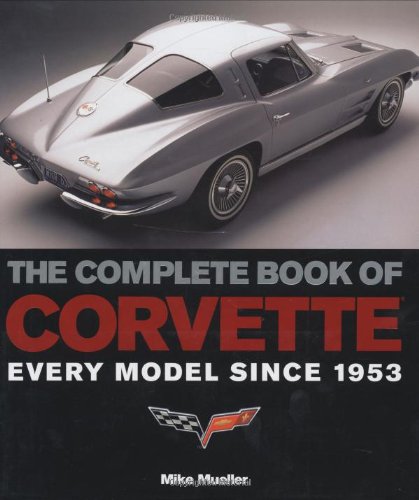
Chevrolet's Corvette is the most iconic, and some would say only, sports car built in America. This lavishly illustrated work conducts readers through the Corvette’s fifty-plus years of continuous production, a rich and varied history unmatched in the automotive world.
An exhaustive review of six generations of American high performance, from the first 6-cylinder ’Vette of 1953 through today's fire-breathing, world-beating C6, The Complete Book of Corvette offers an in-depth look at the prototypes and experimental models, the anniversary and pace cars, and the specialty packages for street and competition driving that have made the Corvette a living automotive legend for more than half a century. With extensive details, specs, and photographic coverage, this book is the ultimate resource on America’s sports car. Officially licensed with Chevrolet and including many never-before-published photographs from the car maker's archives.
Die Inhaltsangabe kann sich auf eine andere Ausgabe dieses Titels beziehen.
Über die Autorin bzw. den Autor
Mike Mueller has worked as a freelance automotive journalist since 1991. A graduate of the University of Illinois’ journalism program, Mueller has held staff positions with Automobile Quarterly, Muscle Car Review and Mustang Monthly. A lifetime car enthusiast, Mueller has written and contributed to over 50 automotive books, contributed photos to Collectible Automobile, Esquire, Life, and Men’s Journal and has written articles for Mustang Monthly and Mustang Enthusiast. He resides in Kennesaw, Georgia.
Von der hinteren Coverseite
This is a Corvette book like no other Corvette book. Many celebrate the most powerful and most attractive Corvette models; few list the less famous, the prototypes, and the racers. Licensed with General Motors and illustrated from GM s design archives, The Complete Book of Corvette showcases in photos, text, and technical specifications all the models since 1953: if it happened, it is here.
The Chevrolet Corvette is the most iconic?some would say only?sports car built in America. This lavishly illustrated work details the Corvette s 50-plus years of continuous production?a rich and varied history unmatched in the automotive world. An exhaustive review of six generations of American high performance, from the first six-cylinder Vette of 1953 through today s fire-breathing, world-beating C6, The Complete Book of Corvette offers an in-depth look at the prototypes and experimental models, the anniversary and pace cars, and the specialty packages for street and competition driving that have made the Corvette a living automotive legend for more than half a century. With extensive details, specifications, and photographic coverage, this book is the ultimate resource on America s favorite sports car.
Aus dem Klappentext
In 2003, Chevrolet s Corvette celebrated its 50th birthday by barely slowing down to blow out the candles. Why dilly-dally when even better times lay ahead? Two years later, Chief Engineer David Hill s team took what was already America s supreme performance machine and transformed it into one of the planet s greatest. Standard performance now qualified as downright surreal: 0?60 in 4.2 seconds and a top end of 186 miles per hour.
What a long, strange trip it s been. Nearly cancelled a few years after its birth, rumored near death or dilution more than one time since, Chevy s fantastic, plastic two-seater is rolling on more confidently than ever, this after six distinct generations of development. Code names for those generations came into vogue during the radically redesigned 1997 Corvette s long haul to market after Chevrolet people let it be known that this all-new platform was identified in-house by the simple ?C5 designation. It was only logical to retroactively label previous generations accordingly: Original solid-axle models built from 1953 to 1962 made up the C1 group; the C2 family consisted of the classic Sting Rays of 1963 to 1967; the C3 era spanned from 1968 to 1982; and the C4 ran from 1984 to 1996. (Chevrolet skipped the 1983 model year, as fourth-generation development work ran past its deadline.)
The fifth-generation Corvette was initially targeted for introduction in August 1992, just in time to help commemorate the Corvette s 40th anniversary. But various pitfalls pushed that debut back repeatedly, first for the 1994 model year, then 1995. When all was said and done, the long-awaited C5 officially appeared in January 1997. The latest rendition, the expectedly tabbed C6, followed eight years later to take the Corvette legacy to all-new heights.
„Über diesen Titel“ kann sich auf eine andere Ausgabe dieses Titels beziehen.
Suchergebnisse für Complete Book of Corvette: Every Model Since 1953

Beispielbild für diese ISBN
The Complete Book of Corvette: Every Model Since 1953 (Complete Book Series)
Verlag:
Motorbooks (edition First Edition), 2006
ISBN 10: 0760326738
ISBN 13: 9780760326732
Gebraucht
Hardcover
Erstausgabe
Anbieter: BooksRun, Philadelphia, PA, USA
Verkäuferbewertung 5 von 5 Sternen

Hardcover. Zustand: Fair. First Edition. With dust jacket. The item might be beaten up but readable. May contain markings or highlighting, as well as stains, bent corners, or any other major defect, but the text is not obscured in any way. Artikel-Nr. 0760326738-7-1-29
Gebraucht kaufen
EUR 7,52
Versand gratis
Versand innerhalb von USA
Versand innerhalb von USA
Anzahl: 1 verfügbar
Beispielbild für diese ISBN
The Complete Book of Corvette : Every Model Since 1953
Verlag:
Quarto Publishing Group USA, 2006
ISBN 10: 0760326738
ISBN 13: 9780760326732
Gebraucht
Hardcover
Anbieter: Better World Books: West, Reno, NV, USA
Verkäuferbewertung 5 von 5 Sternen
Zustand: Good. Former library copy. Pages intact with minimal writing/highlighting. The binding may be loose and creased. Dust jackets/supplements are not included. Includes library markings. Stock photo provided. Product includes identifying sticker. Better World Books: Buy Books. Do Good. Artikel-Nr. 46727637-75
Gebraucht kaufen
EUR 11,27
Versand gratis
Versand innerhalb von USA
Versand innerhalb von USA
Anzahl: 1 verfügbar
Beispielbild für diese ISBN
The Complete Book of Corvette: Every Model Since 1953
Anbieter: Revaluation Books, Exeter, Vereinigtes Königreich
Verkäuferbewertung 5 von 5 Sternen
Hardcover. Zustand: Brand New. 352 pages. 12.00x10.75x1.50 inches. In Stock. Artikel-Nr. 0760326738
Neu kaufen
EUR 90,01
EUR 23,57 Versand
Versand von Vereinigtes Königreich nach USA
Versand von Vereinigtes Königreich nach USA
Anzahl: 1 verfügbar