
Verwandte Artikel zu The Golden Key
Inhaltsangabe
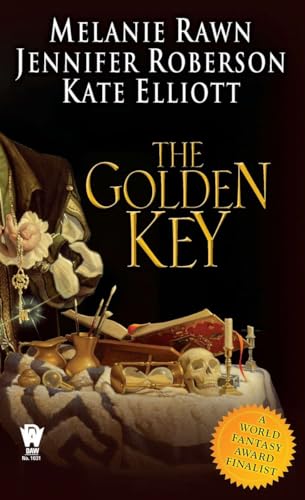
In Tira Virte, art is prized for its beauty and as a binding legal record of everything from marriages to treaties. Yet not even the Grand Duke knows how extraordinary the Grijalva family's art is, for certain Grijalva males are born with the ability to alter events and influence people in the real world through that they paint. Always, their power has been used for Tira Virte. But now Sario Grijalva has learned to use his Gift in a whole new way. And when he begins to work his magic both the Grijalvas and Tira Virte may pay the price.
Die Inhaltsangabe kann sich auf eine andere Ausgabe dieses Titels beziehen.
Über die Autorinnen und Autoren
Jennifer Roberson is the author of the Sword-Dancer Saga and the Chronicles of the Cheysuli, and collaborated with Melanie Rawn and Kate Elliott on the historical fantasy The Golden Key, a finalist for the World Fantasy Award. She has also published three historical novels, and several in other genres. An exhibitor and breeder of Cardigan Welsh Corgis, she lives on acreage in Northern Arizona with eight dogs and two cats. She is currently working on the third Karavans novel.
Jennifer Roberson is the author of the Sword-Dancer Saga and the Chronicles of the Cheysuli, and collaborated with Melanie Rawn and Kate Elliott on the historical fantasy The Golden Key, a finalist for the World Fantasy Award. She has also published three historical novels, and several in other genres. An exhibitor and breeder of Cardigan Welsh Corgis, she lives on acreage in Northern Arizona with eight dogs and two cats. She is currently working on the third Karavans novel.
Auszug. © Genehmigter Nachdruck. Alle Rechte vorbehalten.
Sario Grijalva saw at once what had become of her; where she had gone, despite her physical presence. He knew that look, that blind glaze in eyes, the stillness of features, the fixed feyness of expression. He even knew how it felt: he, too, was what some might call victim. He himself named it potential. Promise. Power. And his definitions were unlike those of others, including the moualimos, the teachers who for now defined his days in the workshops of the students.
Petty men, all of them, even those who were Gifted. They spoke of such things as potential, as promise; even, quietly, of power, and knew nothing of any of them.
He knew. And would know; it was in him to know.
“’Vedra,” he said.
Bound by her inner eye, she neither answered him nor moved.
“’Vedra,” he said more clearly.
Nothing.
“Saavedra.”
She twitched. Her eyes were very black; then slowly the blackness shrank, leaving another color behind. Clear, unmuddied gray, unsullied by underpainting, by impure pigments. It was one of the things about her unlike so many others: Grijalva gray eyes, unusual eyes, the markers of their mutual Tza’ab ancestry, though his was cloaked in far more ordinary clothing: brown eyes, brown hair, desert-dark skin. Nothing in the least remarkable about Sario Grijalva.
Not outside, where men could see. Inside, where no one could see but he, because the only light available was the kindling of ambition, the naphtha of his vision.
He looked upon her. She was older than he, and taller, but now she huddled upon the colonnade bench like a supplicant, a servant, leaving him to accept or deny preeminence. She turned her face up to him, into a shaft of midday sunlight that illuminated expression in quiet chiaroscuro as it illuminated the wood-speckled paper attached to a board, the agile, beautiful hands. With a quick, unthinking motion she tossed unkempt black hair out of her eyes; saw him then, registered his presence, marked identity—and answered, dredging awareness back from the vast geography of her other world, confined by the bindings of her inner eye.
“Wait—” Clipped, impatient, imperative, as if he were the servant now.
They were all of them servants, Grijalvas: gifted and Gifted alike.
“—wait—” she repeated—softer now, pleading, asking understanding, forgiveness, all underscored by impatience—and sketched frantically upon the paper.
He understood. There was compassion in him for her, unalloyed comprehension. But impatience also, his own for other reasons, and more than a little resentment that she should expect him to wait; she was not and could not be Gifted, not as he was Gifted.
Therefore he could answer: “There is no time, ‘Vedra. Not if we are to see it.”
Silence, save for the scratching of her charcoal upon the inferior paper.
“’Vedra—”
“I must get this down ...” And unspoken: —while it is alive, while it is fresh, while I see it—
He understood, but could not coddle it. “We must go.”
“A moment, just a moment longer—momentita, grazzo—” She worked quickly, with an unadorned economy of movement he admired. Many of the young girls labored over their work, as did many boys, digging and digging for small truths that would strengthen their work, but Saavedra understood better what she wanted to do. Her truths, as his, were immense, if unacknowledged by either of them as anything other than ordinary, because to each of them such truths were. They breathed them every moment.
As did he, she saw those truths, that light, the images completed by her mind in all the complexities, exploring none so much as freeing them with a minimum of strokes, a swift stooping of her gift.
Luza do’Orro, the Golden Light, the true-talent of the mind.
He watched. For once he felt like moualimo to student, teacher to estuda. It was not he laboring beneath the unrelenting eye of another, but she beneath his eye, doing nothing for him but for herself instead, only for herself; she understood that freedom, that desire for expression apart from the requisites of their family, the demands of the moualimos.
“No,” he said suddenly, and swooped down upon her. His own vision, his own Luza do’Orro, could not be denied. Even for such dictates as courtesy. Even for her. “No, not like that... here—do you see?” They none of them were without pockets or charcoal; he took a burned stick from his tunic and sat down beside her, pulling the board and paper away into his own lap. “Look you—see?”
A moment only, a single corrected line: Baltran do’Verrada, Tira Virte’s Duke, whom they had seen only today in the Galerria.
Saavedra sat back, staring at the image.
“Do you see?” Urgency drove him; he must explain before the light of his vision died. Quickly he scrubbed away what he could of the offending line, blew it free of residue. The portrait now, though still rough and over-hasty, was indeed more accurate. He displayed it. “The addition here gives life to the left side of his face ... he is crooked, you know. No face is pure in balance.” He filled in a shadow. “And there is his cheekbone—like so... do you see?”
Saavedra was silent.
It struck him like a wave: he had erred. He had hurt her. “’Vedra, forgive me—” Matra ei Filho, when someone did that to him— “Oh, ‘Vedra, I’m sorry! I am!” He was. “But I couldn’t help myself.”
She put her charcoal into her tunic pocket. “I know.”
“’Vedra—”
“I know, Sario. You never can help yourself.” She got up from the bench and shook out her tunic. Charcoal dust clouded. Her tunic was, as his, stained by powdered pigments, dyestuffs, binder, melted resins, oil, all the workings of their world. “It is better, what you have done.”
He was anxious now, thrusting the board and pinned paper back into her hands as he rose hastily. “It was only—” He gestured helplessly. “It was only that I saw—”
“I know,” she said again, accepting the board but not looking at the sketch. “You saw what I didn’t see; what I should have seen.” Saavedra shrugged, a small, self-conscious lifting of her shoulders. “I should have seen it also.”
It lay between them now. They were alike in many ways, unalike in others. She could not be Gifted, but she was gifted, and more so than most.
He saw again in his inner eye the image. No one would mistake it. No one could have mistaken it for anyone other than Baltran do’Verrada before he had altered the sketch, but he had altered it nonetheless.
He was sorry to hurt her. But there was exactitude in his Gift, a punishing rectitude: there was no room in his world for than anything less than perfection.
“Regretto,” he said in a small, pinched voice. Inside his head: Nazha irrada; don’t be angry. Nazha irrada, ‘Vedra. But he could not speak it aloud; there was too much of begging in it, too much humility. Even to her, even for her, he could not bare so much of himself. “I’m sorry...”
She was in that moment far older than he. “You always are, Sario.”
It was punishment, though for her it was merely truth, a bastard form of luza do’orro. He valued that in her. Truth was important. But truth could also punish; his own personal truth had transformed the rough sketch from good to brilliant, with merely an added line, a touch of shadow—he understood it all so...
„Über diesen Titel“ kann sich auf eine andere Ausgabe dieses Titels beziehen.
Suchergebnisse für The Golden Key

Beispielbild für diese ISBN
The Golden Key
Anbieter: World of Books (was SecondSale), Montgomery, IL, USA
Verkäuferbewertung 5 von 5 Sternen

Zustand: Very Good. Item in very good condition! Textbooks may not include supplemental items i.e. CDs, access codes etc. Artikel-Nr. 00108431531
Gebraucht kaufen
EUR 4,98
Versand gratis
Versand innerhalb von USA
Versand innerhalb von USA
Anzahl: 2 verfügbar
Beispielbild für diese ISBN
The Golden Key
Anbieter: Better World Books, Mishawaka, IN, USA
Verkäuferbewertung 5 von 5 Sternen
Zustand: Good. Pages intact with minimal writing/highlighting. The binding may be loose and creased. Dust jackets/supplements are not included. Stock photo provided. Product includes identifying sticker. Better World Books: Buy Books. Do Good. Artikel-Nr. 4360567-6
Gebraucht kaufen
EUR 7,05
Versand gratis
Versand innerhalb von USA
Versand innerhalb von USA
Anzahl: 2 verfügbar
Beispielbild für diese ISBN
The Golden Key
Anbieter: Better World Books: West, Reno, NV, USA
Verkäuferbewertung 5 von 5 Sternen
Zustand: Good. Pages intact with minimal writing/highlighting. The binding may be loose and creased. Dust jackets/supplements are not included. Stock photo provided. Product includes identifying sticker. Better World Books: Buy Books. Do Good. Artikel-Nr. 4360567-6
Gebraucht kaufen
EUR 7,05
Versand gratis
Versand innerhalb von USA
Versand innerhalb von USA
Anzahl: 1 verfügbar
Beispielbild für diese ISBN
The Golden Key
Anbieter: ThriftBooks-Dallas, Dallas, TX, USA
Verkäuferbewertung 5 von 5 Sternen
Unknown. Zustand: Good. No Jacket. Pages can have notes/highlighting. Spine may show signs of wear. ~ ThriftBooks: Read More, Spend Less. Artikel-Nr. G0756406714I3N00
Gebraucht kaufen
EUR 8,56
Versand gratis
Versand innerhalb von USA
Versand innerhalb von USA
Anzahl: 1 verfügbar
Beispielbild für diese ISBN
The Golden Key
Anbieter: ThriftBooks-Phoenix, Phoenix, AZ, USA
Verkäuferbewertung 5 von 5 Sternen
Unknown. Zustand: Good. No Jacket. Pages can have notes/highlighting. Spine may show signs of wear. ~ ThriftBooks: Read More, Spend Less. Artikel-Nr. G0756406714I3N00
Gebraucht kaufen
EUR 8,56
Versand gratis
Versand innerhalb von USA
Versand innerhalb von USA
Anzahl: 1 verfügbar
Beispielbild für diese ISBN
The Golden Key
Anbieter: WorldofBooks, Goring-By-Sea, WS, Vereinigtes Königreich
Verkäuferbewertung 5 von 5 Sternen
Paperback. Zustand: Very Good. The book has been read, but is in excellent condition. Pages are intact and not marred by notes or highlighting. The spine remains undamaged. Artikel-Nr. GOR005335767
Gebraucht kaufen
EUR 4,24
EUR 6,53 Versand
Versand von Vereinigtes Königreich nach USA
Versand von Vereinigtes Königreich nach USA
Anzahl: 1 verfügbar