
Verwandte Artikel zu Deadly Invaders: Marburg Virus, Bird Flu, And Other...
Inhaltsangabe
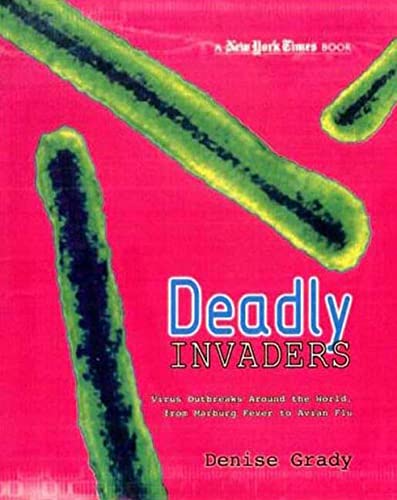
An epidemic strikes the United States, plunging the country into chaos. New York Times medical reporter Denise Grady uses this terrifying scenario, taken from the pages of a U.S. government report on the potential outcome of a pandemic, as the starting point for a journey into the gripping world of emerging diseases.
In search of a better understanding of these often deadly diseases, Grady heads to Angola, the site of the 2005 Marburg virus epidemic, a disease closely related to Ebola. On the ground, and sometimes frighteningly close to victims of the disease, Denise explores the realities of health care in the developing world, and its potential effects on our own welfare.
With supplemental sidebars that explain key scientific and social issues and in-depth chapters on the origins and spread of Marburg, avian flu, HIV, SARS, West Nile virus, hantavirus, and monkeypox, this is a fascinating look at the health dangers we face in a global society.
Die Inhaltsangabe kann sich auf eine andere Ausgabe dieses Titels beziehen.
Über die Autorin bzw. den Autor
Denise Grady has been a science reporter for The New York Times since 1998 and has written more than five hundred articles about medicine and biology. She is the recipient of numerous awards, including a commendation from the Newspaper Guild for Choice and Excellence of Crusading Journalistic Contributions in the Areas of Science and Medicine. She lives in Westchester, New York.
Rezensionen
Science reporter for the New York Times, Grady recalls her 2005 trip to Angola, where she reported on a large outbreak of Marburg fever. In the first half of the book, a new entry in a line of books published in cooperation with the Times, Grady discusses the Marburg virus, the incurable disease it causes, and its effects on individuals and communities, as seen through the lens of her personal experiences in Angola. Many teens will find this compelling reading. Next she offers a short, informative chapter on each of seven deadly diseases: Marburg fever, avian flu, HIV/AIDS, Hantavirus pulmonary syndrome, West Nile disease, SARS, and monkeypox. Rather than source notes, Grady appends a discussion of how she researches her stories. Following that, the "Further Reading" section recommends 100 articles--all from the Times--and another page lists recommended Internet sites. The illustrations (not seen in final form), mainly photos, will be in color. Despite its limited documentation, this is a useful and quite readable source of information on viral diseases that have made headlines. Carolyn Phelan
Copyright © American Library Association. All rights reserved
Starred Review. Grade 7 Up–This readable and riveting text introduces students to the new age of viral epidemics. Grady begins with an account of her trip to Angola in 2005 to cover an outbreak of Marburg fever as a reporter for the New York Times. Her writing is informative and compelling. She persuasively relays the challenges of fighting a viral epidemic in a city that lacks such basic services as running water. The medical professionals also had to cope with language barriers and cultural differences. Grady clearly conveys the difficulties of confining and halting the spread of diseases in an age in which air travel makes it possible for an infected individual to spread a disease worldwide in a matter of hours. A map shows how one person infected with the SARS virus infected 400 individuals from around the globe while staying at a hotel in China. Boxed areas highlight information and individuals. For instance, one profiles Maria Bonino, an Italian pediatrician who died of Marburg during the outbreak. The layout is appealing and includes good-quality, full-color, relevant photographs on almost every spread. After relaying her experiences reporting on the Marburg outbreak, Grady profiles other deadly diseases, including Avian Flu, HIV and AIDS, SARS, and West Nile. A fast-paced, timely, and important book.–Maren Ostergard, King County Library System, Issaquah, WA
Copyright © Reed Business Information, a division of Reed Elsevier Inc. All rights reserved.
Auszug. © Genehmigter Nachdruck. Alle Rechte vorbehalten.
Chapter One
Luanda, Angola
Monday, April 11, 2005
Standing in a tent outside the Américo Boavida Hospital in Luanda, Angola, I
peeled off my sweaty blouse and jeans and pulled on a green hospital scrub
shirt and pants. It was noon, hot and humid—a typical day in southwestern
Africa—and it felt as if there were no air in the tent. A rooster crowed from a
field of weeds just outside, and as I tied the drawstring on my pants I
thought, I've been writing about medicine for twenty-five years, and I've never
been to a hospital with roosters before. The scrubs, not long off the
clothesline, felt damp, and they reeked of bleach. But it was a reassuring
smell. The tent had been pitched as a changing room for doctors and nurses
just outside a building that housed the "hot zone," a special ward created for
patients infected with the deadly, contagious Marburg virus. Bleach was the
best way to kill the virus on clothing, equipment, and even people's hands.
It was my third day in Luanda, Angola's capital, a teeming city of four million
where SUVs zigzagged around gaping potholes and women strode gracefully
by with enormous baskets of bread or fruit balanced on their heads. About
180 miles (290 kilometers) north of us, the province of Uige (pronounced
Weej) was in the grip of the world's largest epidemic ever of Marburg fever.
There is no cure for Marburg. By the time I arrived in Angola, of 214 people
who had caught it, 194 had died, usually after being sick for only a week. It
was a shockingly high death rate, among the worst for any infectious
disease. Of the first 100 or so victims, many were babies and small children.
The outbreak had taken Angola by surprise, and no one knew exactly how,
where, or when it had started.
Although Marburg had first been identified in blood samples from patients in
Uige in March of 2005, it had probably been killing people for months before
that, maybe since October of 2004. Much of that time, doctors had probably
been mistaking it for something else. There is so much disease in Africa—
malaria, diarrheal infections, and yellow fever are just a few examples—that it
is easy for a new illness to sneak in and gain a foothold. That is precisely
what Marburg did: it blended in and got such a head start on doctors and
health officials that suddenly, before they even knew what was happening,
they had an epidemic on their hands. The disease was still spreading. Virus
experts had flown in from all over the world to try to stop it. Tomorrow, I would
fly to the center of the outbreak, Uige.
From New York, where I work at The New York Times, I had been following
reports from the World Health Organization about the epidemic in Angola,
and urging (some might call it pestering) the paper to cover it. American
newspapers were not writing much about the disease. Finally, when I sent
around an e-mail noting that the outbreak had officially become the largest
known Marburg epidemic ever, one of my editors said, "Do you want to go?"
"Sure," I said—and wondered immediately what I had volunteered for. But, I
must admit, the disease fascinated me. I was a biology major in college, and
the student in me wanted to know more. The reporter in me wanted to tell the
story of the crisis in Angola.
Some people thought going there was a crazy idea. Colleagues, relatives,
and friends asked if I wasn't afraid I would catch the disease myself.
Of course I was afraid. I would be walking into an epidemic of a contagious,
incurable, and usually fatal disease, in an isolated part of a poor, crumbling
nation with a shaky health-care system. At least one doctor and several
nurses in Uige had caught the disease from their patients and died. The
incubation period—the time between when a person is infected and when he
or she becomes sick—is short, between three and ten days. I knew that if I
became infected in Angola, I would probably die there, too.
But at the same time, I thought it should be possible to report on Marburg
without catching it. Infected people aren't contagious until they start having
symptoms, so I wouldn't have to worry around people who weren't sick. Even
then, the virus does not spread through the air. To catch it, you have to
touch body fluids like blood, vomit, and urine from sick patients. Many people
in Angola became infected from taking care of others with the disease.
Corpses, teeming with the virus, are especially dangerous, and some
Angolans got sick and died from washing the body of a dead relative to
prepare it for burial.
It seemed to me that if I didn't get close to sick people or dead bodies, and
took care about where I went and what I touched, I should be able to avoid
the virus. I would be interviewing experts in infectious disease, and I decided
that I would follow their advice and do whatever they did to keep from being
infected.
Still, there was a risk. The odds of not coming home were small, but real.
Even without Marburg, Angola wasn't the safest place. It had been torn apart
by civil war from 1975 to 2002, and the countryside was still littered with land
mines, so there were many areas where you simply couldn't walk or ride.
Outside Luanda, you weren't even supposed to drive up on the shoulder of
the road to pass another car, because the shoulders had been planted with
land mines. Medical care was poor, except in Luanda. Law and order were
sketchy. The U.S. State Department Web site warned that bandits might
stop cars along roads outside Luanda, especially at night, and that the police
had been known to rob people. The State Department also said, "Police and
military officials are sometimes undisciplined, and their authority should not
be challenged." Even getting in and out of Angola could be tough, because
there had been incidents in which officials at the airport pulled scams,
detaining travelers or threatening to vaccinate them with unsterilized needles
unless bribes were paid.
I booked flights and a hotel in Luanda, applied for a visa, and saw a doctor
who specialized in travel medicine. He prescribed pills to prevent malaria and
antibiotics to carry in case I got sick from tainted food. He also gave me five
shots: vaccinations against polio, meningitis, hepatitis A, typhoid, and yellow
fever. But there was nothing that could protect me from Marburg fever—
except, perhaps, my own common sense.
I left New York on Thursday night, April 7. My arm was still sore from the
shots. My suitcase was stuffed full of mosquito repellent, germ-killing hand
cleaner, PowerBars, and packages of nuts in case I found myself in places
with no food, or food I was afraid to eat. I was wearing a money belt hidden
under my clothes, with about $4,000 in it. It made me nervous to carry so
much money, but drivers and translators—the official language in Angola is
Portuguese—would be expensive and would have to be paid in cash.
On the first leg of the trip, a flight to London, I sat next to a man who had
traveled quite a bit in Africa.
"Fortunately," he said, "I've always been able to avoid Angola."
„Über diesen Titel“ kann sich auf eine andere Ausgabe dieses Titels beziehen.
Suchergebnisse für Deadly Invaders: Marburg Virus, Bird Flu, And Other...

Beispielbild für diese ISBN
New York Times Deadly Invaders : Virus Outbreaks Around the World, from Marburn Fever to Avian Flu
Anbieter: Better World Books, Mishawaka, IN, USA
Verkäuferbewertung 5 von 5 Sternen

Zustand: Good. Former library copy. Pages intact with minimal writing/highlighting. The binding may be loose and creased. Dust jackets/supplements are not included. Includes library markings. Stock photo provided. Product includes identifying sticker. Better World Books: Buy Books. Do Good. Artikel-Nr. 39150898-6
Gebraucht kaufen
EUR 8,57
Versand gratis
Versand innerhalb von USA
Versand innerhalb von USA
Anzahl: 3 verfügbar
Beispielbild für diese ISBN
New York Times Deadly Invaders: Virus Outbreaks Around the World, from Marburn Fever to Avian Flu
Anbieter: ThriftBooks-Atlanta, AUSTELL, GA, USA
Verkäuferbewertung 5 von 5 Sternen
Hardcover. Zustand: Very Good. No Jacket. Former library book; May have limited writing in cover pages. Pages are unmarked. ~ ThriftBooks: Read More, Spend Less. Artikel-Nr. G0753459957I4N10
Gebraucht kaufen
EUR 9,54
Versand gratis
Versand innerhalb von USA
Versand innerhalb von USA
Anzahl: 1 verfügbar
Beispielbild für diese ISBN
New York Times Deadly Invaders: Virus Outbreaks Around the World, from Marburn Fever to Avian Flu
Anbieter: ThriftBooks-Dallas, Dallas, TX, USA
Verkäuferbewertung 5 von 5 Sternen
Hardcover. Zustand: Very Good. No Jacket. Former library book; May have limited writing in cover pages. Pages are unmarked. ~ ThriftBooks: Read More, Spend Less. Artikel-Nr. G0753459957I4N10
Gebraucht kaufen
EUR 9,54
Versand gratis
Versand innerhalb von USA
Versand innerhalb von USA
Anzahl: 1 verfügbar
Beispielbild für diese ISBN
Deadly Invaders: Virus Outbreaks Around the World, from Marburg Fever to Avian Flu (New York Times Book)
Anbieter: Reuseabook, Gloucester, GLOS, Vereinigtes Königreich
Verkäuferbewertung 5 von 5 Sternen
Hardcover. Zustand: Used; Very Good. Dispatched, from the UK, within 48 hours of ordering. Though second-hand, the book is still in very good shape. Minimal signs of usage may include very minor creasing on the cover or on the spine. Artikel-Nr. CHL6353513
Gebraucht kaufen
EUR 26,57
EUR 11,68 Versand
Versand von Vereinigtes Königreich nach USA
Versand von Vereinigtes Königreich nach USA
Anzahl: 2 verfügbar