
Verwandte Artikel zu Development, Security and Unending War: Governing the...
Inhaltsangabe
According to politicians, we now live in a radically interconnected world. Unless there is international stability – even in the most distant places – the West's way of life is threatened. In meeting this global danger, reducing poverty and developing the unstable regions of the world are now imperative. In what has become a truism of the post-Cold War period, security without development is questionable, while development without security is impossible.
In this accessible and path-breaking book, Mark Duffield questions this conventional wisdom and lays bare development not as a way of bettering other people but of governing them. He offers a profound critique of the new wave of Western humanitarian and peace interventionism, arguing that rather than bridging the lifechance divide between development and underdevelopment, it maintains and polices it. As part of the defence of an insatiable mass consumer society, those living beyond its borders must be content with self-reliance.
With case studies drawn from Mozambique, Ethiopia and Afghanistan, the book provides a critical and historically informed analysis of the NGO movement, humanitarian intervention, sustainable development, human security, coherence, fragile states, migration and the place of racism within development. It is a must-read for all students and scholars of development, humanitarian intervention and security studies as well as anyone concerned with our present predicament.
Die Inhaltsangabe kann sich auf eine andere Ausgabe dieses Titels beziehen.
Über die Autorin bzw. den Autor
Mark Duffield is Professor of Development Politics at the University of Bristol.
Von der hinteren Coverseite
According to politicians, we now live in a radically interconnected world. Unless there is international stability – even in the most distant places – the West's way of life is threatened. In meeting this global danger, reducing poverty and developing the unstable regions of the world are now imperative. In what has become a truism of the post-Cold War period, security without development is questionable, while development without security is impossible.
In this accessible and path-breaking book, Mark Duffield questions this conventional wisdom and lays bare development not as a way of bettering other people but of governing them. He offers a profound critique of the new wave of Western humanitarian and peace interventionism, arguing that rather than bridging the lifechance divide between development and underdevelopment, it maintains and polices it. As part of the defence of an insatiable mass consumer society, those living beyond its borders must be content with self-reliance.
With case studies drawn from Mozambique, Ethiopia and Afghanistan, the book provides a critical and historically informed analysis of the NGO movement, humanitarian intervention, sustainable development, human security, coherence, fragile states, migration and the place of racism within development. It is a must-read for all students and scholars of development, humanitarian intervention and security studies as well as anyone concerned with our present predicament.
Aus dem Klappentext
According to politicians, we now live in a radically interconnected world. Unless there is international stability – even in the most distant places – the West's way of life is threatened. In meeting this global danger, reducing poverty and developing the unstable regions of the world are now imperative. In what has become a truism of the post-Cold War period, security without development is questionable, while development without security is impossible.
In this accessible and path-breaking book, Mark Duffield questions this conventional wisdom and lays bare development not as a way of bettering other people but of governing them. He offers a profound critique of the new wave of Western humanitarian and peace interventionism, arguing that rather than bridging the lifechance divide between development and underdevelopment, it maintains and polices it. As part of the defence of an insatiable mass consumer society, those living beyond its borders must be content with self-reliance.
With case studies drawn from Mozambique, Ethiopia and Afghanistan, the book provides a critical and historically informed analysis of the NGO movement, humanitarian intervention, sustainable development, human security, coherence, fragile states, migration and the place of racism within development. It is a must-read for all students and scholars of development, humanitarian intervention and security studies as well as anyone concerned with our present predicament.
„Über diesen Titel“ kann sich auf eine andere Ausgabe dieses Titels beziehen.
Suchergebnisse für Development, Security and Unending War: Governing the...

Beispielbild für diese ISBN
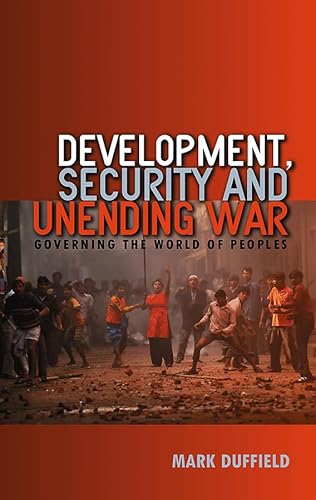
Development, Security and Unending War: Governing the World of Peoples
Anbieter: Ria Christie Collections, Uxbridge, Vereinigtes Königreich
Verkäuferbewertung 5 von 5 Sternen

Zustand: New. In English. Artikel-Nr. ria9780745635798_new
Neu kaufen
EUR 81,71
EUR 13,32 Versand
Versand von Vereinigtes Königreich nach USA
Versand von Vereinigtes Königreich nach USA
Anzahl: Mehr als 20 verfügbar
Foto des Verkäufers
Duffield, M: Development, Security and Unending War
Anbieter: moluna, Greven, Deutschland
Verkäuferbewertung 5 von 5 Sternen
Zustand: New. This path-breaking book argues that development is not a way of bettering other people but of governing them. With examples drawn from Mozambique, Ethiopia and Afghanistan, the book analyses the NGO movement, humanitarian intervention, sustainable developme. Artikel-Nr. 594930246
Neu kaufen
EUR 82,04
EUR 48,99 Versand
Versand von Deutschland nach USA
Versand von Deutschland nach USA
Anzahl: Mehr als 20 verfügbar
Foto des Verkäufers
Development, Security and Unending War : Governing the World of Peoples
Anbieter: AHA-BUCH GmbH, Einbeck, Deutschland
Verkäuferbewertung 5 von 5 Sternen
Buch. Zustand: Neu. Neuware - According to politicians, we now live in a radically interconnected world. Unless there is international stability - even in the most distant places - the West's way of life is threatened. In meeting this global danger, reducing poverty and developing the unstable regions of the world are now imperative. In what has become a truism of the post-Cold War period, security without development is questionable, while development without security is impossible. In this accessible and path-breaking book, Mark Duffield questions this conventional wisdom and lays bare development not as a way of bettering other people but of governing them. He offers a profound critique of the new wave of Western humanitarian and peace interventionism, arguing that rather than bridging the lifechance divide between development and underdevelopment, it maintains and polices it. As part of the defence of an insatiable mass consumer society, those living beyond its borders must be content with self-reliance. With case studies drawn from Mozambique, Ethiopia and Afghanistan, the book provides a critical and historically informed analysis of the NGO movement, humanitarian intervention, sustainable development, human security, coherence, fragile states, migration and the place of racism within development. It is a must-read for all students and scholars of development, humanitarian intervention and security studies as well as anyone concerned with our present predicament. Artikel-Nr. 9780745635798
Neu kaufen
EUR 109,05
EUR 35,00 Versand
Versand von Deutschland nach USA
Versand von Deutschland nach USA
Anzahl: 2 verfügbar