
Verwandte Artikel zu Space Invaders: Radical Geographies of Protest (Radical...
Inhaltsangabe
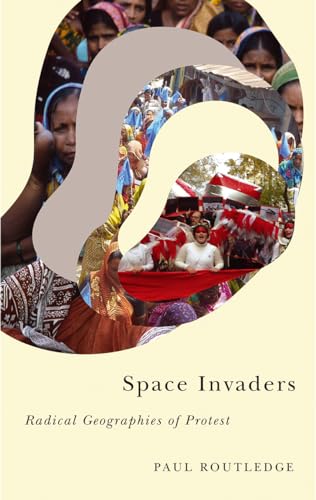
Space Invaders argues for the importance of a radical geographic perspective in enabling us to make sense of protests and social movements around the world. Under conditions of increasing global economic inequalities, we are witnessing the flourishing of grassroots people's movements fighting for improved rights. Whether it be the alter-globalisation mobilisations of the turn of the century, the flurry of Occupy protests, or the current wave of anti-austerity mobilisations taking place, there is a geographical logic to all forms of protest whether that be through transforming landscapes, occupying enemy territory or developing solidarity and communication networks. Paul Routledge takes a primarily auto-ethnographical perspective, drawing upon his extensive experience over the past thirty years working with various forms of protest in Europe, Asia and Latin America, to provide an account of how a radical geographical imagination can inform our understanding and the prosecution of protest.
Die Inhaltsangabe kann sich auf eine andere Ausgabe dieses Titels beziehen.
Über die Autorin bzw. den Autor
Paul Routledge is professor of contentious politics and social change at the University of Leeds, England.
Auszug. © Genehmigter Nachdruck. Alle Rechte vorbehalten.
Space Invaders
Radical Geographies of Protest
By Paul RoutledgePluto Press
Copyright © 2017 Paul Routledge
All rights reserved.
ISBN: 978-0-7453-3624-4All rights reserved.
Contents
List of Figures, vi,
Acknowledgements, vii,
Series Preface, viii,
1 Radical Geographies of Protest: Spatial Strategies, Sites of Intervention and Scholar Activism, 1,
2 Know Your Place: Barricades, Rooftops and Being Steadfast, 24,
3 Make Some Space: Camps, Commons and Occupations, 41,
4 Stay Mobile: Packs and Swarms, Flash Mobs and Hacktivism, 61,
5 Wage Wars of Words: Testimonies, Communiqués and Culture Jamming, 77,
6 Extend Your Reach: Convergences, Conferences and Caravans, 96,
7 Feel Out Of Place: Ethical Spectacles, Zaps and Guerrilla Performances, 113,
8 Space Invaders: Power, Politics and Protest, 129,
Notes, 150,
Index, 173,
CHAPTER 1
Radical Geographies of Protest
Spatial Strategies, Sites of Intervention and Scholar Activism
Protestors are space invaders. In the course of protests, all kinds of spaces – such as homes, corporate offices, streets and factories – are used, occupied, defended and abandoned. Particular places provide protestors with opportunities and constraints as they wage their struggles. Places can influence the character of protests as well as being transformed by them. Protestors make space, and in so doing they can imbue places with different meanings and feelings. In short, protest always has a geographical character and this has implications for the emergence, character, impact and outcomes of particular struggles.
Protests form part of a broader set of interactions, repertoires and processes that are termed 'contentious politics', which can include strike waves, revolutions, armed conflict, civil wars, guerrilla insurgencies and democratic processes involving political actors and governments. Protests are prosecuted by a spectrum of different societal actors including individuals, groups and, of particular interest to this book, social movements – that is, organisations of varying size that share a collective identity and solidarity, are engaged in forms of conflict in opposition to an adversary (such as a government or corporation), and attempt to challenge or transform particular elements within a social system (such as governments, laws, policies, cultural codes and so on).
Whether it be the alter-globalisation mobilisations of the turn of the century, the flurry of Occupy protests that peppered the planet a few years ago, the recent wave of anti-austerity mobilisations or ongoing protests against the construction of dams or the spread of agribusiness, there is a geographical logic to all forms of protest. Through a discussion of different case studies, I will explain how an understanding of 'radical' geography – an approach to geography that is motivated by concerns for social and environmental justice within a global capitalist economy – enables us to make sense of protests around the world, and provides a series of geographical strategies of use to protestors.
This book will consider two distinct yet interrelated geographical logics that are critical in overall strategic approaches to the prosecution of protest: a primary logic of spatial strategies, by which the character of protest is informed by, and shapes, the geographical contexts in which it takes place; and a secondary logic concerning key sites of intervention, physical and conceptual targets within a system that are directly related to a protest's concerns, goals or broader strategies. Taken together, these 'logics' provide an innovative approach to protest that enables us to understand why such mobilisations occur where they do, and provides useful insights for students and activists wishing to make sense of the world of protest and build effective campaigns.
In this chapter I will discuss what is meant by geography, and in particular, radical geography and the contributions that it has made to social movement theory. I will also consider the practice of scholar activism, and issues of ethics and representation concerning collaborating with and writing about political struggles. Following a discussion of politics, protest and power, I will introduce six spatial strategies and nine sites of intervention that I use to interpret political protest from a radical geographical perspective.
GEOGRAPHY AND THE RADICAL IMAGINATION
Human geography is concerned with the people and places that make up the world, their similarities and differences, their connections (or lack thereof) and the processes by which our world is structured into identifiable places and peoples. Two key geographical concepts used throughout this book are place and space. Place refers to a particular geographical locale distinguished by the cultural or subjective meanings through which it is constructed and differentiated (from other locales). These meanings can change over time, and places are always connected to other locales regionally, nationally and internationally through flows of people, investment, ideas, products and so on. Space refers to the ongoing flows, forms and social relations of the world in which we find ourselves. Space is never static, but rather plural, multiple and subject to transformation.
At root is the recognition that everything happens somewhere, and that, for geographers, this is important. For example, where we are in the world is fundamental to what we see (or do not see), what problems we face, what languages we speak and think in, what we do, what chances we have in life, who we interact with and so on. In the language of human geography, we say that human and non-human things exist in and through space: in very mundane ways, all of us live in homes that organise the world into private and public realms; we live in settlements that we name and categorise by whether they are villages, neighbourhoods, towns and cities and so on; we belong to and reside in specific territories (such as nation states) that are differentiated from others in particular ways; and we move between places and across territories due to work, leisure, migration and so forth. In other words, spaces have a material reality and a symbolic significance that are important to how we experience and engage with the world.
In addition, the various processes that generate social differences and inequalities (regarding health, gender, race, class and so on) are a product of how power and resources are distributed, manipulated and struggled over, which themselves are geographical in character. Such disparities have real impacts on geographical processes such as the location and provision of schools and hospitals (and hence access to doctors and education), transport provision (and hence people's journey times) and the location of waste. In short, geographical (or spatial) patterns produce, and are produced by, social relations and socio-economic processes.
Radical geographers are not interested in merely mapping such differences within or between regions, cities and so on, but rather in investigating why and how 'context' enables an explanation for such differences. Such a geographical interpretation of social life enables us to begin to understand the reasons for the emergence of protest in particular places. For example, the environmental justice movement began in Warren County, North Carolina, in 1973, after the decision by the US state government to build a landfill for contaminated soil following the dumping of 31,000...
„Über diesen Titel“ kann sich auf eine andere Ausgabe dieses Titels beziehen.
Suchergebnisse für Space Invaders: Radical Geographies of Protest (Radical...

Beispielbild für diese ISBN
Space Invaders: Radical Geographies of Protest
Anbieter: WorldofBooks, Goring-By-Sea, WS, Vereinigtes Königreich
Verkäuferbewertung 5 von 5 Sternen

Paperback. Zustand: Very Good. The book has been read, but is in excellent condition. Pages are intact and not marred by notes or highlighting. The spine remains undamaged. Artikel-Nr. GOR009236393
Gebraucht kaufen
EUR 11,27
EUR 6,50 Versand
Versand von Vereinigtes Königreich nach USA
Versand von Vereinigtes Königreich nach USA
Anzahl: 1 verfügbar
Beispielbild für diese ISBN
Space Invaders: Radical Geographies of Protest (Radical Geography)
Anbieter: Anybook.com, Lincoln, Vereinigtes Königreich
Verkäuferbewertung 5 von 5 Sternen
Zustand: Good. This is an ex-library book and may have the usual library/used-book markings inside.This book has soft covers. In good all round condition. Please note the Image in this listing is a stock photo and may not match the covers of the actual item,350grams, ISBN:9780745336244. Artikel-Nr. 8245180
Gebraucht kaufen
EUR 7,57
EUR 15,80 Versand
Versand von Vereinigtes Königreich nach USA
Versand von Vereinigtes Königreich nach USA
Anzahl: 1 verfügbar
Beispielbild für diese ISBN
Space Invaders
Anbieter: PBShop.store UK, Fairford, GLOS, Vereinigtes Königreich
Verkäuferbewertung 5 von 5 Sternen
PAP. Zustand: New. New Book. Shipped from UK. Established seller since 2000. Artikel-Nr. FW-9780745336244
Neu kaufen
EUR 20,84
EUR 4,83 Versand
Versand von Vereinigtes Königreich nach USA
Versand von Vereinigtes Königreich nach USA
Anzahl: 15 verfügbar
Beispielbild für diese ISBN
Space Invaders Radical Geographies of Protest
Anbieter: Revaluation Books, Exeter, Vereinigtes Königreich
Verkäuferbewertung 5 von 5 Sternen
Paperback. Zustand: Brand New. 182 pages. 8.50x5.50x0.50 inches. In Stock. Artikel-Nr. __0745336248
Neu kaufen
EUR 21,28
EUR 11,61 Versand
Versand von Vereinigtes Königreich nach USA
Versand von Vereinigtes Königreich nach USA
Anzahl: 2 verfügbar
Beispielbild für diese ISBN
Space Invaders: Radical Geographies of Protest
Anbieter: Kennys Bookstore, Olney, MD, USA
Verkäuferbewertung 5 von 5 Sternen
Zustand: New. Looking at the history of global protests and social movements from the perspective of radical geography. Num Pages: 192 pages. BIC Classification: JPW; RGC. Category: (P) Professional & Vocational. Dimension: 215 x 135. . . 2017. Reprint. Paperback. . . . . Books ship from the US and Ireland. Artikel-Nr. V9780745336244
Neu kaufen
EUR 27,50
EUR 9,23 Versand
Versand innerhalb von USA
Versand innerhalb von USA
Anzahl: Mehr als 20 verfügbar
Beispielbild für diese ISBN
Space Invaders: Radical Geographies of Protest
Anbieter: Ria Christie Collections, Uxbridge, Vereinigtes Königreich
Verkäuferbewertung 5 von 5 Sternen
Zustand: New. In English. Artikel-Nr. ria9780745336244_new
Neu kaufen
EUR 25,93
EUR 10,88 Versand
Versand von Vereinigtes Königreich nach USA
Versand von Vereinigtes Königreich nach USA
Anzahl: Mehr als 20 verfügbar