
Verwandte Artikel zu Economics for Everyone - 2nd edition: A Short Guide...
Inhaltsangabe
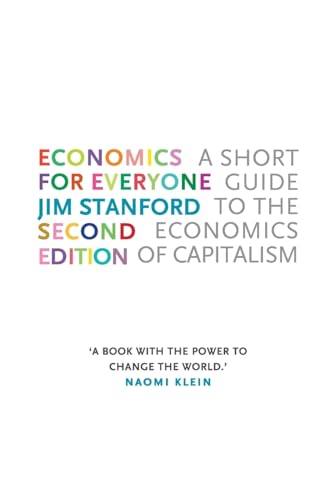
Economics is too important to be left to the economists. This concise and readable book provides non-specialist readers with all the information they need to understand how capitalism works (and how it doesn't). Economics for Everyone, now published in second edition, is an antidote to the abstract and ideological way that economics is normally taught and reported. Key concepts such as finance, competition and wages are explored, and their importance to everyday life is revealed. Stanford answers questions such as "Do workers need capitalists?", "Why does capitalism harm the environment?", and "What really happens on the stock market?" The book will appeal to those working for a fairer world, and students of social sciences who need to engage with economics. It is illustrated with humorous and educational cartoons by Tony Biddle, and is supported with a comprehensive set of web-based course materials for popular economics courses.
Die Inhaltsangabe kann sich auf eine andere Ausgabe dieses Titels beziehen.
Über die Autorin bzw. den Autor
Jim Stanford is Director of the Centre for Future Work, based at the Australia Institute and Honorary Professor of Political Economy at University of Sydney. He writes an economics column for the Globe and Mail, appears regularly on CBC TV's 'Bottom Line' economics panel and is the author of Economics for Everyone (Pluto, 2015).
Auszug. © Genehmigter Nachdruck. Alle Rechte vorbehalten.
Economics for Everyone
A Short Guide to the Economics of Capitalism
By Jim Stanford, Tony BiddlePluto Press
Copyright © 2015 Jim Stanford
All rights reserved.
ISBN: 978-0-7453-3577-3All rights reserved.
Contents
Acknowledgements, ix,
Introduction: Why Study Economics?, 1,
Part One: Preliminaries,
1 The Economy and Economics, 15,
2 Capitalism, 31,
3 Economic History, 41,
4 The Politics of Economics, 52,
Part Two: The Basics of Capitalism: Work, Tools, and Profit,
5 Work, Production, and Value, 63,
6 Working with Tools, 79,
7 Companies, Owners, and Profit, 90,
8 Working for a Living, 105,
9 Reproduction (for Economists!), 118,
10 Closing the Little Circle, 127,
Part Three: Capitalism as a System,
11 Competition, 137,
12 Business Investment, 148,
13 Employment and Unemployment, 158,
14 Inequality and its Consequences, 168,
15 Divide and Conquer, 183,
16 Capitalism and the Environment, 195,
Part Four: The Complexity of Capitalism,
17 Money and Banking, 213,
18 Inflation, Central Banks, and Monetary Policy, 235,
19 Paper Chase: Stock Markets, Financialization, and Pensions, 250,
20 The Conflicting Personalities of Government, 266,
21 Spending and Taxing, 279,
22 Globalization, 296,
23 Development (and Otherwise), 312,
24 Closing the Big Circle, 324,
25 The Ups and Downs of Capitalism, 333,
26 Meltdown and Aftermath, 343,
Part Five: Challenging Capitalism,
27 Evaluating Capitalism, 361,
28 Improving Capitalism, 371,
29 Replacing Capitalism?, 383,
Conclusion: A Baker's Dozen: Key Things to Remember, 399,
Index, 403,
CHAPTER 1
The Economy and Economics
Take a walk
The economy must be a very complicated, volatile thing. At least that's how it seems in the business pages of the newspaper. Mind-boggling stock market tables. Charts and graphs. GDP statistics. Foreign exchange rates. It's little wonder the media turn to economists, the high priests of this mysterious world, to tell us what it means, and why it's important. And we hear from them several times each day – usually via monotonous "market updates" that interrupt the hourly news broadcasts. Company X's shares are up two points; Company Y's are down two points; the analysts are "bullish"; the analysts are "bearish."
But is all that financial hyperactivity really what the economy is about? Is economics really so complex and unintelligible? Should we trust the "experts" and analysts at all? Maybe we should find out what's going on for ourselves.
Forget the market updates. Here's a better way to find out about the economy your economy. Take a walk. And ask some questions.
Start at the front door of your own household. How many people live there? What generations? Who works outside the household, and how much do they earn? How long have they been working there? How long do they plan to keep working, and how will they support themselves when they retire? What kind of work goes on inside the household? How many hours? Is it paid or unpaid, and who does it? Who does which chores? Are there any children? Who cares for them? Does anyone else in your home require care? Do you own your house or apartment, or do you rent it? If you rent it, from whom? If you own it, how did you pay for it? What shape is it in?
Now walk through your neighbourhood, and the next neighbourhood. Are the homes or apartments all roughly the same, or different? Does everyone have a home? Are the homes well-cared-for, or falling apart? Do most people have jobs? What sorts of jobs? Are they well off? Can they comfortably pay for the things they and their families need?
Watch your neighbours going off to work, school, or other destinations. How are they travelling? In their own cars? On public transport? Walking? How much money, time, and physical space is devoted in your neighbourhood to "getting around"?
Is there a school in your neighbourhood? A hospital? A library? Who pays for those buildings? Who works there? How do those public facilities compare with the private homes and businesses around them? Are they newer, or older? Nicer, or shabbier? Is there anywhere a person can go inside in your neighbourhood (other than their own home) without having to pay money or buy something?
Are the streets clean? If so, who cleaned them? Is the air fresh or smoggy? Are there any parks in your neighbourhood? Is there anywhere to play? Can people in your neighbourhood safely drink the water from their taps? How much do they pay for that water? And to whom?
Walk through the nearest shopping district. What kinds of products are displayed in the windows? Were any of them produced locally (say, within 100 miles of your home)? Elsewhere in your country? In another country? Can your neighbours afford what they buy? Are they usually happy with their purchases, or disappointed? Do they pay with cash, bank cards, or credit cards?
Now walk to a local bank branch and see what's happening inside. Compare what you see (deposits, withdrawals, home loans) with the activities you read about in the business pages of the newspaper (leveraged buyouts, financial speculation, foreign exchange). Which matters more to day-to-day life in your neighbourhood?
This is a good time to stop at a café. Pull out a pencil and paper. List your approximate monthly income. Then list how much of it goes to the following categories: rent or mortgage (including utilities); income taxes; car payments or public transport; groceries; other "stuff" (merchandise); and going out (entertainment). Can you comfortably pay your bills each month? Do you regularly save? Is your income higher than it was five years ago, lower, or about the same? Has your income increased faster than the prices of the things you buy? If you had a little more income, what would you do with it? If you walked back to that bank and asked for a loan, would they give you one?
Apart from the places we've mentioned (schools, stores, and banks), what other workplaces are visible in your neighbourhood? Any factories? What do they produce, and what shape are they in? Any professional or government offices? Other services? Can you see any office buildings from your neighbourhood? Who works there? Can you guess what they do? Imagine the conditions in those offices (spaciousness, quality of furnishings, security, caretaking), and compare them to conditions inside your local school. Which would be a nicer place to spend time?
Have any new workplaces opened up recently in your neighbourhood? If so, what do they do? Or did you see any businesses that have closed down? Did you see any "help wanted" signs posted in local workplaces? What kinds of jobs were they advertising for?
Now you can return home. Congratulations! You've done a lot more than just take a stroll. You've conducted a composite economic profile of your own community. It has no statistics, charts, or graphs (though you could add those if you wish, with a bit of work at the local library). Nevertheless, just by walking around your neighbourhood, asking questions, and taking notes, you have identified the crucial factors determining economic affairs in your community:
• Work Who works? Who works inside the home, and works outside the home? Are they employed by someone else (and if so, who?), or do they work for themselves? Do they get paid, and if so, how much? What tools do they use? Are they productive and efficient? Is it...
„Über diesen Titel“ kann sich auf eine andere Ausgabe dieses Titels beziehen.
Suchergebnisse für Economics for Everyone - 2nd edition: A Short Guide...

Beispielbild für diese ISBN
Economics for Everyone: A Short Guide to the Economics of Capitalism
Anbieter: World of Books (was SecondSale), Montgomery, IL, USA
Verkäuferbewertung 5 von 5 Sternen

Paperback. Zustand: Good. Biddle, Tony (illustrator). An introductory and critical guide to how the economy works, and what this means for us. Artikel-Nr. 00102494730
Gebraucht kaufen
EUR 6,12
Versand gratis
Versand innerhalb von USA
Versand innerhalb von USA
Anzahl: 2 verfügbar
Beispielbild für diese ISBN
Economics for Everyone: A Short Guide to the Economics of Capitalism
Anbieter: ThriftBooks-Dallas, Dallas, TX, USA
Verkäuferbewertung 5 von 5 Sternen
Paperback. Zustand: Fair. No Jacket. Biddle, Tony (illustrator). Readable copy. Pages may have considerable notes/highlighting. ~ ThriftBooks: Read More, Spend Less. Artikel-Nr. G0745335772I5N00
Gebraucht kaufen
EUR 6,13
Versand gratis
Versand innerhalb von USA
Versand innerhalb von USA
Anzahl: 1 verfügbar
Beispielbild für diese ISBN
Economics for Everyone: A Short Guide to the Economics of Capitalism
Anbieter: ThriftBooks-Reno, Reno, NV, USA
Verkäuferbewertung 5 von 5 Sternen
Paperback. Zustand: Good. No Jacket. Biddle, Tony (illustrator). Pages can have notes/highlighting. Spine may show signs of wear. ~ ThriftBooks: Read More, Spend Less. Artikel-Nr. G0745335772I3N00
Gebraucht kaufen
EUR 6,13
Versand gratis
Versand innerhalb von USA
Versand innerhalb von USA
Anzahl: 1 verfügbar
Beispielbild für diese ISBN
Economics for Everyone: A Short Guide to the Economics of Capitalism
Anbieter: ThriftBooks-Atlanta, AUSTELL, GA, USA
Verkäuferbewertung 5 von 5 Sternen
Paperback. Zustand: Very Good. No Jacket. Biddle, Tony (illustrator). May have limited writing in cover pages. Pages are unmarked. ~ ThriftBooks: Read More, Spend Less. Artikel-Nr. G0745335772I4N00
Gebraucht kaufen
EUR 6,13
Versand gratis
Versand innerhalb von USA
Versand innerhalb von USA
Anzahl: 1 verfügbar
Beispielbild für diese ISBN
Economics for Everyone: A Short Guide to the Economics of Capitalism
Anbieter: ThriftBooks-Atlanta, AUSTELL, GA, USA
Verkäuferbewertung 5 von 5 Sternen
Paperback. Zustand: Good. No Jacket. Biddle, Tony (illustrator). Pages can have notes/highlighting. Spine may show signs of wear. ~ ThriftBooks: Read More, Spend Less. Artikel-Nr. G0745335772I3N00
Gebraucht kaufen
EUR 6,13
Versand gratis
Versand innerhalb von USA
Versand innerhalb von USA
Anzahl: 1 verfügbar
Beispielbild für diese ISBN
Economics for Everyone: A Short Guide to the Economics of Capitalism
Anbieter: ThriftBooks-Dallas, Dallas, TX, USA
Verkäuferbewertung 5 von 5 Sternen
Paperback. Zustand: Good. No Jacket. Biddle, Tony (illustrator). Pages can have notes/highlighting. Spine may show signs of wear. ~ ThriftBooks: Read More, Spend Less. Artikel-Nr. G0745335772I3N00
Gebraucht kaufen
EUR 6,13
Versand gratis
Versand innerhalb von USA
Versand innerhalb von USA
Anzahl: 1 verfügbar
Beispielbild für diese ISBN
Economics for Everyone, Second Edition : A Short Guide to the Economics of Capitalism
Anbieter: Better World Books, Mishawaka, IN, USA
Verkäuferbewertung 5 von 5 Sternen
Zustand: Good. Biddle, Tony (illustrator). Pages intact with minimal writing/highlighting. The binding may be loose and creased. Dust jackets/supplements are not included. Stock photo provided. Product includes identifying sticker. Better World Books: Buy Books. Do Good. Artikel-Nr. 14008054-20
Gebraucht kaufen
EUR 6,34
Versand gratis
Versand innerhalb von USA
Versand innerhalb von USA
Anzahl: 1 verfügbar
Beispielbild für diese ISBN
Economics for Everyone, Second Edition : A Short Guide to the Economics of Capitalism
Anbieter: Better World Books, Mishawaka, IN, USA
Verkäuferbewertung 5 von 5 Sternen
Zustand: Good. Biddle, Tony (illustrator). Former library copy. Pages intact with minimal writing/highlighting. The binding may be loose and creased. Dust jackets/supplements are not included. Includes library markings. Stock photo provided. Product includes identifying sticker. Better World Books: Buy Books. Do Good. Artikel-Nr. 14599279-6
Gebraucht kaufen
EUR 6,34
Versand gratis
Versand innerhalb von USA
Versand innerhalb von USA
Anzahl: 1 verfügbar
Beispielbild für diese ISBN
Economics for Everyone, Second Edition: A Short Guide to the Economics of Capitalism
Anbieter: WorldofBooks, Goring-By-Sea, WS, Vereinigtes Königreich
Verkäuferbewertung 5 von 5 Sternen
Paperback. Zustand: Very Good. Biddle, Tony (illustrator). The book has been read, but is in excellent condition. Pages are intact and not marred by notes or highlighting. The spine remains undamaged. Artikel-Nr. GOR007627112
Gebraucht kaufen
EUR 6,97
EUR 6,65 Versand
Versand von Vereinigtes Königreich nach USA
Versand von Vereinigtes Königreich nach USA
Anzahl: 2 verfügbar
Beispielbild für diese ISBN
Economics for Everyone - 2nd edition: A Short Guide to the Economics of Capitalism
Anbieter: AwesomeBooks, Wallingford, Vereinigtes Königreich
Verkäuferbewertung 5 von 5 Sternen
Paperback. Zustand: Very Good. Biddle, Tony (illustrator). Economics for Everyone - 2nd edition: A Short Guide to the Economics of Capitalism This book is in very good condition and will be shipped within 24 hours of ordering. The cover may have some limited signs of wear but the pages are clean, intact and the spine remains undamaged. This book has clearly been well maintained and looked after thus far. Money back guarantee if you are not satisfied. See all our books here, order more than 1 book and get discounted shipping. Artikel-Nr. 7719-9780745335773
Gebraucht kaufen
EUR 9,36
EUR 4,89 Versand
Versand von Vereinigtes Königreich nach USA
Versand von Vereinigtes Königreich nach USA
Anzahl: 2 verfügbar