
Verwandte Artikel zu Epic Recession: Prelude to Global Depression
Inhaltsangabe
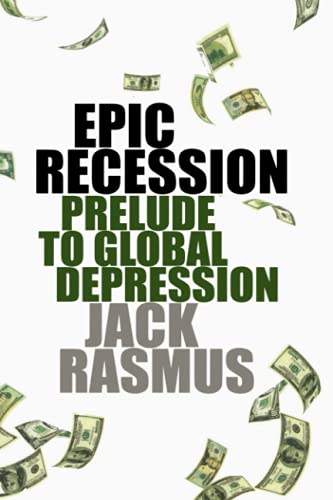
The US is still in deep trouble. Banks are sustained by trillions of government dollars, unemployment is approaching 25 million and the long-term future of the economy is in doubt. In Epic Recession, Jack Rasmus shows that we need a new way of understanding the crisis if things are to improve. Rasmus interrogates US economic history to show that the current predicament is what he terms an 'Epic Recession', neither a full-blown depression or a short-lived period of contraction followed by a swift return to growth. He then shows that the only way to prevent the onset of depression is to radically restructure the economy through a massive job creation program, nationalisations, a fundamentally new kind of banking structure and a long-term redistribution of income through better healthcare and benefit systems. Epic Recession provides a rallying point for trade unionists and concerned citizens who want to ensure that any recovery is felt further than Wall street.
Die Inhaltsangabe kann sich auf eine andere Ausgabe dieses Titels beziehen.
Über die Autorinnen und Autoren
Jack Rasmus is a Professor of Economics at St Marys College and Santa Clara University, both in California. He is a freelance economics journalist and author of Epic Recession: Prelude to Global Depression (Pluto, 2010). He has been a business economist, market analyst and vice-president of the National Writers Union.
Jack Rasmus is a Professor of Economics at St Marys College and Santa Clara University, both in California. He is a freelance economics journalist and author of Epic Recession: Prelude to Global Depression (Pluto, 2010). He has been a business economist, market analyst and vice-president of the National Writers Union.
Auszug. © Genehmigter Nachdruck. Alle Rechte vorbehalten.
Epic Recession
Prelude to Global Depression
By Jack RasmusPluto Press
Copyright © 2010 Jack Rasmus
All rights reserved.
ISBN: 978-0-7453-2998-7All rights reserved.
Contents
Introduction: Epic Recession — Past, Present, and Prologue,
PART ONE: THEORY,
1 Quantitative Characteristics of Epic Recession,
2 Qualitative Characteristics of Epic Recession,
3 The Dynamics of Epic Recession,
PART TWO: HISTORY,
4 U.S. Depressions in the Nineteenth Century,
5 'Type I' Epic Recession: 1907–14,
6 'Type II' Epic Recession: 1929–31,
PART THREE: EPIC RECESSION, 2007–10,
7 The Epic Recession of 2007–10,
8 The Bush–Obama Recovery Programs,
9 An Alternative Program for Economic Recovery,
Glossary of Key Terms,
Notes,
Index,
CHAPTER 1
Quantitative Characteristics of Epic Recession
Chapter 1 and Chapter 2 that follows together provide a preliminary definition of 'Epic Recession.' These chapters identify and describe static characteristics that differentiate Epic Recessions from 'normal' recessions or a depression. Chapter 3 will describe dynamic characteristics that further distinguish Epic Recessions from normal recessions or depression.
Static characteristics may be either quantitative or qualitative. If quantitative, the question arises, what is the magnitude of a characteristic necessary to qualify as 'Epic'— in contrast to a lesser magnitude in the case of a normal recession or greater magnitude in the case of a depression? And if qualitative, what are the characteristics that are unique to Epic Recessions that are not present in cases of normal recessions, or are absent in cases of Epic Recession but occur in depressions? Differences in both magnitude (quantitative) and/or uniqueness (qualitative) therefore serve as essential starting points for distinguishing Epic Recessions from normal recessions and depressions.
THREEFOLD CHARACTERISTICS OF EPIC RECESSION
This chapter considers five important quantitative characteristics that differentiate Epic Recessions from normal recessions. They include the depth of the economic decline, its duration, and levels or degrees of debt, deflation, and default.
The qualitative characteristics addressed in Chapter 2 include financial instability and fragility, a large shadow banking system, consumption fragility, a shift to speculative investing relative to traditional forms of investing, and global synchronization of the crisis.
Dynamic characteristics of Epic Recession discussed in Chapter 3 include several sets of particular relationships that are complex and interdependent. These include relationships and interdependencies between speculative and non-speculative forms of investing; between speculative investing and debt; between debt, deflation, and default; between defaults and financial and consumption fragility; and, finally, between government fiscal and monetary policies and the key processes of debt–deflation–default and fragility. The dynamic characteristics thus focus heavily on the processes by which quantitative and qualitative characteristics mutually determine each other in various causal relationships, transmission mechanisms, and feedback processes.
Of the five quantitative characteristics addressed in this chapter, the first two — depth and duration — are primarily descriptive. They describe the degree to which Epic Recessions differ from normal recessions. That is, Epic Recessions are more severe in terms of both their depth of decline and their duration than are normal recessions. More severe as well are the remaining three quantitative characteristics: debt, deflation, and default. However, these latter three are important to Epic Recession in more than just degree of severity. They are central, and distinguish Epic Recession for more fundamental reasons as well. Epic Recessions are set in motion by financial instability and crisis. As will be shown, this is quite unlike normal recessions, which are not precipitated by financial instability and crisis. It is the accumulation of debt and price inflation that create the financial fragility that leads to the financial crisis event. Moreover, once the financial crisis erupts and evolves, it is once again debt and price that play a key role. Specifically, it is now the reversal — i.e. the unwinding of debt and now price deflation — that results in the deepening and spread of default — bank, non-bank business, and consumer alike — that subsequently drives the real economy into Epic Recession. Thus, it is not simply that debt–deflation–default are more severe in terms of level or degree in the case of Epic Recession compared to normal recession. The three characteristics are also critical elements that, along with other key elements described shortly, drive a transition to Epic Recession. In a sense, therefore, it is debt, deflation and default that in turn produce the more severe depth and duration characteristics associated with Epic Recession.
Of course, even more fundamental are those forces that produce the excessive debt accumulation and price inflation in the first place, creating a condition of financial fragility that ultimately provokes the financial crisis. As will be discussed in more detail in the next two chapters, the key to the more fundamental forces is the major shift to speculative forms of investing and the growing weight and mix of those forms compared to non-speculative forms of investment in the economy. Understanding what underlies that speculative shift takes analysis even deeper. And once the financial crisis has erupted and the transition to Epic Recession has begun, on the 'downside' or the 'bust phase' of decline yet more forces begin to play a contributing role to the transition to Epic Recession as well. But more on all that subsequently. For the remainder of this chapter, it is necessary first to understand simply in a static sense how debt–deflation–default, and depth and duration, are characteristics of Epic Recession.
QUANTITATIVE CHARACTERISTICS OF EPIC RECESSION
The characteristics of depth are measurable in several possible ways. This chapter identifies five such ways or indicators by which to distinguish depth in an Epic Recession: gross domestic product (GDP), employment, industrial production, exports, and the stock market.
The duration characteristics are measured in terms of what is called the 'peak to trough' of an economic decline — i.e. how long in months or quarters that the decline continues from its immediate pre-recession high point to its recession lowest point, and thereafter how long it takes from the low point to return to the previous high point. The 'peak to trough' to recovery may describe a recession either as a 'V', an 'L', a 'U', or a 'W' in duration terms. 'V' represents a sharp decline and just as sharp a recovery; 'L' a long-term stagnation following the initial decline; 'U' a decline followed by a lengthy period before recovery; and 'W' a double-dip decline, followed by recovery, followed by another decline and recovery.
The debt characteristic is defined as total debt, which includes public debt (federal, state, and local government), consumer debt, and business debt — the latter of which can be segmented in turn into bank and non-bank business debt. Whether the debt is short term or long term in its payment structure is also a factor, as is the...
„Über diesen Titel“ kann sich auf eine andere Ausgabe dieses Titels beziehen.
Suchergebnisse für Epic Recession: Prelude to Global Depression

Beispielbild für diese ISBN
Epic Recession: Prelude to Global Depression
Anbieter: World of Books (was SecondSale), Montgomery, IL, USA
Verkäuferbewertung 5 von 5 Sternen

Zustand: Very Good. Item in very good condition! Textbooks may not include supplemental items i.e. CDs, access codes etc. Artikel-Nr. 00103422080
Gebraucht kaufen
EUR 6,06
Versand gratis
Versand innerhalb von USA
Versand innerhalb von USA
Anzahl: 1 verfügbar
Beispielbild für diese ISBN
Epic Recession: Prelude to Global Depression
Anbieter: World of Books (was SecondSale), Montgomery, IL, USA
Verkäuferbewertung 5 von 5 Sternen
Zustand: Good. Item in good condition and has highlighting/writing on text. Used texts may not contain supplemental items such as CDs, info-trac etc. Artikel-Nr. 00104723765
Gebraucht kaufen
EUR 6,06
Versand gratis
Versand innerhalb von USA
Versand innerhalb von USA
Anzahl: 1 verfügbar
Beispielbild für diese ISBN
Epic Recession: Prelude to Global Depression
Anbieter: ThriftBooks-Atlanta, AUSTELL, GA, USA
Verkäuferbewertung 5 von 5 Sternen
Paperback. Zustand: Very Good. No Jacket. May have limited writing in cover pages. Pages are unmarked. ~ ThriftBooks: Read More, Spend Less. Artikel-Nr. G0745329985I4N00
Gebraucht kaufen
EUR 7,05
Versand gratis
Versand innerhalb von USA
Versand innerhalb von USA
Anzahl: 1 verfügbar
Beispielbild für diese ISBN
Epic Recession: Prelude to Global Depression
Anbieter: Better World Books: West, Reno, NV, USA
Verkäuferbewertung 5 von 5 Sternen
Zustand: Very Good. Pages intact with possible writing/highlighting. Binding strong with minor wear. Dust jackets/supplements may not be included. Stock photo provided. Product includes identifying sticker. Better World Books: Buy Books. Do Good. Artikel-Nr. 7871521-6
Gebraucht kaufen
EUR 7,12
Versand gratis
Versand innerhalb von USA
Versand innerhalb von USA
Anzahl: 1 verfügbar
Beispielbild für diese ISBN
Epic Recession: Prelude to Global Depression
Anbieter: World of Books (was SecondSale), Montgomery, IL, USA
Verkäuferbewertung 5 von 5 Sternen
Zustand: Good. Item in good condition and has highlighting/writing on text. Used texts may not contain supplemental items such as CDs, info-trac etc. Artikel-Nr. 00087537453
Gebraucht kaufen
EUR 9,70
Versand gratis
Versand innerhalb von USA
Versand innerhalb von USA
Anzahl: 1 verfügbar
Beispielbild für diese ISBN
Epic Recession: Prelude to Global Depression
Anbieter: Better World Books Ltd, Dunfermline, Vereinigtes Königreich
Verkäuferbewertung 5 von 5 Sternen
Zustand: Good. Former library copy. Pages intact with minimal writing/highlighting. The binding may be loose and creased. Dust jackets/supplements are not included. Includes library markings. Stock photo provided. Product includes identifying sticker. Better World Books: Buy Books. Do Good. Artikel-Nr. 42442810-20
Gebraucht kaufen
EUR 7,08
EUR 5,83 Versand
Versand von Vereinigtes Königreich nach USA
Versand von Vereinigtes Königreich nach USA
Anzahl: 1 verfügbar
Beispielbild für diese ISBN
Epic Recession
Anbieter: Majestic Books, Hounslow, Vereinigtes Königreich
Verkäuferbewertung 4 von 5 Sternen

Zustand: New. pp. 352. Artikel-Nr. 8028774
Neu kaufen
EUR 27,33
EUR 7,57 Versand
Versand von Vereinigtes Königreich nach USA
Versand von Vereinigtes Königreich nach USA
Anzahl: 1 verfügbar
Beispielbild für diese ISBN
Epic Recession: Prelude to Global Depression
Anbieter: Pearlydewdrops, Streat, Vereinigtes Königreich
Verkäuferbewertung 5 von 5 Sternen
Paperback. Zustand: Fine. Some slight shelf wear to surface and corners of cover and to closed edge, otherwise a new and unread book Shipped from the UK within 2 business days of order being placed. Artikel-Nr. mon0000050668
Gebraucht kaufen
EUR 13,20
EUR 25,63 Versand
Versand von Vereinigtes Königreich nach USA
Versand von Vereinigtes Königreich nach USA
Anzahl: 1 verfügbar
Beispielbild für diese ISBN
Epic Recession
Anbieter: Romtrade Corp., STERLING HEIGHTS, MI, USA
Verkäuferbewertung 5 von 5 Sternen
Zustand: New. This is a Brand-new US Edition. This Item may be shipped from US or any other country as we have multiple locations worldwide. Artikel-Nr. ABBB-185211
Foto des Verkäufers
Epic Recession: Prelude to Global Depression.
Anbieter: Kloof Booksellers & Scientia Verlag, Amsterdam, Niederlande
Verkäuferbewertung 4 von 5 Sternen
Zustand: very good. London : Pluto Press, 2010. Paperback. 340 pp.Book DescriptionThe US is still in deep trouble. Banks are sustained by trillions of government dollars, unemployment is approaching 25 million and the long-term future of the economy is in doubt. In Epic Recession, Jack Rasmus shows that we need a new way of understanding the crisis if things are to improve. Rasmus interrogates US economic history to show that the current predicament is what he terms an 'Epic Recession', neither a full-blown depression or a short-lived period of contraction followed by a swift return to growth. He then shows that the only way to prevent the onset of depression is to radically restructure the economy through a massive job creation program, nationalisations, a fundamentally new kind of banking structure and a long-term redistribution of income through better healthcare and benefit systems. Epic Recession provides a rallying point for trade unionists and concerned citizens who want to ensure that any recovery is felt further than Wall street.English text. Condition : very good. Condition : very good copy. ISBN 9780745329987. Keywords : , Artikel-Nr. 41773
Gebraucht kaufen
EUR 16,95
EUR 30,00 Versand
Versand von Niederlande nach USA
Versand von Niederlande nach USA
Anzahl: 1 verfügbar