
Verwandte Artikel zu No Way to Run an Economy: Why the System Failed and...
Inhaltsangabe
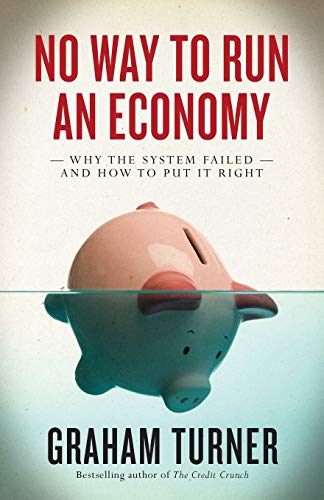
In The Credit Crunch, Graham Turner predicted that banks would be nationalised and interest rates would be reduced too slowly to halt the crisis. His predictions were correct. His new book, No Way to Run an Economy, is the essential guide to the turbulent times ahead. Turner recommended radical measures, such as quantitative easing, in early 2008 but argues that action has been taken too late and been too timid to make a real difference. He dissects the policy mistakes of the last 12 months including Obama's doomed market-led response to the crisis and the obsession of central banks with the red herring of inflation. There is no doubt the economy is still in serious trouble, but Turner shows that learning from the mistakes made so far can prevent a situation worse than that of the 1930s crisis.
Die Inhaltsangabe kann sich auf eine andere Ausgabe dieses Titels beziehen.
Über die Autorin bzw. den Autor
Graham Turner is the founder of GFC Economics an independent economic consultancy which provides forecasting services for some of the world's largest banks. He has worked in the financial sector for over 20 years and is the author of The Credit Crunch (Pluto, 2008) and No Way to Run an Economy (Pluto, 2009).
Auszug. © Genehmigter Nachdruck. Alle Rechte vorbehalten.
No Way to Run an Economy
Why the System Failed and How to Put it Right
By Graham TurnerPluto Press
Copyright © 2009 Graham Turner
All rights reserved.
ISBN: 978-0-7453-2976-5All rights reserved.
Contents
List of Tables and Figures, vi,
Glossary, ix,
GFC Economics, xiii,
Acknowledgements, xiv,
Introduction, 1,
1 From Bear Stearns to Recession, 12,
2 Learning from the Great Depression, 43,
3 Policy Mistakes in the 2008/09 Bear Market, 63,
4 Globalisation and the Race to the Bottom, 97,
5 Structural Causes of the Recession, 112,
6 A Flawed Economic System?, 140,
7 Obama's Crisis?, 148,
8 Breaking with the Past, 163,
Notes, 178,
Index, 213,
CHAPTER 1
FROM BEAR STEARNS TO RECESSION
'Time is running out for the Federal Reserve' was the blunt assessment in early April 2008 as The Credit Crunch went to print. Borrowing costs, in particular mortgage rates, had to be targeted and driven lower, through a mixture of deep rate cuts and quantitative easing. Otherwise, more banks would fail and depression could follow recession. Delay would prove costly.
Governments and central banks had to act quickly to prevent debt deflation from taking root. But after a bankrupt Bear Stearns had been sold to JP Morgan in March 2008, policymakers and politicians sat back. They did little to arrest the downward spiral in house prices and the inevitable slide into deep recession. Bear Stearns was a one-off, they thought. They switched tack, fretting about inflation when the real threat was the Japanese curse of falling prices and multiple banking failures.
That was hard to square with the evidence. By the time the US had lost the first of its five major investment banks, 238 mortgage companies had already gone out of business. More banks were certain to fail if the Federal Reserve did not try to stabilise the property market. Bad debts would continue to accumulate causing shareholders to flee banks and sparking depositor runs.
Federal Reserve Chair Ben Bernanke has since claimed that the Federal Reserve 'responded aggressively to the crisis since its emergence in the summer of 2007'. The policy response was 'exceptionally rapid and proactive' in historical comparison, he has argued.
The Fed had allowed money supply to contract during 1930 and 1931, amplifying the initial fallout of the stock market crash a year earlier and turning a recession into depression. The contrast with the supposedly more proactive policy adopted from the summer of 2007 onwards showed the Fed had learnt the lessons that would prevent another economic slump.
In reality, Ben Bernanke's Fed made precisely the same mistakes that fuelled the Great Depression. Huge numbers of banks defaulted a year after the stock market crash in 1929, notably in Missouri, Indiana, Illinois, Iowa, Arkansas and North Carolina. In November 1930, 256 banks failed and a month later another 352 banks collapsed, including the Bank of United States. Very little was done to prevent their demise.
The decline in money supply was driven by the loss of these banks. As they failed, credit suddenly became scarce and the decline in asset prices accelerated. More banks collapsed and the economy spiralled deeper into recession.
In this critical respect, the latter months of 2006 and early 2007 were no different from 1930 or 1931. The implosion of so many mortgage originators from 2006 onwards similarly accelerated the decline in the availability of credit. The failure of the Federal Reserve to act when these lenders collapsed turned what might have been a soft landing into a crash.
Indeed, it is perhaps notable that Ben Bernanke claims the summer of 2007 marks the starting point of the crisis. For many financial market participants the crisis began in February 2007 following profit warnings in the US from HSBC and New Century Financial. For huge numbers of US homeowners struggling to meet debt repayments, the problems started two years before that. Indeed, sub-prime borrowers were in trouble even before interest rates started to rise during 2004.
Federal Reserve data should have alerted the US authorities to the risks of a hard landing. At the peak of the boom in Q3 2005, $631.5 billion of new mortgage-backed bonds were issued to fund the lending frenzy. Throughout 2006, the pace of issuance dropped progressively. By the third quarter of 2006, it had already fallen by nearly a fifth. As mortgage originators started to fold, issuance fell sharply in the final quarter, by just over a third from a year earlier. And it carried on sliding during the first half of 2007.
By the third quarter of 2007, the disappearance of so many lenders, combined with a reluctance of investors to buy mortgage bonds, had caused issuance to collapse to minus $232.4 billion (see Figure 1.1). Mortgage funding from these bonds – a critical driver of the housing boom – had not just slowed. It was contracting.
This was a stunning reversal and without precedent in modern times. It represented a shrinkage and collapse of money supply similar to that seen in the first year of the Great Depression. History was repeating itself.
The Inflation 'Crisis'
The Federal Reserve governors of 1930 and 1931 were also unwilling to support the banks. They tended to view bank failures as 'regrettable consequences of bad management and bad banking practices'. They were also 'beholden' to the Gold Standard because it was considered to be the ultimate bulwark against inflation.
The Fed of 2007 and 2008 overestimated the inflation risks too, with tragic consequences for millions who would lose their jobs and homes. The Fed was not alone. The Bank of England and the European Central Bank also failed to comprehend the true threat facing the world economy.
Superficially, it did appear as if the policymakers had a point. By March 2008, inflation had risen to 4.0 per cent in the US, 2.4 per cent in the UK and 3.5 per cent in Euroland. Oil and food prices were soaring. Over the summer, inflation would climb to a high of 5.6 per cent in the US. It would more than double in the UK, rising to 5.2 per cent by September. And in Euroland, it would accelerate to more than twice the European Central Bank's target, jumping to 4.1 per cent by July.
The debate over runaway commodity prices was polarised. Some saw this as a manifestation of loose monetary policies in the West and particularly emerging market economies. Central banks in the West would have to hike interest rates further, it was claimed, to compensate for the unwillingness of policymakers to tame a surge in inflation across emerging market economies. Across Eastern Europe, Asia, Latin America, the Middle East and Africa, inflation was accelerating, climbing well into double digits in many countries.
Some economists highlighted the specific supply problems that had contributed to big cost increases. Peak Oil, the growth of biofuels and climate change were held responsible for the surge in energy and food costs. However, metals and other non-food and energy commodity prices were also rising sharply in response to strong emerging market demand.
But the longer-term or secular threat to inflation was far from clear-cut. Much of the rapid growth in emerging market demand reflected domestic credit bubbles that in many cases were more extreme than in the West. When they burst, demand for commodities would collapse taking prices down swiftly.
And so it proved. Having more than doubled in three years, base metal prices finally...
„Über diesen Titel“ kann sich auf eine andere Ausgabe dieses Titels beziehen.
Suchergebnisse für No Way to Run an Economy: Why the System Failed and...

Beispielbild für diese ISBN
No Way to Run an Economy: Why the System Failed and How to Put It Right : Why the System Failed and How to Put It Right
Anbieter: Better World Books Ltd, Dunfermline, Vereinigtes Königreich
Verkäuferbewertung 5 von 5 Sternen

Zustand: Very Good. Pages intact with possible writing/highlighting. Binding strong with minor wear. Dust jackets/supplements may not be included. Stock photo provided. Product includes identifying sticker. Better World Books: Buy Books. Do Good. Artikel-Nr. GRP69137683
Gebraucht kaufen
EUR 5,74
EUR 5,92 Versand
Versand von Vereinigtes Königreich nach USA
Versand von Vereinigtes Königreich nach USA
Anzahl: 1 verfügbar
Beispielbild für diese ISBN
No Way to Run an Economy: Why the System Failed and How to Put It Right
Anbieter: Reuseabook, Gloucester, GLOS, Vereinigtes Königreich
Verkäuferbewertung 5 von 5 Sternen
Paperback. Zustand: Used; Very Good. Dispatched, from the UK, within 48 hours of ordering. Though second-hand, the book is still in very good shape. Minimal signs of usage may include very minor creasing on the cover or on the spine. Artikel-Nr. CHL1628897
Gebraucht kaufen
EUR 5,74
EUR 8,29 Versand
Versand von Vereinigtes Königreich nach USA
Versand von Vereinigtes Königreich nach USA
Anzahl: 1 verfügbar
Beispielbild für diese ISBN
No Way to Run an Economy: Why the System Failed and How to Put It Right
Anbieter: medimops, Berlin, Deutschland
Verkäuferbewertung 5 von 5 Sternen
Zustand: good. Befriedigend/Good: Durchschnittlich erhaltenes Buch bzw. Schutzumschlag mit Gebrauchsspuren, aber vollständigen Seiten. / Describes the average WORN book or dust jacket that has all the pages present. Artikel-Nr. M00745329764-G
Gebraucht kaufen
EUR 4,37
EUR 10,00 Versand
Versand von Deutschland nach USA
Versand von Deutschland nach USA
Anzahl: 1 verfügbar
Foto des Verkäufers
No Way to Run an Economy
Anbieter: Hamelyn, Madrid, M, Spanien
Verkäuferbewertung 5 von 5 Sternen
Zustand: Very Good. : En este libro, Graham Turner ofrece una guía esencial para comprender las causas de la crisis económica global y los errores políticos que llevaron al mundo a una situación de depresión. A través de un análisis detallado, el autor examina las respuestas fallidas de los gobiernos y bancos centrales, argumentando que las medidas tomadas fueron insuficientes y tardías. Turner, quien predijo con precisión eventos clave como la nacionalización de bancos, propone lecciones fundamentales para evitar que la crisis se agrave y supere los niveles de la Gran Depresión de los años 30. Es una obra imprescindible para quienes buscan entender la complejidad del sistema financiero y las políticas necesarias para su recuperación. EAN: 9780745329765 Tipo: Libros Categoría: Negocios y Economía Título: No Way to Run an Economy Autor: Graham Turner Editorial: Pluto Press Idioma: en Páginas: 240 Formato: tapa blanda. Artikel-Nr. Happ-2026-09-15-1d880cb6
Gebraucht kaufen
EUR 7,33
EUR 11,99 Versand
Versand von Spanien nach USA
Versand von Spanien nach USA
Anzahl: 1 verfügbar
Beispielbild für diese ISBN
No Way to Run an Economy: Why the System Failed and How to Put It Right
Anbieter: HR1 Books, Hereford, Vereinigtes Königreich
Verkäuferbewertung 5 von 5 Sternen
paperback. Zustand: Fine. Same / next day dispatch (Monday - Friday), Artikel-Nr. mon0000105235
Gebraucht kaufen
EUR 5,07
EUR 18,35 Versand
Versand von Vereinigtes Königreich nach USA
Versand von Vereinigtes Königreich nach USA
Anzahl: 1 verfügbar
Beispielbild für diese ISBN
No Way to Run an Economy: Why the System Failed and How to Put it Right
Anbieter: Majestic Books, Hounslow, Vereinigtes Königreich
Verkäuferbewertung 4 von 5 Sternen

Zustand: New. pp. 240. Artikel-Nr. 8028787
Neu kaufen
EUR 16,91
EUR 7,69 Versand
Versand von Vereinigtes Königreich nach USA
Versand von Vereinigtes Königreich nach USA
Anzahl: 4 verfügbar
Beispielbild für diese ISBN
No Way to Run an Economy - Why the System Failed and How to Put It Right
Anbieter: PBShop.store UK, Fairford, GLOS, Vereinigtes Königreich
Verkäuferbewertung 5 von 5 Sternen
PAP. Zustand: New. New Book. Shipped from UK. Established seller since 2000. Artikel-Nr. FW-9780745329765
Neu kaufen
EUR 28,08
EUR 4,92 Versand
Versand von Vereinigtes Königreich nach USA
Versand von Vereinigtes Königreich nach USA
Anzahl: 15 verfügbar
Beispielbild für diese ISBN
No Way to Run an Economy How the World Slipped into Depression
Anbieter: Romtrade Corp., STERLING HEIGHTS, MI, USA
Verkäuferbewertung 5 von 5 Sternen
Zustand: New. This is a Brand-new US Edition. This Item may be shipped from US or any other country as we have multiple locations worldwide. Artikel-Nr. ABBB-36820
Beispielbild für diese ISBN
No Way To Run An Economy: Why The System Failed And How To Put It Right
Anbieter: Romtrade Corp., STERLING HEIGHTS, MI, USA
Verkäuferbewertung 5 von 5 Sternen
Zustand: New. This is a Brand-new US Edition. This Item may be shipped from US or any other country as we have multiple locations worldwide. Artikel-Nr. ABBB-187746
Beispielbild für diese ISBN
No Way to Run an Economy: Why the System Failed and How to Put It Right: Why the System Failed and How to Put It Right
Anbieter: Ria Christie Collections, Uxbridge, Vereinigtes Königreich
Verkäuferbewertung 5 von 5 Sternen
Zustand: New. In English. Artikel-Nr. ria9780745329765_new
Neu kaufen
EUR 42,08
EUR 11,09 Versand
Versand von Vereinigtes Königreich nach USA
Versand von Vereinigtes Königreich nach USA
Anzahl: Mehr als 20 verfügbar