
Verwandte Artikel zu Tourism, Globalization and Development: Responsible...
Inhaltsangabe
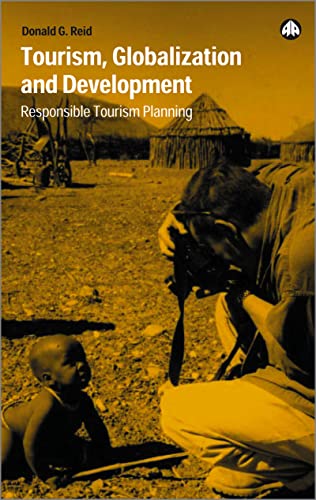
Tourism is booming worldwide -- it makes up a massive part of the global economy. Donald G., Reid's book focuses on tourism in developing and less-developed countries. He examines its social and environmental impact and offers a timely critical analysis of the part it plays in globalization. Many of the world's poorest countries rely on the tourist trade for the major part of their income. However, all too often, the local communities involved do not reap the benefits of this trade. Developers often exclude local communities from the initial planning and decision-making process, viewing them either as a benign resource to be exploited, or as an impediment. Reid presents a rigourous critique of corporate-led tourism development and lays out alternatives that would give planning and control to the local communities involved. He argues that only in this way can the vastly differing requirments of each community be addressed, and social and environmental issues can be dealt with properly. The book includes a discussion of macro planning theory, and offers three case studies of locally controlled projects that show clearly how communities developing a tourist trade can benefit from it.
Die Inhaltsangabe kann sich auf eine andere Ausgabe dieses Titels beziehen.
Über die Autorin bzw. den Autor
Donald G. Reid is professor and former Director of the School of Rural Planning and Development, Faculty of Environmental Design and Development, University of Guelph, Canada.
Auszug. © Genehmigter Nachdruck. Alle Rechte vorbehalten.
Tourism, Globalization and Development
Responsible Tourism Planning
By Donald G. ReidPluto Press
Copyright © 2003 Donald G. Reid
All rights reserved.
ISBN: 978-0-7453-1998-8All rights reserved.
Contents
List of Tables and Figures, viii,
Acknowledgements, ix,
1 INTRODUCTION, 1,
2 GLOBALIZATION AND THE POLITICAL ECONOMY OF TOURISM DEVELOPMENT, 26,
3 TOURISM AS A FUNCTION OF DEVELOPMENT STUDIES, 67,
4 CONCEPTS OF TOURISM, 102,
5 PLANNING AND DEVELOPMENT THEORIES AND THEIR RELATION TO TOURISM DEVELOPMENT, 120,
6 THE NORMATIVE VIEW OF TOURISM PLANNING, 144,
7 CASE STUDIES IN TOURISM PLANNING, 182,
8 THE INTEGRATION OF TOURISM WITHIN GENERAL DEVELOPMENT, 224,
Bibliography, 237,
Index, 244,
CHAPTER 1
Introduction
TOURISM AND DEVELOPMENT
Tourism is a dynamic force homogenizing societies and commodifying cultures across the globe. It is promoted as a positive means of economic development for the many countries and communities who have lost their traditional industries, or for those who simply hope to improve their general economic condition. Historically, however, tourism has not been a positive experience for all parties engaged in the development process, or treated all stakeholders in the enterprise equally. While trans-national corporations and entrepreneurs benefit greatly from tourism development, local people often bear the cost of that development without adequate reward. In an attempt to expose these inadequacies and subsequently set out a different course, this book provides a critique of the tourism development process as it has developed historically. This critique is followed by a practical guide to the future development of the industry. It stresses the role of community as the foundation on which tourism development must be constructed if it is to achieve the results proponents suggest are important to society. Tourism is analyzed here from the point of view of holistic development, and the constraints placed on its sustainability by corporate globalization are examined.
After the dramatic attacks on the World Trade Center and the Pentagon on September 11, 2001, President George W. Bush announced that 'those responsible will be brought to justice, or justice will be brought to them'. At first blush this may seem to most US citizens like an appropriate response – particularly to those personally affected by the disaster, and their allies across the globe. However, it is recognized by many that this attitude will not deal with the root causes of the problem that provoked the incident in the first place, nor with what has been described as the worldwide rise of terrorism. Some scholars, including McMurtry (1999), argue that these types of event are incubated by what he calls the 'cancer stage of capitalism', and by the rise of trans-national corporate hegemony, leaving a single superpower dominating the world. Democracy is viewed from many parts of the world as skewed in favor of the rich and powerful. In his book Jihad vs McWorld: Terrorism's Challenge to Democracy, Benjamin Barber wrote:
If democracy is to be the instrument by which the world avoids the stark choice between a sterile cultural monism (McWorld) and a raging cultural fundamentalism (Jihad), neither of which services diversity or civic liberty, then America, Britain, and their allies will have to open a crucial second civic and democratic front aimed not against terrorism per se but against the anarchism and social chaos – the economic reductionism and its commercializing homogeneity – that have created the climate of despair and hopelessness that terrorism has so effectively exploited. A second democratic front will be advanced not only in the name of retributive justice and secularist interests, but in the name of distributive justice ...
(Barber, 1995: xiii)
This book is about the achievement of distributive justice through the development of tourism. However, at present tourism is a major force in the organization of 'McWorld', both symbolically and practically. It is a worldwide phenomenon dominated by transnational corporations, which both exports the culture of the West to developing countries, and – perhaps more importantly – drains the developing world of its resources, including capital. Tourism is a product of the hegemony of the West, and demonstrates both the rising difference in the conditions of material subsistence between wealthy and poor nations, and the growing Third World conditions found in many parts of the wealthy nations themselves. It is often the poorest people living in these already underprivileged circumstances who provide labor to the tourism industry across the globe. Employment in tourism provides a meager living to its workers, rarely allowing them to lift themselves beyond conditions of social marginalization and poverty. For distributive justice to be achieved, tourism will have to develop a new approach in both its planning and development processes, producing a project that would look very different to the one prevailing at present.
This book provides a critique of the principles on which tourism is structured at present, and presents an alternative prescription for tourism development, designed to address more directly the goal of distributive justice. The priorities of community planning and control are given greater importance in this new design, as opposed to the prerogatives of the trans-national corporation.
Economic globalization affects all countries and continents. Corporate globalization has been legitimized by the collapse of the Soviet Union and the supposed triumph of capitalism over socialism. Without a global counter-force, capital enjoys free rein to exploit labor and other resources in all corners of the globe. This exploitation is supported by the mantra of development, supposedly for the benefit of those who are left behind by the economic advances and increased standard of living created in the industrialized world. Tourism is advanced by businesses and governments alike as a development mechanism which can lift people out of poverty and make them equal partners in society. But regardless of how altruistic this claim may sound, it is doubtful whether those who are intended to benefit – at least according to the rhetoric – have gained nearly as much as those promoting tourism through corporate globalization. While no one can condone the carnage of the events of September 11, they must be viewed as a rejection of corporate globalization and the exploitation taking place across the globe, and not simply as the actions of a few deranged individuals, as some would have us believe. As Barber suggests, referring to public attitudes towards these events throughout the developing world, 'their quarrel is not with modernity but with the aggressive neo-liberal ideology that has been prosecuted in its name in pursuit of global market society more conducive to profits for some than to justice for all'. (Barber, 1995: xv)
The tourism sector is tied closely to the globalizing force which pursues profits over justice. In fact, tourism is one of the main products being globalized, while some even argue that it is one of the main forces driving globalization (Brown, 1998; George, 2002). While globalization is made possible by the drive of capitalism to expand and grow, and by the development and pervasiveness of new technologies, tourism is one of the important beneficiaries and vehicles of its expression. New technologies such as the internet and air travel have...
„Über diesen Titel“ kann sich auf eine andere Ausgabe dieses Titels beziehen.
Suchergebnisse für Tourism, Globalization and Development: Responsible...

Beispielbild für diese ISBN
Tourism, Globalization and Development: Responsible Tourism Planning
Anbieter: AwesomeBooks, Wallingford, Vereinigtes Königreich
Verkäuferbewertung 5 von 5 Sternen

Paperback. Zustand: Very Good. Tourism, Globalization and Development: Responsible Tourism Planning This book is in very good condition and will be shipped within 24 hours of ordering. The cover may have some limited signs of wear but the pages are clean, intact and the spine remains undamaged. This book has clearly been well maintained and looked after thus far. Money back guarantee if you are not satisfied. See all our books here, order more than 1 book and get discounted shipping. Artikel-Nr. 7719-9780745319988
Gebraucht kaufen
EUR 5,02
EUR 4,86 Versand
Versand von Vereinigtes Königreich nach USA
Versand von Vereinigtes Königreich nach USA
Anzahl: 2 verfügbar
Beispielbild für diese ISBN
Tourism, Globalization and Development: Responsible Tourism Planning
Anbieter: Better World Books Ltd, Dunfermline, Vereinigtes Königreich
Verkäuferbewertung 5 von 5 Sternen
Zustand: Good. Pages intact with minimal writing/highlighting. The binding may be loose and creased. Dust jackets/supplements are not included. Stock photo provided. Product includes identifying sticker. Better World Books: Buy Books. Do Good. Artikel-Nr. 19153791-6
Gebraucht kaufen
EUR 5,70
EUR 5,89 Versand
Versand von Vereinigtes Königreich nach USA
Versand von Vereinigtes Königreich nach USA
Anzahl: 1 verfügbar
Beispielbild für diese ISBN
Tourism, Globalization and Development: Responsible Tourism Planning
Anbieter: Better World Books Ltd, Dunfermline, Vereinigtes Königreich
Verkäuferbewertung 5 von 5 Sternen
Zustand: Good. Former library copy. Pages intact with minimal writing/highlighting. The binding may be loose and creased. Dust jackets/supplements are not included. Includes library markings. Stock photo provided. Product includes identifying sticker. Better World Books: Buy Books. Do Good. Artikel-Nr. 19137074-20
Gebraucht kaufen
EUR 5,70
EUR 5,89 Versand
Versand von Vereinigtes Königreich nach USA
Versand von Vereinigtes Königreich nach USA
Anzahl: 1 verfügbar
Beispielbild für diese ISBN
Tourism, Globalization and Development: Responsible Tourism Planning
Anbieter: Better World Books Ltd, Dunfermline, Vereinigtes Königreich
Verkäuferbewertung 5 von 5 Sternen
Zustand: Very Good. Former library copy. Pages intact with possible writing/highlighting. Binding strong with minor wear. Dust jackets/supplements may not be included. Includes library markings. Stock photo provided. Product includes identifying sticker. Better World Books: Buy Books. Do Good. Artikel-Nr. 52986660-20
Gebraucht kaufen
EUR 5,70
EUR 5,89 Versand
Versand von Vereinigtes Königreich nach USA
Versand von Vereinigtes Königreich nach USA
Anzahl: 1 verfügbar
Beispielbild für diese ISBN
Tourism, Globalization and Development: Responsible Tourism Planning
Anbieter: Better World Books: West, Reno, NV, USA
Verkäuferbewertung 5 von 5 Sternen
Zustand: Very Good. Pages intact with possible writing/highlighting. Binding strong with minor wear. Dust jackets/supplements may not be included. Stock photo provided. Product includes identifying sticker. Better World Books: Buy Books. Do Good. Artikel-Nr. 53589217-6
Gebraucht kaufen
EUR 12,15
Versand gratis
Versand innerhalb von USA
Versand innerhalb von USA
Anzahl: 1 verfügbar
Beispielbild für diese ISBN
Tourism, Globalization and Development: Responsible Tourism Planning
Anbieter: Bahamut Media, Reading, Vereinigtes Königreich
Verkäuferbewertung 4 von 5 Sternen

Paperback. Zustand: Very Good. This book is in very good condition and will be shipped within 24 hours of ordering. The cover may have some limited signs of wear but the pages are clean, intact and the spine remains undamaged. This book has clearly been well maintained and looked after thus far. Money back guarantee if you are not satisfied. See all our books here, order more than 1 book and get discounted shipping. Artikel-Nr. 6545-9780745319988
Gebraucht kaufen
EUR 5,34
EUR 8,23 Versand
Versand von Vereinigtes Königreich nach USA
Versand von Vereinigtes Königreich nach USA
Anzahl: 2 verfügbar
Beispielbild für diese ISBN
Tourism, Globalization And Development: Responsible Tourism Planning
Anbieter: Phatpocket Limited, Waltham Abbey, HERTS, Vereinigtes Königreich
Verkäuferbewertung 5 von 5 Sternen
Zustand: Good. Your purchase helps support Sri Lankan Children's Charity 'The Rainbow Centre'. Ex-library, so some stamps and wear, but in good overall condition. May contain underlining and/or highlighting. Our donations to The Rainbow Centre have helped provide an education and a safe haven to hundreds of children who live in appalling conditions. Artikel-Nr. Z1-J-033-02132
Gebraucht kaufen
EUR 1,21
EUR 12,54 Versand
Versand von Vereinigtes Königreich nach USA
Versand von Vereinigtes Königreich nach USA
Anzahl: 2 verfügbar
Beispielbild für diese ISBN
Tourism, Globalization and Development: Responsible Tourism Planning
Anbieter: Anybook.com, Lincoln, Vereinigtes Königreich
Verkäuferbewertung 5 von 5 Sternen
Zustand: Poor. This is an ex-library book and may have the usual library/used-book markings inside.This book has soft covers. Book contains pen & pencil markings With owner's name inside cover. In poor condition, suitable as a reading copy. Please note the Image in this listing is a stock photo and may not match the covers of the actual item,500grams, ISBN:9780745319988. Artikel-Nr. 9754362
Gebraucht kaufen
EUR 4,73
EUR 15,37 Versand
Versand von Vereinigtes Königreich nach USA
Versand von Vereinigtes Königreich nach USA
Anzahl: 1 verfügbar
Beispielbild für diese ISBN
Tourism, Globalization and Development: Responsible Tourism Planning
Anbieter: Anybook.com, Lincoln, Vereinigtes Königreich
Verkäuferbewertung 5 von 5 Sternen
Zustand: Poor. This is an ex-library book and may have the usual library/used-book markings inside.This book has soft covers. Book contains pen & pencil markings With owner's name inside cover. In poor condition, suitable as a reading copy. Please note the Image in this listing is a stock photo and may not match the covers of the actual item,500grams, ISBN:9780745319988. Artikel-Nr. 9754363
Gebraucht kaufen
EUR 4,73
EUR 15,37 Versand
Versand von Vereinigtes Königreich nach USA
Versand von Vereinigtes Königreich nach USA
Anzahl: 1 verfügbar
Foto des Verkäufers
Tourism, Globalization and Development: Responsible Tourism Planning
Anbieter: THE BOOK BROTHERS, CHATHAM, ON, Kanada
Verkäuferbewertung 4 von 5 Sternen
Soft cover. Zustand: Very Good +. No Jacket. Very good + copy. (see picture) 251 pages including index.All clean,tight and bright. Artikel-Nr. 015708
Gebraucht kaufen
EUR 11,59
EUR 9,33 Versand
Versand von Kanada nach USA
Versand von Kanada nach USA
Anzahl: 1 verfügbar