
Verwandte Artikel zu ULRICH BECK: A Critical Introduction To Risk Society
Inhaltsangabe
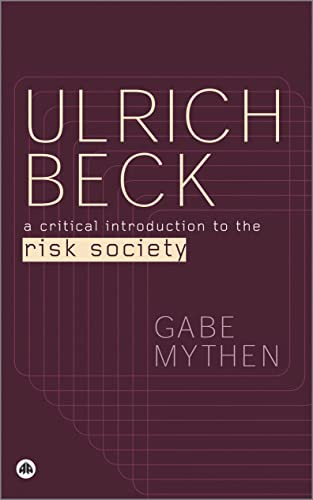
Ulrich Beck has emerged as one of the leading thinkers of the age. His principal claim to fame is as author of the widely acclaimed 'Risk Society', first published in 1986. Since this time, Beck's work has had a profound effect on the trajectory of social theory, leading to him being hailed as a zietgeist sociologist. The risk society thesis has gained credence within the academic community and across the disciplines as a means of explaining the large-scale changes that have enveloped contemporary society.Despite its continued popularity as a touchstone for debate, the risk society perspective is yet to be systematically unravelled. Gabe Mythen provides both an introduction to and a critique of Beck's work that places his contribution within the context of other theorists of risk, such as Giddens, Douglas and Foucault. Key areas of analysis include risk and the environment, lifestyles and risk, public perceptions, media representations of danger and the changing nature of political engagement.
Die Inhaltsangabe kann sich auf eine andere Ausgabe dieses Titels beziehen.
Über die Autorinnen und Autoren
Gabe Mythen is Senior Lecturer in Sociology at the University of Liverpool. He has been researching in the field of public understandings of risk for several years, having published noted articles on risk society situations, such as BSE and GM foods. He is presently involved in research around the dynamics of the risk communications process and coordinates a number of undergraduate courses revolving around risk, urban cultures and sociocultural practices.
Richard Seymour is the author of Unhitched: the Trial of Christopher Hitchens (2012), American Insurgents: A Brief History of American Anti-Imperialism (2012), The Meaning of David Cameron (2010) and The Liberal Defence of Murder (2008). His writes regularly for the Guardian and runs the popular blog Lenin's Tomb.
Auszug. © Genehmigter Nachdruck. Alle Rechte vorbehalten.
Ulrich Beck
A Critical Introduction to the Risk Society
By Gabe MythenPluto Press
Copyright © 2004 Gabe Mythen
All rights reserved.
ISBN: 978-0-7453-1814-1All rights reserved.
Contents
Acknowledgements, vii,
Introduction, 1,
1 Mapping the Risk Society, 11,
2 Risk and the Environment, 30,
3 Defining Risk, 53,
4 Mediating Risk, 73,
5 Perceiving Risk, 95,
6 Living with Risk, 117,
7 Risk, Reflexivity and Trust, 137,
8 The Politics of Risk, 157,
Conclusion, 180,
Notes, 187,
Bibliography, 195,
Index, 209,
CHAPTER 1
Mapping the Risk Society
Since the mid 1980s, the concept of risk has acted as a fulcrum for the sociological project of Ulrich Beck. The seminal Risk Society (1992) has been widely acclaimed as the centrepiece of Beck's work. The book, which has sold well over 60,000 copies worldwide, propelled its author into the spotlight and produced significant reverberations, both within and outside academic circles (McGuigan, 1999; Rustin, 1994). Risk Society (1992) is amongst the most ambitious and provocative of texts written within the social sciences in recent years. Not only does it sweep through an extensive range of topics, it is also - by turns – furious, projective, ironic and humorous. Predictably, the book broke the mould within academic publishing, casting the writer forth as part heretic, part sociological clairvoyant. In his native Germany, Beck is esteemed not only for academic achievement, but also for his thought provoking contributions to high circulation newspapers and magazines (Bronner, 1995: 67). As McGuigan notes, the ripples produced by Risk Society (1992) have extended well beyond the confines of the university campus: 'It is not just a work of abstract social theory, but a significant intervention in the public sphere of the Federal Republic, a bestseller and required reading for the chattering class' (McGuigan, 1999: 125).
It should come as no surprise that the academic and social debate about risk has mushroomed since the publication of Risk Society (1992). Reflecting on the author's background, one comes to understand the unprecedented breadth and diversity of the risk society approach. Beck's work is truly eclectic; he is 'the master of many traditions and the servant of none' (Bronner, 1995: 68). Through doctoral research, Beck developed an interest in the production of social knowledge and the application of science. In the risk society thesis, concern about the construction of scientific 'objectivity' is illuminated in the ecological problematique and consolidated through a sustained critique of expert systems. Beck's early research into industrial sociology and the sociology of the family finds voice in his analysis of structural changes in employment, family life and social relationships. In addition, German political conventions – in particular, the politics of the Green movement – have sculpted the risk society perspective. As far as academic tradition is concerned, the concentration on social structure and the negative consequences of capitalist development are indelibly Germanic, following in the footsteps of Marx, Weber and Simmel. Within contemporary sociology, Beck's work has been contrasted with the drier and structurally inspired projects of Luhmann and Habermas (see Lash, 2002).
In a nutshell, Beck's groundbreaking approach charts the relationship between the unbinding of social structures, qualitative changes in the nature of risk and shifting patterns of cultural experience. Following on from the publication of Risk Society (1992), the concept of risk has remained an omnipresent feature of Beck's work (1994; 1995b; 1997; 1999; 2000b; 2002). In more recent offerings, Beck has continued to mobilise risk as an articulation point for debate about the restructuring of employment relations (2000a), the diversification of political activity (1997; 1999) the contents of globalisation (2000b) and the threat of international terrorism (2002). Despite focussing on an extensive range of subjects, Beck has reserved risk as a vital theoretical referent. In the midst of a peculiar mixture of acclaim and bitter criticism, Beck has consistently maintained that contemporary western society is embedded in a culture of risk which has profound impacts on the nature of everyday life.
In this opening chapter, I wish to provide an inventory of the theoretical materials used to assemble the risk society perspective. Firstly, the essential features of the argument will be recounted with reference to the 'pillars of risk' which prop up Beck's thesis. Secondly, the two rudimentary processes that propel the risk society – namely individualisation and risk distribution – will be outlined. By reviewing the defining features of the risk society, an appropriate theoretical framework for the issues discussed in subsequent chapters will be erected. Insofar as our review will remain exegetical, the pillars and processes of risk will be revisited with a more critical eye throughout the book. However, in order to appreciate the resonance of Beck's work, it is necessary to consider the broader concept of risk. Thus, prior to emptying out the risk society perspective, it may first prove instructive to briefly chronicle the semantic history of risk.
DEFINING RISK
As Lupton (1999a: 8) notes, 'risk' is a word that is commonly used to indicate threat and harm. In everyday parlance, the term 'risk' is used as 'a synonym for danger or peril, for some unhappy event which may happen to someone' (Ewald, 1991: 199). Whilst this definition is apposite to the modern age, it is important to recognise that the meaning of risk has evolved over time. In historical terms, risk is a relatively novel phenomenon, seeping into European languages in the last 400 years. However, there remains a distinct lack of consensus about the etymology of 'risk'. Some historians believe that the term derives from the Arabic word risq, which refers to the acquisition of wealth and good fortune (Skeat, 1910). Others have claimed that 'risk' finds its origins in the Latin word risco and was first used as a navigational term by sailors entering uncharted waters (Ewald, 1991: 199; 1993: 226, Giddens, 1999: 1, Lupton, 1999a: 5; Strydom, 2003: 75). Curiously, these two derivations of risk were soldered together in the seventeenth century through the principle of maritime insurance. Under this banner, risk came to relate to the balance between acquisitive opportunities and potential dangers (Wilkinson, 2001: 91). Such quantitative conceptions of risk were bolstered by the probability theorems of seventeenth-century mathematicians, such as Pascal and de Fermet (Bernstein, 1996: 68). The process of economic development in the eighteenth and nineteenth centuries further cemented risk to calculation. In this period, the steady expansion of industry and capital ensured that risk became associated with the economy through the activities of investors and bankers. By the beginning of the twentieth century, 'risk' was commonly used in insurance and finance to describe the possible outcomes of investment for borrowers and lenders. In modern times, risk remains firmly coupled to the economic world through forms of statistical calculation, stock-market speculation and company acquisitions. Capitalist markets cannot be sustained without risk, which is ingrained in the decisions of fund managers, the speculations of market makers, the borrowing of business managers and the valuations of insurance...
„Über diesen Titel“ kann sich auf eine andere Ausgabe dieses Titels beziehen.
Suchergebnisse für ULRICH BECK: A Critical Introduction To Risk Society

Beispielbild für diese ISBN
Ulrich Beck: a Critical Introduction to the Risk Society
Anbieter: Better World Books Ltd, Dunfermline, Vereinigtes Königreich
Verkäuferbewertung 5 von 5 Sternen

Zustand: Very Good. Former library copy. Pages intact with possible writing/highlighting. Binding strong with minor wear. Dust jackets/supplements may not be included. Includes library markings. Stock photo provided. Product includes identifying sticker. Better World Books: Buy Books. Do Good. Artikel-Nr. GRP82471118
Gebraucht kaufen
EUR 14,20
EUR 5,81 Versand
Versand von Vereinigtes Königreich nach USA
Versand von Vereinigtes Königreich nach USA
Anzahl: 1 verfügbar
Beispielbild für diese ISBN
Ulrich Beck: a Critical Introduction to the Risk Society
Anbieter: Better World Books Ltd, Dunfermline, Vereinigtes Königreich
Verkäuferbewertung 5 von 5 Sternen
Zustand: Good. Pages intact with minimal writing/highlighting. The binding may be loose and creased. Dust jackets/supplements are not included. Stock photo provided. Product includes identifying sticker. Better World Books: Buy Books. Do Good. Artikel-Nr. 17239759-20
Gebraucht kaufen
EUR 14,20
EUR 5,81 Versand
Versand von Vereinigtes Königreich nach USA
Versand von Vereinigtes Königreich nach USA
Anzahl: 1 verfügbar
Beispielbild für diese ISBN
Ulrich Beck: A Critical Introduction to the Risk Society
Anbieter: Anybook.com, Lincoln, Vereinigtes Königreich
Verkäuferbewertung 5 von 5 Sternen
Zustand: Good. This is an ex-library book and may have the usual library/used-book markings inside.This book has soft covers. In good all round condition. Please note the Image in this listing is a stock photo and may not match the covers of the actual item,400grams, ISBN:9780745318141. Artikel-Nr. 4958283
Gebraucht kaufen
EUR 28,34
EUR 15,81 Versand
Versand von Vereinigtes Königreich nach USA
Versand von Vereinigtes Königreich nach USA
Anzahl: 1 verfügbar
Beispielbild für diese ISBN
Ulrich Beck: A Critical Introduction to the Risk Society
Anbieter: Anybook.com, Lincoln, Vereinigtes Königreich
Verkäuferbewertung 5 von 5 Sternen
Zustand: Good. This is an ex-library book and may have the usual library/used-book markings inside.This book has soft covers. In good all round condition. Please note the Image in this listing is a stock photo and may not match the covers of the actual item,400grams, ISBN:9780745318141. Artikel-Nr. 4958282
Gebraucht kaufen
EUR 28,34
EUR 15,81 Versand
Versand von Vereinigtes Königreich nach USA
Versand von Vereinigtes Königreich nach USA
Anzahl: 1 verfügbar
Beispielbild für diese ISBN
Ulrich Beck A Critical Introduction to the Risk Society
Anbieter: Revaluation Books, Exeter, Vereinigtes Königreich
Verkäuferbewertung 5 von 5 Sternen
Paperback. Zustand: Brand New. 240 pages. 8.25x5.25x0.75 inches. In Stock. Artikel-Nr. zk0745318142
Neu kaufen
EUR 66,38
EUR 11,63 Versand
Versand von Vereinigtes Königreich nach USA
Versand von Vereinigtes Königreich nach USA
Anzahl: 1 verfügbar