
Inhaltsangabe
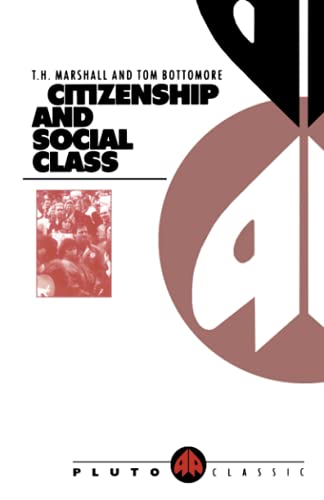
Over forty years after it first appeared, T.H. Marshall's seminal essay on citizenship and social class in postwar Britain has acquired the status of a classic. His lucid analysis of the principal elements of citizenship--namely the possession of civil, political, and social rights--is as relevant today as it was when it first appeared. This edition includes complementary material from Tom Bottomore that brings the work into a more contemporary context.
Die Inhaltsangabe kann sich auf eine andere Ausgabe dieses Titels beziehen.
Über die Autorin bzw. den Autor
T.H. Marshall was Professor of Sociology at the London School of Economics, then director of the Social Sciences Department at UNECSO and President of the International Sociological Assoiciation from 1959 to 1962. Tom Bottomore is Professor Emeritus at the University of Sussex, where he was Professor of Sociology for seventeen years. He was a president of the British Sociological Association and of the International Sociological Association. He is the author of numerous books, including Between Marginalism and Marxism and Elites and Society.
Auszug. © Genehmigter Nachdruck. Alle Rechte vorbehalten.
Citizenship and Social Class
By T.H. Marshall, Tom BottomorePluto Press
Copyright © 1992 Tom Bottomore
All rights reserved.
ISBN: 978-0-7453-0476-2All rights reserved.
Contents
Foreword by Robert Moore, vi,
Preface by Tom Bottomore, vii,
PART I Citizenship and Social Class T.H. Marshall,
1. The Problem Stated, with the Assistance of Alfred Marshall, 3,
2. The Development of Citizenship to the 8 End of the Nineteenth Century, 8,
3. The Early Impact of Citizenship on Social Class, 17,
4. Social Rights in the Twentieth Century, 27,
5. Conclusions, 44,
Notes, 49,
PART II Citizenship and Social Class, Forty Years On Tom Bottomore,
1. Citizens, Classes and Equality, 55,
2. Capitalism, Socialism and Citizenship, 57,
3. New Questions about Citizenship, 65,
4. Changing Classes, Changing Doctrines, 73,
5. A Kind of Conclusion, 83,
Notes, 92,
Bibliography, 94,
Index, 97,
CHAPTER 1
The Problem Stated with the Assistance of Alfred Marshall
The invitation to deliver these lectures gave me both personal and professional pleasure. But, whereas my personal response was a sincere and modest appreciation of an honour I had no right to expect, my professional reaction was not modest at all. Sociology, it seemed to me, had every right to claim a share in this annual commemoration of Alfred Marshall, and I considered it a sign of grace that a University which has not yet accepted sociology as an inmate should nevertheless be prepared to welcome her as a visitor. It may be-and the thought is a disturbing one-that sociology is on trial here in my person. If so, I am sure I can rely on you to be scrupulously fair in your judgement, and to regard any merit you may find in my lectures as evidence of the academic value of the subject I profess, while treating everything in them that appears to you paltry, common or ill-conceived as the product of qualities peculiar to myself and not to be found in any of my colleagues.
I will not defend the relevance of my subject to the occasion by claiming Marshall as a sociologist. For, once he had deserted his first loves of metaphysics, ethics and psychology, he devoted his life to the development of economics as an independent science and to the perfection of its own special methods of investigation and analysis. He deliberately chose a path markedly different from that followed by Adam Smith and John Stuart Mill, and the mood in which he made this choice is indicated in the inaugural lecture which he delivered here in Cambridge in 1885. Speaking of Comte's belief in a unified social science, he said: 'No doubt if that existed economics would gladly find shelter under its wing. But it does not exist; it shows no signs of coming into existence. There is no use in waiting idly for it; we must do what we can with our present resources. He therefore defended the autonomy and the superiority of the economic method, a superiority due mainly to its use of the measuring rod of money, which 'is so much the best measure of motives that no other can compete with it.'
Marshall was, as you know, an idealist; so much so that Keynes has said of him that he 'was too anxious to do good'. The last thing I wish to do is to claim him for sociology on that account. It is true that some sociologists have suffered from a similar affliction of benevolence, often to the detriment of their intellectual performance, but I should hate to distinguish the economist from the sociologist by saying that the one should be ruled by his head while the other may be swayed by his heart. For every honest sociologist, like every honest economist, knows that the choice of ends or ideals lies outside the field of social science and within the field of social philosophy. But idealism made Marshall passionately eager to put the science of economics at the service of policy by using it-as a science may legitimately be used-to lay bare the full nature and content of the problems with which policy has to deal and to assess the relative efficacy of alternative means for the achievement of given ends. And he realised that, even in the case of what would naturally be regarded as economic problems, the science of economics was not of itself able fully to render these two services. For they involved the consideration of social forces which are as immune to attack by the economist's tape-measure as was the croquet ball to the blows which Alice tried in vain to strike with the head of her flamingo. It was, perhaps, on this account that, in certain moods, Marshall felt a quite unwarranted disappointment at his achievements, and even expressed regret that he had preferred economics to psychology, a science which might have brought him nearer to the pulse and life-blood of society and given him a deeper understanding of human aspirations.
It would be easy to cite many passages in which Marshall was drawn to speak of these elusive factors of whose importance he was so firmly convinced, but I prefer to confine my attention to one essay whose theme comes very near to that which I have chosen for these lectures. It is a paper he read to the Cambridge Reform Club in 1873 on The Future of the Working Classes, and it has been republished in the memorial volume edited by Professor Pigou. There are some textual differences between the two editons which, I understand, are to be attributed to corrections made by Marshall himself after the original version had appeared in print as a pamphlet was reminded of this essay by my colleague, Professor Phelps Brown, who made use of it in his inaugural lecture last November. It is equally well suited to my purpose today, because in it Marshall, while examining one facet of the problem of social equality from the point of view of economic cost, came right up to the frontier beyond which lies the territory of sociology, crossed it, and made a brief excursion on the other side. His action could be interpreted as a challenge to sociology to send an emissary to meet him at the frontier, and to join with him in the task of converting no-man's-land into common ground. I have been presumptuous enough to answer the challenge by setting out to travel, as historian and sociologist, towards a point on the economic frontier of that same general theme, the problem of social equality.
In his Cambridge paper Marshall posed the question 'whether there be valid ground for the opinion that the amelioration of the working classes has limits beyond which it cannot pass'. 'The question', he said, 'is not whether all men will ultimately be equal-that they certainly will not-but whether progress may not go on steadily, if slowly, till, by occupation at least, every man is a gentleman. I hold that it may, and that it will/ His faith was based on the belief that the distinguishing feature of the working classes was heavy and excessive labour, and that the volume of such labour could be greatly reduced. Looking round he found evidence that the skilled artisans, whose labour was not deadening and soul-destroying, were already rising towards the condition which he foresaw as the ultimate achievement of all. They are learning, he said, to value education and leisure more than 'mere increase of wages and material comforts'. They are 'steadily developing independence and a manly respect for themselves and, therefore, a courteous respect for others; they are steadily accepting the private and public duties of a citizen; steadily increasing their grasp of the truth that they are men, and not producing machines. They are steadily becoming gentlemen.' When technical advance has reduced heavy...
„Über diesen Titel“ kann sich auf eine andere Ausgabe dieses Titels beziehen.
Weitere beliebte Ausgaben desselben Titels

Suchergebnisse für CITIZENSHIP AND SOCIAL CLASS (Pluto Perspectives)

Beispielbild für diese ISBN
Citizenship and Social Class
Anbieter: Anybook.com, Lincoln, Vereinigtes Königreich
Verkäuferbewertung 5 von 5 Sternen

Zustand: Fair. This is an ex-library book and may have the usual library/used-book markings inside.This book has soft covers. Book contains pencil markings. In fair condition, suitable as a study copy. Please note the Image in this listing is a stock photo and may not match the covers of the actual item,250grams, ISBN:9780745304762. Artikel-Nr. 8666460
Gebraucht kaufen
EUR 3,02
EUR 15,74 Versand
Versand von Vereinigtes Königreich nach USA
Versand von Vereinigtes Königreich nach USA
Anzahl: 1 verfügbar
Beispielbild für diese ISBN
Citizenship and Social Class
Anbieter: Anybook.com, Lincoln, Vereinigtes Königreich
Verkäuferbewertung 5 von 5 Sternen
Zustand: Fair. This is an ex-library book and may have the usual library/used-book markings inside.This book has soft covers. Book contains pen, pencil & highlighter markings. In fair condition, suitable as a study copy. Please note the Image in this listing is a stock photo and may not match the covers of the actual item,300grams, ISBN:9780745304762. Artikel-Nr. 9877416
Gebraucht kaufen
EUR 3,59
EUR 15,74 Versand
Versand von Vereinigtes Königreich nach USA
Versand von Vereinigtes Königreich nach USA
Anzahl: 1 verfügbar
Beispielbild für diese ISBN
Citizenship and Social Class
Anbieter: AwesomeBooks, Wallingford, Vereinigtes Königreich
Verkäuferbewertung 5 von 5 Sternen
paperback. Zustand: Very Good. Citizenship and Social Class This book is in very good condition and will be shipped within 24 hours of ordering. The cover may have some limited signs of wear but the pages are clean, intact and the spine remains undamaged. This book has clearly been well maintained and looked after thus far. Money back guarantee if you are not satisfied. See all our books here, order more than 1 book and get discounted shipping. Artikel-Nr. 7719-9780745304762
Gebraucht kaufen
EUR 17,67
EUR 5,78 Versand
Versand von Vereinigtes Königreich nach USA
Versand von Vereinigtes Königreich nach USA
Anzahl: 2 verfügbar
Beispielbild für diese ISBN
Citizenship and Social Class
Anbieter: WorldofBooks, Goring-By-Sea, WS, Vereinigtes Königreich
Verkäuferbewertung 5 von 5 Sternen
Paperback. Zustand: Good. The book has been read but remains in clean condition. All pages are intact and the cover is intact. Some minor wear to the spine. Artikel-Nr. GOR003042329
Gebraucht kaufen
EUR 18,53
EUR 6,48 Versand
Versand von Vereinigtes Königreich nach USA
Versand von Vereinigtes Königreich nach USA
Anzahl: 1 verfügbar
Beispielbild für diese ISBN
Citizenship and Social Class
Anbieter: Bahamut Media, Reading, Vereinigtes Königreich
Verkäuferbewertung 5 von 5 Sternen
paperback. Zustand: Very Good. This book is in very good condition and will be shipped within 24 hours of ordering. The cover may have some limited signs of wear but the pages are clean, intact and the spine remains undamaged. This book has clearly been well maintained and looked after thus far. Money back guarantee if you are not satisfied. See all our books here, order more than 1 book and get discounted shipping. Artikel-Nr. 6545-9780745304762
Gebraucht kaufen
EUR 17,34
EUR 8,08 Versand
Versand von Vereinigtes Königreich nach USA
Versand von Vereinigtes Königreich nach USA
Anzahl: 2 verfügbar
Beispielbild für diese ISBN
Citizenship and Social Class
Anbieter: Anybook.com, Lincoln, Vereinigtes Königreich
Verkäuferbewertung 5 von 5 Sternen
Zustand: Poor. This is an ex-library book and may have the usual library/used-book markings inside.This book has soft covers. Book contains highlighter markings. In poor condition, suitable as a reading copy. Please note the Image in this listing is a stock photo and may not match the covers of the actual item,250grams, ISBN:9780745304762. Artikel-Nr. 9815344
Gebraucht kaufen
EUR 18,67
EUR 15,74 Versand
Versand von Vereinigtes Königreich nach USA
Versand von Vereinigtes Königreich nach USA
Anzahl: 1 verfügbar
Foto des Verkäufers
Citizenship and social class
Verlag:
Pluto Press, Great Britain, 1992
ISBN 10: 0745304761
ISBN 13: 9780745304762
Gebraucht
Softcover
Anbieter: Biblioteca di Babele, Tarquinia, VT, Italien
Verkäuferbewertung 5 von 5 Sternen
Zustand: BUONO USATO. I ED. Pluto Perspectives INGLESE Collana diretta da Robert Moore. Il volume si presenta in buono stato di conservazione. Il dorso e le copertine mostrano lievi segni di usura, adesivo al dorso e un velo di polvere. Le pagine interne sono leggermente ingiallite dal tempo e fruibili. I tagli appena bruniti e regolari. La cerniera è ben salda. Numero pagine 101. Il volume potrebbe contenere timbri, il materiale è stato regolarmente acquisito dalla nostra Libreria. Artikel-Nr. TVM0904
Gebraucht kaufen
EUR 6,00
EUR 42,00 Versand
Versand von Italien nach USA
Versand von Italien nach USA
Anzahl: 1 verfügbar
Beispielbild für diese ISBN
Citizenship and Social Class (Pluto Classics)
Anbieter: Ria Christie Collections, Uxbridge, Vereinigtes Königreich
Verkäuferbewertung 5 von 5 Sternen
Zustand: New. In. Artikel-Nr. ria9780745304762_new
Neu kaufen
EUR 36,86
EUR 13,87 Versand
Versand von Vereinigtes Königreich nach USA
Versand von Vereinigtes Königreich nach USA
Anzahl: Mehr als 20 verfügbar
Beispielbild für diese ISBN
Citizenship and Social Class (Pluto Perspectives)
Anbieter: Revaluation Books, Exeter, Vereinigtes Königreich
Verkäuferbewertung 5 von 5 Sternen
Paperback. Zustand: Brand New. 102 pages. 8.50x5.50x0.50 inches. In Stock. Artikel-Nr. x-0745304761
Neu kaufen
EUR 44,75
EUR 11,58 Versand
Versand von Vereinigtes Königreich nach USA
Versand von Vereinigtes Königreich nach USA
Anzahl: 2 verfügbar
Beispielbild für diese ISBN
Citizenship and Social Class
Anbieter: Kennys Bookstore, Olney, MD, USA
Verkäuferbewertung 5 von 5 Sternen
Zustand: New. A Pluto Classic. This book examines the prospects for social equality in post-war Britain, and provides a detailed consideration of what has been achieved so far. Series: Pluto Classics. Num Pages: 101 pages, black & white illustrations. BIC Classification: JFFN; JFS; JPVH1. Category: (UU) Undergraduate. Dimension: 215 x 141 x 8. Weight in Grams: 158. . 1987. Paperback. . . . . Books ship from the US and Ireland. Artikel-Nr. V9780745304762
Neu kaufen
EUR 70,59
EUR 9,11 Versand
Versand innerhalb von USA
Versand innerhalb von USA
Anzahl: Mehr als 20 verfügbar