
Verwandte Artikel zu Julius Caesar (Folger Shakespeare Library)
Inhaltsangabe
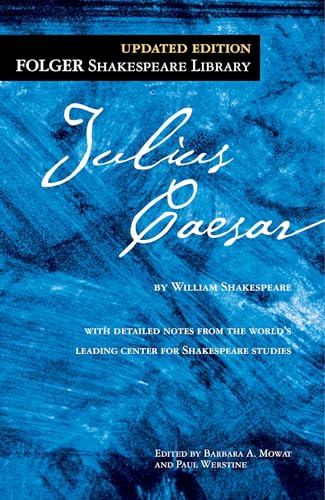
The authoritative edition of Julius Caesar from The Folger Shakespeare Library, the trusted and widely used Shakespeare series for students and general readers.
Shakespeare may have written Julius Caesar as the first of his plays to be performed at the Globe, in 1599. For it, he turned to a key event in Roman history: Caesar’s death at the hands of friends and fellow politicians. Renaissance writers disagreed over the assassination, seeing Brutus, a leading conspirator, as either hero or villain. Shakespeare’s play keeps this debate alive.
This edition includes:
-Freshly edited text based on the best early printed version of the play
-Newly revised explanatory notes conveniently placed on pages facing the text of the play
-Scene-by-scene plot summaries
-A key to the play’s famous lines and phrases
-An introduction to reading Shakespeare’s language
-An essay by a leading Shakespeare scholar providing a modern perspective on the play
-Fresh images from the Folger Shakespeare Library’s vast holdings of rare books
-An up-to-date annotated guide to further reading
Essay by Coppélia Kahn
The Folger Shakespeare Library in Washington, DC, is home to the world’s largest collection of Shakespeare’s printed works, and a magnet for Shakespeare scholars from around the globe. In addition to exhibitions open to the public throughout the year, the Folger offers a full calendar of performances and programs. For more information, visit Folger.edu.
Die Inhaltsangabe kann sich auf eine andere Ausgabe dieses Titels beziehen.
Über die Autorin bzw. den Autor
William Shakespeare was born in April 1564 in the town of Stratford-upon-Avon, on England’s Avon River. When he was eighteen, he married Anne Hathaway. The couple had three children—an older daughter Susanna and twins, Judith and Hamnet. Hamnet, Shakespeare’s only son, died in childhood. The bulk of Shakespeare’s working life was spent in the theater world of London, where he established himself professionally by the early 1590s. He enjoyed success not only as a playwright and poet, but also as an actor and shareholder in an acting company. Although some think that sometime between 1610 and 1613 Shakespeare retired from the theater and returned home to Stratford, where he died in 1616, others believe that he may have continued to work in London until close to his death.
Von der hinteren Coverseite
The authoritative edition of Julius Caesar from The Folger Shakespeare Library, the trusted and widely used Shakespeare series for students and general readers.
Shakespeare may have written Julius Caesar as the first of his plays to be performed at the Globe, in 1599. For it, he turned to a key event in Roman history: Caesar’s death at the hands of friends and fellow politicians. Renaissance writers disagreed over the assassination, seeing Brutus, a leading conspirator, as either hero or villain. Shakespeare’s play keeps this debate alive.
This edition includes:
-Freshly edited text based on the best early printed version of the play
-Newly revised explanatory notes conveniently placed on pages facing the text of the play
-Scene-by-scene plot summaries
-A key to the play’s famous lines and phrases
-An introduction to reading Shakespeare’s language
-An essay by a leading Shakespeare scholar providing a modern perspective on the play
-Fresh images from the Folger Shakespeare Library’s vast holdings of rare books
-An up-to-date annotated guide to further reading
Essay by Coppélia Kahn
The Folger Shakespeare Library in Washington, DC, is home to the world’s largest collection of Shakespeare’s printed works, and a magnet for Shakespeare scholars from around the globe. In addition to exhibitions open to the public throughout the year, the Folger offers a full calendar of performances and programs. For more information, visit Folger.edu.
Auszug. © Genehmigter Nachdruck. Alle Rechte vorbehalten.
Julius Casar
By William ShakespeareWashington Square Press
Copyright © 2004 William ShakespeareAll right reserved.
ISBN: 9780743482745
Shakespeare's Life
Surviving documents that give us glimpses into the life of William Shakespeare show us a playwright, poet, and actor who grew up in the market town of Stratford-upon-Avon, spent his professional life in London, and returned to Stratford a wealthy landowner. He was born in April 1564, died in April 1616, and is buried inside the chancel of Holy Trinity Church in Stratford.
We wish we could know more about the life of the world's greatest dramatist. His plays and poems are testaments to his wide reading -- especially to his knowledge of Virgil, Ovid, Plutarch, Holinshed's Chronicles, and the Bible -- and to his mastery of the English language, but we can only speculate about his education. We know that the King's New School in Stratford-upon-Avon was considered excellent. The school was one of the English "grammar schools" established to educate young men, primarily in Latin grammar and literature. As in other schools of the time, students began their studies at the age of four or five in the attached "petty school," and there learned to read and write in English, studying primarily the catechism from the Book of Common Prayer. After two years in the petty school, students entered the lower form (grade) of the grammar school, where they began the serious study of Latin grammar and Latin texts that would occupy most of the remainder of their school days. (Several Latin texts that Shakespeare used repeatedly in writing his plays and poems were texts that schoolboys memorized and recited.) Latin comedies were introduced early in the lower form; in the upper form, which the boys entered at age ten or eleven, students wrote their own Latin orations and declamations, studied Latin historians and rhetoricians, and began the study of Greek using the Greek New Testament.
Since the records of the Stratford "grammar school" do not survive, we cannot prove that William Shakespeare attended the school; however, every indication (his father's position as an alderman and bailiff of Stratford, the playwright's own knowledge of the Latin classics, scenes in the plays that recall grammar-school experiences -- for example, The Merry Wives of Windsor, 4.1) suggests that he did. We also lack generally accepted documentation about Shakespeare's life after his schooling ended and his professional life in London began. His marriage in 1582 (at age eighteen) to Anne Hathaway and the subsequent births of his daughter Susanna (1583) and the twins Judith and Hamnet (1585) are recorded, but how he supported himself and where he lived are not known. Nor do we know when and why he left Stratford for the London theatrical world, nor how he rose to be the important figure in that world that he had become by the early 1590s.
We do know that by 1592 he had achieved some prominence in London as both an actor and a playwright. In that year was published a book by the playwright Robert Greene attacking an actor who had the audacity to write blank-verse drama and who was "in his own conceit [i.e., opinion] the only Shake-scene in a country." Since Greene's attack includes a parody of a line from one of Shakespeare's early plays, there is little doubt that it is Shakespeare to whom he refers, a "Shake-scene" who had aroused Greene's fury by successfully competing with university-educated dramatists like Greene himself. It was in 1593 that Shakespeare became a published poet. In that year he published his long narrative poem Venus and Adonis; in 1594, he followed it with The Rape of Lucrece. Both poems were dedicated to the young earl of Southampton (Henry Wriothesley), who may have become Shakespeare's patron.
It seems no coincidence that Shakespeare wrote these narrative poems at a time when the theaters were closed because of the plague, a contagious epidemic disease that devastated the population of London. When the theaters reopened in 1594, Shakespeare apparently resumed his double career of actor and playwright and began his long (and seemingly profitable) service as an acting-company shareholder. Records for December of 1594 show him to be a leading member of the Lord Chamberlain's Men. It was this company of actors, later named the King's Men, for whom he would be a principal actor, dramatist, and shareholder for the rest of his career.
So far as we can tell, that career spanned about twenty years. In the 1590s, he wrote his plays on English history as well as several comedies and at least two tragedies (Titus Andronicus and Romeo and Juliet). These histories, comedies, and tragedies are the plays credited to him in 1598 in a work, Palladis Tamia, that in one chapter compares English writers with "Greek, Latin, and Italian Poets." There the author, Francis Meres, claims that Shakespeare is comparable to the Latin dramatists Seneca for tragedy and Plautus for comedy, and calls him "the most excellent in both kinds for the stage." He also names him "Mellifluous and honey-tongued Shakespeare": "I say," writes Meres, "that the Muses would speak with Shakespeare's fine filed phrase, if they would speak English." Since Meres also mentions Shakespeare's "sugared sonnets among his private friends," it is assumed that many of Shakespeare's sonnets (not published until 1609) were also written in the 1590s.
In 1599, Shakespeare's company built a theater for themselves across the river from London, naming it the Globe. The plays that are considered by many to be Shakespeare's major tragedies (Hamlet, Othello, King Lear, and Macbeth) were written while the company was resident in this theater, as were such comedies as Twelfth Night and Measure for Measure. Many of Shakespeare's plays were performed at court (both for Queen Elizabeth I and, after her death in 1603, for King James I), some were presented at the Inns of Court (the residences of London's legal societies), and some were doubtless performed in other towns, at the universities, and at great houses when the King's Men went on tour; otherwise, his plays from 1599 to 1608 were, so far as we know, performed only at the Globe. Between 1608 and 1612, Shakespeare wrote several plays -- among them The Winter's Tale and The Tempest -- presumably for the company's new indoor Blackfriars theater, though the plays seem to have been performed also at the Globe and at court. Surviving documents describe a performance of The Winter's Tale in 1611 at the Globe, for example, and performances of The Tempest in 1611 and 1613 at the royal palace of Whitehall.
Shakespeare wrote very little after 1612, the year in which he probably wrote King Henry VIII. (It was at a performance of Henry VIII in 1613 that the Globe caught fire and burned to the ground.) Sometime between 1610 and 1613 he seems to have returned to live in Stratford-upon-Avon, where he owned a large house and considerable property, and where his wife and his two daughters and their husbands lived. (His son Hamnet had died in 1596.) During his professional years in London, Shakespeare had presumably derived income from the acting company's profits as well as from his own career as an actor, from the sale of his play manuscripts to the acting company, and, after 1599, from his shares as an owner of the Globe. It was presumably that income, carefully invested in land and other property, which made him the wealthy man that surviving documents show him to have become. It is also assumed that William Shakespeare's...
„Über diesen Titel“ kann sich auf eine andere Ausgabe dieses Titels beziehen.
Suchergebnisse für Julius Caesar (Folger Shakespeare Library)

Beispielbild für diese ISBN
Julius Caesar
Anbieter: World of Books (was SecondSale), Montgomery, IL, USA
Verkäuferbewertung 5 von 5 Sternen

Zustand: Good. The Folger Library offers the definitive, updated edition of Shakespeares work, with newly edited text, explanatory notes, scene summaries, and more. Artikel-Nr. 00099199767
Gebraucht kaufen
EUR 3,71
Versand gratis
Versand innerhalb von USA
Versand innerhalb von USA
Anzahl: Mehr als 20 verfügbar
Beispielbild für diese ISBN
Julius Caesar
Anbieter: World of Books (was SecondSale), Montgomery, IL, USA
Verkäuferbewertung 5 von 5 Sternen
Zustand: Very Good. The Folger Library offers the definitive, updated edition of Shakespeares work, with newly edited text, explanatory notes, scene summaries, and more. Artikel-Nr. 00110390067
Gebraucht kaufen
EUR 3,71
Versand gratis
Versand innerhalb von USA
Versand innerhalb von USA
Anzahl: 10 verfügbar
Beispielbild für diese ISBN
Julius Caesar
Anbieter: World of Books (was SecondSale), Montgomery, IL, USA
Verkäuferbewertung 5 von 5 Sternen
Zustand: Fair. The Folger Library offers the definitive, updated edition of Shakespeares work, with newly edited text, explanatory notes, scene summaries, and more. Artikel-Nr. 00091541394
Gebraucht kaufen
EUR 3,71
Versand gratis
Versand innerhalb von USA
Versand innerhalb von USA
Anzahl: Mehr als 20 verfügbar
Beispielbild für diese ISBN
Julius Caesar (Folger Shakespeare Library)
Verlag:
Simon & Schuster (edition Reprint,Updated), 2004
ISBN 10: 0743482743
ISBN 13: 9780743482745
Gebraucht
Paperback
Anbieter: BooksRun, Philadelphia, PA, USA
Verkäuferbewertung 5 von 5 Sternen
Paperback. Zustand: Fair. Reprint,Updated. The item might be beaten up but readable. May contain markings or highlighting, as well as stains, bent corners, or any other major defect, but the text is not obscured in any way. Artikel-Nr. 0743482743-7-1
Gebraucht kaufen
EUR 4,05
Versand gratis
Versand innerhalb von USA
Versand innerhalb von USA
Anzahl: 3 verfügbar
Beispielbild für diese ISBN
Julius Caesar (Folger Shakespeare Library)
Verlag:
Simon & Schuster (edition Reprint,Updated), 2004
ISBN 10: 0743482743
ISBN 13: 9780743482745
Gebraucht
Mass Market Paperback
Anbieter: BooksRun, Philadelphia, PA, USA
Verkäuferbewertung 5 von 5 Sternen
Mass Market Paperback. Zustand: Very Good. Reprint,Updated. It's a well-cared-for item that has seen limited use. The item may show minor signs of wear. All the text is legible, with all pages included. It may have slight markings and/or highlighting. Artikel-Nr. 0743482743-11-1
Gebraucht kaufen
EUR 4,89
Versand gratis
Versand innerhalb von USA
Versand innerhalb von USA
Anzahl: 16 verfügbar
Beispielbild für diese ISBN
Julius Caesar (Folger Shakespeare Library)
Verlag:
Simon & Schuster (edition Reprint,Updated), 2004
ISBN 10: 0743482743
ISBN 13: 9780743482745
Gebraucht
Mass Market Paperback
Anbieter: BooksRun, Philadelphia, PA, USA
Verkäuferbewertung 5 von 5 Sternen
Mass Market Paperback. Zustand: Fair. Reprint,Updated. The item might be beaten up but readable. May contain markings or highlighting, as well as stains, bent corners, or any other major defect, but the text is not obscured in any way. Artikel-Nr. 0743482743-7-1-13
Gebraucht kaufen
EUR 4,98
Versand gratis
Versand innerhalb von USA
Versand innerhalb von USA
Anzahl: 3 verfügbar
Beispielbild für diese ISBN
Julius Caesar
Verlag:
Simon & Schuster, 2004
ISBN 10: 0743482743
ISBN 13: 9780743482745
Gebraucht
Mass Market Paperback
Anbieter: ThriftBooks-Atlanta, AUSTELL, GA, USA
Verkäuferbewertung 5 von 5 Sternen
Mass Market Paperback. Zustand: Very Good. No Jacket. May have limited writing in cover pages. Pages are unmarked. ~ ThriftBooks: Read More, Spend Less. Artikel-Nr. G0743482743I4N00
Gebraucht kaufen
EUR 5,94
Versand gratis
Versand innerhalb von USA
Versand innerhalb von USA
Anzahl: 2 verfügbar
Beispielbild für diese ISBN
Julius Caesar
Verlag:
Simon & Schuster, 2004
ISBN 10: 0743482743
ISBN 13: 9780743482745
Gebraucht
Mass Market Paperback
Anbieter: ThriftBooks-Phoenix, Phoenix, AZ, USA
Verkäuferbewertung 5 von 5 Sternen
Mass Market Paperback. Zustand: Very Good. No Jacket. May have limited writing in cover pages. Pages are unmarked. ~ ThriftBooks: Read More, Spend Less. Artikel-Nr. G0743482743I4N00
Gebraucht kaufen
EUR 5,94
Versand gratis
Versand innerhalb von USA
Versand innerhalb von USA
Anzahl: 2 verfügbar
Beispielbild für diese ISBN
Julius Caesar
Verlag:
Simon & Schuster, 2004
ISBN 10: 0743482743
ISBN 13: 9780743482745
Gebraucht
Mass Market Paperback
Anbieter: ThriftBooks-Dallas, Dallas, TX, USA
Verkäuferbewertung 5 von 5 Sternen
Mass Market Paperback. Zustand: Fair. No Jacket. Readable copy. Pages may have considerable notes/highlighting. ~ ThriftBooks: Read More, Spend Less. Artikel-Nr. G0743482743I5N00
Gebraucht kaufen
EUR 5,94
Versand gratis
Versand innerhalb von USA
Versand innerhalb von USA
Anzahl: 2 verfügbar
Beispielbild für diese ISBN
Julius Caesar
Verlag:
Simon & Schuster, 2004
ISBN 10: 0743482743
ISBN 13: 9780743482745
Gebraucht
Mass Market Paperback
Anbieter: ThriftBooks-Dallas, Dallas, TX, USA
Verkäuferbewertung 5 von 5 Sternen
Mass Market Paperback. Zustand: Good. No Jacket. Pages can have notes/highlighting. Spine may show signs of wear. ~ ThriftBooks: Read More, Spend Less. Artikel-Nr. G0743482743I3N00
Gebraucht kaufen
EUR 5,94
Versand gratis
Versand innerhalb von USA
Versand innerhalb von USA
Anzahl: Mehr als 20 verfügbar