
Verwandte Artikel zu The Feast of Roses: A Novel
Inhaltsangabe
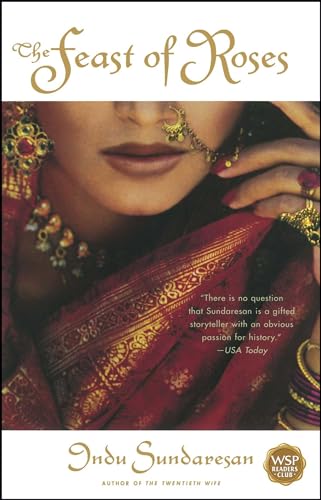
The love story of Emperor Jahangir and Mehrunnisa, begun in the critically praised debut novel The Twentieth Wife, continues in Indu Sundaresan's lush second novel, The Feast of Roses. Here, Mehrunnisa comes into Jahangir's harem as his twentieth and last wife. This time Jahangir has married for love, and members of his court are worried that Mehrunnisa could exert control over their futures. Their concerns are well founded.
Mehrunnisa soon becomes the most powerful woman in the Mughal Empire in spite of a formidable rival in the imperial harem who has schemed and plotted against her from the start. She rules from behind the veil, securing her status by forming a junta of sorts with her father, brother, and stepson -- and risking it all, even her daughter, to get what she wants. But she never loses the love of the man who bestows this power upon her....
Die Inhaltsangabe kann sich auf eine andere Ausgabe dieses Titels beziehen.
Über die Autorin bzw. den Autor
Indu Sundaresan was born in India and came to the US for graduate school at the University of Delaware. She is the author of The Twentieth Wife, The Feast of Roses, Splendor of Silence, In the Convent of Little Flowers, Shadow Princess, and The Mountain of Light.
Auszug. © Genehmigter Nachdruck. Alle Rechte vorbehalten.
Chapter One
Nature had endowed her with a quick understanding, a piercing intellect, a versatile temper, sound common sense. Education had developed the gifts of nature in no common degree. She was versed in Persian literature and composed verses, limpid and flowing, which assisted her in capturing the heart of her husband.
-- BENI PRASAD, History of Jahangir
The months of June and July passed. The monsoons were tardy this year -- the nights hinted rain constantly with an aroma in the air, a cooling on the skin, soundless lightning across skies. But when morning came, the sun rose strong again, mocking Agra and its inhabitants. And the days crawled by, brazenly hot, when every breath was an effort, every movement a struggle, every night sweat-stewed. In temples, incantations were offered, the muezzins called the faithful to prayers, their voices melodious and pleading, and the bells of the Jesuit churches chimed. But the Gods seemed indifferent. The rice paddies lay plowed after the pre-monsoon rains, awaiting the seedlings; too long a wait and the ground would grow hard again.
A few people moved torpidly in the streets of Agra; only the direst of emergencies had called them from their cool, stone-flagged homes. Even the normally frantic pariah dogs lay panting on doorsteps, too exhausted to yelp when passing urchins pelted them with stones.
The bazaars were barren too, shopfronts pulled down, shopkeepers too tired to haggle with buyers. Custom could wait for cooler times. The whole city seemed to have slowed to a halt.
The imperial palaces and courtyards were hushed in the night, the corridors empty of footsteps. Slaves and eunuchs plied iridescent peacock feather fans, wiping their perspiring faces with one hand. The ladies of the harem slept under the intermittent breeze of the fans, goblets of cold sherbets flavored with khus and ginger resting by their sides. Every now and then, a slave would refresh the goblet, bringing in another one filled with new shards of ice. When her mistress awoke, and wake she would many times during the night, her drink would be ready. The ice, carved in huge chunks from the Himalayan Mountains, covered with gunnysacks and brought down to the plains in bullock carts, was a blessing for everyone, nobles and commoners alike. But in this heat, ice melted all too soon, disappearing into a puddle of warm water under sawdust and jute.
In Emperor Jahangir's apartments, music floated through the courtyard, stopping and tripping in the still night air as the musicians' slick fingers slipped on the strings of the sitar.
The courtyard was square, built with Mughal and Persian precision in sharp-cut lines. An arched, cusped verandah filled one side; along the others were trees and bushes, smudged and indistinct in the darkness. In the center was a square pool, its waters silent and calm. The sandstone steps of the verandah led down to a marble platform that thrust into the pool like a missing tooth in a gaping smile. Two figures lay here in sleep under the benign gaze of the night sky. The music drifted down from the screened balcony over the verandah's arches.
When Mehrunnisa opened her eyes, she first saw the sky above her, packed with stars. Every inch of her vision was filled with them, a ceiling of diamonds on black velvet. Emperor Jahangir slept by her side, his forehead resting on her shoulder. His breath, warm on her skin, was steady. Mehrunnisa could not see her husband's face, just the top of his head. His hair lay flattened against his skull with a ring around where the imperial turban sat during the day. She touched his face lightly, her fingers resting against his cheekbones, then swirling down his chin, where a stubble scratched at the pads of her fingers. She did this without waking him, feeling his face, searching through familiarity, although her memory was flooded with every contour and line.
When Mehrunnisa had gone to sleep, she had been alone. She had waited for Jahangir, reading by the light of an oil lamp, but soon, exhausted by the heat, the words blurring before her eyes, she had slept, the book by her side. He must have come to her later, taken the book away, covered her with a weightless cotton sheet. Her fingers stilled on the Emperor's face and moved to lie on his chest.
For the first time in many, many years, Mehrunnisa woke to an absence of feeling. There was no fear, no apprehension, no sense that something was amiss in her life. For the first time, too, she had not put out a hand blindly, half-asleep, for Ladli. She knew that Ladli was safe, in a nearby apartment. She knew, without thinking about it, that before he slept, the Emperor would have glanced in at Ladli, so he could tell her when she woke that her daughter was fine.
She rested her face on his head, the dull essence of sandalwood filling her nostrils. It was a scent she associated with Jahangir, with comfort, with love. Love. Yes, this was love. A different kind, one she had not known existed, did not think she could have. For many years she had wanted a child, then she had had Ladli. For all those years she had wanted Jahangir too, not really knowing why. Because he made her smile inside, because he lightened her life, gave it meaning, a fullness, a purpose. It surprised her, this force of feeling. It frightened her -- this possibility that her self would be so engrossed by him once they were married that she could have no control over the life she had so carefully built.
And now it was two months after the wedding, two languorous months, when time seemed to pass in a slow circle around them. Even the empire and its concerns stepped away, hovering somewhere in the periphery. But last night, for the first time, Jahangir had been called away as they had gone to bed. The empire would wait no longer.
She moved Jahangir's head gently onto a silk-covered pillow, shifted his arm from where it lay on her stomach and sat up. To her left, along the arches of the verandah, the eunuchs on guard stiffened. She sat there looking at them, these half-men who had care of the Emperor's person. There were fifteen eunuchs, one in each sandstone arch. They stood with their feet apart, hands behind their backs, gazes fixed past the pool into the deep shadows of the garden. The guard around Jahangir changed every twelve hours, and in different combinations so no two men would have the opportunity to concoct a conspiracy.
As she sat there, looking at them, being pointedly ignored by them, sweat began to pool damply under the weight of her hair, on her neck, soaking through the thin cotton of the kurta she wore. She rubbed her back and unwound her hair from its plait until it lay about her shoulders in a dense blanket. Stepping past the sleeping Emperor, Mehrunnisa went to the edge of the platform and sat down, letting her legs dangle in the water. A breeze swept through the courtyard, and she raised her face to it, lifting her arms so it could ruffle the long sleeves of her tunic. It brought the scent of smoldering neem leaves from braziers in the verandah, unpleasant enough to keep away the mosquitoes.
The water around her was afloat with banyan leaf lanterns, stitched together with little sticks to form cups that held sesame oil with a cotton thread wick. At one end of the pool, in full night bloom, a parijat tree swooned over, slowly drifting its tiny white flowers into the water. The stars were captured on the pool's surface too, intermittently, where the light of the lanterns did not reach. Pushing herself off the edge of the marble platform, Mehrunnisa melted into the pool.
The water was warm as honey and heavy around her, but cooler than the air. Mehrunnisa dipped her head in, letting her hair swirl wet about her face. She said her new name out loud. "Nur Jahan." Her...
„Über diesen Titel“ kann sich auf eine andere Ausgabe dieses Titels beziehen.
Suchergebnisse für The Feast of Roses: A Novel

Beispielbild für diese ISBN
The Feast of Roses: A Novel
Anbieter: World of Books (was SecondSale), Montgomery, IL, USA
Verkäuferbewertung 5 von 5 Sternen

Zustand: Good. Item in good condition. Textbooks may not include supplemental items i.e. CDs, access codes etc. Artikel-Nr. 00098873951
Gebraucht kaufen
EUR 3,72
Versand gratis
Versand innerhalb von USA
Versand innerhalb von USA
Anzahl: 4 verfügbar
Beispielbild für diese ISBN
The Feast of Roses: A Novel
Anbieter: World of Books (was SecondSale), Montgomery, IL, USA
Verkäuferbewertung 5 von 5 Sternen
Zustand: Acceptable. Item in acceptable condition! Textbooks may not include supplemental items i.e. CDs, access codes etc. Artikel-Nr. 00087981292
Gebraucht kaufen
EUR 3,72
Versand gratis
Versand innerhalb von USA
Versand innerhalb von USA
Anzahl: 4 verfügbar
Beispielbild für diese ISBN
The Feast of Roses: A Novel
Verlag:
Atria Books (edition Reprint), 2004
ISBN 10: 0743456416
ISBN 13: 9780743456418
Gebraucht
Paperback
Anbieter: BooksRun, Philadelphia, PA, USA
Verkäuferbewertung 5 von 5 Sternen
Paperback. Zustand: Fair. Reprint. The item might be beaten up but readable. May contain markings or highlighting, as well as stains, bent corners, or any other major defect, but the text is not obscured in any way. Artikel-Nr. 0743456416-7-1
Gebraucht kaufen
EUR 4,87
Versand gratis
Versand innerhalb von USA
Versand innerhalb von USA
Anzahl: 1 verfügbar
Beispielbild für diese ISBN
The Feast of Roses: A Novel
Verlag:
Washington Square Press, 2004
ISBN 10: 0743456416
ISBN 13: 9780743456418
Gebraucht
Softcover
Anbieter: Wonder Book, Frederick, MD, USA
Verkäuferbewertung 5 von 5 Sternen
Zustand: Good. . Slightly dampstained. Artikel-Nr. Q02G-00478
Gebraucht kaufen
EUR 5,05
Versand gratis
Versand innerhalb von USA
Versand innerhalb von USA
Anzahl: 1 verfügbar
Beispielbild für diese ISBN
The Feast of Roses
Anbieter: ThriftBooks-Atlanta, AUSTELL, GA, USA
Verkäuferbewertung 5 von 5 Sternen
Paperback. Zustand: Very Good. No Jacket. May have limited writing in cover pages. Pages are unmarked. ~ ThriftBooks: Read More, Spend Less. Artikel-Nr. G0743456416I4N00
Gebraucht kaufen
EUR 6,15
Versand gratis
Versand innerhalb von USA
Versand innerhalb von USA
Anzahl: 1 verfügbar
Beispielbild für diese ISBN
The Feast of Roses : A Novel
Verlag:
Washington Square Press, 2004
ISBN 10: 0743456416
ISBN 13: 9780743456418
Gebraucht
Softcover
Anbieter: Better World Books: West, Reno, NV, USA
Verkäuferbewertung 5 von 5 Sternen
Zustand: Good. Reprint. Pages intact with minimal writing/highlighting. The binding may be loose and creased. Dust jackets/supplements are not included. Stock photo provided. Product includes identifying sticker. Better World Books: Buy Books. Do Good. Artikel-Nr. GRP11296618
Gebraucht kaufen
EUR 6,57
Versand gratis
Versand innerhalb von USA
Versand innerhalb von USA
Anzahl: 2 verfügbar
Beispielbild für diese ISBN
The Feast of Roses : A Novel
Verlag:
Washington Square Press, 2004
ISBN 10: 0743456416
ISBN 13: 9780743456418
Gebraucht
Softcover
Anbieter: Better World Books: West, Reno, NV, USA
Verkäuferbewertung 5 von 5 Sternen
Zustand: Very Good. Reprint. Pages intact with possible writing/highlighting. Binding strong with minor wear. Dust jackets/supplements may not be included. Stock photo provided. Product includes identifying sticker. Better World Books: Buy Books. Do Good. Artikel-Nr. 3432439-6
Gebraucht kaufen
EUR 6,57
Versand gratis
Versand innerhalb von USA
Versand innerhalb von USA
Anzahl: 1 verfügbar
Beispielbild für diese ISBN
The Feast of Roses : A Novel
Verlag:
Washington Square Press, 2004
ISBN 10: 0743456416
ISBN 13: 9780743456418
Gebraucht
Softcover
Anbieter: Better World Books, Mishawaka, IN, USA
Verkäuferbewertung 5 von 5 Sternen
Zustand: Good. Reprint. Pages intact with minimal writing/highlighting. The binding may be loose and creased. Dust jackets/supplements are not included. Stock photo provided. Product includes identifying sticker. Better World Books: Buy Books. Do Good. Artikel-Nr. GRP11296618
Gebraucht kaufen
EUR 6,57
Versand gratis
Versand innerhalb von USA
Versand innerhalb von USA
Anzahl: 1 verfügbar
Beispielbild für diese ISBN
The Feast of Roses
Anbieter: AwesomeBooks, Wallingford, Vereinigtes Königreich
Verkäuferbewertung 5 von 5 Sternen
Paperback. Zustand: Very Good. The Feast of Roses This book is in very good condition and will be shipped within 24 hours of ordering. The cover may have some limited signs of wear but the pages are clean, intact and the spine remains undamaged. This book has clearly been well maintained and looked after thus far. Money back guarantee if you are not satisfied. See all our books here, order more than 1 book and get discounted shipping. Artikel-Nr. 7719-9780743456418
Gebraucht kaufen
EUR 3,43
EUR 4,87 Versand
Versand von Vereinigtes Königreich nach USA
Versand von Vereinigtes Königreich nach USA
Anzahl: 2 verfügbar
Foto des Verkäufers
The Feast of Roses
Anbieter: WeBuyBooks, Rossendale, LANCS, Vereinigtes Königreich
Verkäuferbewertung 5 von 5 Sternen
paperback. Zustand: Good. Most items will be dispatched the same or the next working day. A copy that has been read but remains in clean condition. All of the pages are intact and the cover is intact and the spine may show signs of wear. The book may have minor markings which are not specifically mentioned. Artikel-Nr. rev4687491192
Gebraucht kaufen
EUR 1,65
EUR 6,84 Versand
Versand von Vereinigtes Königreich nach USA
Versand von Vereinigtes Königreich nach USA
Anzahl: 3 verfügbar