
Verwandte Artikel zu Captain's Glory (Star Trek)
Inhaltsangabe
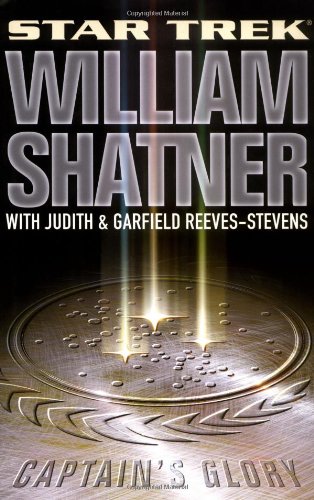
During James T. Kirk's heroic five-year mission as captain of the Starship Enterprise, a mysterious alien threat called "The Totality" commenced its stealthy invasion, intending to conquer the Milky Way galaxy as it had conquered the Andromeda. Now the time for secrecy has passed, and a war unlike any other has begun - one that threatens to destroy the Federation, first by bringing warp travel to an end, and then by absorbing all living matter into an unknown realm.
Twice before, Captain Kirk has encountered the Totality. Both times it took the beguiling form of Norinda, an irresistible alien who becomes the woman each person she meets most desperately desires. In his first encounter, Kirk almost lost the Enterprise. In his second encounter, he almost lost his child and watched in horror as the Totality absorbed Spock in its monstrous dimensional tendrils. But now, Kirk faces an even more devastating personal challenge. The battle lines have been drawn, and he and his friend Captain Jean-Luc Picard are on opposite sides.
After the events of Star Trek Nemesis, on the leading edge of Star Trek's future history, Captain's Glory depicts a Federation attacked from within, on the brink of collapse, with Earth's own solar system an armed and isolated camp. Reunited with Dr. Leonard "Bones" McCoy and Chief Engineer Scott, Kirk must join forces with Admiral Kathryn Janeway and the Holographic Doctor from the Starship Voyager in order to save Spock and expose the true nature of the Totality.
With Captain William Riker and Commander Deanna Troi of the Starship Titan caught in the cross fire of the conflict between Kirk and Picard, and with Kirk's own child poised on the brink of a startling destiny millions of years in the making, Kirk must prepare for his final encounter with the Totality. But how can Kirk fight an enemy whose greatest weapon is love? And how can he triumph, when the price of victory is the life of his only child?
Die Inhaltsangabe kann sich auf eine andere Ausgabe dieses Titels beziehen.
Über die Autorinnen und Autoren
William Shatner is the author of nine Star Trek ® novels, including the New York Times bestsellers The Ashes of Eden and The Return. He is also the author of several nonfiction books, including Get a Life! and I'm Working on That. In addition to his role as Captain James T. Kirk, he stars as Denny Crane in the hit television series from David E. Kelley, Boston Legal -- a role for which he has won two Emmy Awards and a Golden Globe. More information is available at williamshatner.com.
Judith & Garfield Reeves-Stevens are the authors of more than thirty books, including numerous New York Times bestselling Star Trek novels. Their newest novel of suspense, Freefall, is a follow-up to their Los Angeles Times bestseller, Icefire, and is set against the political intrigue and historical conspiracy surrounding the next race to the Moon.
In keeping with their interest in both the reality of space exploration and the science fiction that helps inspire it, in 2003 Judith and Garfield were invited to join a NASA Space Policy Workshop for the development of NASA's new goals as put forth in the agency's 2004 Vision for Space Exploration. Then, for the 2004 television season, the couple joined the writing staff of Star Trek: Enterprise as executive story editors. For more information, please visit www.reeves-stevens.com.
Auszug. © Genehmigter Nachdruck. Alle Rechte vorbehalten.
1
COCHRANE INSTITUTE, NEW MONTANA
STARDATE 58552.2
The citizens of Alpha Centauri B II, who had not thought of themselves as "colonists" for generations, were unprepared for the violence of the first attack. Nor had anyone anticipated the target of that violence.
Only the grove of fig trees planted by the great man himself more than two centuries earlier survived. The rest of the Cochrane Institute lay in ruins.
But the day that ended with the gathering storm of war had begun as any other on a world complacent and too used to peace.
It was late winter in the Northern Hemisphere of New Montana; the stars Centauri A and Centauri B rose together in the dawn. Only during summer is sunlight present for a full twenty-six hours each day. That's the season when the orbit of Centauri B's second planet places it between the two larger stars of the ternary Alpha Centauri system.
On the island continent of Atlantis, the early morning then was crisp, the forests of Earth maple and birch bare of leaves, their empty branches little more than quick dark brush strokes against the pure blue canvas of a sky that had not been "alien" to humans for centuries.
Outside the main urban centers of the east coast, smoke trailed from the chimneys of housing clusters. The crackle and scent of burning wood added the sensory texture missing from the island's efficient geothermal power plants that provided energy to its scattered communities. It was only at the Cochrane Institute that planet-based antimatter generators were used, a requirement of its cutting-edge work in warp propulsion.
More than thirty major buildings formed the main campus, their dusky red forms sweeping up a gentle rise of green foothills. The structures that commanded the hilltops looked out to Lily's Ocean to the east and the rugged Rockier Mountains to the west. As the first human to journey to Centauri B II, Zefram Cochrane had thoroughly enjoyed exercising his right to name both the planet and its major geological features.
One of the uppermost buildings was a Starfleet installation. The research performed there was restricted, ensuring that Starfleet's capabilities would always remain significantly more advanced than those of civilian ships, privateers, and any potential "peer competitors" -- Starfleet's current bland term for the restive Klingon Empire.
Officially known as Facility 18, the building was older than the others, constructed almost ninety standard years earlier. Its historic façade of intricately sculpted, red Centauran sandstone was set off by bold horizontal timbers of the pale, native Lincoln trees praised -- and named -- by Cochrane for producing logs of exceptional uniformity.
Facility 18's stark and sleek interior, however, revealed signs of regular rebuilding and upgrading. The most recent changes dated from the frantic months toward the end of the Dominion War, eight years earlier. Though the realization was never discussed in public, the leadership of Starfleet was uncomfortably aware that the war's heavy price for survival had also spurred one of the most productive periods of scientific advancement Starfleet had experienced for generations.
On this date, Middleday, Twelfthmonth 27 on New Montana, Stardate 58552.2 for the Federation at large, Facility 18 was preparing to run a static test on a prototype warp core. Little different in principle from those in service on most Starfleet vessels, the experimental device was notable for its size -- almost one-third smaller than the standard design for its payload capacity. The anticipation was that, within a decade at the present rate of development, Starfleet would be able to test runabout-size vessels capable of warp-nine velocities. In terms of travel time, the galaxy grew smaller every day.
The prototype warp core was scheduled to come online at 0800 hours. For this test, it would produce a warp bubble approximately four meters in diameter with a field strength of no more than five millicochranes. These specifics were important: A warp field that weak would not be able to pop out of the planet's relativistic frame. Even more significant, the core would remain motionless as researchers measured the field's shape and stability, and the efficiency of the miniaturized synthetic-dilithium matrix -- one of the keys to the warp core's smaller size.
If the test were successful, space trials would follow, with the prototype warp core installed on a test sled.
But the test was not successful, and Starfleet's Advanced Warp Development Group paid the price of that failure.
Commander Tresk Drumain was a third-generation Star-fleet engineer, and the lead investigator on the current prototype tests. He had arrived at Facility 18 at noon the day before, and had worked through the night to prepare the prototype core for the static test.
As the time for the initialization approached, Drumain needed no coffee or other stimulant to stay awake. He was thirty-four standard years old, and the excitement and the challenge of the moment were more than enough to keep him alert. Even making commander by age thirty-two hadn't been as thrilling as this test promised to be.
Drumain felt confident in his team's preparations. The prototype core was already locked down in the center of the main test chamber -- an immense, reinforced, triduranium-sheathed room more than one hundred meters on a side. Even if a miscalculation or a power surge resulted in the core jumping to warp, the chamber was aligned so that the planet's own rotation would cause the core to slam into a vast reservoir containing four hundred thousand liters of water. That reservoir was built into the grassy hillside to the east of Facility 18. Because the core's power supply remained outside the warp field, the field would collapse instantly, allowing for no more than a few hundred meters of travel.
There was no need for concern.
At 0750, in the dimly lit control room overlooking the test chamber, Drumain took his chair at the main monitoring console. As scheduled, the triduranium blast shield slid silently over the large observation window. Now the test core was visible only on the rows of console monitors displaying visual sensor readings from inside the chamber.
Three hours earlier, the atmosphere had been pumped out of the test chamber, leaving the core in a vacuum that was almost the equal of interstellar space. The visual images from inside the chamber were sharp and clear.
At 0755, Drumain glanced again at the message padd propped on the console so all could see. It held the good luck wishes of Commander Geordi La Forge. The man was a legend in Starfleet, and Drumain and his crew had been surprised and encouraged to realize that one of Starfleet's greatest engineering geniuses was paying personal attention to what they were attempting here. La Forge had asked to be informed about the test results as quickly as possible, and Drumain looked forward to making that call sometime before lunch.
At 0759, Drumain polled his team -- a group of more than fifty Starfleet and institute personnel. Their responses were instant and reassuring. All systems on the test core were checked and ready. All sensors were operational. The antimatter generator was online and producing the required level of power.
Drumain tugged down on his Starfleet jacket as the final few seconds of the countdown proceeded.
Timecode: zero.
Everything occurred exactly as planned.
For eighteen seconds.
That was when a warning alert flashed on Drumain's board. A minor power surge.
It wasn't large enough for the computer safety subroutines to automatically shut down the test, but the warning prompted Drumain to keep his hand over the large red "kill" switch.
His eyes jumped back and forth between the display showing the power graph and the display showing the test core, but except for the soft blue glow...
„Über diesen Titel“ kann sich auf eine andere Ausgabe dieses Titels beziehen.
Suchergebnisse für Captain's Glory (Star Trek)

Beispielbild für diese ISBN
Captains Glory Star Trek The O
Anbieter: World of Books (was SecondSale), Montgomery, IL, USA
Verkäuferbewertung 5 von 5 Sternen

Zustand: Acceptable. Item in acceptable condition! Textbooks may not include supplemental items i.e. CDs, access codes etc. Artikel-Nr. 00104921732
Gebraucht kaufen
EUR 3,91
Versand gratis
Versand innerhalb von USA
Versand innerhalb von USA
Anzahl: 1 verfügbar
Beispielbild für diese ISBN
Captains Glory Star Trek The O
Anbieter: World of Books (was SecondSale), Montgomery, IL, USA
Verkäuferbewertung 5 von 5 Sternen
Zustand: Good. Item in good condition and has highlighting/writing on text. Used texts may not contain supplemental items such as CDs, info-trac etc. Artikel-Nr. 00099728546
Gebraucht kaufen
EUR 3,91
Versand gratis
Versand innerhalb von USA
Versand innerhalb von USA
Anzahl: 1 verfügbar
Beispielbild für diese ISBN
Captain's Glory
Anbieter: Better World Books: West, Reno, NV, USA
Verkäuferbewertung 5 von 5 Sternen
Zustand: Very Good. Pocket Books Hardcover Ed. Former library copy. Pages intact with possible writing/highlighting. Binding strong with minor wear. Dust jackets/supplements may not be included. Includes library markings. Stock photo provided. Product includes identifying sticker. Better World Books: Buy Books. Do Good. Artikel-Nr. GRP63490855
Gebraucht kaufen
EUR 5,97
Versand gratis
Versand innerhalb von USA
Versand innerhalb von USA
Anzahl: 1 verfügbar
Beispielbild für diese ISBN
Captain's Glory
Anbieter: Better World Books: West, Reno, NV, USA
Verkäuferbewertung 5 von 5 Sternen
Zustand: Good. Pocket Books Hardcover Ed. Former library copy. Pages intact with minimal writing/highlighting. The binding may be loose and creased. Dust jackets/supplements are not included. Includes library markings. Stock photo provided. Product includes identifying sticker. Better World Books: Buy Books. Do Good. Artikel-Nr. GRP17033264
Gebraucht kaufen
EUR 5,97
Versand gratis
Versand innerhalb von USA
Versand innerhalb von USA
Anzahl: 1 verfügbar
Beispielbild für diese ISBN
Captain's Glory
Anbieter: Better World Books, Mishawaka, IN, USA
Verkäuferbewertung 5 von 5 Sternen
Zustand: Good. Pocket Books Hardcover Ed. Former library copy. Pages intact with minimal writing/highlighting. The binding may be loose and creased. Dust jackets/supplements are not included. Includes library markings. Stock photo provided. Product includes identifying sticker. Better World Books: Buy Books. Do Good. Artikel-Nr. GRP17033264
Gebraucht kaufen
EUR 5,97
Versand gratis
Versand innerhalb von USA
Versand innerhalb von USA
Anzahl: 1 verfügbar
Beispielbild für diese ISBN
Captain's Glory
Anbieter: ThriftBooks-Atlanta, AUSTELL, GA, USA
Verkäuferbewertung 5 von 5 Sternen
Hardcover. Zustand: Good. No Jacket. Pages can have notes/highlighting. Spine may show signs of wear. ~ ThriftBooks: Read More, Spend Less. Artikel-Nr. G0743453433I3N00
Gebraucht kaufen
EUR 6,20
Versand gratis
Versand innerhalb von USA
Versand innerhalb von USA
Anzahl: 1 verfügbar
Beispielbild für diese ISBN
Captain's Glory (Star Trek)
Anbieter: World of Books (was SecondSale), Montgomery, IL, USA
Verkäuferbewertung 5 von 5 Sternen
Zustand: Good. Good condition ex-library book with usual library markings and stickers. Artikel-Nr. 00106702489
Gebraucht kaufen
EUR 9,19
Versand gratis
Versand innerhalb von USA
Versand innerhalb von USA
Anzahl: 1 verfügbar
Beispielbild für diese ISBN
Captain's Glory (Star Trek: The Original S.)
Anbieter: AwesomeBooks, Wallingford, Vereinigtes Königreich
Verkäuferbewertung 5 von 5 Sternen
Hardcover. Zustand: Very Good. Captain's Glory (Star Trek: The Original S.) This book is in very good condition and will be shipped within 24 hours of ordering. The cover may have some limited signs of wear but the pages are clean, intact and the spine remains undamaged. This book has clearly been well maintained and looked after thus far. Money back guarantee if you are not satisfied. See all our books here, order more than 1 book and get discounted shipping. Artikel-Nr. 7719-9780743453431
Gebraucht kaufen
EUR 4,78
EUR 4,80 Versand
Versand von Vereinigtes Königreich nach USA
Versand von Vereinigtes Königreich nach USA
Anzahl: 2 verfügbar
Beispielbild für diese ISBN
Captain's Glory
Anbieter: WorldofBooks, Goring-By-Sea, WS, Vereinigtes Königreich
Verkäuferbewertung 5 von 5 Sternen
Paperback. Zustand: Fair. A readable copy of the book which may include some defects such as highlighting and notes. Cover and pages may be creased and show discolouration. Artikel-Nr. GOR002080213
Gebraucht kaufen
EUR 3,35
EUR 6,52 Versand
Versand von Vereinigtes Königreich nach USA
Versand von Vereinigtes Königreich nach USA
Anzahl: 1 verfügbar
Beispielbild für diese ISBN
Captain's Glory (Star Trek: The Original S.)
Anbieter: WorldofBooks, Goring-By-Sea, WS, Vereinigtes Königreich
Verkäuferbewertung 5 von 5 Sternen
Paperback. Zustand: Very Good. The book has been read, but is in excellent condition. Pages are intact and not marred by notes or highlighting. The spine remains undamaged. Artikel-Nr. GOR001724375
Gebraucht kaufen
EUR 3,35
EUR 6,52 Versand
Versand von Vereinigtes Königreich nach USA
Versand von Vereinigtes Königreich nach USA
Anzahl: 4 verfügbar