
Verwandte Artikel zu My Name Is Bill: Bill Wilson--His Life and the Creation...
Inhaltsangabe
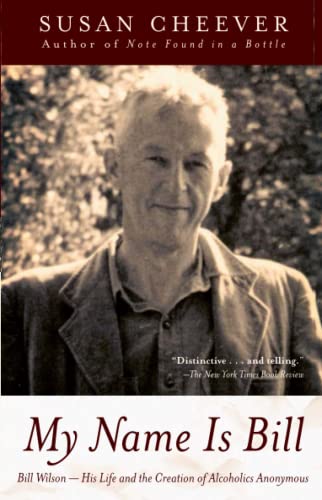
The definitive biography of Bill Wilson, the man who established Alcoholics Anonymous, and the first to be written with access to documents in that organization's archives, by a noted author who is herself a recovering alcoholic.
In this definitive and groundbreaking biography, acclaimed author Susan Cheever offers a remarkably human portrait of a man whose life and work both influenced and saved the lives of millions of people. Drawing from personal letters, diaries, AA archives, interviews—and Cheever's own experiences with alcoholism—My Name Is Bill is the first fully documented, deeply felt account of Bill Wilson and Alcoholics Anonymous.
Die Inhaltsangabe kann sich auf eine andere Ausgabe dieses Titels beziehen.
Über die Autorin bzw. den Autor
Susan Cheever is the bestselling author of thirteen previous books, including five novels and the memoirs Note Found in a Bottle and Home Before Dark. Her work has been nominated for the National Book Critics Circle Award and won the Boston Globe Winship Medal. She is a Guggenheim Fellow, a member of the Corporation of Yaddo, and a member of the Author's Guild Council. She teaches in the Bennington College M.F.A. program. She lives in New York City with her family.
Auszug. © Genehmigter Nachdruck. Alle Rechte vorbehalten.
Chapter One: The Wilson House
The evening before Thanksgiving on November 25, 1895, Mrs. Emily Griffith Wilson, twenty-five years old, very confused and very pregnant, might have been found in the Wilson House hotel kitchen as the afternoon cold settled in outside and the steam formed on the windowpanes. She was preparing to bake an apple pie, cutting the apples and then rolling out the crust, and keeping an eye on the popcorn just warming up in a cast-iron pan over the woodstove. The big north-facing room where she worked smelled of cooking: of flour and the sweetness of apples, of a batch of sugar cookies and the sausage frying for the stuffing. Usually, she found these smells delicious, but this afternoon they were nauseating. Pregnancy ruined everything, she thought.
Emily could hear the others thumping around upstairs, Grandma Wilson and Gilly, and the rhythmic thunk, thunk of someone splitting wood in the big shed where the sheep and goats were penned in for the winter. Up the hill a dog barked. Out the back windows the kitchen garden, where a few pumpkins still lazed against the cold earth, was framed by the white columns of the porch, the big pine tree, and the road that followed Mad Tom Brook down to the peaked roof of the railroad station. She could hear the trains going through three times each day -- the Green Mountain Flyer and the midnight sleeper when she was up late. The track came down from Montreal, past Dorset Pond just a few miles north, then right past the general store and the cheese factory, and then down the valley toward Manchester Depot and Manchester Village on the way to Albany, where you could change for Boston or New York City. Grover Cleveland was president, New York City police had just cracked down on an illicit distillery, and Oscar Hammerstein was packing them in at his Olympia Theater.
Across the green, as night fell and the pains made it harder for her to stay and work at the kitchen table, Emily could just see the parsonage where she and Gilly were planning to live once the baby was born. Then the lights went on in her parents' little white house with the cheerful red door and the green shutters. They would be over for dinner tomorrow, but the thought of them at prayer in the cozy little parlor where she had grown up made the pains subside for a moment. Not that their life had been perfect -- life was always hard -- but right now, alone for a moment, she remembered the innocent girl she had once been. Things had seemed so simple then. Slow-moving oxen pulled the great blocks of marble out of the mountains and loaded them onto railroad cars. There was maple sugaring in the spring and apple picking and cider in the fall. There was the General Store, where Mr. Barrows always smiled at her; the town meetings over in Dorset Village; the Grange Hall, where men argued about politics; the blacksmith shop where the family horses got new shoes; and the cobbler where she went for her own new shoes.
On the other side of the tracks were the marble mills where the blocks were cut into the slabs that were as common as grass all over town. East Dorset marble was the best marble in the world. There was her family's church and another church for the Irish who had come when the Freedleyville Quarry opened. There was school and playing and wonderful books. Emily had always imagined herself as Becky Thatcher in Mark Twain's book Tom Sawyer -- adventurous, daring, and a little too smart for her own good. Her family, the Griffiths, were local nobility. They were the wealthiest family in town although they would never say so. Her father, Gardner Fayette Griffith, had fought for the Union Army during the Civil War. He had been at Gettysburg with the Vermont 14th Regiment and helped repel Pickett's charge and win the war for the righteous. He owned the town's waterworks. He and his cousin Silas had the idea of selling wood cut from the forests that blanketed the surrounding mountains, and it had been a very good idea.
For what seemed like a long time the Griffiths had lived happily in their house on the green with their children, their beloved son Clarence and their daughters Millie and Emily. Everyone knew how smart Emily was. After grade school she had gone off to train at the Normal School over in Castleton, and she had become a teacher in the local one-room schoolhouse. Emily had her heart set on more than teaching, though. "Success, success, success, let that be your watchword!" she exhorted her son years later. Now she exhorted herself. Even then, as she carried that first child through the summer and fall of 1895, she imagined being something greater, something a man might be, perhaps a doctor or a lawyer.
Emily loved her parents -- her father often seemed to be the only person who really understood her. He understood that she was too big for life in their little village. She was aiming for larger things. Her mother was always reminding her that she was a woman and that she should act like a woman, but her father didn't seem to feel that way. She was like him, she told herself. She had high ambitions for everyone around her, ambitions that transcended gender. What her mother called stubbornness she saw as determination; determination like her father's. Even though her father was her best friend, the events of the last few years just seemed to have overwhelmed their friendship.
First Emily's little brother, Clarence, was sick. There was something wrong with his lungs. He couldn't breathe. Dr. Liddle came over from Dorset and said Clarence had to be sent to Colorado. Of course her parents followed instructions, but it was awful to see the little boy off on the train. Then they got word that the Colorado air hadn't worked. Clarence was dead. Ever since that boy died so far away, and no one knew who was there to comfort him in his last hours, Fayette had been different. Losing his ten-year-old son broke his heart. Even now, she knew her father didn't like complaining. Pregnancy wasn't something she would talk about with him; she had to concentrate on putting her fears aside.
Fayette Griffith expected that even children would adjust their feelings to life's little practicalities. She remembered the way he had reacted the one time she allowed herself to get sentimental about a farm animal. "Thanksgiving dinner with rousing fires in all the stoves to keep out the zero cold, and plenty of good cheer all around," she remembered forty years later. "The dinners were mostly always turkey. Occasionally we had chicken," she continued, "and once a little young barbecued pig -- and that little pig was my pet -- and the unusual sight of him made me feel kind of sick and faint." She wasn't allowed to leave the table.
A handsome Yankee woman with long chestnut hair, Emily couldn't believe how quickly she lay her ambitions aside and did what seemed to be expected of her, embracing marriage and motherhood. She was feeling angry at her husband Gilman, who was already not quite shaping up to be the man she had imagined he could be when they married a year before.
It was almost an arranged marriage. She and Gilly had known each other all their lives. Her family was no-nonsense and well off and lived on the north side of the green; his family was social and gregarious and owned the Wilson House on the south side of the green. Maybe that was the problem. She had grown up in a house; Gilly had grown up running an inn with his widowed mother, drinking with the guests and entertaining them even when he was a boy. Gilly was a charming man, a personable bachelor who had gone to Albany College in New York State. He had already been made manager of the North Quarry, and Emily had hoped that marriage would turn him into a responsible man.
Their family history seemed to affect Gilly in a different way than it affected her. At twilight on the night of November 25, as...
„Über diesen Titel“ kann sich auf eine andere Ausgabe dieses Titels beziehen.
Suchergebnisse für My Name Is Bill: Bill Wilson--His Life and the Creation...

Beispielbild für diese ISBN
My Name Is Bill: Bill Wilson - His Life and the Creation of Alcoholics Anonymous
Verlag:
Washington Square Press Inc.,N.Y., 2005
ISBN 10: 0743405919
ISBN 13: 9780743405911
Gebraucht
Paperback
Anbieter: World of Books (was SecondSale), Montgomery, IL, USA
Verkäuferbewertung 5 von 5 Sternen

Paperback. Zustand: Good. Alcoholics Anonymous is a worldwide organisation, which, since 1935, has helped millions of people to break free of their addiction. Now, acclaimed author Susan Cheever paints a remarkably human portrait of Bill Wilson, the man who created the famous Twelve-Step Programme and, with his friend, Dr Bob Smith, founded AA. Using extensive research, Cheever traces Wilson's life from his birth in small-town Vermont, to his battle with alcoholism and the eventual creation of AA. Wilson's life had many struggles and controversies and Cheever does credit to his legacy. Artikel-Nr. 00108384313
Gebraucht kaufen
EUR 4,09
Versand gratis
Versand innerhalb von USA
Versand innerhalb von USA
Anzahl: 1 verfügbar
Beispielbild für diese ISBN
My Name Is Bill: Bill Wilson - His Life and the Creation of Alcoholics Anonymous
Verlag:
Washington Square Press Inc.,N.Y., 2005
ISBN 10: 0743405919
ISBN 13: 9780743405911
Gebraucht
Paperback
Anbieter: World of Books (was SecondSale), Montgomery, IL, USA
Verkäuferbewertung 5 von 5 Sternen
Paperback. Zustand: Very Good. Alcoholics Anonymous is a worldwide organisation, which, since 1935, has helped millions of people to break free of their addiction. Now, acclaimed author Susan Cheever paints a remarkably human portrait of Bill Wilson, the man who created the famous Twelve-Step Programme and, with his friend, Dr Bob Smith, founded AA. Using extensive research, Cheever traces Wilson's life from his birth in small-town Vermont, to his battle with alcoholism and the eventual creation of AA. Wilson's life had many struggles and controversies and Cheever does credit to his legacy. Artikel-Nr. 00106850052
Gebraucht kaufen
EUR 4,09
Versand gratis
Versand innerhalb von USA
Versand innerhalb von USA
Anzahl: 1 verfügbar
Beispielbild für diese ISBN
My Name Is Bill: Bill Wilson--His Life and the Creation of Alcoholics Anonymous
Verlag:
Washington Square Press, 2005
ISBN 10: 0743405919
ISBN 13: 9780743405911
Gebraucht
Paperback
Anbieter: ThriftBooks-Reno, Reno, NV, USA
Verkäuferbewertung 5 von 5 Sternen
Paperback. Zustand: Good. No Jacket. Pages can have notes/highlighting. Spine may show signs of wear. ~ ThriftBooks: Read More, Spend Less. Artikel-Nr. G0743405919I3N00
Gebraucht kaufen
EUR 5,99
Versand gratis
Versand innerhalb von USA
Versand innerhalb von USA
Anzahl: 2 verfügbar
Beispielbild für diese ISBN
My Name Is Bill: Bill Wilson--His Life and the Creation of Alcoholics Anonymous
Verlag:
Washington Square Press, 2005
ISBN 10: 0743405919
ISBN 13: 9780743405911
Gebraucht
Paperback
Anbieter: ThriftBooks-Phoenix, Phoenix, AZ, USA
Verkäuferbewertung 5 von 5 Sternen
Paperback. Zustand: Good. No Jacket. Pages can have notes/highlighting. Spine may show signs of wear. ~ ThriftBooks: Read More, Spend Less. Artikel-Nr. G0743405919I3N00
Gebraucht kaufen
EUR 6,01
Versand gratis
Versand innerhalb von USA
Versand innerhalb von USA
Anzahl: 2 verfügbar
Beispielbild für diese ISBN
My Name Is Bill: Bill Wilson--His Life and the Creation of Alcoholics Anonymous
Verlag:
Washington Square Press, 2005
ISBN 10: 0743405919
ISBN 13: 9780743405911
Gebraucht
Paperback
Anbieter: ThriftBooks-Dallas, Dallas, TX, USA
Verkäuferbewertung 5 von 5 Sternen
Paperback. Zustand: Very Good. No Jacket. May have limited writing in cover pages. Pages are unmarked. ~ ThriftBooks: Read More, Spend Less. Artikel-Nr. G0743405919I4N00
Gebraucht kaufen
EUR 6,03
Versand gratis
Versand innerhalb von USA
Versand innerhalb von USA
Anzahl: 1 verfügbar
Beispielbild für diese ISBN
My Name Is Bill: Bill Wilson--His Life and the Creation of Alcoholics Anonymous
Verlag:
Washington Square Press, 2005
ISBN 10: 0743405919
ISBN 13: 9780743405911
Gebraucht
Paperback
Anbieter: ThriftBooks-Atlanta, AUSTELL, GA, USA
Verkäuferbewertung 5 von 5 Sternen
Paperback. Zustand: Good. No Jacket. Pages can have notes/highlighting. Spine may show signs of wear. ~ ThriftBooks: Read More, Spend Less. Artikel-Nr. G0743405919I3N00
Gebraucht kaufen
EUR 6,03
Versand gratis
Versand innerhalb von USA
Versand innerhalb von USA
Anzahl: 2 verfügbar
Beispielbild für diese ISBN
My Name Is Bill: Bill Wilson--His Life and the Creation of Alcoholics Anonymous
Verlag:
Washington Square Press, 2005
ISBN 10: 0743405919
ISBN 13: 9780743405911
Gebraucht
Paperback
Anbieter: ThriftBooks-Dallas, Dallas, TX, USA
Verkäuferbewertung 5 von 5 Sternen
Paperback. Zustand: Fair. No Jacket. Readable copy. Pages may have considerable notes/highlighting. ~ ThriftBooks: Read More, Spend Less. Artikel-Nr. G0743405919I5N00
Gebraucht kaufen
EUR 6,03
Versand gratis
Versand innerhalb von USA
Versand innerhalb von USA
Anzahl: 1 verfügbar
Beispielbild für diese ISBN
My Name Is Bill: Bill Wilson--His Life and the Creation of Alcoholics Anonymous
Verlag:
Washington Square Press, 2005
ISBN 10: 0743405919
ISBN 13: 9780743405911
Gebraucht
Paperback
Anbieter: ThriftBooks-Dallas, Dallas, TX, USA
Verkäuferbewertung 5 von 5 Sternen
Paperback. Zustand: Good. No Jacket. Pages can have notes/highlighting. Spine may show signs of wear. ~ ThriftBooks: Read More, Spend Less. Artikel-Nr. G0743405919I3N00
Gebraucht kaufen
EUR 6,03
Versand gratis
Versand innerhalb von USA
Versand innerhalb von USA
Anzahl: 2 verfügbar
Beispielbild für diese ISBN
My Name Is Bill (Bill Wilson--His Life and the Creation of Alcoholics Anonymous)
Verlag:
Washington Square Press, 2005
ISBN 10: 0743405919
ISBN 13: 9780743405911
Gebraucht
Softcover
Anbieter: Wonder Book, Frederick, MD, USA
Verkäuferbewertung 5 von 5 Sternen
Zustand: Good. Good condition. A copy that has been read but remains intact. May contain markings such as bookplates, stamps, limited notes and highlighting, or a few light stains. Artikel-Nr. R01K-02622
Gebraucht kaufen
EUR 6,33
Versand gratis
Versand innerhalb von USA
Versand innerhalb von USA
Anzahl: 1 verfügbar
Beispielbild für diese ISBN
My Name Is Bill : Bill Wilson--His Life and the Creation of Alcoholics Anonymous
Verlag:
Washington Square Press, 2005
ISBN 10: 0743405919
ISBN 13: 9780743405911
Gebraucht
Softcover
Anbieter: Better World Books: West, Reno, NV, USA
Verkäuferbewertung 5 von 5 Sternen
Zustand: Good. Reprint. Pages intact with minimal writing/highlighting. The binding may be loose and creased. Dust jackets/supplements are not included. Stock photo provided. Product includes identifying sticker. Better World Books: Buy Books. Do Good. Artikel-Nr. 5293440-20
Gebraucht kaufen
EUR 9,95
Versand gratis
Versand innerhalb von USA
Versand innerhalb von USA
Anzahl: 3 verfügbar