
Verwandte Artikel zu Deep Descent: Adventure and Death Diving the Andrea...
Inhaltsangabe
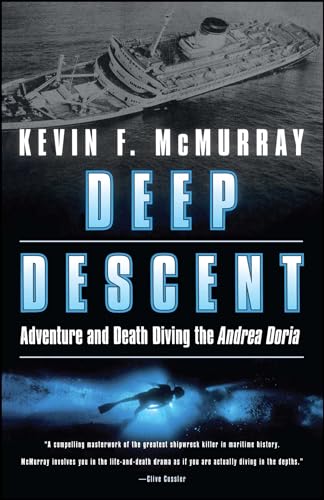
On a foggy July evening in 1956, the Italian cruise liner Andrea Doria, bound for New York, was struck broadside by another vessel. In eleven hours, she would sink nearly 250 feet to the murky Atlantic Ocean floor. Thanks to a daring rescue operation, only 51 of more than 1,700 people died in the tragedy. But the Andrea Doria is still taking lives.
Considered the Mt. Everest of diving, the Andrea Doria is the ultimate deepwater wreck challenge. Over the years, a small but fanatical group of extreme scuba divers have investigated the Andrea Doria, pushing themselves to the very limits of human endurance to explore her -- and not all have returned. Diver Kevin McMurray takes you inside this elite club with a hard, honest look at those who go deeper, farther, and closer to the edge than others would ever dream.
Deep Descent is the riveting true story of the human spirit overcoming human frailty and of fearsome, mortal risks traded for a hard-core adrenaline rush. Chronicling these adventures in his page-turning narrative and in dozens of dramatic photos, McMurray draws us deeper into the cold heart of the unforgiving sea, giving us a powerful vision of a place to which few will ever have the skills -- or the courage -- to go.
Die Inhaltsangabe kann sich auf eine andere Ausgabe dieses Titels beziehen.
Über die Autorin bzw. den Autor
Kevin F. McMurray is an award-winning journalist and photographer whose work has appeared in The New York Times, New York magazine, Outside, Yankee, Men's Journal, The Sunday Times (London), Rock and Ice, Cigar Aficionado, and other publications. An avid outdoor adventurer, McMurray is an expert scuba diver and former world record holder for swimming around Manhattan. He is also the author of Deep Descent and Dark Descent. He lives in Brewster, New York.
Von der hinteren Coverseite
An in-depth look at the danger-loving divers of the Andrea Doria, the so-called 'Everest' of deep-sea diving, from a writer and photographer who has met the wreck, and her victims, firsthand.
Auszug. © Genehmigter Nachdruck. Alle Rechte vorbehalten.
CHAPTER ONE
It is not death, but dying, which is terrible.
Henry Fielding
Wearing close to two-hundred pounds of scuba gear, Gary Gilligan was anxious to make his ungainly entry into the rolling seas of the Atlantic. The neoprene dry suit and his heavy undergarments had him sweating bullets under the hot July-afternoon sun. Prior to his giant step outward and down from the deck of the dive boat RV Wahoo, Gary glanced around and surveyed his surroundings with only the narrow range of vision that his dive mask afforded him.
Land had long since disappeared over the horizon, and no other vessel was in sight. The glare of the sun reflecting off the glassy seas made him wince behind his faceplate. He of course was aware of the activity around him. Getting into the water is always a major hassle for deep divers, and attendance by crew members and fellow divers prior to entry is a necessity, not a luxury. Still, it was tough for Gary Gilligan to be patient, overburdened as he was with gear, not to mention with anxiety. Gary had to remind himself to be cool: getting all bent out of shape before entering the water was a bad idea, he knew. It had a way of biting you back in the ass.
Gary tried to maintain his balance, but he felt encumbered with all the hardware, encased from head to toe in the suffocating dry suit. It was not easy what with the three-foot swells gently lifting up the fifty-five-foot fiberglass boat, only to drop it back down into the following trough, making the deck of the vessel an unstable platform. The cerulean skies high overhead, Gary noticed, still had contrails vectoring eastward to Europe, left behind by the streaking Concorde whose sonic booms had rocked the boat just minutes earlier.
Then the dorsal and caudal fins of the circling blue sharks and their ominous forms beneath suddenly disappeared. They had descended into the depths, Gary thought, knowing full well that he would catch glimpses of their skittish shadows on his long swim to the bottom. Steadying himself on the gunwale, he was relishing the thought of immersion in the cold, blue-green waters of the Atlantic. Finally he would be on his way down the distance of a seventeen-floor skyscraper to the wreck of the Andrea Doria.
Gary checked to see if his buddy Sally Wahrmann was ready. They gave each other the thumb-to-forefinger salute indicating that everything was okay. Gary pressed his mask tight to his face, snugged his double tanks to his back, and entered the ocean.
With only twenty-five minutes allotted for bottom time, Gary and Sally quickly emptied their bloated dry suits of air and kicked hard for the bow anchor line that led down to the sunken luxury liner. Gary was surprised to see three divers lingering on a line running from the anchor line aft at the fifty-foot mark.
Kicking down past them, Gary gave a quick glance back up. He could see the three men were having difficulties. Just a mere hour ago the three had rigged the two long sets of hoses and breathing regulators that were hooked to a tank of pure oxygen aboard the Wahoo and had secured them to a weighted line amidships at the desired depth of twenty feet. Gary could now see that one of those divers, twenty-seven-year-old John Ormsby, one of the charterers of the trip, had gotten hung up in the traverse line. Another diver, Billy Deans, had come to his aid to untangle him. Gary could see they were handling the situation and continued his descent.
In deep diving it was a radically new practice to use supplemental oxygen in water. Breathing pure oxygen after a dive was always known to be beneficial, but using it underwater had only recently been advocated, by Billy Deans of Key West, Florida. Deans knew it was a quick way to expunge the nitrogen gas that had been absorbed by the blood and soft tissues under the crushing load of the ocean. The tiny nitrogen bubbles released by the rapid reduction of pressure, if not compensated for by a slow ascent and a supply of oxygen, could spread through the body, crippling or even killing the diver. Divers called it getting "bent," but the medical community referred to it as decompression sickness.
Sally Wahrmann never saw the unfolding drama above her. She was focused on the dark abyss beneath her. Only later would she hear the story and think about how it was a tragic foreshadowing of what was to happen just minutes later, more than two-hundred feet beneath the surface deep within the holds of the sunken steel sarcophagus of the Andrea Doria.
No one would ever guess that Sally Wahrmann was a pioneer in the world of deep diving. At thirty-nine, Sally looked more like the accounting professor she actually was in the professional world. Only five foot five and edging precipitously toward two hundred pounds, Sally was one of the most accomplished scuba divers -- male or female -- in the rarefied world of deep-wreck diving. She had logged over sixty dives alone on the Doria.
On July 31, 1985, Sally was again on the Wahoo. She was more excited than usual as several Florida diving luminaries were also aboard.
Spencer Slate from Key Largo had chartered the Wahoo. Slate owned the Atlantis Diver Center in Key Largo, which was a popular tourist destination for divers in the Florida Keys. It had always been a dream of Slate's to dive the Andrea Doria, so he had put the group together to charter the Wahoo. Billy Deans owned Key West Diver, a dive shop and training business. Deans was a trailblazer in deep diving, and his exploits in Florida-water shipwrecks were the stuff of legend. Neal Watson, the owner of Undersea Adventures, which consisted of diving resorts in Florida and the Caribbean, also had the record at the time for the deepest dive on scuba at 437 feet. John Ormsby, Deans's best friend, dive buddy, and instructor at his shop, had the record for free diving, or skin diving, down to 170 feet on just one breath. Rick Frehsee was an internationally acclaimed underwater photographer, whose work had appeared in National Geographic among others. Also in the charter were Dick Masten, a police officer, and Lou Delotto, an airline pilot, both well-known in the Florida dive community. It was a first trip for all of them to the Andrea Doria. For all his deep-water experience, Billy Deans had never dove outside the state of Florida.
The group made the trek up to Montauk at the tip of New York's Long Island, where the Wahoo was to pick them up.
Spencer Slate, who had chartered the boat, wasn't with them. On one of his training dives for the Doria, Slate had taken a minor hit of decompression sickness in 250 feet of water off Key West, and his doctor thought for safety's sake Slate should back out of the deep Andrea Doria dive.
The Florida group was there for one reason: china. Pieces of china, crystal, and silverware with the mark of the Italia steamship company are more precious than Spanish doubloons to wreck divers. The Floridians had discussed the china the day before departure with veteran Doria diver Gary Gentile, who was crewing on the Wahoo. Gentile had already made a trip out to the wreck the week before, and he had his recovered artifacts from the first-class gift shop. Deans remembered the trinkets had stirred up "a fever, a frenzy, a rabidity," among the Florida group. On the way out to the wreck site the only topic of conversation was the Andrea Doria ship plans and how to get some artifacts off her.
Rick Jaszyn, another deep diver with Doria experience, was also crewing aboard the Wahoo. A New Jersey resident, Jaszyn was only twenty-seven years old, but he had logged hundreds of dives on the deep wrecks found in the waters of the North Atlantic. He was the only diver, besides Gary Gentile and Steve...
„Über diesen Titel“ kann sich auf eine andere Ausgabe dieses Titels beziehen.
Suchergebnisse für Deep Descent: Adventure and Death Diving the Andrea...

Foto des Verkäufers
Deep Descent: Adventure and Death Diving the Andrea Doria
Anbieter: Dream Books Co., Denver, CO, USA
Verkäuferbewertung 5 von 5 Sternen

Zustand: acceptable. This copy has clearly been enjoyedâ"expect noticeable shelf wear and some minor creases to the cover. Binding is strong, and all pages are legible. May contain previous library markings or stamps. Artikel-Nr. DBV.0743400631.A
Gebraucht kaufen
EUR 3,79
Versand gratis
Versand innerhalb von USA
Versand innerhalb von USA
Anzahl: 2 verfügbar
Beispielbild für diese ISBN
Deep Descent: Adventure and Death Diving the Andrea Doria
Anbieter: World of Books (was SecondSale), Montgomery, IL, USA
Verkäuferbewertung 5 von 5 Sternen
Paperback. Zustand: Good. On a dense, foggy evening in July of 1956, the Italian cruise liner Andrea Doria, bound for New York, was struck broadside by another cruiseship, killing 51 people. Although she now rests silently on the sandy bottom of the Atlantic, nearly a half-century later the Doria continues to take lives (twelve since 1981). Yet a small, fanatical group of scuba divers continues to challenge her, pushing themselves far beyond the limits of recreational divers, to the very limits of human endurance. In DEEP DESCENT, Kevin F. McMurray, author and veteran Doria diver, takes readers inside this elite club of men and women who dare to go deeper, farther and close to the edge than prudence of common sense might allow. Artikel-Nr. 00097004734
Gebraucht kaufen
EUR 3,86
Versand gratis
Versand innerhalb von USA
Versand innerhalb von USA
Anzahl: 8 verfügbar
Beispielbild für diese ISBN
Deep Descent: Adventure and Death Diving the Andrea Doria
Anbieter: World of Books (was SecondSale), Montgomery, IL, USA
Verkäuferbewertung 5 von 5 Sternen
Paperback. Zustand: Very Good. On a dense, foggy evening in July of 1956, the Italian cruise liner Andrea Doria, bound for New York, was struck broadside by another cruiseship, killing 51 people. Although she now rests silently on the sandy bottom of the Atlantic, nearly a half-century later the Doria continues to take lives (twelve since 1981). Yet a small, fanatical group of scuba divers continues to challenge her, pushing themselves far beyond the limits of recreational divers, to the very limits of human endurance. In DEEP DESCENT, Kevin F. McMurray, author and veteran Doria diver, takes readers inside this elite club of men and women who dare to go deeper, farther and close to the edge than prudence of common sense might allow. Artikel-Nr. 00105900134
Gebraucht kaufen
EUR 3,86
Versand gratis
Versand innerhalb von USA
Versand innerhalb von USA
Anzahl: 1 verfügbar
Beispielbild für diese ISBN
Deep Descent: Adventure and Death Diving the Andrea Doria
Anbieter: World of Books (was SecondSale), Montgomery, IL, USA
Verkäuferbewertung 5 von 5 Sternen
Paperback. Zustand: Fair. On a dense, foggy evening in July of 1956, the Italian cruise liner Andrea Doria, bound for New York, was struck broadside by another cruiseship, killing 51 people. Although she now rests silently on the sandy bottom of the Atlantic, nearly a half-century later the Doria continues to take lives (twelve since 1981). Yet a small, fanatical group of scuba divers continues to challenge her, pushing themselves far beyond the limits of recreational divers, to the very limits of human endurance. In DEEP DESCENT, Kevin F. McMurray, author and veteran Doria diver, takes readers inside this elite club of men and women who dare to go deeper, farther and close to the edge than prudence of common sense might allow. Artikel-Nr. 00101624718
Gebraucht kaufen
EUR 3,86
Versand gratis
Versand innerhalb von USA
Versand innerhalb von USA
Anzahl: 2 verfügbar
Beispielbild für diese ISBN
Deep Descent: Adventure and Death Diving the Andrea Doria
Verlag:
Atria (edition Reprint), 2002
ISBN 10: 0743400631
ISBN 13: 9780743400633
Gebraucht
Paperback
Anbieter: BooksRun, Philadelphia, PA, USA
Verkäuferbewertung 5 von 5 Sternen
Paperback. Zustand: Fair. Reprint. The item might be beaten up but readable. May contain markings or highlighting, as well as stains, bent corners, or any other major defect, but the text is not obscured in any way. Artikel-Nr. 0743400631-7-1
Gebraucht kaufen
EUR 4,83
Versand gratis
Versand innerhalb von USA
Versand innerhalb von USA
Anzahl: 1 verfügbar
Beispielbild für diese ISBN
Deep Descent: Adventure and Death Diving the Andrea Doria
Anbieter: BooksRun, Philadelphia, PA, USA
Verkäuferbewertung 5 von 5 Sternen
Paperback. Zustand: Very Good. It's a well-cared-for item that has seen limited use. The item may show minor signs of wear. All the text is legible, with all pages included. It may have slight markings and/or highlighting. Artikel-Nr. 0743400631-11-1
Gebraucht kaufen
EUR 5,48
Versand gratis
Versand innerhalb von USA
Versand innerhalb von USA
Anzahl: 1 verfügbar
Beispielbild für diese ISBN
Deep Descent: Adventure and Death Diving the Andrea Doria
Anbieter: ThriftBooks-Reno, Reno, NV, USA
Verkäuferbewertung 5 von 5 Sternen
Paperback. Zustand: Good. No Jacket. Pages can have notes/highlighting. Spine may show signs of wear. ~ ThriftBooks: Read More, Spend Less. Artikel-Nr. G0743400631I3N00
Gebraucht kaufen
EUR 5,94
Versand gratis
Versand innerhalb von USA
Versand innerhalb von USA
Anzahl: 1 verfügbar
Beispielbild für diese ISBN
Deep Descent: Adventure and Death Diving the Andrea Doria
Anbieter: ThriftBooks-Phoenix, Phoenix, AZ, USA
Verkäuferbewertung 5 von 5 Sternen
Paperback. Zustand: Good. No Jacket. Pages can have notes/highlighting. Spine may show signs of wear. ~ ThriftBooks: Read More, Spend Less. Artikel-Nr. G0743400631I3N00
Gebraucht kaufen
EUR 5,94
Versand gratis
Versand innerhalb von USA
Versand innerhalb von USA
Anzahl: 1 verfügbar
Beispielbild für diese ISBN
Deep Descent: Adventure and Death Diving the Andrea Doria
Anbieter: ThriftBooks-Phoenix, Phoenix, AZ, USA
Verkäuferbewertung 5 von 5 Sternen
Paperback. Zustand: Fair. No Jacket. Readable copy. Pages may have considerable notes/highlighting. ~ ThriftBooks: Read More, Spend Less. Artikel-Nr. G0743400631I5N00
Gebraucht kaufen
EUR 5,94
Versand gratis
Versand innerhalb von USA
Versand innerhalb von USA
Anzahl: 1 verfügbar
Beispielbild für diese ISBN
Deep Descent: Adventure and Death Diving the Andrea Doria
Anbieter: ThriftBooks-Dallas, Dallas, TX, USA
Verkäuferbewertung 5 von 5 Sternen
Paperback. Zustand: Good. No Jacket. Pages can have notes/highlighting. Spine may show signs of wear. ~ ThriftBooks: Read More, Spend Less. Artikel-Nr. G0743400631I3N00
Gebraucht kaufen
EUR 5,94
Versand gratis
Versand innerhalb von USA
Versand innerhalb von USA
Anzahl: 1 verfügbar