
Verwandte Artikel zu Fatal Forecast: An Incredible True Tale of Disaster...
Inhaltsangabe
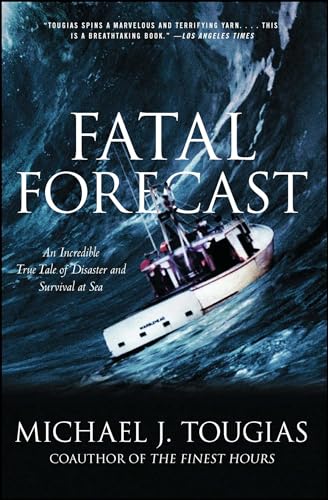
Now in paperback, a true story as spellbinding and harrowing as The Perfect Storm, “marvel- ous and terrifying” (Los Angeles Times)—published to herald the arrival of Tougias’s new hardcover, The Finest Hours.
On the morning of November 21, 1980, two small boats set out for Georges Bank, a lucrative but perilous lobster fishing ground off the coast of Cape Cod. The National Weather Service had forecast typical fall weather, and the young, rugged crewmen aboard the Sea Fever and the Fair Wind had no reason to expect that this trip would be any different from the dozens they’d made earlier in the season. But the only weather buoy in the area was malfunctioning, and the National Weather Service had failed to reveal this critical detail. And as the two small boats headed out to sea, a colossal storm was brewing to the southeast, a furious maelstrom that would batter the boats with sixty-foot waves and hurricane-force winds. A true story of catastrophe and survival at sea, this is a vivid moment-by-moment account of seventy-two hours in the lives of eight young fishermen. Most amazing is the story of Ernie Hazzard, who spent more than fifty terrifying hours adrift on the stormy open sea.
Gripping and heart-pounding, Fatal Forecast is an unfor- gettable true story about the collision of two spectacular forces: the brutality of nature and the human will to survive.
Die Inhaltsangabe kann sich auf eine andere Ausgabe dieses Titels beziehen.
Über die Autorin bzw. den Autor
Michael J. Tougias is the author of a number of books, including Rescue of the Bounty: Disaster and Survival in Superstorm Sandy; Overboard!; The Finest Hours (with Casey Sherman), the basis of the major motion picture released in 2016; Fatal Forecast; and Ten Hours Until Dawn: The True Story of Heroism and Tragedy Aboard the Can Do. He is a sought-after lecturer who gives more than seventy presentations each year. He lives in Massachusetts.
Auszug. © Genehmigter Nachdruck. Alle Rechte vorbehalten.
Fatal Forecast
An Incredible True Tale of Disaster and Survival at SeaBy Michael J. TougiasScribner
Copyright © 2009 Michael J. TougiasAll right reserved.
ISBN: 9780743297042
Chapter 1
The Fair Wind Crew
Ernie Hazard was in his third year of offshore lobster fishing, and although thework was brutally demanding, he felt fortunate. The Fair Wind, a 50-foot steel lobster boat on which Ernie worked, was a meticulously maintained vessel equipped with the most modern gear and electronics. Equally important, Ernie enjoyed the company of his fellow crewmembers and his captain -- no one slacked off and everyone contributed to making the Fair Wind a very profitable boat.
On November 20, 1980, the crew was having dinner at the Backside Saloon in Hyannis, Massachusetts, enjoying a good meal before making the last trip of the season. The men had made close to thirty fishing trips to Georges Bank since theprevious April, and they were all looking forward to having the next four monthsoff. Ernie talked about going down to Florida to see his brother or possibly heading out to Carmel, California, to visit friends. Thirty-year-old captain Billy Garnos planned to focus on his new house and his fiancée. Rob Thayer, agetwenty-two, hadn't made any definite plans, but he hoped to travel, having spentprior off-seasons in such far-flung places as Labrador and Newfoundland. Dave Berry, the youngest crewmember at just twenty years old, lived up in Marblehead,Massachusetts, and he'd likely take a little time off to be with friends beforeworking at his father's wholesale fish business.
Ernie felt relaxed that night, quietly listening as the rest of the crew discussed their plans. Every now and then he made a joke or a wry comment. The others had come to enjoy his self-deprecating humor and quick, dry wit. They also appreciated the muscle and stamina packed into his burly six-foot frame. Hehad arms as big as most men's thighs, and he put those arms to good use hauling and setting lobster traps. He looked tough and perhaps a bit menacing with his muscular arms, piercing black eyes, and wild black beard, but his crewmates knewthat behind the gruff exterior was an intelligent and thoughtful man.
But Ernie was no saint, and occasionally he and Billy Garnos would pound down a few rounds of beers after a week at sea and raise a little hell. This was especially true after they'd managed to harpoon a swordfish in addition to catching lobster, when each had a wad of cash in his pocket. Neither man went looking for trouble, but some situations called for Ernie to throw a punch or two. After most trips, however, all Ernie really wanted to do was rest for a couple of days before heading back out to Georges Bank and the bone-numbing workof lobstering.
Although Ernie, at age thirty-three, was the oldest of the crew, the others hadbeen fishing just as long or longer. Ernie got his position on board the Fair Wind by simply answering a help wanted advertisement he'd seen in the newspaper three years earlier. He was single and living in Peabody, Massachusetts, bouncing from one factory job to another, making lightbulbs at the General Electric plant in Lynn and working for a concrete manufacturer. WhenErnie saw the advertisement for a crewman, he was between jobs, so he figured, What the heck, that's something I've never done.
The boat's owner, Charlie Raymond, worked alongside Billy Garnos and another crew member, so Ernie became the fourth crewman. Ernie had never been offshore,and on his first trip out he couldn't help but think that he had entered anotherworld as he gazed at the gray ocean stretching endlessly in all directions. Somenewcomers to commercial fishing get spooked and disoriented on their initial voyage when they realize how insignificant their boat is compared to theenormous seas. But Ernie was fascinated by the new experience, and CharlieRaymond and Billy Garnos kept him busy from the moment he set foot on the Fair Wind, teaching him everything they could. "They had me driving the boat," says Ernie, "which was a big deal for me. I'd never driven a fifty-footboat, and I loved every minute of it. Plowing through that vast open space was athrill, and I remember thinking this is absolutely incredible -- it was all so new and different."
Ernie's initial trip on the Fair Wind was also the boat's first of the season. When they reached the fishing grounds after a twenty-hour ride, Ernie learned what it took to make a living from the sea. "I wondered how long these people were going to work without taking a rest," says Ernie. "They seemed tireless." The boat was loaded with dozens of traps, and they had to bait eachone and then drop it down. There were twenty-two traps to a trawl (a set or string of traps), and on that trip they dropped three trawls, working throughoutthe day and well into the night.
As backbreaking as the work seemed, the next trip was even tougher. The crew hadto haul in the previously set traps, rebait them, then drop them over again.Ernie's hands had not yet developed calluses, and his tender flesh was in constant pain from pulling so much rope. He found he had muscles in his handsand forearms that he'd never felt before, and they ached incessantly. But he didn't complain. He already knew that this work was more rewarding than his manufacturing jobs. It paid better too, but that didn't matter to him; thesatisfaction was in the work itself, the ocean setting, and the guys who workedbeside him.
The trips fell into a pattern of five days out at sea, and then a day or two back in port. Ernie's skin quickly developed thick calluses, and the muscles inhis hands became so large he could barely touch his thumb to his smallest finger. Charlie and Billy continued to teach him about the boat and lobstering, and Ernie soaked up as much as he could, enthralled by this new ocean world. Each trip was different; sometimes the North Atlantic unleashed an angry seriesof pounding waves, but other times the water remained as smooth as glass, andthe crew could tell the difference between a swordfish and a shark from the surface almost a mile away.
Ernie's pay depended on the catch, and his cut of the boat's profits was slightly lower than those of the more senior men. When the catch was poor, all the crew suffered. "If we weren't catching lobster," says Ernie, "the work justseemed like ball-busting labor. But when we had good days, there was no feeling quite like it. It wasn't just that we would make more money, but more a feelingthat 'we did it.' And we never knew how many lobster we would haul up or what else would be in the trap." On one trip the only thing caught in the trap was alobster claw, but what a claw it was. It measured seventeen inches long and contained fifteen pounds of meat. Ernie kept the claw, removed the meat,lacquered the shell, and mounted it at his mother's home to show friends who couldn't believe its size. The lobster from which the claw had come likely measured five feet from the tail to the outstretched claw.
Over the course of the season, as Ernie got to know Charlie and Billy, he began to view them as a family and he understood how each man relied on the other. A crewmate's energy and natural disposition become apparent within a couple days, and he either gels with the rest of the crew or he doesn't. Everything becomes magnified in this self-contained world, and if someone isn't pulling his weight or can't fit in with the men already on board, he doesn't stay long. This kind of crewmember can poison a boat and its productivity.
For the three years Ernie fished on...
„Über diesen Titel“ kann sich auf eine andere Ausgabe dieses Titels beziehen.
Suchergebnisse für Fatal Forecast: An Incredible True Tale of Disaster...

Beispielbild für diese ISBN
Fatal Forecast: An Incredible True Tale of Disaster and Survival at Sea
Verlag:
Scribner (edition Reprint), 2009
ISBN 10: 0743297040
ISBN 13: 9780743297042
Gebraucht
Paperback
Anbieter: BooksRun, Philadelphia, PA, USA
Verkäuferbewertung 5 von 5 Sternen

Paperback. Zustand: Fair. Reprint. The item might be beaten up but readable. May contain markings or highlighting, as well as stains, bent corners, or any other major defect, but the text is not obscured in any way. Artikel-Nr. 0743297040-7-1
Gebraucht kaufen
EUR 4,76
Versand gratis
Versand innerhalb von USA
Versand innerhalb von USA
Anzahl: 1 verfügbar
Beispielbild für diese ISBN
Fatal Forecast: An Incredible True Tale of Disaster and Survival at Sea
Anbieter: ThriftBooks-Phoenix, Phoenix, AZ, USA
Verkäuferbewertung 5 von 5 Sternen
Paperback. Zustand: Fair. No Jacket. Readable copy. Pages may have considerable notes/highlighting. ~ ThriftBooks: Read More, Spend Less. Artikel-Nr. G0743297040I5N00
Gebraucht kaufen
EUR 5,88
Versand gratis
Versand innerhalb von USA
Versand innerhalb von USA
Anzahl: 1 verfügbar
Beispielbild für diese ISBN
Fatal Forecast: An Incredible True Tale of Disaster and Survival at Sea
Anbieter: ThriftBooks-Reno, Reno, NV, USA
Verkäuferbewertung 5 von 5 Sternen
Paperback. Zustand: Fair. No Jacket. Readable copy. Pages may have considerable notes/highlighting. ~ ThriftBooks: Read More, Spend Less. Artikel-Nr. G0743297040I5N00
Gebraucht kaufen
EUR 5,88
Versand gratis
Versand innerhalb von USA
Versand innerhalb von USA
Anzahl: 1 verfügbar
Beispielbild für diese ISBN
Fatal Forecast: An Incredible True Tale of Disaster and Survival at Sea
Anbieter: ThriftBooks-Reno, Reno, NV, USA
Verkäuferbewertung 5 von 5 Sternen
Paperback. Zustand: Good. No Jacket. Pages can have notes/highlighting. Spine may show signs of wear. ~ ThriftBooks: Read More, Spend Less. Artikel-Nr. G0743297040I3N00
Gebraucht kaufen
EUR 5,88
Versand gratis
Versand innerhalb von USA
Versand innerhalb von USA
Anzahl: 1 verfügbar
Beispielbild für diese ISBN
Fatal Forecast: An Incredible True Tale of Disaster and Survival at Sea
Anbieter: ThriftBooks-Atlanta, AUSTELL, GA, USA
Verkäuferbewertung 5 von 5 Sternen
Paperback. Zustand: Fair. No Jacket. Readable copy. Pages may have considerable notes/highlighting. ~ ThriftBooks: Read More, Spend Less. Artikel-Nr. G0743297040I5N00
Gebraucht kaufen
EUR 5,90
Versand gratis
Versand innerhalb von USA
Versand innerhalb von USA
Anzahl: 1 verfügbar
Beispielbild für diese ISBN
Fatal Forecast: An Incredible True Tale of Disaster and Survival at Sea
Anbieter: ThriftBooks-Dallas, Dallas, TX, USA
Verkäuferbewertung 5 von 5 Sternen
Paperback. Zustand: Fair. No Jacket. Readable copy. Pages may have considerable notes/highlighting. ~ ThriftBooks: Read More, Spend Less. Artikel-Nr. G0743297040I5N00
Gebraucht kaufen
EUR 5,90
Versand gratis
Versand innerhalb von USA
Versand innerhalb von USA
Anzahl: 2 verfügbar
Beispielbild für diese ISBN
Fatal Forecast: An Incredible True Tale of Disaster and Survival at Sea
Anbieter: ThriftBooks-Atlanta, AUSTELL, GA, USA
Verkäuferbewertung 5 von 5 Sternen
Paperback. Zustand: Good. No Jacket. Pages can have notes/highlighting. Spine may show signs of wear. ~ ThriftBooks: Read More, Spend Less. Artikel-Nr. G0743297040I3N00
Gebraucht kaufen
EUR 5,91
Versand gratis
Versand innerhalb von USA
Versand innerhalb von USA
Anzahl: 1 verfügbar
Beispielbild für diese ISBN
Fatal Forecast: An Incredible True Tale of Disaster and Survival at Sea
Anbieter: ThriftBooks-Dallas, Dallas, TX, USA
Verkäuferbewertung 5 von 5 Sternen
Paperback. Zustand: Good. No Jacket. Pages can have notes/highlighting. Spine may show signs of wear. ~ ThriftBooks: Read More, Spend Less. Artikel-Nr. G0743297040I3N00
Gebraucht kaufen
EUR 5,91
Versand gratis
Versand innerhalb von USA
Versand innerhalb von USA
Anzahl: 1 verfügbar
Beispielbild für diese ISBN
Fatal Forecast : An Incredible True Tale of Disaster and Survival at Sea
Anbieter: Better World Books, Mishawaka, IN, USA
Verkäuferbewertung 5 von 5 Sternen
Zustand: Good. Reprint. Pages intact with minimal writing/highlighting. The binding may be loose and creased. Dust jackets/supplements are not included. Stock photo provided. Product includes identifying sticker. Better World Books: Buy Books. Do Good. Artikel-Nr. 6293008-6
Gebraucht kaufen
EUR 6,35
Versand gratis
Versand innerhalb von USA
Versand innerhalb von USA
Anzahl: 5 verfügbar
Beispielbild für diese ISBN
Fatal Forecast : An Incredible True Tale of Disaster and Survival at Sea
Anbieter: Better World Books: West, Reno, NV, USA
Verkäuferbewertung 5 von 5 Sternen
Zustand: Very Good. Reprint. Pages intact with possible writing/highlighting. Binding strong with minor wear. Dust jackets/supplements may not be included. Stock photo provided. Product includes identifying sticker. Better World Books: Buy Books. Do Good. Artikel-Nr. 7928583-6
Gebraucht kaufen
EUR 6,35
Versand gratis
Versand innerhalb von USA
Versand innerhalb von USA
Anzahl: 2 verfügbar