
Verwandte Artikel zu It's All Too Much: An Easy Plan for Living a Richer...
Inhaltsangabe
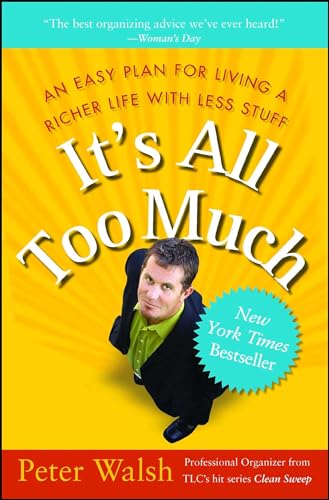
Whether it’s tidying up or tiny-house living, the decluttering revolution is taking America by storm. In It’s All Too Much organizational expert Peter Walsh reveals the tools for taking control of your physical—and emotional—clutter in order to reclaim your life.
Are you surrounded by papers? Overstuffed closets? Are you stepping over toys or searching under piles, and leaving boxes of mementos unopened for years? Do you feel under siege by your belongings? Peter Walsh, the organizational guru from TLC's hit show Clean Sweep, understands.
It's All Too Much is Peter’s proven system for anyone who wants to let go and escape the suffocating clutter in their lives. With his good humor and reassuring advice, Peter shows you how to face the really big question: What is the vision for the life you want to live? Through simple techniques and step-by-step plans, you can assess the state of your home, prioritize your possessions, and let go of the clutter you have been holding on to that has kept you from living the life you imagine. Going way beyond color-coded boxes and storage bin solutions, It's All Too Much shows you how to honestly determine what adds to your quality of life and what's keeping you from living the life of your dreams. The result is freed-up space, less stress, and more energy for living a happier, richer life every day.
Die Inhaltsangabe kann sich auf eine andere Ausgabe dieses Titels beziehen.
Über die Autorin bzw. den Autor
Peter Walsh is a clutter expert and organizational consultant who characterizes himself as part-contractor and part-therapist. He can be heard weekly on The Peter Walsh Show on the Oprah and Friends XM radio network, was a regular guest on The Oprah Winfrey Show, and was also the host of the hit TLC show Clean Sweep. Peter holds a master's degree with a specialty in educational psychology. He divides his time between Los Angeles and Melbourne, Australia.
Auszug. © Genehmigter Nachdruck. Alle Rechte vorbehalten.
Introduction
Something is afoot. Something that until recently I could not have imagined or predicted. Something that is changing the basic fabric of people's lives and is impacting how all of us relate to the things we have and the things we own. Something that affects us all. We are, as a nation, overwhelmed with too much stuff.
Did the title of this book catch your eye? Maybe you are at a stage in your life where something in your life is too much -- your career, your relationship, or "just everything" is suddenly overwhelming. If so, you are part of a harsh awakening in this country, and across much of the developed world, as we come to realize that happiness and success might not be measured by more material things. That having more possessions may be more suffocating than liberating. That a larger house, better car, and more "stuff" come with no guarantee of greater happiness. That for many of us, the stuff we own ends up owning us. Suddenly you look around at the life you've built and all you've acquired and realize that it's all too much!
I have an unusual job. I help people dig themselves out from under the overwhelming crush of their own possessions. I'm not talking about a messy closet or one too many boxes of holiday decorations in the garage. I work with people who have filled their homes, their offices, sometimes their cars, and always their lives with too much stuff. These are people who have lost the ability to deal reasonably and rationally with what they own. They fill every corner of their homes with clothes, papers, their kids' school projects, wrapping paper, collectibles, scrapbooking materials, garden tools, kitchen products, sporting gear, antiques, dolls, toys, books, car parts, and every imaginable (and unimaginable!) item you could list.
Surprisingly, as I've traveled across the United States helping people declutter and get organized, I have come to see that the problem is one that affects far more families than I could have imagined. Every single person I have met tells me not only about their own clutter problem, but the clutter problems of a family member, or those of a friend. Nobody seems immune. The stories are not dissimilar -- papers and magazines run amok, garages overflow with unopened boxes, kids' toys fill rooms, and closets are so stuffed that it looks like the clothing department of a major retailer is having a fire sale. The epidemic of clutter, the seeming inability to get organized, and the sense that "the stuff" is taking over affects us all.
We are at the center of an orgy of consumption, and many are now seeing that this need to own so much comes with a heavy price: Kids so overstimulated by the sheer volume of stuff in their home that they lose the ability to concentrate and focus. Financial strain caused by misplaced bills or overpurchasing. Constant fighting because neither partner is prepared to let go of their possessions. The embarrassment of living in a house that long ago became more of a storage facility than a home.
This clutter doesn't just come in the form of the physical items that crowd our homes. We are bombarded every day with dire predictions of disaster and face many uncertainties -- some real and many manufactured. Think about the perils that we've been warned about in the last decade alone -- killer bees, Y2K, SARS, anthrax, mad cow disease, avian flu, flesh-eating bacteria . . . the list goes on and on. We are also faced daily with reports of war, an unstable economy, and global terrorism coming very close to home. Surprisingly, this endless barrage (its own kind of clutter) inspires many of the families with whom I work to finally take control of their own clutter. In an unpredictable, dangerous world that is out of their control, they look to their homes for stability -- to get some degree of organization back into their closets, their garages, their home offices, their lives. This quest for organization is a deeply personal response to the feeling that the rest of the world is out of control.
Among the clutter, the frustration, and the yearning for organization, I constantly hear the same refrain: It is all overwhelming. The stuff has taken on a life of its own and families have no idea where to even begin. They are paralyzed by their own stuff. Often the people I work with lament, "It's all too much -- help me!"
If you find yourself at the point of being overwhelmed by your possessions, you have a clear choice: Decide here and now that you no longer want your stuff to overrun your life. Work with me to get balance and harmony back into your family and relationships. It can be done and I know how. None of this frightens me or overwhelms me because I have seen it all. I have never walked away from a cluttered home because it was too much. However, I have walked away from those who value their stuff over their relationships, their things over their dreams, or their possessions over their vision for the life they really want.
If you are one of those for whom it's suddenly all too much and want to let go, come on an exciting journey with me to reclaim your life. Living a richer, fuller, more exciting, and rewarding life is not that far away. Trust me, I've led many there already and you can be next. I promise you, if you do this, there is nothing you can't do!
IT'S ALL TOO MUCH
Let me tell you about one of my average workdays. One sunny June day, Jared and Lisa invited me into their modest house in the suburbs of Maryland. From the tree-lined street their home looked welcoming. The grass was neatly trimmed, the garden in full bloom. A gray sedan was parked in the driveway. I rang the doorbell.
The door opened to an appalling site. The floor was invisible. Every flat surface was stacked high with papers. The walls were lined with wall-to-wall file boxes, some stacked on shelves or tables. Many of the piles reached the top of my head and I'm not a short man. The living room was so crowded that the kitchen had become their little boy Cooper's playroom. A toy train track ran through the legs of the kitchen table, its cars long ago scattered, tripped on, and lost. The family was overrun with what appeared to be scrapbooking materials: glue, notebooks, piles of photos, trim, and all sorts of craft material. In short, the house was a disaster. I glanced at Jared and Lisa. To all appearances they are clean, hardworking, upstanding citizens, no different from you or me. Jared manages a successful airport shuttle business. After taking a few years off to have their first child, Lisa has just gotten her real-estate license. Cooper was three years old and delighted in showing me his firm handshake. A great family. And a successful one, in spite of the clutter. But underneath their sunny exterior was tension. They wanted more from their lives and believed the chaos of their home was taking away from their happiness. There was an obvious question that needed an answer: Why was their house completely out of control?
I asked Lisa what it was like living in this chaos. She said, "It's suffocating. I feel like I can't breathe when I look in the office." Lisa felt buried by her own stuff. She went on, "Something has to change. I don't want to live like this. But I have no idea where to begin."
And then I heard the one refrain that sums it all up, the words of despair that I hear over and over again from everyone I work with: "It's all too much."
That is why I decided to call this book It's All Too Much. It's a response to the hopelessness of that refrain. It's about what to do when you reach the point where you don't know where to start. When you're faced with so much mess that you throw up your hands in despair and give up. When you just want to move into a hotel, or throw it all out, or shove it in the garage, like when you were a kid and stuffed...
„Über diesen Titel“ kann sich auf eine andere Ausgabe dieses Titels beziehen.
Suchergebnisse für It's All Too Much: An Easy Plan for Living a Richer...

Beispielbild für diese ISBN
It's All Too Much: An Easy Plan for Living a Richer Life with Less Stuff
Anbieter: World of Books (was SecondSale), Montgomery, IL, USA
Verkäuferbewertung 5 von 5 Sternen

Paperback. Zustand: Good. In It's All Too Much, organizing icon Peter Walsh offers advice and psychological insights on how to let go of the physical and mental clutter that is holding you back from living a happier more fulfilled life. Artikel-Nr. 00062595419
Gebraucht kaufen
EUR 3,66
Versand gratis
Versand innerhalb von USA
Versand innerhalb von USA
Anzahl: Mehr als 20 verfügbar
Beispielbild für diese ISBN
It's All Too Much: An Easy Plan for Living a Richer Life with Less Stuff
Verlag:
Free Press (edition Reprint), 2007
ISBN 10: 0743292650
ISBN 13: 9780743292658
Gebraucht
Paperback
Anbieter: BooksRun, Philadelphia, PA, USA
Verkäuferbewertung 5 von 5 Sternen
Paperback. Zustand: Very Good. Reprint. It's a well-cared-for item that has seen limited use. The item may show minor signs of wear. All the text is legible, with all pages included. It may have slight markings and/or highlighting. Artikel-Nr. 0743292650-11-1
Gebraucht kaufen
EUR 4,68
Versand gratis
Versand innerhalb von USA
Versand innerhalb von USA
Anzahl: 2 verfügbar
Beispielbild für diese ISBN
It's All Too Much: An Easy Plan for Living a Richer Life with Less Stuff
Verlag:
Free Press (edition Reprint), 2007
ISBN 10: 0743292650
ISBN 13: 9780743292658
Gebraucht
Paperback
Anbieter: BooksRun, Philadelphia, PA, USA
Verkäuferbewertung 5 von 5 Sternen
Paperback. Zustand: Fair. Reprint. The item might be beaten up but readable. May contain markings or highlighting, as well as stains, bent corners, or any other major defect, but the text is not obscured in any way. Artikel-Nr. 0743292650-7-1-13
Gebraucht kaufen
EUR 4,73
Versand gratis
Versand innerhalb von USA
Versand innerhalb von USA
Anzahl: 1 verfügbar
Beispielbild für diese ISBN
It's All Too Much: An Easy Plan for Living a Richer Life with Less Stuff
Anbieter: ThriftBooks-Atlanta, AUSTELL, GA, USA
Verkäuferbewertung 5 von 5 Sternen
Paperback. Zustand: Very Good. No Jacket. May have limited writing in cover pages. Pages are unmarked. ~ ThriftBooks: Read More, Spend Less. Artikel-Nr. G0743292650I4N00
Gebraucht kaufen
EUR 5,87
Versand gratis
Versand innerhalb von USA
Versand innerhalb von USA
Anzahl: 2 verfügbar
Beispielbild für diese ISBN
It's All Too Much: An Easy Plan for Living a Richer Life with Less Stuff
Anbieter: ThriftBooks-Reno, Reno, NV, USA
Verkäuferbewertung 5 von 5 Sternen
Paperback. Zustand: Very Good. No Jacket. May have limited writing in cover pages. Pages are unmarked. ~ ThriftBooks: Read More, Spend Less. Artikel-Nr. G0743292650I4N00
Gebraucht kaufen
EUR 5,87
Versand gratis
Versand innerhalb von USA
Versand innerhalb von USA
Anzahl: 2 verfügbar
Beispielbild für diese ISBN
It's All Too Much: An Easy Plan for Living a Richer Life with Less Stuff
Anbieter: ThriftBooks-Dallas, Dallas, TX, USA
Verkäuferbewertung 5 von 5 Sternen
Paperback. Zustand: Very Good. No Jacket. May have limited writing in cover pages. Pages are unmarked. ~ ThriftBooks: Read More, Spend Less. Artikel-Nr. G0743292650I4N00
Gebraucht kaufen
EUR 5,87
Versand gratis
Versand innerhalb von USA
Versand innerhalb von USA
Anzahl: 2 verfügbar
Beispielbild für diese ISBN
It's All Too Much: An Easy Plan for Living a Richer Life with Less Stuff
Anbieter: ThriftBooks-Dallas, Dallas, TX, USA
Verkäuferbewertung 5 von 5 Sternen
Paperback. Zustand: Very Good. No Jacket. Former library book; May have limited writing in cover pages. Pages are unmarked. ~ ThriftBooks: Read More, Spend Less. Artikel-Nr. G0743292650I4N10
Gebraucht kaufen
EUR 5,87
Versand gratis
Versand innerhalb von USA
Versand innerhalb von USA
Anzahl: 1 verfügbar
Beispielbild für diese ISBN
It's All Too Much: An Easy Plan for Living a Richer Life with Less Stuff
Anbieter: ThriftBooks-Phoenix, Phoenix, AZ, USA
Verkäuferbewertung 5 von 5 Sternen
Paperback. Zustand: Very Good. No Jacket. May have limited writing in cover pages. Pages are unmarked. ~ ThriftBooks: Read More, Spend Less. Artikel-Nr. G0743292650I4N00
Gebraucht kaufen
EUR 5,87
Versand gratis
Versand innerhalb von USA
Versand innerhalb von USA
Anzahl: 2 verfügbar
Beispielbild für diese ISBN
It's All Too Much : An Easy Plan for Living a Richer Life with Less Stuff
Anbieter: Better World Books: West, Reno, NV, USA
Verkäuferbewertung 5 von 5 Sternen
Zustand: Good. 1 Edition. Pages intact with minimal writing/highlighting. The binding may be loose and creased. Dust jackets/supplements are not included. Stock photo provided. Product includes identifying sticker. Better World Books: Buy Books. Do Good. Artikel-Nr. GRP95937912
Gebraucht kaufen
EUR 6,09
Versand gratis
Versand innerhalb von USA
Versand innerhalb von USA
Anzahl: 1 verfügbar
Beispielbild für diese ISBN
It's All Too Much : An Easy Plan for Living a Richer Life with Less Stuff
Anbieter: Better World Books: West, Reno, NV, USA
Verkäuferbewertung 5 von 5 Sternen
Zustand: Good. 1 Edition. Former library copy. Pages intact with minimal writing/highlighting. The binding may be loose and creased. Dust jackets/supplements are not included. Includes library markings. Stock photo provided. Product includes identifying sticker. Better World Books: Buy Books. Do Good. Artikel-Nr. GRP30694052
Gebraucht kaufen
EUR 6,09
Versand gratis
Versand innerhalb von USA
Versand innerhalb von USA
Anzahl: 2 verfügbar