
Verwandte Artikel zu The Carrot Principle: How the Best Managers Use Recognition...
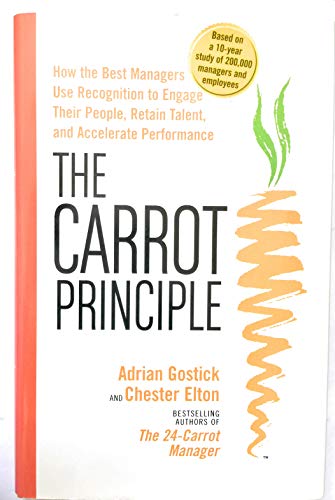
The Carrot Principle: How the Best Managers Use Recognition to Engage Their People, Retain Talent, and Accelerate Performance - Hardcover
Inhaltsangabe
Got carrotphobia? Do you think that recognizing your employees will distract you and your team from more serious business, create jealousy, or make you look soft?
Think again.
The Carrot Principle reveals the groundbreaking results of one of the most in-depth management studies ever undertaken, showing definitively that the central characteristic of the most successful managers is that they provide their employees with frequent and effective recognition. With independent research from The Jackson Organization and analysis by bestselling leadership experts Adrian Gostick and Chester Elton, this breakthrough study of 200,000 people over ten years found dramatically greater business results when managers offered constructive praise and meaningful rewards in ways that powerfully motivated employees to excel.
Drawing on case studies from leading companies including Disney, DHL, KPMG, and Pepsi Bottling Group, bestselling authors Gostick and Elton show how the transformative power of purpose-based recognition produces astonishing increases in operating results -- whether measured by return on equity, return on assets, or operating margin. And they show how great managers lead with carrots, not sticks, and in doing so achieve higher
- Productivity
- Engagement
- Retention
- Customer satisfaction
The Carrot Principle illustrates that the relationship between recognition and improved business results is highly predictable -- it's proven to work. But it's not the employee recognition some of us have been using for years. It is recognition done right, recognition combined with four other core traits of effective leadership.
Gostick and Elton explain the remarkably simple but powerful methods great managers use to provide their employees with effective recognition, which all managers can easily learn and begin practicing for immediate results. Great recognition doesn't take time -- it can be done in a matter of moments -- and it doesn't take budget-busting amounts of money.
This exceptional book presents the simple steps to becoming a Carrot Principle manager and to building a recognition culture in your organization; it offers a wealth of specific examples, culled from real-life cases, of the ways to do recognition right. Following these simple steps will make you a high-performance leader and take your team to a new level of achievement.
Die Inhaltsangabe kann sich auf eine andere Ausgabe dieses Titels beziehen.
Über die Autorinnen und Autoren
Adrian Gostick is the leader of O. C. Tanner Company's recognition training and publishing practice. His books The 24-Carrot Manager and A Carrot A Day are sold in more than fifty countries around the world. Learn more at adriangostick.com.
Chester Elton is coauthor of the bestselling Carrot books, a popular lecturer on motivation, and an influential voice in global workplace trends. He is O.C. Tanner's lead recognition consultant and researcher and works with numerous Fortune 100 clients. Subscribe to his weekly podcasts at chesterelton.com.
Auszug. © Genehmigter Nachdruck. Alle Rechte vorbehalten.
1
A Missing Ingredient
Striding home from the local mercantile, Charles Goodyear glanced down at a charred piece of India rubber in his hands and hoped it wouldn't be another dead end. It was 1839. For five roller-coaster years, he had searched for the missing ingredient that would stabilize rubber. Had he finally found it? It was a little frightening, really, to be teetering on the edge of something revolutionary like this, especially considering how many times he had come this far and failed.
Goodyear's first brush with fortune had come when he was just twenty-six. He had set up the first hardware store in America to sell domestically manufactured farm implements. The timing was right, and the venture was successful. In fact, it was doubly successful from Goodyear's perspective: not only did he own the store, he was a partner in the firm that produced many of the implements sold there.
Everyone, including Goodyear, agreed that fortune and fame were his for the taking -- everyone, that is, except fate. Within three years, several of Goodyear's American suppliers closed their doors. Goodyear, who had been just inches from wild success, served the first of many sentences in debtors' prison.
About the same time, rubber companies around the country were universally closing their doors. Although the new waterproof gum elastic from Brazil had captivated the public when introduced, it was untested and had a lot of bugs. In the heat, rubber products became soft, sticky, and smelly. In the cold, they became hard and brittle and often cracked.
But while most were giving up on rubber, Goodyear became fascinated by the substance and the challenge of stabilizing it. The waterproof gum from Brazil was cheap enough for him to purchase even while in debtors' prison. With little to occupy his time, he spent hours working it with his wife's rolling pin, though with no success. Once out of prison, he tried mixing the rubber with magnesia and lampblack dissolved in turpentine. Next, he combined the rubber with magnesia and boiled it in quicklime and water. Over the next five years, Goodyear tried hundreds of experiments. Then one day, he rubbed nitric acid on a sample of rubber to remove its coating of bronze paint. It turned the sample black, but also made it smooth and dry and almost clothlike. The acid, it turned out, was a curing agent.
It seemed to work so well, in fact, that the U.S. Post Office in Boston ordered 150 rubber mailbags cured with nitric acid in the hope that waterproof bags would protect the mail from rain and snow during delivery. Goodyear made the mailbags, then stored them while he took his family on a celebratory vacation. They returned to find the bags had rotted in the warm storage room; the acid had cured only the rubber's surface, leaving the interior to decompose.
The year 1839 was difficult. The Goodyear children dug in the neighboring farmer's fields for potatoes to eat. Farmers gave them free milk. Many times that winter Goodyear considered giving up, but then he would experience a minor breakthrough, and success would seem so close that he had to continue.
And now, after five long years, it seemed he had done it. He stopped in the winter night to examine the charred piece of rubber in his hand. How had it happened? The last few moments were a blur.
He had gone to the mercantile to demonstrate his new mixture of rubber and sulfur to the men gathered there. When they laughed at him, he responded in disgust, forcefully flipping a small piece of the rubber-sulfur mixture in his hand onto the nearby stove. He wanted to storm from the store, but rubber and sulfur cost money. So he went to the stove to pick up the piece he imagined had melted on the hot surface. But instead of softening, the rubber had charred like leather, and on the edge of the charred section was a brown rim, where the rubber had perfectly cured.
Heat was what had been missing.
The transformation of rubber from a useless substance to a resilient product was as simple as adding a missing process -- heat, in the form of steam. Goodyear named the process vulcanization after the Roman god of fire, Vulcan.
Today it's hard to imagine life without Goodyear's rubber. There would be no electricity, no cars, no computers, no bicycles, no radios or televisions, no phones. We wouldn't have airplanes, washing machines, or toasters. We wouldn't even have our favorite pair of old sneakers.
Years later, those chronicling his life called Goodyear's moment of discovery an accident. Goodyear strongly disagreed. He argued that if he had not "applied himself most perseveringly to the subject," the accident would have had no meaning. He asserted that he was the only man "whose mind was prepared to draw an inference" from the incident. In other words, he was prepared and ready to go when the rubber hit the sizzling, pot-bellied stove.
Goodyear was a visionary. Not only could he see a future that others could not, he was the only man in a crowded room to recognize the introduction of heat to sulfur and rubber for what it was -- a revolutionary, transformational acceleration process.
We've found that in business, there are leaders who are visionaries. They see the untapped potential of their workforces and believe it is possible to reach higher. They have spent years experimenting with their leadership styles. They have consulted mentors, read business books, and attended seminars. Through their efforts, they have brought their employees a long way toward reaching their maximum potential -- but not all the way. And there's the rub.
Show us any leader who sets clear goals, communicates openly, respects people and treats them fairly, holds people accountable, and creates trusting relationships, and we'll show you a leader who's almost got it right.
Show us an organization where people are coming to work on time, doing their jobs, and feel satisfied, and we'll show you an organization that is close to achieving its full potential.
Show us some good management books that promise to transform your organization from ordinary to extraordinary, and we'll show you wisdom that will push you nearer to your goals than you've ever gotten before.
Almost. Closer. Nearer. Some would argue that they are good words. For some leaders, they might even be good enough. But for those of us who are determined to reach beyond the ordinary to our maximum potential, "almost there" is a frustrating place to be.
What we need is an accelerator.
Scientists have known the secret of accelerants for decades, adding them to speed up chemical reactions, achieving results more quickly. Accelerators work the same way in business, making the things you're doing work better, faster, and more smoothly, without throwing you (or your organization) off balance.
It may sound like magic, but it isn't. The relationship between a management accelerant and improved business results is highly predictable. In fact, an accelerant is the missing ingredient that will bridge the gap between where your team is now and where it can be. And in the workplace, there is no accelerator with more impact than purpose-based recognition. The numbers prove it.
First, the Research
Our guts always told us that acceleration was the answer. During the past fifteen years, we have visited more than two dozen countries, taught seminars to almost a million people, and spent thousands of hours consulting with leaders of Fortune 500 titans. Through that time, we have repeatedly witnessed the power of recognition to improve not only morale but business results as well. But what we really needed -- and what drives businesses in general -- is unmistakable empirical evidence. That evidence is what makes this book unique. Here are just a few preview insights from our research that might startle you:
- ...
„Über diesen Titel“ kann sich auf eine andere Ausgabe dieses Titels beziehen.
Suchergebnisse für The Carrot Principle: How the Best Managers Use Recognition...

Beispielbild für diese ISBN
Carrot Principle: How the Best Managers Use Recognition to Engage Their People, Retain Talent, and Accelerate Performance
Anbieter: World of Books (was SecondSale), Montgomery, IL, USA
Verkäuferbewertung 5 von 5 Sternen

Zustand: Good. Stick Management is out. Carrot management is in The Carrot Principle offers proven strategies to help recognize and motivate your valued employees. Since its original publication in 2007, the New York Times bestseller The Carrot Principle has received rave reviews in The Wall Street Journal, Fortune, and The New York Times, and has helped a host of managers to energize their teams, and companies to dramatically boost their business results. The book was even adopted by the prestigious FranklinCovey International training and consulting group for its leadership training. This updated edition couldn't come at a better time, as the economic downturn requires us all to come up with creative and cost-effective ways to stimulate growth and productivity. Revealing the groundbreaking results of one of the most in-depth management studies ever undertaken, The Carrot Principle shows definitively that the central characteristic of the most successful managers is that they provide their employees with frequent and effective recognition. With independent results from HealthStream Research, and analysis by bestselling leadership experts Adrian Gostick and Chester Elton, this breakthrough study of 200,000 people over ten years found dramatically greater business results when managers offered constructive praise and meaningful rewards in ways that powerfully motivated employees to excel. These managers lead with carrots, not sticks, and in doing so achieve higher: - Productivity - Engagement - Retention In a new chapter, Gostick and Elton report on the results of an extensive study, conducted by leading research authority Towers Perrin, that confirms the extraordinary effectiveness of the Carrot Principle approach all around the globe. Drawing on case studies from leading companies including Disney, DHL, KPMG, and Pepsi Bottling Group, Gostick and Elton show how the key to recognition done right is combining it with four other core traits of effective leadership. Gostick and Elton walk readers through exactly how to use the simple but powerful methods they have discovered all great managers use to provide their employees with this effective recognition, which can be learned easily and will produce immediate results. Great recognition can be done in a matter of moments -- and it doesn't take budget-busting amounts of money. Following these simple steps will make you a high-performance leader and take your team to a new level of achievement. Artikel-Nr. 00045634501
Gebraucht kaufen
EUR 3,75
Versand gratis
Versand innerhalb von USA
Versand innerhalb von USA
Anzahl: 9 verfügbar
Beispielbild für diese ISBN
The Carrot Principle: How the Best Managers Use Recognition to Engage Their Employees, Retain Talent, and Drive Performance
Anbieter: Bellwetherbooks, McKeesport, PA, USA
Verkäuferbewertung 4 von 5 Sternen

hardcover. Zustand: Fine. LIKE NEW!!! Has a red or black remainder mark on bottom/exterior edge of pages. Artikel-Nr. mon0000048509
Gebraucht kaufen
EUR 1,90
EUR 3,54 Versand
Versand innerhalb von USA
Versand innerhalb von USA
Anzahl: 1 verfügbar
Beispielbild für diese ISBN
The Carrot Principle: How the Best Managers Use Recognition to Engage Their Employees, Retain Talent, and Drive Performance
Anbieter: Bellwetherbooks, McKeesport, PA, USA
Verkäuferbewertung 4 von 5 Sternen
hardcover. Zustand: Very Good. Very Good Condition - May show some limited signs of wear and may have a remainder mark. Pages and dust cover are intact and not marred by notes or highlighting. Artikel-Nr. mon0000033750
Gebraucht kaufen
EUR 2,21
EUR 3,54 Versand
Versand innerhalb von USA
Versand innerhalb von USA
Anzahl: 1 verfügbar
Beispielbild für diese ISBN
The Carrot Principle: How the Best Managers Use Recognition to Engage Their Employees, Retain Talent, and Drive Performance
Anbieter: Wonder Book, Frederick, MD, USA
Verkäuferbewertung 5 von 5 Sternen
Zustand: As New. Like New condition. Like New dust jacket. A near perfect copy that may have very minor cosmetic defects. Artikel-Nr. E09L-00643
Gebraucht kaufen
EUR 6,45
Versand gratis
Versand innerhalb von USA
Versand innerhalb von USA
Anzahl: 3 verfügbar
Beispielbild für diese ISBN
The Carrot Principle: How the Best Managers Use Recognition to Engage Their Employees, Retain Talent, and Drive Performance
Anbieter: Wonder Book, Frederick, MD, USA
Verkäuferbewertung 5 von 5 Sternen
Zustand: Very Good. Very Good condition. Very Good dust jacket. A copy that may have a few cosmetic defects. May also contain light spine creasing or a few markings such as an owner's name, short gifter's inscription or light stamp. Artikel-Nr. D16A-03224
Gebraucht kaufen
EUR 6,45
Versand gratis
Versand innerhalb von USA
Versand innerhalb von USA
Anzahl: 2 verfügbar
Beispielbild für diese ISBN
The Carrot Principle: How the Best Managers Use Recognition to Engage Their Employees, Retain Talent, and Drive Performance
Anbieter: ThriftBooks-Atlanta, AUSTELL, GA, USA
Verkäuferbewertung 5 von 5 Sternen
Hardcover. Zustand: As New. No Jacket. Pages are clean and are not marred by notes or folds of any kind. ~ ThriftBooks: Read More, Spend Less. Artikel-Nr. G0743290097I2N00
Gebraucht kaufen
EUR 6,53
Versand gratis
Versand innerhalb von USA
Versand innerhalb von USA
Anzahl: 1 verfügbar
Beispielbild für diese ISBN
The Carrot Principle: How the Best Managers Use Recognition to Engage Their Employees, Retain Talent, and Drive Performance
Anbieter: ThriftBooks-Atlanta, AUSTELL, GA, USA
Verkäuferbewertung 5 von 5 Sternen
Hardcover. Zustand: Very Good. No Jacket. May have limited writing in cover pages. Pages are unmarked. ~ ThriftBooks: Read More, Spend Less. Artikel-Nr. G0743290097I4N00
Gebraucht kaufen
EUR 6,53
Versand gratis
Versand innerhalb von USA
Versand innerhalb von USA
Anzahl: 1 verfügbar
Beispielbild für diese ISBN
The Carrot Principle : How the Best Managers Use Recognition to Engage Their People, Retain Talent, and Accelerate Performance
Anbieter: Better World Books, Mishawaka, IN, USA
Verkäuferbewertung 5 von 5 Sternen
Zustand: Good. Former library copy. Pages intact with minimal writing/highlighting. The binding may be loose and creased. Dust jackets/supplements are not included. Includes library markings. Stock photo provided. Product includes identifying sticker. Better World Books: Buy Books. Do Good. Artikel-Nr. GRP91591159
Gebraucht kaufen
EUR 7,04
Versand gratis
Versand innerhalb von USA
Versand innerhalb von USA
Anzahl: 1 verfügbar
Beispielbild für diese ISBN
The Carrot Principle : How the Best Managers Use Recognition to Engage Their People, Retain Talent, and Accelerate Performance
Anbieter: Better World Books: West, Reno, NV, USA
Verkäuferbewertung 5 von 5 Sternen
Zustand: Very Good. Former library copy. Pages intact with possible writing/highlighting. Binding strong with minor wear. Dust jackets/supplements may not be included. Includes library markings. Stock photo provided. Product includes identifying sticker. Better World Books: Buy Books. Do Good. Artikel-Nr. 18745418-75
Gebraucht kaufen
EUR 7,04
Versand gratis
Versand innerhalb von USA
Versand innerhalb von USA
Anzahl: 1 verfügbar
Beispielbild für diese ISBN
The Carrot Principle: How the Best Managers Use Recognition to Engage Their People, Retain Talent, And Accelerate Performance
Verlag:
Free Press, Old Tappan, New Jersey, U.S.A., 2007
ISBN 10: 0743290097
ISBN 13: 9780743290098
Gebraucht
Hardcover
Anbieter: The Yard Sale Store, Narrowsburg, NY, USA
Verkäuferbewertung 5 von 5 Sternen
Hardcover. Zustand: Good. Hardcover edition. In a full dust jacket. A few scuff marks to the dust jacket. A few pages have their corners folded. Artikel-Nr. Audio2N90109159
Gebraucht kaufen
EUR 2,11
EUR 5,35 Versand
Versand innerhalb von USA
Versand innerhalb von USA
Anzahl: 1 verfügbar