
Verwandte Artikel zu At the Point of a Gun: Democratic Dreams and Armed...
Inhaltsangabe
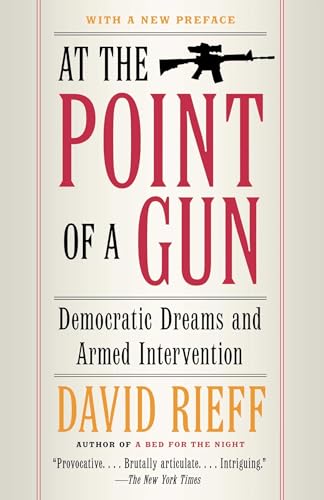
Writing from the front lines of the hot wars of the post-Cold War world -- the Balkans, Africa, the Middle East, and most recently Afghanistan and Iraq for The New York Times Magazine -- David Rieff witnessed firsthand most of the armed interventions waged by the West or the United Nations in the name of human rights and democratization. His report is anything but reassuring. In this timely collection of his most illuminating articles, Rieff, one of our leading experts on the subject, reassesses some of his own judgments about the use of military might to solve the world's most pressing humanitarian problems and curb the world's cruelest human rights abusers, presenting what, taken as a whole, is a thoughtful and impassioned argument against armed intervention in all but the most extreme cases.
At the Point of a Gun raises critical questions we cannot ignore in this era of gunboat democracy. When, if ever, is it appropriate to intervene militarily in the domestic affairs of other nations? Are human rights and humanitarian concerns legitimate reasons for intervening, or is the assault on sovereignty -- sovereignty that is as much an article of faith at the UN as it is in Washington -- a flag of convenience for the recolonization of part of the world? What role should the United Nations play in alleviating humanitarian crises? And, above all, can democracy be imposed through the barrel of an M16?
Collected here for the first time, Rieff's essays draw a searing portrait of what happens when the grandiose schemes of policymakers and the grandiose ethical ambitions of human rights activists go horribly wrong in the field. Again and again, they ask the question: Do these moral ambitions of ours to protect people from massacre and want match either our means or our wisdom?
Rieff's articles appear as they were written. Some, however, are accompanied by brief reconsiderations in which the author describes how and why his thinking has changed both as he has reflected on what it means, as in Iraq, to impose democracy by force, and as he has witnessed, firsthand, what that redemptive project actually looks like in practice.
This is not an optimistic report. To the contrary, it is the chastened conclusion of a writer who was once one of the leading advocates of such interventions. But the questions Rieff raises are of the essence as the United States grapples with the harsh consequences of what it has wrought on the ground in Afghanistan and Iraq.
Die Inhaltsangabe kann sich auf eine andere Ausgabe dieses Titels beziehen.
Über die Autorin bzw. den Autor
David Rieff is the author of eight previous books, including Swimming in a Sea of Death, At the Point of a Gun: Democratic Dreams and Armed Intervention; A Bed for the Night: Humanitarianism in Crisis; and Slaughterhouse: Bosnia and the Failure of the West. He lives in New York City.
Auszug. © Genehmigter Nachdruck. Alle Rechte vorbehalten.
Introduction
The logic of the present moment, we are told by American policymakers across the political spectrum from George W. Bush to John Kerry and from an equally broad range of policy analysts from advocates of "hard" American power such as Robert Kagan to those who extol the uses of soft power and multilateral institutions like the United Nations such as Joseph Nye, is one of American hegemony. Americans are uncomfortable with the term empire, and in many ways it does not adequately describe the realities of United States preponderance in the world. Frank advocates of an imperial vocation for the U.S., many of whom, like the historian Niall Ferguson, interestingly are British (will this "Greece to their Rome" never end?), may not have the influence the attention paid to them in the media might suggest. But within the policy elite, there seems to be a broad consensus that, as the military historian Eliot A. Cohen has put it, "in the end, it makes very little difference whether one thinks of the United States as an empire or as something else...the real alternatives are U.S. hegemony exercised prudently or foolishly, consistently or fecklessly, safely or dangerously."
Cohen is associated with the neoconservative movement in the United States, but his view is one that most members of the U.S. policy elite would probably agree with, even while they would certainly differ over the question of, say, whether the Bush administration's use of American power in Iraq can best be described as prudent or foolish. It was President Bill Clinton's secretary of state, Madeleine Albright, after all, who called for an exercise of American power "with allies if possible, alone if necessary." And those who defended the American invasion of Iraq in 2003 against charges that it was illegal under international law were surely right to respond that by that criterion the War in Kosovo in 1999 had been illegal as well.
If UN Secretary General Kofi Annan's assent and that of the UN Security Council had not been a requirement in the Balkans, why was it necessary in the Middle East? There are answers to that, of course, not least the obvious one that the Kosovo war was overwhelmingly supported (Greece being the predictable exception) by the countries of the region whereas the war in Iraq was opposed by virtually every country in the Middle East with the exception of Israel. Nonetheless, the question is a pertinent one and cannot simply be brushed aside, particularly by those who supported intervention in Bosnia and Kosovo and opposed it in Iraq -- i.e., by people like me.
Of course, the triumphalist moment in America with regard to Iraq passed quickly. Almost no one, even the staunchest advocates of the overthrow of Saddam Hussein, would still claim that what followed the fall of the Iraqi dictator was the unbridled success they had predicted before the war started. The continued bloodletting on the ground in Iraq, the overwhelming evidence that although U.S. troops may have been welcomed when they toppled the Baathist regime, they soon came to be viewed with hostility by the Iraqi people, who resented the American occupation of their country, and the growing realization, supported even by U.S. State Department statistics showing that there were more terrorist incidents in 2003 than in any previous year, that the world was anything but safer after Operation Iraqi Freedom despite what the Bush administration had promised, might have been expected to shake people's faith in the idea of armed intervention in the name of democracy, human rights, and humanitarian need. But this has not been the case.
The enthusiasm in the U.S. Congress during the summer of 2004 to declare that the ethnic cleansing in the western Sudanese region of Darfur constituted genocide in the legal sense of the term; the demand by candidate John Kerry that President Bush go to the UN and help organize a humanitarian military intervention; the support that these demands received in much of Europe; the offer by both Britain and Australia to commit troops to any "humanitarian" deployment: all of these things testified to the extent to which faith in the idea of imposing human rights or alleviating humanitarian suffering norms at the point of a gun remained a powerful and compelling idea. Despite Iraq, it seemed there were many in both Western Europe and, more importantly, in the United States, where most of any serious troop deployment, if nothing else, at the logistical level, would have to come from, still subscribed to the view of humanitarian intervention enunciated by British Prime Minister Tony Blair in Chicago in 1999, when he argued that "if we can establish and spread the values of liberty, the rule of law, human rights, and an open society then that is in our national interests, too."
It is an argument that the human rights movement had been making for decades. It underscored that movement's campaign for rights in the former Soviet empire and also its campaigns against U.S. collaboration with Third World dictators from Vietnam to El Salvador. When it was taken up during the administration of President Jimmy Carter, who appointed human rights activists like Patricia Derian to positions of authority in Washington, the American right was aghast. Now, as I write in 2004, this language is the boilerplate of the American right. As President Bush's deputy defense secretary, Paul Wolfowitz, by many accounts the ideological architect of the Iraq War, has put it, "if people are set free to run their countries as they see fit, we will be dealing with a world very favorable to American interests."
In the gaps in that sentence -- "set free" by whom and under what conditions? -- you can hear, in all its pathos, and with a sense of ghastly inevitability, or fatedness, worthy of a Greek tragedy, the Bush administration's profound miscalculation of and wishful thinking about the realities on the ground of postwar Iraq and the limits of what U.S. military power can actually accomplish. And yet arguably, the human rights justification for the decision to invade Iraq stands up to scrutiny far better than the false claims that Saddam Hussein had weapons of mass destruction or the false assurance that overthrowing him would reduce the level of terrorist threat to the United States.
Given the rise of human rights as an over-arching moral context for the exercise of power by Western countries, this probably should not be surprising. By now, the view that, at least where possible, and, ideally, as often as possible, humanitarian or human rights disasters must not be allowed to take place -- a view shared by figures with otherwise little if anything in common in their view of the role of international institutions or the authority of international law as Kofi Annan and Paul Wolfowitz -- is almost no longer open to question among foreign policy experts. In the United States, only activists on the far left, like Noam Chomsky, on the far right, like Pat Buchanan, and those who belong to the increasingly beleaguered realist school, notably members of President George Herbert Walker Bush's security team like General Brent Scowcroft and General William Odom (whether it was Bosnia, Iraq, or George W. Bush's doctrine of pre-emption, American military officers in the post-Cold War era have been consistently more cautious than their civilian counterparts), have bucked this policy consensus on a consistent basis.
In what may have been an unguarded moment, Robert Kagan, viewed by many as one of the premier theorists for the expansive use of American military power, once said to me that his real position was that the choice America faced was "leaning toward or away from" the use of military force. And the argument of "hard Wilsonians" like Kagan -- the phrase is that of another neo-conservative writer, Max Boot -- was that whereas the Clinton administration...
„Über diesen Titel“ kann sich auf eine andere Ausgabe dieses Titels beziehen.
Suchergebnisse für At the Point of a Gun: Democratic Dreams and Armed...

Beispielbild für diese ISBN
At the Point of a Gun: Democratic Dreams and Armed Intervention
Verlag:
Simon & Schuster (edition Reprint), 2006
ISBN 10: 074328707X
ISBN 13: 9780743287074
Gebraucht
Paperback
Anbieter: BooksRun, Philadelphia, PA, USA
Verkäuferbewertung 5 von 5 Sternen

Paperback. Zustand: Very Good. Reprint. It's a well-cared-for item that has seen limited use. The item may show minor signs of wear. All the text is legible, with all pages included. It may have slight markings and/or highlighting. Artikel-Nr. 074328707X-11-1
Gebraucht kaufen
EUR 4,68
Versand gratis
Versand innerhalb von USA
Versand innerhalb von USA
Anzahl: 1 verfügbar
Beispielbild für diese ISBN
At the Point of a Gun : Democratic Dreams and Armed Intervention
Anbieter: Better World Books, Mishawaka, IN, USA
Verkäuferbewertung 5 von 5 Sternen
Zustand: Very Good. Reprint. Pages intact with possible writing/highlighting. Binding strong with minor wear. Dust jackets/supplements may not be included. Stock photo provided. Product includes identifying sticker. Better World Books: Buy Books. Do Good. Artikel-Nr. 4432180-75
Gebraucht kaufen
EUR 6,09
Versand gratis
Versand innerhalb von USA
Versand innerhalb von USA
Anzahl: 1 verfügbar
Beispielbild für diese ISBN
At the Point of a Gun: Democratic Dreams and Armed Intervention
Anbieter: Wonder Book, Frederick, MD, USA
Verkäuferbewertung 5 von 5 Sternen
Zustand: Good. Good condition. A copy that has been read but remains intact. May contain markings such as bookplates, stamps, limited notes and highlighting, or a few light stains. Artikel-Nr. U10A-05987
Gebraucht kaufen
EUR 6,33
Versand gratis
Versand innerhalb von USA
Versand innerhalb von USA
Anzahl: 1 verfügbar
Foto des Verkäufers
At the Point of a Gun: Democratic Dreams and Armed Intervention
Anbieter: WeBuyBooks, Rossendale, LANCS, Vereinigtes Königreich
Verkäuferbewertung 5 von 5 Sternen
Paperback. Zustand: Good. Most items will be dispatched the same or the next working day. A copy that has been read but remains in clean condition. All of the pages are intact and the cover is intact and the spine may show signs of wear. The book may have minor markings which are not specifically mentioned. A few small marks or stains to the page edges/pages . Darkened tan to the page edges/pages . Minor shelf wear. Artikel-Nr. rev7462231049
Gebraucht kaufen
EUR 9,26
EUR 6,26 Versand
Versand von Vereinigtes Königreich nach USA
Versand von Vereinigtes Königreich nach USA
Anzahl: 1 verfügbar
Foto des Verkäufers
At the Point of a Gun
Anbieter: Hamelyn, Madrid, M, Spanien
Verkäuferbewertung 5 von 5 Sternen
Zustand: Good. : En esta oportuna colección de ensayos, el veterano periodista David Rieff ofrece un retrato crudo de las intervenciones militares occidentales llevadas a cabo en nombre de los derechos humanos y la democratización. A través de su experiencia directa en zonas de conflicto como los Balcanes, África y Oriente Medio, Rieff cuestiona si la democracia puede realmente imponerse mediante la fuerza de las armas y analiza las consecuencias de los ambiciosos planes de los responsables políticos.El autor reevalúa sus propios juicios previos sobre el uso del poder militar para resolver crisis humanitarias, planteando preguntas críticas sobre la soberanía nacional y el papel de las Naciones Unidas. Es una obra esencial para comprender los desafíos éticos y prácticos a los que se enfrenta la comunidad internacional en la era de la 'democracia de cañonera'. EAN: 9780743287074 Tipo: Libros Categoría: Historia Título: At the Point of a Gun Autor: David Rieff Editorial: Simon & Schuster Idioma: en Páginas: 288 Formato: tapa blanda. Artikel-Nr. Happ-2026-03-11-b15c70c0
Gebraucht kaufen
EUR 11,01
EUR 12,99 Versand
Versand von Spanien nach USA
Versand von Spanien nach USA
Anzahl: 1 verfügbar
Beispielbild für diese ISBN
At the Point of a Gun: Democratic Dreams and Armed Intervention
Anbieter: Revaluation Books, Exeter, Vereinigtes Königreich
Verkäuferbewertung 5 von 5 Sternen
Paperback. Zustand: Brand New. reprint edition. 270 pages. 8.50x5.50x0.75 inches. In Stock. Artikel-Nr. x-074328707X
Neu kaufen
EUR 22,54
EUR 11,63 Versand
Versand von Vereinigtes Königreich nach USA
Versand von Vereinigtes Königreich nach USA
Anzahl: 2 verfügbar