
Verwandte Artikel zu Chuck Klosterman IV: A Decade of Curious People and...
Inhaltsangabe
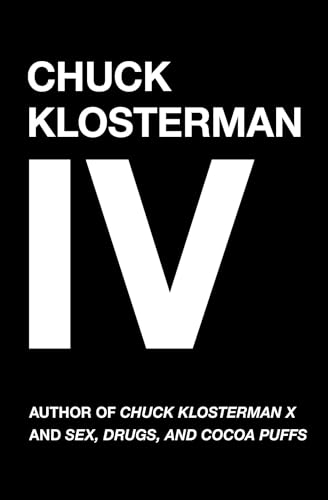
Coming off the breakthrough success of Sex, Drugs, and Cocoa Puffs and Killing Yourself to Live, bestselling pop culture guru Chuck Klosterman assembles his best work previously unavailable in book form—including the groundbreaking 1996 piece about his chicken McNuggets experiment, his uncensored profile of Britney Spears, and a previously unpublished short story—all recontextualized in Chuck’s unique voice with new intros, outros, segues, and masterful footnotes.
Chuck Klosterman IV consists of three parts:
Things That Are True—Profiles and trend stories: Britney Spears, Radiohead, Billy Joel, Metallica, Val Kilmer, Bono, Wilco, the White Stripes, Steve Nash, Morrissey, Robert Plant—all with new introductions and footnotes.
Things That Might Be True—Opinions and theories on everything from monogamy to pirates to robots to super people to guilt, and (of course) Advancement—all with new hypothetical questions and footnotes.
Something That Isn’t True At All—This is old fiction. There’s a new introduction, but no footnotes. Well, there’s a footnote in the introduction, but none in the story.
Die Inhaltsangabe kann sich auf eine andere Ausgabe dieses Titels beziehen.
Über die Autorin bzw. den Autor
Chuck Klosterman is the bestselling author of ten nonfiction books (including The Nineties; Sex, Drugs, and Cocoa Puffs; and But What If We’re Wrong?), two novels (Downtown Owl and The Visible Man), and the short story collection Raised in Captivity. He has written for The New York Times, The Washington Post, Esquire, Spin, The Guardian, The Believer, and ESPN. Klosterman served as the Ethicist for The New York Times Magazine and was an original founder of the website Grantland with Bill Simmons. He was raised in rural North Dakota and now lives in Portland, Oregon.
Von der hinteren Coverseite
A bestselling pop culture guru and author of "Sex, Drugs, and Cocoa Puffs" takes a unique look at his career in journalism, in this collection of work that includes the legendary chicken McNuggets experiment and an uncensored profile of Britney Spears.
Auszug. © Genehmigter Nachdruck. Alle Rechte vorbehalten.
"Can I tell you something weird?" he asked. This probably isn't a valid question, because one can never say no to such an inquiry. But this is what he asked me.
"Of course," I said in response. "Always."
"Okay, well...great. That's great."
He collected his thoughts for fourteen seconds.
"Something is happening to me," he said. "I keep thinking about something that happened to me a long time ago. Years ago. Like, this thing happened to me in eighth fucking grade. This is a situation I hadn't even thought about for probably ten or fifteen years. But then I saw a documentary that reexamined the Challenger explosion, and this particular event had happened around that same time. And what's disturbing is that -- now -- I find myself thinking about this particular afternoon constantly. I have dreams about it. Every time I get drunk or stoned, I inevitably find myself sitting in a dark room, replaying the sequence of the events in my mind, over and over again. And the details I remember from this 1986 afternoon are unfathomably intense. Nothing is missing and nothing is muddled. And I'm starting to believe -- and this, I suppose, is the weird part -- that maybe this day was the most important day of my entire life, and that everything significant about my personality was created on this one particular afternoon. I'm starting to suspect that this memory is not merely about a certain day of my life; this memory is about the day, if you get my meaning."
"I think I do," I said. "Obviously, I'm intrigued."
"I thought you would be," he replied. "In fact, that's why I specifically wanted to talk to you about this problem. Because the story itself isn't amazing. It's not like my best friend died on this particular day. It's not like a wolf showed up at my school and mauled a bunch of teachers. It's not a sad story, and it's not even a funny story. It's about a junior-high basketball game."
"A junior-high basketball game."
"Yes."
"The most important day in your life was a junior-high basketball game."
"Yes."
"And you're realizing this now, as a thirty-three-year-old chemical engineer with two children."
"Yes."
I attempted to arch my eyebrows to suggest skepticism, but the sentiment did not translate.
"Obviously, this story isn't really about basketball," he said. "I suppose it's kind of about basketball, because I was playing a basketball game on this particular afternoon. However, I have a feeling that the game itself is secondary."
"It always is," I said.
"Exactly. So, here's the situation: when I was in eighth grade, our basketball team was kind of terrible. You only play a ten-game schedule when you're in eighth grade, and we lost four of our first six games, a few of them by wide margins. I was probably the best player on the team, and I sucked. We were bad. We knew we were bad. And on the specific afternoon I'm recalling, we were playing the Fairmount Pheasants. We had played Fairmount in the first game of the year, and they beat us by twenty-two points. Fairmount only had three hundred people in their whole goddamn town, but they had the best eighth-grade basketball team in rural southeast North Dakota that winter."
"That's tremendous," I said.
"They had a power forward named Tyler RaGoose. He was the single most unstoppable Pheasant. He was wiry and swarthy and strong, and he almost had a mustache; every great eighth-grade basketball player almost has a mustache. The rumor was that he could dunk a volleyball and that he had already fucked two girls, one of whom was a sophomore. It seemed plausible. They also had a precocious, flashy seventh grader who played point guard -- I think his name was Trevor Monroe. He was one of those kids who was just naturally good at everything: he played point guard in the winter, shortstop in the summer, and quarterback in the fall. I'm not sure if Fairmount had a golf course, but I assume he was the best chipper in town if they did. They had this guy named Kenwood Dotzenrod who always looked sleepy, but he could get fouled whenever he felt like it. That was his gift -- he knew how to get fouled. Do you remember Adrian Dantley? That stoic dude who played for the Utah Jazz and the Detroit Pistons with a really powerful ass? Kenwood Dotzenrod was like a white, thirteen-year-old Adrian Dantley. It seemed like he shot twelve free throws every night. These were just perfect, flawless Pheasants. And it's hard to understand how that happened, because -- once those kids got into high school -- Fairmount defined mediocrity. They were never better than a .500 club. But as junior-high kids, they were a potato sack full of wolverines. They were going to humiliate us, and everybody in my school seemed to know this.
"Because we were junior-high kids, the game started right after school. It was scheduled for 4:15 p.m. That school day was interminable. I was wearing a gray acrylic sweater and cargo pants, because our coach didn't let us wear jeans on game days. It was a different era, I suppose -- no rap music. I remember walking around the school in those idiotic cargo pants, eating corndogs at lunch, pretending to care about earth science, and just longing for 4:15. Because I had this irrefutable, unexplainable premonition that we were going to play great that day. I didn't think we would necessarily win, because Fairmount was better and they had the mustache dude, and we were lazy, underfed losers. But I still had a vague sense that we would not humiliate ourselves. We would execute and hustle, and the game would be close. This feeling was almost spiritual. And I was not the kind of kid who looked on the bright side of anything; I was never optimistic about any element of my eighth-grade life. But something made me certain that good things were on the horizon. We started warming up for the game at 3:55, and I can recall standing in the lay-up line and looking at the Pheasants at the other end of the court. Half of their team had spiky rattail haircuts, which was the style of the time. It was a different era, I suppose -- Don Johnson and David Lee Roth defined masculinity. The gym felt especially hot and especially dry. I couldn't make myself sweat. I remember thinking, Our school needs a humidifier. Our cheerleaders weren't even paying attention to us. They were probably looking at Tyler RaGoose's potential mustache."
"So did your team play well?" I asked. "Was your intuition correct?"
"Fuck, yeah," he responded immediately. "We couldn't have played any better than we did. I mean, remember: we were junior-high kids. We were just little guys -- half our squad weighed less than one hundred pounds. I still didn't have pubic hair. But we played like basketball geniuses. Fairmount scored on the first possession of the game, we scored on the second possession, and it just went back and forth like that for the entire first half. Nobody on either team seemed to miss. Do you recall when Villanova upset Georgetown in the 1985 NCAA championship game? It was like we were all possessed by the spirit of Villanova. This was unlike any junior-high game I've ever witnessed, before or since. It was better than half of the shit they show on ESPN2. That Trevor Monroe kid -- this spiky-haired little elf who was maybe five feet tall -- knocked down three twenty-one-foot jump shots in a row. My memories of this are all so goddamn vivid. It actually freaks me out, because I barely remember anything else from that winter; I barely remember anything else from that entire school year. But I somehow recall that the score was 35 to 33 in Fairmount's favor with ten seconds left in the first half, and somebody from our team dribbled the ball off his own foot. Trevor Monroe rushed the rock up the court and threw a blind bounce pass to a kid named Billy Barnaby in the right corner; Barnaby was a 4.00...
„Über diesen Titel“ kann sich auf eine andere Ausgabe dieses Titels beziehen.
Suchergebnisse für Chuck Klosterman IV: A Decade of Curious People and...

Beispielbild für diese ISBN
Chuck Klosterman IV: A Decade of Curious People and Dangerous Ideas
Anbieter: World of Books (was SecondSale), Montgomery, IL, USA
Verkäuferbewertung 5 von 5 Sternen

Zustand: Good. Item in good condition. Textbooks may not include supplemental items i.e. CDs, access codes etc. Artikel-Nr. 00087945520
Gebraucht kaufen
EUR 3,62
Versand gratis
Versand innerhalb von USA
Versand innerhalb von USA
Anzahl: 14 verfügbar
Beispielbild für diese ISBN
Chuck Klosterman IV: A Decade of Curious People and Dangerous Ideas
Anbieter: World of Books (was SecondSale), Montgomery, IL, USA
Verkäuferbewertung 5 von 5 Sternen
Zustand: Acceptable. Item in acceptable condition! Textbooks may not include supplemental items i.e. CDs, access codes etc. Artikel-Nr. 00085607935
Gebraucht kaufen
EUR 3,62
Versand gratis
Versand innerhalb von USA
Versand innerhalb von USA
Anzahl: 9 verfügbar
Beispielbild für diese ISBN
Chuck Klosterman IV: A Decade of Curious People and Dangerous Ideas
Verlag:
Scribner (edition Reprint), 2007
ISBN 10: 0743284895
ISBN 13: 9780743284899
Gebraucht
Paperback
Anbieter: BooksRun, Philadelphia, PA, USA
Verkäuferbewertung 5 von 5 Sternen
Paperback. Zustand: Very Good. Reprint. It's a well-cared-for item that has seen limited use. The item may show minor signs of wear. All the text is legible, with all pages included. It may have slight markings and/or highlighting. Artikel-Nr. 0743284895-11-1
Gebraucht kaufen
EUR 4,72
Versand gratis
Versand innerhalb von USA
Versand innerhalb von USA
Anzahl: 1 verfügbar
Beispielbild für diese ISBN
Chuck Klosterman IV: A Decade of Curious People and Dangerous Ideas
Verlag:
Scribner (edition Reprint), 2007
ISBN 10: 0743284895
ISBN 13: 9780743284899
Gebraucht
Paperback
Anbieter: BooksRun, Philadelphia, PA, USA
Verkäuferbewertung 5 von 5 Sternen
Paperback. Zustand: Very Good. Reprint. It's a well-cared-for item that has seen limited use. The item may show minor signs of wear. All the text is legible, with all pages included. It may have slight markings and/or highlighting. Artikel-Nr. 0743284895-11-6
Gebraucht kaufen
EUR 4,87
Versand gratis
Versand innerhalb von USA
Versand innerhalb von USA
Anzahl: 1 verfügbar
Beispielbild für diese ISBN
Chuck Klosterman IV: A Decade of Curious People and Dangerous Ideas
Verlag:
Scribner (edition Reprint), 2007
ISBN 10: 0743284895
ISBN 13: 9780743284899
Gebraucht
Paperback
Anbieter: BooksRun, Philadelphia, PA, USA
Verkäuferbewertung 5 von 5 Sternen
Paperback. Zustand: Fair. Reprint. The item might be beaten up but readable. May contain markings or highlighting, as well as stains, bent corners, or any other major defect, but the text is not obscured in any way. Artikel-Nr. 0743284895-7-18
Gebraucht kaufen
EUR 4,95
Versand gratis
Versand innerhalb von USA
Versand innerhalb von USA
Anzahl: 1 verfügbar
Beispielbild für diese ISBN
Chuck Klosterman IV: A Decade of Curious People and Dangerous Ideas
Verlag:
Scribner (edition Reprint), 2007
ISBN 10: 0743284895
ISBN 13: 9780743284899
Gebraucht
Paperback
Anbieter: BooksRun, Philadelphia, PA, USA
Verkäuferbewertung 5 von 5 Sternen
Paperback. Zustand: Very Good. Reprint. It's a well-cared-for item that has seen limited use. The item may show minor signs of wear. All the text is legible, with all pages included. It may have slight markings and/or highlighting. Artikel-Nr. 0743284895-11-18
Gebraucht kaufen
EUR 5,45
Versand gratis
Versand innerhalb von USA
Versand innerhalb von USA
Anzahl: 1 verfügbar
Beispielbild für diese ISBN
Chuck Klosterman IV Vol. 4 : A Decade of Curious People and Dangerous Ideas
Anbieter: Better World Books, Mishawaka, IN, USA
Verkäuferbewertung 5 von 5 Sternen
Zustand: Good. 1 Edition. Pages intact with minimal writing/highlighting. The binding may be loose and creased. Dust jackets/supplements are not included. Stock photo provided. Product includes identifying sticker. Better World Books: Buy Books. Do Good. Artikel-Nr. 809427-6
Gebraucht kaufen
EUR 6,20
Versand gratis
Versand innerhalb von USA
Versand innerhalb von USA
Anzahl: 1 verfügbar
Beispielbild für diese ISBN
Chuck Klosterman IV Vol. 4 : A Decade of Curious People and Dangerous Ideas
Anbieter: Better World Books, Mishawaka, IN, USA
Verkäuferbewertung 5 von 5 Sternen
Zustand: Very Good. 1 Edition. Pages intact with possible writing/highlighting. Binding strong with minor wear. Dust jackets/supplements may not be included. Stock photo provided. Product includes identifying sticker. Better World Books: Buy Books. Do Good. Artikel-Nr. 4726210-75
Gebraucht kaufen
EUR 6,20
Versand gratis
Versand innerhalb von USA
Versand innerhalb von USA
Anzahl: 1 verfügbar
Beispielbild für diese ISBN
Chuck Klosterman IV Vol. 4 : A Decade of Curious People and Dangerous Ideas
Anbieter: Better World Books: West, Reno, NV, USA
Verkäuferbewertung 5 von 5 Sternen
Zustand: Good. 1 Edition. Pages intact with minimal writing/highlighting. The binding may be loose and creased. Dust jackets/supplements are not included. Stock photo provided. Product includes identifying sticker. Better World Books: Buy Books. Do Good. Artikel-Nr. 809427-6
Gebraucht kaufen
EUR 6,20
Versand gratis
Versand innerhalb von USA
Versand innerhalb von USA
Anzahl: 1 verfügbar
Beispielbild für diese ISBN
Chuck Klosterman IV: A Decade of Curious People and Dangerous Ideas
Anbieter: Wonder Book, Frederick, MD, USA
Verkäuferbewertung 5 von 5 Sternen
Zustand: Good. Good condition. A copy that has been read but remains intact. May contain markings such as bookplates, stamps, limited notes and highlighting, or a few light stains. Artikel-Nr. G03E-02654
Gebraucht kaufen
EUR 6,27
Versand gratis
Versand innerhalb von USA
Versand innerhalb von USA
Anzahl: 1 verfügbar