
Verwandte Artikel zu The Cult of Personality Testing: How Personality Tests...
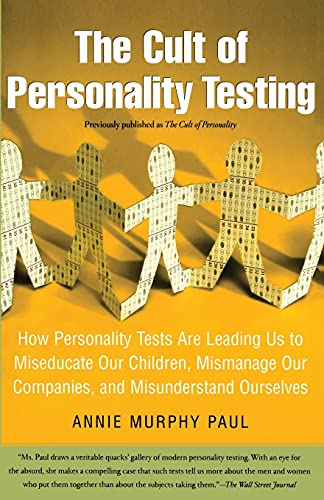
The Cult of Personality Testing: How Personality Tests Are Leading Us to Miseducate Our Children, Mismanage Our Companies, and Misunderstand Ourselves - Softcover
Inhaltsangabe
Millions of people worldwide take personality tests each year to direct their education, to decide on a career, to determine if they'll be hired, to join the armed forces, and to settle legal disputes. Yet, according to award-winning psychology writer Annie Murphy Paul, the sheer number of tests administered obscures a simple fact: they don't work. Most personality tests are seriously flawed, and sometimes unequivocally wrong. They fail the field's own standards of validity and reliability. They ask intrusive questions. They produce descriptions of people that are nothing like human beings as they actually are: complicated, contradictory, changeable across time and place. "The Cult Of Personality Testing" documents, for the first time, the disturbing consequences of these tests. Children are being labelled in limiting ways. Businesses and the government are wasting hundreds of millions of dollars every year, only to make ill-informed decisions about hiring and firing. Job seekers are having their privacy invaded and their rights trampled, and our judicial system is being undermined by faulty evidence. Paul's eye-opening chronicle reveals the fascinating history behind a lucrative and largely unregulated business. Captivating, insightful, and sometimes shocking, "The Cult Of Personality Testing" offers an exhilarating trip into the human mind and heart.
Die Inhaltsangabe kann sich auf eine andere Ausgabe dieses Titels beziehen.
Über die Autorin bzw. den Autor
Annie Murphy Paul is a magazine journalist and book author who writes about the biological and social sciences. Born in Philadelphia, she graduated from Yale University and from the Columbia University Graduate School of Journalism. A former senior editor at Psychology Today magazine, she was awarded the Rosalynn Carter Fellowship for Mental Health Journalism. Her writing has appeared in the New York Times Magazine, the New York Times Book Review, Slate, Discover, Health, O: The Oprah Magazine, and many other publications. She is the author of Origins: How the Nine Months Before Birth Shape the Rest of Our Lives and The Cult of Personality: How Personality Tests Are Leading Us to Miseducate Our Children, Mismanage Our Companies, and Misunderstand Ourselves.
Auszug. © Genehmigter Nachdruck. Alle Rechte vorbehalten.
The Cult of Personality Testing
How Personality Tests Are Leading Us to Miseducate Our Children, Mismanage Our Companies, and Misunderstand OurselvesBy Annie Murphy PaulFree Press
Copyright © 2005 Annie Murphy PaulAll right reserved.
ISBN: 0743280725
Introduction
Hello. Nice to meet you. Please allow me to tell you who you are.
Such is the introduction, polite but firm, extended by personality tests. When we first encounter them we are strangers (even, as some tests would have it, to ourselves). When we part some time later, we're a known quantity, neatly tagged. Personality tests take wildly different forms -- questionnaires, inkblots, stories, drawings, dolls -- but all make the same promise: to reduce our complicated, contradictory, changeable selves to a tidy label. These tests claim to measure not what we know, but what we're like; not what we can do, but who we are.
Today, personality tests are a startlingly ubiquitous part of American life, from the thousands of quizzes popping up online, to the personality types assigned in seminars and workshops, to the honesty tests and personality screens routinely required of job applicants. Millions of our nation's workers -- from hourly employees to professionals like managers, doctors, and lawyers -- must take personality tests to obtain a position or to advance in their careers. Citizens seeking justice in our courts may be compelled to take personality tests to secure parental custody or receive compensation for emotional distress. Even children are obliged to take personality tests: to gain admission to private schools and programs, to diagnose academic or behavioral problems, to guide the way they're taught or the kind of projects they're assigned. But where did these tests come from? And just what are they saying about us?
This book tells the surprising and disturbing story of the tests that claim to capture human nature. It goes behind the scenes to discover how personality tests are used -- in America's companies, its courts, its schools, and in organizations from churches to community centers to dating services. Drawing on the latest scientific research, it exposes the serious flaws of personality tests, explaining why their results are often invalid, unreliable, and unfair. And it delves into the extraordinary history of the tests' creation, revealing how these allegedly neutral instruments were in fact shaped by the demands of industry and government -- and by the idiosyncratic and often eccentric personalities of their creators.
The story begins with Hermann Rorschach, a Swiss psychiatrist possessed by a desire to create "a key to the knowledge of mankind." The inkblot test that bears his name, though one of psychologists' favorite tools for more than fifty years, has come under increasingly intense criticism over the past decade. The test's numerous detractors charge that the Rorschach -- originally designed for use with psychiatric patients but now frequently given to normal people -- "overpathologizes," making healthy individuals look sick. Multiple investigations have concluded that many of the test's results are simply not supported by evidence. Yet the Rorschach is still used by eight out of ten clinical psychologists, administered in nearly a third of emotional injury assessments and in almost half of child custody evaluations.
Even more popular is the Minnesota Multiphasic Personality Inventory, a 567-item questionnaire created at a Midwestern mental hospital in the 1930s. The MMPI, as it's known, was assembled in a highly unusual way: in the words of Starke Hathaway, one of its authors, "we permitted the patients to design their own test." Today it's administered to an estimated 15 million Americans each year, in spite of the fact that it features invasive questions about test takers' sex lives and bathroom habits. Like the Rorschach, the MMPI was intended for use with the mentally ill, but it is now given to a broad range of normal people, including aspiring doctors, psychologists, paramedics, clergy members, police officers, firefighters, and airplane pilots. It has also become a template for personality questionnaires that are used even more widely in the workplace: a 2003 survey shows that personality tests are now administered by 30 percent of American companies, from mom-and-pop operations to giants like Wal-Mart and General Motors.
The corporate world has seized on the innovations of another personality test creator: Henry Murray, a brilliant Harvard professor whose charismatic ebullience disguised a dark secret life. In collaboration with his mistress, he designed the Thematic Apperception Test, which asks the taker to tell stories about a set of ambiguous drawings. Despite falling "woefully short of professional and scientific test standards," the technique is popular with psychologists (it's used by 60 percent of clinicians, according to a recent survey) and also with marketers, who use its insights about personality to shape their product pitches. During World War II, Murray was enlisted to select spies for American intelligence operations, and from this work emerged another tool for evaluating personality: the assessment center. These centers, which put participants through a series of simulated tasks, have received mixed reviews from researchers -- but they are used today by thousands of American companies, along with two-thirds of police and fire departments and state and county governments.
Perhaps no other personality test has achieved the cult status of the Myers-Briggs Type Indicator, an instrument created in the 1940s by a Pennsylvania housewife. Fiercely proud of the test she called "my baby," Isabel Myers believed that it could bring about world peace -- or at least make everyone a little nicer. The Myers-Briggs, which assigns each test taker a personality type represented by four letters, is now given to 2.5 million people each year, and is used by 89 of the companies in the Fortune 100. Employed by businesses to "identify strengths" and "facilitate teamwork," the Myers-Briggs has also been embraced by a multitude of individuals who experience a revelation (what devotees call the "aha reaction") upon learning about psychological type. Their enthusiasm persists despite research showing that as many as three-quarters of test takers achieve a different personality type when tested again, and that the sixteen distinctive types described by the Myers-Briggs have no scientific basis whatsoever.
Personality testing begins early, when children are in elementary school or even before. One of the first instruments to be used widely with youngsters was the Draw-a-Person Test, designed by Karen Machover, a New York City therapist who had herself endured a singularly bleak childhood. Psychologists administering it or a related technique, the House-Tree-Person Test, make judgments about children's personalities based on the style and content of their sketches. Although decades of research have shown these tests to be all but worthless -- "again and again," write two respected scientists, the results of drawing tests "have failed to hold up" -- the Draw-a-Person Test is still used by more than a quarter of clinicians, the House-Tree-Person Test by more than a third. More recently, a fad among educators for teaching to each student's "learning style" has led to the development of at least half a dozen tests that label children by their personalities: feeling or thinking, imaginative or practical, flexible or organized. While proponents of the concept contend that its application can reduce delinquency, prevent dropouts, and even alleviate...
„Über diesen Titel“ kann sich auf eine andere Ausgabe dieses Titels beziehen.
Suchergebnisse für The Cult of Personality Testing: How Personality Tests...

Beispielbild für diese ISBN
The Cult of Personality Testin
Anbieter: World of Books (was SecondSale), Montgomery, IL, USA
Verkäuferbewertung 5 von 5 Sternen

Zustand: Good. Item in good condition. Textbooks may not include supplemental items i.e. CDs, access codes etc. Artikel-Nr. 00106616924
Gebraucht kaufen
EUR 4,67
Versand gratis
Versand innerhalb von USA
Versand innerhalb von USA
Anzahl: 1 verfügbar
Beispielbild für diese ISBN
The Cult of Personality Testing: How Personality Tests Are Leading Us to Miseducate Our Children, Mismanage Our Companies, and Misunderstand Ourselves
Verlag:
Free Press (edition Reprint), 2005
ISBN 10: 0743280725
ISBN 13: 9780743280723
Gebraucht
Paperback
Anbieter: BooksRun, Philadelphia, PA, USA
Verkäuferbewertung 5 von 5 Sternen
Paperback. Zustand: Fair. Reprint. The item might be beaten up but readable. May contain markings or highlighting, as well as stains, bent corners, or any other major defect, but the text is not obscured in any way. Artikel-Nr. 0743280725-7-1
Gebraucht kaufen
EUR 4,68
Versand gratis
Versand innerhalb von USA
Versand innerhalb von USA
Anzahl: 1 verfügbar
Beispielbild für diese ISBN
The Cult of Personality Testing: How Personality Tests Are Leading Us to Miseducate Our Children, Mismanage Our Companies, and Misunderstand Ourselves
Anbieter: Wonder Book, Frederick, MD, USA
Verkäuferbewertung 5 von 5 Sternen
Zustand: Very Good. Very Good condition. A copy that may have a few cosmetic defects. May also contain light spine creasing or a few markings such as an owner's name, short gifter's inscription or light stamp. Artikel-Nr. V03O-00416
Gebraucht kaufen
EUR 6,21
Versand gratis
Versand innerhalb von USA
Versand innerhalb von USA
Anzahl: 1 verfügbar
Beispielbild für diese ISBN
The Cult of Personality Testing: How Personality Tests Are Leading Us to Miseducate Our Children, Mismanage Our Companies, and Misunderstand Ourselves
Anbieter: ThriftBooks-Dallas, Dallas, TX, USA
Verkäuferbewertung 5 von 5 Sternen
Paperback. Zustand: Fair. No Jacket. Readable copy. Pages may have considerable notes/highlighting. ~ ThriftBooks: Read More, Spend Less. Artikel-Nr. G0743280725I5N00
Gebraucht kaufen
EUR 6,50
Versand gratis
Versand innerhalb von USA
Versand innerhalb von USA
Anzahl: 1 verfügbar
Beispielbild für diese ISBN
The Cult of Personality Testing: How Personality Tests Are Leading Us to Miseducate Our Children, Mismanage Our Companies, and Misunderstand Ourselves
Anbieter: ThriftBooks-Dallas, Dallas, TX, USA
Verkäuferbewertung 5 von 5 Sternen
Paperback. Zustand: Good. No Jacket. Pages can have notes/highlighting. Spine may show signs of wear. ~ ThriftBooks: Read More, Spend Less. Artikel-Nr. G0743280725I3N00
Gebraucht kaufen
EUR 6,50
Versand gratis
Versand innerhalb von USA
Versand innerhalb von USA
Anzahl: 1 verfügbar
Beispielbild für diese ISBN
The Cult of Personality Testing: How Personality Tests Are Leading Us to Miseducate Our Children, Mismanage Our Companies, and Misunderstand Ourselves
Anbieter: ThriftBooks-Atlanta, AUSTELL, GA, USA
Verkäuferbewertung 5 von 5 Sternen
Paperback. Zustand: Good. No Jacket. Pages can have notes/highlighting. Spine may show signs of wear. ~ ThriftBooks: Read More, Spend Less. Artikel-Nr. G0743280725I3N00
Gebraucht kaufen
EUR 6,50
Versand gratis
Versand innerhalb von USA
Versand innerhalb von USA
Anzahl: 1 verfügbar
Beispielbild für diese ISBN
The Cult of Personality Testing : How Personality Tests Are Leading Us to Miseducate Our Children, Mismanage Our Companies, and Misunderstand Ourselves
Anbieter: Better World Books, Mishawaka, IN, USA
Verkäuferbewertung 5 von 5 Sternen
Zustand: Very Good. Reprint. Former library copy. Pages intact with possible writing/highlighting. Binding strong with minor wear. Dust jackets/supplements may not be included. Includes library markings. Stock photo provided. Product includes identifying sticker. Better World Books: Buy Books. Do Good. Artikel-Nr. 10418564-6
Gebraucht kaufen
EUR 8,07
Versand gratis
Versand innerhalb von USA
Versand innerhalb von USA
Anzahl: 1 verfügbar
Beispielbild für diese ISBN
The Cult of Personality Testing : How Personality Tests Are Leading Us to Miseducate Our Children, Mismanage Our Companies, and Misunderstand Ourselves
Anbieter: Better World Books, Mishawaka, IN, USA
Verkäuferbewertung 5 von 5 Sternen
Zustand: Good. Reprint. Former library copy. Pages intact with minimal writing/highlighting. The binding may be loose and creased. Dust jackets/supplements are not included. Includes library markings. Stock photo provided. Product includes identifying sticker. Better World Books: Buy Books. Do Good. Artikel-Nr. 6084220-6
Gebraucht kaufen
EUR 8,07
Versand gratis
Versand innerhalb von USA
Versand innerhalb von USA
Anzahl: 2 verfügbar
Beispielbild für diese ISBN
The Cult of Personality Testing: How Personality Tests Are Leading Us to Miseducate Our Children, Mismanage Our Companies, and Misunderstand Ourselves
Anbieter: Books From California, Simi Valley, CA, USA
Verkäuferbewertung 4 von 5 Sternen

paperback. Zustand: Very Good. Artikel-Nr. mon0003745924
Gebraucht kaufen
EUR 8,84
EUR 4,30 Versand
Versand innerhalb von USA
Versand innerhalb von USA
Anzahl: 1 verfügbar
Foto des Verkäufers
The Cult of Personality Testing: How Personality Tests Are Leading Us to Miseducate Our Children, Mismanage Our Companies, and Misunderstand Ourselves
Anbieter: WeBuyBooks, Rossendale, LANCS, Vereinigtes Königreich
Verkäuferbewertung 5 von 5 Sternen
paperback. Zustand: Good. Most items will be dispatched the same or the next working day. A copy that has been read but remains in clean condition. All of the pages are intact and the cover is intact and the spine may show signs of wear. The book may have minor markings which are not specifically mentioned. Artikel-Nr. rev4056895462
Gebraucht kaufen
EUR 7,30
EUR 6,77 Versand
Versand von Vereinigtes Königreich nach USA
Versand von Vereinigtes Königreich nach USA
Anzahl: 1 verfügbar