
Verwandte Artikel zu Lean Solutions: How Companies and Customers Can Create...
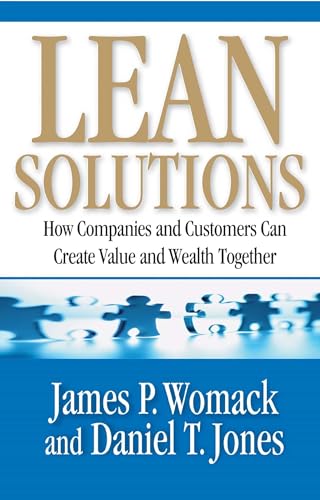
Inhaltsangabe
A massive disconnect exists between consumers and providers today. Consumers have a greater selection of higher quality goods to choose from and can obtain these items from a growing number of sources. Computers, cars, and even big-box retail sites promise to solve our every need. So why aren't consumers any happier?
Because everything surrounding the process of obtaining and using all these products causes us frustration and disappointment. Why is it that, when our computers or our cell phones fail to satisfy our needs, virtually every interaction with help lines, support centers, or any organization providing service is marked with wasted time and extra hassle? And who among us hasn't spent countless hours in the waiting room at the doctor's office, or driven away from the mechanic only to have the "fix engine" light go on?
In their bestselling business classic Lean Thinking, James Womack and Daniel Jones introduced the world to the principles of lean production -- principles for eliminating waste during production. Now, in Lean Solutions, the authors establish the groundbreaking principles of lean consumption, showing companies how to eliminate inefficiency during consumption.
The problem is neither that companies don't care nor that the people trying to fix our broken products are inept. Rather, it's that few companies today see consumption as a process -- a series of linked goods and services, all of which must occur seamlessly for the consumer to be satisfied. Buying a home computer, for example, involves researching, purchasing, integrating, maintaining, upgrading, and, ultimately, replacing it.
Across all industries, companies that apply the principles of lean consumption will learn how to provide the full value consumers desire from products without wasting time or effort -- theirs or the consumers' -- and as a result these companies will be more profitable and competitive.
Lean Solutions is full of surprising success stories: Fujitsu, a leading service company for technology, has transformed the way call centers solve problems -- learning how to eliminate the underlying cause of current problems rather than fixing them again and again. An extremely successful car dealership has adopted lean principles to streamline its business, making for dramatically reduced wait time, fewer return trips, and greater satisfaction for customers -- and a far more lucrative enterprise.
Lean Solutions will inspire managers to take the first steps toward perfecting their company's process of giving consumers what they really want.
Die Inhaltsangabe kann sich auf eine andere Ausgabe dieses Titels beziehen.
Über die Autorinnen und Autoren
James P. Womack is the president and founder of the Lean Enterprise Institute (www.lean.org), a nonprofit education and research organization based in Brookline, Massachusetts.
Daniel T. Jones is the chairman and founder of the Lean Enterprise Academy (www.leanuk.org), a nonprofit education and research organization based in the UK.
Auszug. © Genehmigter Nachdruck. Alle Rechte vorbehalten.
Lean Solutions
Chapter 1
Learning to See Consumption
“Let’s take a walk.” This has been our standard response for many years when an organization asks us to talk about lean thinking. The firm’s managers usually want to meet in the conference room or the CEO’s office. But we know from long experience that value is only created on the gemba—the Japanese word for the place in the office or factory where the real work is done. So that’s always the place we insist on starting, to learn what the true situation is.
Consumers have a gemba, too. It’s the path they follow to solve their problems. And most managers seem to have a very hard time seeing it, even when they follow the path themselves, once they take off their provider hats and put on their consumer hats. So, in recent years, we’ve spent a lot of time walking the consumer gemba, dragging along managers whenever we can.
Our objective is simple: We aim to teach managers to see all of the steps a consumer must perform to research, obtain, install, integrate, maintain, repair, upgrade, and recycle the goods and services needed to solve their problem. We then challenge each step, asking why it’s necessary at all and why it often can’t be performed properly. Once worthless steps are eliminated, we can talk about flow and pull, heading toward perfection.
To make this method clear, let’s take a walk right now, putting ourselves in the position of a consumer. Let’s experience a simple car repair, following the path of Bob Scott, a prototypical consumer whom we first encountered in Lean Thinking when he bent the rear bumper of his pickup.
Walking the Consumer Gemba
This time the process started when the mysterious “check engine” light began glowing on the instrument panel, and Bob needed to search for a repair outlet. The choices were the new car dealer he felt victimized by the last time he needed service, other dealers within driving range who sell and service the same type of vehicle, and several local garages, which may or may not have the latest equipment and knowledge about the specific vehicle.
After several phone calls describing the problem and inquiring about the likely cost, Bob decided to go to a new car dealer he had not visited previously.
The next step was to schedule an appointment—the equivalent action to placing an order in the case of a product, for example, Dan’s computer. Bob then took the car to the dealer at the appointed time.
At the dealer, the problem needed describing. Because Bob was a stranger, the dealer knew nothing about the history of the vehicle and no information had been collected prior to his arrival. This circumstance required a wait in a queue at the service desk to fill out and sign the appropriate forms.
The vehicle couldn’t be fixed immediately, and Bob needed to get to work, so a “loaner” car was provided. This caused another wait while the replacement vehicle was transferred from its storage area. Fortunately, the actual commuting time was no longer than Bob’s normal commute, although in many cases it would be.
During the day, the dealer’s service department made the dreaded call to Bob to describe the problems found and to reveal the cost of the repair. Later, Bob received a second call sharing the bad news that the vehicle would not be ready until the next day because of a lack of parts. As we will see, this is a typical experience when the consumer and the provider are strangers who fail to discuss the nature of the problem up front or share any data on the product’s “as is” condition. As a result, parts have to be ordered and shop time can’t be scheduled accurately.
The next evening, Bob returned to the dealer to pick up the vehicle. This required a short wait in line to fill out the paperwork—reviewing the statement, providing the credit card, collecting the keys. After paying, he encountered a second wait, while the vehicle was brought around from the remote parking area used to store vehicles once repaired.
With the addition of the trip home—counting only the travel time in addition to the daily commute time necessitated by the need to get the car serviced—the consumption process was seemingly complete. However, on the drive home the problem recurred. The mysterious “check engine” light that instigated the initial service went on again.
This is actually a common outcome, as documented by the International Car Distribution Programme (ICDP).1 The chances in North America and Europe of getting a vehicle fixed right the first time are only about 80 percent. And the chances of getting it fixed right the first time and on time are only about 60 percent.
Because the dealer had failed to fix the problem but the repair had already been paid for, the search process moving forward was very simple. Bob made another appointment at the same dealer, the vehicle was returned to go through the check-in and checkout steps, and—two times lucky—the car actually worked properly.
On the next page we have listed the steps that Bob needed to take to complete what appeared to him to be a simple act of consumption. None of the 16 steps was by their nature complex, and each took only a small amount of time. However, when they are added up, the magnitude of effort and time required is striking. Bob expended three hours and 30 minutes of his own time to solve his problem.
Drawing a Consumption Map2
Step lists of the type we have just created can be constructed for any consumption process. They are designed to help managers learn to see the process and its implications. However, we find that many managers and employees are more visual than verbal, so we also draw simple consumption maps to show a process at a glance.
In the consumption time map (The Long and Winding Repair Path) depicted on page 24, we’ve arranged the steps involved from upper left to lower right to illustrate the flow of the process from start to finish, with a back-flow loop of Step 10 through Step 16. We have also drawn the boxes for each step in proportion to the time taken.
Consumption Step List
Steps
Consumer time
1. Search for the best repair facility
25 min.
2. Make appointment with selected facility
5 min.
3. Drive vehicle to facility
20 min.
4. Wait in queue, describe problems, and do paperwork
15 min.
5. Wait for loaner car and sign form
10 min.
6. Discuss problem with service staff and authorize repairs
5 min.
7. Second call to say the car will not be ready until the next day
5 min.
8. Fill out paperwork and wait for delivery of the car
15 min.
9. Drive vehicle home (and discover problem was not corrected)
20 min.
10. Make appointment with same facility
5 min.
11. Drive vehicle to facility
20 min.
12. Wait in queue, describe problems, and do paperwork
15 min.
13. Wait for loaner car and sign form
10 min.
14. Discuss problem with service staff and authorize repairs
5 min.
15. Fill out paperwork and wait for delivery of the car
15 min.
16. Drive vehicle home
20 min.
Total consumer time (16 steps)
210 min.
(3 hr. 30 min.)
The Long and Winding Repair Path
From Consumption Process to Consumer Experience
So far there is nothing right or wrong about all this activity. It’s just a fact. These are the steps, conducted in a specific sequence, that were required of Bob...
„Über diesen Titel“ kann sich auf eine andere Ausgabe dieses Titels beziehen.
Suchergebnisse für Lean Solutions: How Companies and Customers Can Create...

Beispielbild für diese ISBN
Lean Solutions: How Companies and Customers Can Create Value and Wealth Together
Anbieter: ThriftBooks-Dallas, Dallas, TX, USA
Verkäuferbewertung 5 von 5 Sternen

Paperback. Zustand: Very Good. No Jacket. May have limited writing in cover pages. Pages are unmarked. ~ ThriftBooks: Read More, Spend Less. Artikel-Nr. G0743277791I4N00
Gebraucht kaufen
EUR 5,84
Versand gratis
Versand innerhalb von USA
Versand innerhalb von USA
Anzahl: 1 verfügbar
Beispielbild für diese ISBN
Lean Solutions: How Companies and Customers Can Create Value and Wealth Together
Anbieter: ThriftBooks-Dallas, Dallas, TX, USA
Verkäuferbewertung 5 von 5 Sternen
Paperback. Zustand: Good. No Jacket. Pages can have notes/highlighting. Spine may show signs of wear. ~ ThriftBooks: Read More, Spend Less. Artikel-Nr. G0743277791I3N00
Gebraucht kaufen
EUR 5,84
Versand gratis
Versand innerhalb von USA
Versand innerhalb von USA
Anzahl: 1 verfügbar
Beispielbild für diese ISBN
Lean Solutions: How Companies and Customers Can Create Value and Wealth Together
Anbieter: ThriftBooks-Atlanta, AUSTELL, GA, USA
Verkäuferbewertung 5 von 5 Sternen
Paperback. Zustand: Very Good. No Jacket. May have limited writing in cover pages. Pages are unmarked. ~ ThriftBooks: Read More, Spend Less. Artikel-Nr. G0743277791I4N00
Gebraucht kaufen
EUR 5,84
Versand gratis
Versand innerhalb von USA
Versand innerhalb von USA
Anzahl: 1 verfügbar
Beispielbild für diese ISBN
Lean Solutions: How Companies and Customers Can Create Value and Wealth Together
Anbieter: ThriftBooks-Reno, Reno, NV, USA
Verkäuferbewertung 5 von 5 Sternen
Paperback. Zustand: Very Good. No Jacket. May have limited writing in cover pages. Pages are unmarked. ~ ThriftBooks: Read More, Spend Less. Artikel-Nr. G0743277791I4N00
Gebraucht kaufen
EUR 5,84
Versand gratis
Versand innerhalb von USA
Versand innerhalb von USA
Anzahl: 1 verfügbar
Beispielbild für diese ISBN
Lean Solutions : How Companies and Customers Can Create Value and Wealth Together
Anbieter: Better World Books: West, Reno, NV, USA
Verkäuferbewertung 5 von 5 Sternen
Zustand: Good. Pages intact with minimal writing/highlighting. The binding may be loose and creased. Dust jackets/supplements are not included. Stock photo provided. Product includes identifying sticker. Better World Books: Buy Books. Do Good. Artikel-Nr. 4909550-6
Gebraucht kaufen
EUR 6,97
Versand gratis
Versand innerhalb von USA
Versand innerhalb von USA
Anzahl: 1 verfügbar
Beispielbild für diese ISBN
Lean Solutions: How Companies and Customers Can Create Value and Wealth Together
Anbieter: Books From California, Simi Valley, CA, USA
Verkäuferbewertung 4 von 5 Sternen

paperback. Zustand: Very Good. Artikel-Nr. mon0004176657
Gebraucht kaufen
EUR 6,99
EUR 4,31 Versand
Versand innerhalb von USA
Versand innerhalb von USA
Anzahl: 1 verfügbar
Beispielbild für diese ISBN
Lean Solutions: How Companies and Customers Can Create Value and Wealth Together
Anbieter: Majestic Books, Hounslow, Vereinigtes Königreich
Verkäuferbewertung 4 von 5 Sternen
Zustand: New. pp. 368. Artikel-Nr. 373592013
Neu kaufen
EUR 21,36
EUR 7,56 Versand
Versand von Vereinigtes Königreich nach USA
Versand von Vereinigtes Königreich nach USA
Anzahl: 1 verfügbar
Beispielbild für diese ISBN
Lean Solutions: How Companies and Customers Can Create Value and Wealth Together
Anbieter: Revaluation Books, Exeter, Vereinigtes Königreich
Verkäuferbewertung 5 von 5 Sternen
Paperback. Zustand: Brand New. reprint edition. 368 pages. 9.00x6.00x1.25 inches. In Stock. Artikel-Nr. x-0743277791
Neu kaufen
EUR 26,58
EUR 11,64 Versand
Versand von Vereinigtes Königreich nach USA
Versand von Vereinigtes Königreich nach USA
Anzahl: 2 verfügbar
Beispielbild für diese ISBN
Lean Solutions
Anbieter: Mooney's bookstore, Den Helder, Niederlande
Verkäuferbewertung 4 von 5 Sternen
Zustand: As New. Artikel-Nr. 2BA8446E5B524AE
Gebraucht kaufen
EUR 45,69
EUR 14,95 Versand
Versand von Niederlande nach USA
Versand von Niederlande nach USA
Anzahl: 1 verfügbar
Foto des Verkäufers
Lean Solutions : How Companies and Customers Can Create Value and Wealth Together
Anbieter: AHA-BUCH GmbH, Einbeck, Deutschland
Verkäuferbewertung 5 von 5 Sternen
Taschenbuch. Zustand: Neu. Neuware - A massive disconnect exists between consumers and providers today. Consumers have a greater selection of higher quality goods to choose from and can obtain these items from a growing number of sources. Computers, cars, and even big-box retail sites promise to solve our every need. So why aren't consumers any happier Because everything surrounding the process of obtaining and using all these products causes us frustration and disappointment. Why is it that, when our computers or our cell phones fail to satisfy our needs, virtually every interaction with help lines, support centers, or any organization providing service is marked with wasted time and extra hassle And who among us hasn't spent countless hours in the waiting room at the doctor's office, or driven away from the mechanic only to have the 'fix engine' light go on In their bestselling business classic Lean Thinking, James Womack and Daniel Jones introduced the world to the principles of lean production -- principles for eliminating waste during production. Now, in Lean Solutions, the authors establish the groundbreaking principles of lean consumption, showing companies how to eliminate inefficiency during consumption. The problem is neither that companies don't care nor that the people trying to fix our broken products are inept. Rather, it's that few companies today see consumption as a process -- a series of linked goods and services, all of which must occur seamlessly for the consumer to be satisfied. Buying a home computer, for example, involves researching, purchasing, integrating, maintaining, upgrading, and, ultimately, replacing it. Across all industries, companies that apply the principles of lean consumption will learn how to provide the full value consumers desire from products without wasting time or effort -- theirs or the consumers' -- and as a result these companies will be more profitable and competitive. Lean Solutions is full of surprising success stories: Fujitsu, a leading service company for technology, has transformed the way call centers solve problems -- learning how to eliminate the underlying cause of current problems rather than fixing them again and again. An extremely successful car dealership has adopted lean principles to streamline its business, making for dramatically reduced wait time, fewer return trips, and greater satisfaction for customers -- and a far more lucrative enterprise. Lean Solutions will inspire managers to take the first steps toward perfecting their company's process of giving consumers what they really want. Artikel-Nr. 9780743277792
Neu kaufen
EUR 28,00
EUR 62,08 Versand
Versand von Deutschland nach USA
Versand von Deutschland nach USA
Anzahl: 2 verfügbar