
Verwandte Artikel zu The Art of Learning: An Inner Journey to Optimal Performance
Inhaltsangabe
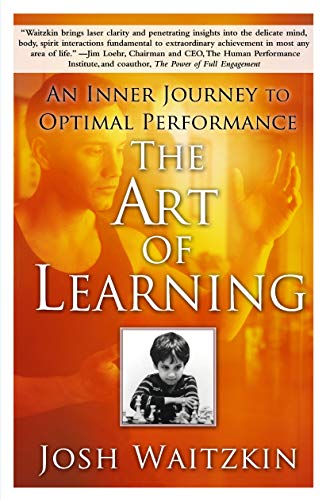
In his riveting new book, The Art of Learning, Waitzkin tells his remarkable story of personal achievement and shares the principles of learning and performance that have propelled him to the top—twice.
Josh Waitzkin knows what it means to be at the top of his game. A public figure since winning his first National Chess Championship at the age of nine, Waitzkin was catapulted into a media whirlwind as a teenager when his father’s book Searching for Bobby Fischer was made into a major motion picture. After dominating the scholastic chess world for ten years, Waitzkin expanded his horizons, taking on the martial art Tai Chi Chuan and ultimately earning the title of World Champion. How was he able to reach the pinnacle of two disciplines that on the surface seem so different? “I’ve come to realize that what I am best at is not Tai Chi, and it is not chess,” he says. “What I am best at is the art of learning.”
With a narrative that combines heart-stopping martial arts wars and tense chess face-offs with life lessons that speak to all of us, The Art of Learning takes readers through Waitzkin’s unique journey to excellence. He explains in clear detail how a well-thought-out, principled approach to learning is what separates success from failure. Waitzkin believes that achievement, even at the championship level, is a function of a lifestyle that fuels a creative, resilient growth process. Rather than focusing on climactic wins, Waitzkin reveals the inner workings of his everyday method, from systematically triggering intuitive breakthroughs, to honing techniques into states of remarkable potency, to mastering the art of performance psychology.
Through his own example, Waitzkin explains how to embrace defeat and make mistakes work for you. Does your opponent make you angry? Waitzkin describes how to channel emotions into creative fuel. As he explains it, obstacles are not obstacles but challenges to overcome, to spur the growth process by turning weaknesses into strengths. He illustrates the exact routines that he has used in all of his competitions, whether mental or physical, so that you too can achieve your peak performance zone in any competitive or professional circumstance.
In stories ranging from his early years taking on chess hustlers as a seven year old in New York City’s Washington Square Park, to dealing with the pressures of having a film made about his life, to International Chess Championships in India, Hungary, and Brazil, to gripping battles against powerhouse fighters in Taiwan in the Push Hands World Championships, The Art of Learning encapsulates an extraordinary competitor’s life lessons in a page-turning narrative.
Die Inhaltsangabe kann sich auf eine andere Ausgabe dieses Titels beziehen.
Über die Autorin bzw. den Autor
Josh Waitzkin, an eight-time National Chess Champion in his youth, was the subject of the book and movie Searching for Bobby Fischer. At eighteen, he published his first book, Josh Waitzkin's Attacking Chess. Since the age of twenty, he has developed and been spokesperson for Chessmaster, the largest computer chess program in the world. Now a martial arts champion, he holds a combined twenty-one National Championship titles in addition to several World Championship titles. When not traveling the country giving seminars and keynote presentations, he lives and trains in New York City. He can be reached at www.joshwaitzkin.com. For more information about Chessmaster visit www.ubi.com.
Von der hinteren Coverseite
In his riveting new book, The Art of Learning, Waitzkin tells his remarkable story of personal achievement and shares the principles of learning and performance that have propelled him to the top―twice.
Josh Waitzkin knows what it means to be at the top of his game. A public figure since winning his first National Chess Championship at the age of nine, Waitzkin was catapulted into a media whirlwind as a teenager when his father’s book Searching for Bobby Fischer was made into a major motion picture. After dominating the scholastic chess world for ten years, Waitzkin expanded his horizons, taking on the martial art Tai Chi Chuan and ultimately earning the title of World Champion. How was he able to reach the pinnacle of two disciplines that on the surface seem so different? “I’ve come to realize that what I am best at is not Tai Chi, and it is not chess,” he says. “What I am best at is the art of learning.”
With a narrative that combines heart-stopping martial arts wars and tense chess face-offs with life lessons that speak to all of us, The Art of Learning takes readers through Waitzkin’s unique journey to excellence. He explains in clear detail how a well-thought-out, principled approach to learning is what separates success from failure. Waitzkin believes that achievement, even at the championship level, is a function of a lifestyle that fuels a creative, resilient growth process. Rather than focusing on climactic wins, Waitzkin reveals the inner workings of his everyday method, from systematically triggering intuitive breakthroughs, to honing techniques into states of remarkable potency, to mastering the art of performance psychology.
Through his own example, Waitzkin explains how to embrace defeat and make mistakes work for you. Does your opponent make you angry? Waitzkin describes how to channel emotions into creative fuel. As he explains it, obstacles are not obstacles but challenges to overcome, to spur the growth process by turning weaknesses into strengths. He illustrates the exact routines that he has used in all of his competitions, whether mental or physical, so that you too can achieve your peak performance zone in any competitive or professional circumstance.
In stories ranging from his early years taking on chess hustlers as a seven year old in New York City’s Washington Square Park, to dealing with the pressures of having a film made about his life, to International Chess Championships in India, Hungary, and Brazil, to gripping battles against powerhouse fighters in Taiwan in the Push Hands World Championships, The Art of Learning encapsulates an extraordinary competitor’s life lessons in a page-turning narrative.
Auszug. © Genehmigter Nachdruck. Alle Rechte vorbehalten.
INTRODUCTION
One has to investigate the principle in one thing or one event exhaustively . . . Things and the self are governed by the same principle. If you understand one, you understand the other, for the truth within and the truth without are identical.
-- Er Cheng Yishu, 11th century
Finals: Tai Chi Chuan Push Hands World Championships
Hsinchuang Stadium, Taipei, Taiwan
December 5, 2004
Forty seconds before round two, and I'm lying on my back trying to breathe. Pain all through me. Deep breath. Let it go. I won't be able to lift my shoulder tomorrow, it won't heal for over a year, but now it pulses, alive, and I feel the air vibrating around me, the stadium shaking with chants, in Mandarin, not for me. My teammates are kneeling above me, looking worried. They rub my arms, my shoulders, my legs. The bell rings. I hear my dad's voice in the stands, 'C'mon Josh!' Gotta get up. I watch my opponent run to the center of the ring. He screams, pounds his chest. The fans explode. They call him Buffalo. Bigger than me, stronger, quick as a cat. But I can take him -- if I make it to the middle of the ring without falling over. I have to dig deep, bring it up from somewhere right now. Our wrists touch, the bell rings, and he hits me like a Mack truck.
Who could have guessed it would come to this? Just a few years earlier I had been competing around the world in elite chess tournaments. Since I was eight years old, I had consistently been the highest rated player for my age in the United States, and my life was dominated by competitions and training regimens designed to bring me into peak form for the next national or world championship. I had spent the years between ages fifteen and eighteen in the maelstrom of American media following the release of the film Searching for Bobby Fischer, which was based on my dad's book about my early chess life. I was known as America's great young chess player and was told that it was my destiny to follow in the footsteps of immortals like Bobby Fischer and Garry Kasparov, to be world champion.
But there were problems. After the movie came out I couldn't go to a tournament without being surrounded by fans asking for autographs. Instead of focusing on chess positions, I was pulled into the image of myself as a celebrity. Since childhood I had treasured the sublime study of chess, the swim through ever-deepening layers of complexity. I could spend hours at a chessboard and stand up from the experience on fire with insight about chess, basketball, the ocean, psychology, love, art. The game was exhilarating and also spiritually calming. It centered me. Chess was my friend. Then, suddenly, the game became alien and disquieting.
I recall one tournament in Las Vegas: I was a young International Master in a field of a thousand competitors including twenty-six strong Grandmasters from around the world. As an up-and-coming player, I had huge respect for the great sages around me. I had studied their masterpieces for hundreds of hours and was awed by the artistry of these men. Before first-round play began I was seated at my board, deep in thought about my opening preparation, when the public address system announced that the subject of Searching for Bobby Fischer was at the event. A tournament director placed a poster of the movie next to my table, and immediately a sea of fans surged around the ropes separating the top boards from the audience. As the games progressed, when I rose to clear my mind young girls gave me their phone numbers and asked me to autograph their stomachs or legs.
This might sound like a dream for a seventeen-year-old boy, and I won't deny enjoying the attention, but professionally it was a nightmare. My game began to unravel. I caught myself thinking about how I looked thinking instead of losing myself in thought. The Grandmasters, my elders, were ignored and scowled at me. Some of them treated me like a pariah. I had won eight national championships and had more fans, public support and recognition than I could dream of, but none of this was helping my search for excellence, let alone for happiness.
At a young age I came to know that there is something profoundly hollow about the nature of fame. I had spent my life devoted to artistic growth and was used to the sweaty-palmed sense of contentment one gets after many hours of intense reflection. This peaceful feeling had nothing to do with external adulation, and I yearned for a return to that innocent, fertile time. I missed just being a student of the game, but there was no escaping the spotlight. I found myself dreading chess, miserable before leaving for tournaments. I played without inspiration and was invited to appear on television shows. I smiled.
Then when I was eighteen years old I stumbled upon a little book called the Tao Te Ching, and my life took a turn. I was moved by the book's natural wisdom and I started delving into other Buddhist and Taoist philosophical texts. I recognized that being at the pinnacle in other people's eyes had nothing to do with quality of life, and I was drawn to the potential for inner tranquility.
On October 5, 1998, I walked into William C. C. Chen's Tai Chi Chuan studio in downtown Manhattan and found myself surrounded by peacefully concentrating men and women floating through a choreographed set of movements. I was used to driven chess players cultivating tunnel vision in order to win the big game, but now the focus was on bodily awareness, as if there were some inner bliss that resulted from mindfully moving slowly in strange ways.
I began taking classes and after a few weeks I found myself practicing the meditative movements for hours at home. Given the complicated nature of my chess life, it was beautifully liberating to be learning in an environment in which I was simply one of the beginners -- and something felt right about this art. I was amazed by the way my body pulsed with life when flowing through the ancient steps, as if I were tapping into a primal alignment.
My teacher, the world-renowned Grandmaster William C. C. Chen, spent months with me in beginner classes, patiently correcting my movements. In a room with fifteen new students, Chen would look into my eyes from twenty feet away, quietly assume my posture, and relax his elbow a half inch one way or another. I would follow his subtle instruction and suddenly my hand would come alive with throbbing energy as if he had plugged me into a soothing electrical current. His insight into body mechanics seemed magical, but perhaps equally impressive was Chen's humility. Here was a man thought by many to be the greatest living Tai Chi Master in the world, and he patiently taught first-day novices with the same loving attention he gave his senior students.
I learned quickly, and became fascinated with the growth that I was experiencing. Since I was twelve years old I had kept journals of my chess study, making psychological observations along the way -- now I was doing the same with Tai Chi.
After about six months of refining my form (the choreographed movements that are the heart of Tai Chi Chuan), Master Chen invited me to join the Push Hands class. This was very exciting, my baby steps toward the martial side of the art. In my first session, my teacher and I stood facing each other, each of us with our right leg forward and the backs of our right wrists touching. He told me to push into him, but when I did he wasn't there anymore. I felt sucked forward, as if by a vacuum. I stumbled and scratched my head. Next, he gently pushed into me and I tried to get out of the way but didn't know where to go. Finally I fell back on old instincts, tried to resist the incoming force, and with barely any contact Chen sent me flying into the air....
„Über diesen Titel“ kann sich auf eine andere Ausgabe dieses Titels beziehen.
Suchergebnisse für The Art of Learning: An Inner Journey to Optimal Performance

Beispielbild für diese ISBN
The Art of Learning: An Inner Journey to Optimal Performance
Anbieter: World of Books (was SecondSale), Montgomery, IL, USA
Verkäuferbewertung 5 von 5 Sternen

Paperback. Zustand: Good. Chess and martial arts champion Josh Waitzkin lays out his battle-tested principles of learning and performance to give readers tools for excellence and success. Artikel-Nr. 00108716797
Gebraucht kaufen
EUR 5,09
Versand gratis
Versand innerhalb von USA
Versand innerhalb von USA
Anzahl: Mehr als 20 verfügbar
Beispielbild für diese ISBN
The Art of Learning: An Inner Journey to Optimal Performance
Anbieter: World of Books (was SecondSale), Montgomery, IL, USA
Verkäuferbewertung 5 von 5 Sternen
Paperback. Zustand: Fair. Chess and martial arts champion Josh Waitzkin lays out his battle-tested principles of learning and performance to give readers tools for excellence and success. Artikel-Nr. 00108522839
Gebraucht kaufen
EUR 5,09
Versand gratis
Versand innerhalb von USA
Versand innerhalb von USA
Anzahl: 1 verfügbar
Beispielbild für diese ISBN
The Art of Learning: An Inner Journey to Optimal Performance
Anbieter: World of Books (was SecondSale), Montgomery, IL, USA
Verkäuferbewertung 5 von 5 Sternen
Paperback. Zustand: Very Good. Chess and martial arts champion Josh Waitzkin lays out his battle-tested principles of learning and performance to give readers tools for excellence and success. Artikel-Nr. CIN0743277465VG
Gebraucht kaufen
EUR 5,09
Versand gratis
Versand innerhalb von USA
Versand innerhalb von USA
Anzahl: 3 verfügbar
Foto des Verkäufers
The Art of Learning: An Inner Journey to Optimal Performance
Anbieter: Dream Books Co., Denver, CO, USA
Verkäuferbewertung 5 von 5 Sternen
Zustand: acceptable. This copy has clearly been enjoyedâ"expect noticeable shelf wear and some minor creases to the cover. Binding is strong, and all pages are legible. May contain previous library markings or stamps. Artikel-Nr. DBV.0743277465.A
Gebraucht kaufen
EUR 5,10
Versand gratis
Versand innerhalb von USA
Versand innerhalb von USA
Anzahl: 2 verfügbar
Beispielbild für diese ISBN
The Art of Learning: An Inner Journey to Optimal Performance
Verlag:
Free Press (edition 37102nd), 2008
ISBN 10: 0743277465
ISBN 13: 9780743277464
Gebraucht
Paperback
Anbieter: BooksRun, Philadelphia, PA, USA
Verkäuferbewertung 5 von 5 Sternen
Paperback. Zustand: Very Good. 37102nd. It's a well-cared-for item that has seen limited use. The item may show minor signs of wear. All the text is legible, with all pages included. It may have slight markings and/or highlighting. Artikel-Nr. 0743277465-11-1
Gebraucht kaufen
EUR 5,65
Versand gratis
Versand innerhalb von USA
Versand innerhalb von USA
Anzahl: 1 verfügbar
Beispielbild für diese ISBN
The Art of Learning: An Inner Journey to Optimal Performance
Anbieter: ThriftBooks-Phoenix, Phoenix, AZ, USA
Verkäuferbewertung 5 von 5 Sternen
Paperback. Zustand: Fair. No Jacket. Former library book; Readable copy. Pages may have considerable notes/highlighting. ~ ThriftBooks: Read More, Spend Less. Artikel-Nr. G0743277465I5N10
Gebraucht kaufen
EUR 6,26
Versand gratis
Versand innerhalb von USA
Versand innerhalb von USA
Anzahl: 1 verfügbar
Beispielbild für diese ISBN
The Art of Learning: An Inner Journey to Optimal Performance
Anbieter: ThriftBooks-Dallas, Dallas, TX, USA
Verkäuferbewertung 5 von 5 Sternen
Paperback. Zustand: Good. No Jacket. Missing dust jacket; Pages can have notes/highlighting. Spine may show signs of wear. ~ ThriftBooks: Read More, Spend Less. Artikel-Nr. G0743277465I3N01
Gebraucht kaufen
EUR 6,26
Versand gratis
Versand innerhalb von USA
Versand innerhalb von USA
Anzahl: 1 verfügbar
Beispielbild für diese ISBN
The Art of Learning: An Inner Journey to Optimal Performance
Anbieter: ThriftBooks-Phoenix, Phoenix, AZ, USA
Verkäuferbewertung 5 von 5 Sternen
Paperback. Zustand: Good. No Jacket. Former library book; Pages can have notes/highlighting. Spine may show signs of wear. ~ ThriftBooks: Read More, Spend Less. Artikel-Nr. G0743277465I3N10
Gebraucht kaufen
EUR 6,26
Versand gratis
Versand innerhalb von USA
Versand innerhalb von USA
Anzahl: 1 verfügbar
Beispielbild für diese ISBN
The Art of Learning: An Inner Journey to Optimal Performance
Anbieter: ThriftBooks-Atlanta, AUSTELL, GA, USA
Verkäuferbewertung 5 von 5 Sternen
Paperback. Zustand: Good. No Jacket. Former library book; Pages can have notes/highlighting. Spine may show signs of wear. ~ ThriftBooks: Read More, Spend Less. Artikel-Nr. G0743277465I3N10
Gebraucht kaufen
EUR 6,26
Versand gratis
Versand innerhalb von USA
Versand innerhalb von USA
Anzahl: 2 verfügbar
Beispielbild für diese ISBN
The Art of Learning: An Inner Journey to Optimal Performance
Anbieter: ThriftBooks-Dallas, Dallas, TX, USA
Verkäuferbewertung 5 von 5 Sternen
Paperback. Zustand: Good. No Jacket. Pages can have notes/highlighting. Spine may show signs of wear. ~ ThriftBooks: Read More, Spend Less. Artikel-Nr. G0743277465I3N00
Gebraucht kaufen
EUR 6,26
Versand gratis
Versand innerhalb von USA
Versand innerhalb von USA
Anzahl: Mehr als 20 verfügbar