
Verwandte Artikel zu Four Trials
Inhaltsangabe
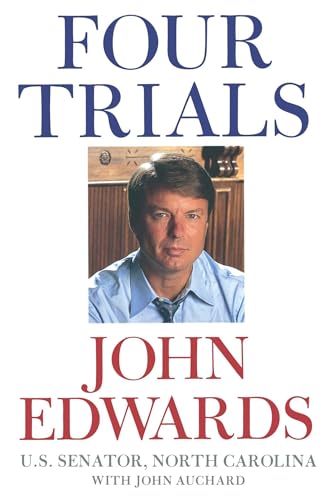
Raised in a small town by parents employed in the local mills, John Edwards worked in those mills himself -- and then went on to become one of America's most successful and respected attorneys. He built a national reputation representing people whose lives had been shattered by corporate recklessness and grievous medical negligence. In landmark cases, Edwards helped people from all walks of life stand up for themselves against tremendous odds. Four Trials provides an electrifying account of four of his cases as it tells the story of the courageous and unmistakably decent people Edwards was privileged to represent in times of tragedy, great loss, and often great joy. And in a deeply moving account, Four Trials also speaks of the tragedies and joys that Senator Edwards has known in his own life -- and how today life and justice are more precious to him than ever.
Die Inhaltsangabe kann sich auf eine andere Ausgabe dieses Titels beziehen.
Über die Autorin bzw. den Autor
Senator John Edwards practiced law for twenty years, representing families and children hurt by the negligence of others. In 1998, he was elected U.S. Senator for North Carolina, where he lives with his family.
Auszug. © Genehmigter Nachdruck. Alle Rechte vorbehalten.
Chapter One: E.G.
"I trust you."
E.G. Sawyer didn't speak these words. Instead, he typed them out on a plastic spelling board that had become his only means of communication since the day his life had changed six years before. It was a December evening in 1984, and my client and I sat on the ninth floor of the Buncombe County courthouse in an otherwise empty courtroom that overlooked the art deco cityscape of downtown Asheville, North Carolina. Only an hour before, I had completed my closing argument in an intense two-week trial where we had sought to prove that E.G. had been permanently disabled as a result of the medical malpractice of an Asheville doctor and the local hospital.
The next morning, the jury would begin deliberations. But for the moment as I sat beside my client, I wondered if I had done everything possible to make those twelve men and women understand the damage E.G. had suffered. Could they see the man he had once been -- the real E.G. lost somewhere in the hunched and colorless figure that now slouched in a wheelchair? Back then this man hadn't needed a chair to get around or a spelling board to speak. This man had once been the freest of movers, the easiest of talkers; the kind of guy whose good looks and easy smile would always shield him -- or so it seemed -- from misfortune.
• • •
Howard E.G. Sawyer -- those middle initials were an Appalachian quirk and stood for nothing -- had long been accustomed to the power of his striking black-Irish good looks. He had known his charm pretty well, and he loved to talk and knew people loved to talk to him. He was a natural salesman, and a good one. When he drove his Chevrolet pickup around western North Carolina selling chemicals, slapping backs, and handing out gifts, he did more than distribute the usual fifths of Crown Royal or Jack Daniel's. He stocked up on baseball cards, penknives, and the like -- for clients' kids and even for friends of their kid's.
E.G. Sawyer lived for the human exchange, and he loved the freedom his job gave him. No office, no time card -- just a monthly quota he easily met but seldom exceeded. As soon as E.G.'s professional obligations were fulfilled, he hit the golf course. When he expanded his sales territory to the golfer's paradise of Florida, his boss, Charles Tate, could hardly complain. E.G.'s sales charm knew no state boundaries, and besides, E.G. took Tate's son along as his caddy.
The Tates had more or less adopted E.G., who lived in
a neatly kept double-wide trailer just north of the Asheville city limits. He was a frequent dinner guest and a reliable presence during holidays. The Tates affectionately referred to him as "our bachelor."
Of course the ladies liked him too, for why shouldn't they -- even if he was a hard man to hold down, with all that moving and all that charm -- and all that golf -- which may have been his greatest passion of all. His first wife, Betty, continued to be fond of him even after she had left him, although she had long accepted that his real loves would always be the road and the links. And although he faithfully picked up their young children, Chad and Kim, each Saturday morning for swim-
ming or baseball games, he loved his role as the Tates' bachelor at least as much as he enjoyed his role as Saturday dad.
But as E.G. entered his forties, as his sales chums and golfing partners abandoned him each evening for the tediums and glories of married life, bachelorhood lost its luster. In 1976, E.G. married again, a woman who was young, beautiful, and spirited -- too spirited, it turned out, for the life E.G. envisioned. The marriage did not last a year.
His friends had never known him to drink -- at all. While the others passed a whiskey bottle, an Orange Crush always sufficed for E.G., but when loneliness was accompanied by bitterness and humiliation, the once carefree man began a descent. In the privacy of his trailer, he began to drink whole fifths of vodka. For a full year, he kept his new addiction to himself, embarrassed by this latest failing. Then his sales performance began to slip. One day Charles Tate found E.G. in his trailer surrounded by empty bottles. He checked his employee and friend into St. Joseph's Hospital on Saturday, September 9, 1978.
• • •
I had just told E.G. that the defense attorneys had approached me with a settlement offer that he would need to accept -- or refuse -- before the jury returned for deliberations the next morning. It was an offer of $750,000. E.G.'s fingers immediately stumbled onto the rickety plastic slab that sat just above his lap. That spelling board was supposed to prompt a synthesized voice for each word typed, but it constantly malfunctioned, so to understand what he was trying to say I generally had to watch E.G.'s once powerful fingers fumble against the letters. It was agonizing for him, and wrenching for anyone who watched him.
"Take it," he wrote, and although nothing had changed on his deadened face, I could feel his excitement.
For a moment I didn't respond. "Take it," his fingers wrote again -- as if I hadn't understood.
I could hardly blame him. It was a lot of money -- not just to my client, but to me, for E.G.'s working-class world was the world I knew. E.G.'s father drove a bus in Weaverville, just north of Asheville; my own dad had spent much of his life in the textile mills of North and South Carolina, where I was raised. In Raleigh, my wife Elizabeth still wore the $11 wedding ring I had bought for her seven years before. So when he said "Take it," I understood. I understood completely.
I had already talked with my partners and they were impressed with the offer and at first they seemed happy with it, but we all soon realized that in the long run it wouldn't be nearly enough to give E.G. any kind of life. The figure may have represented the sum of his lost potential wages, but that hardly meant anything for someone who could no longer walk or talk or drive, or cook for himself or dress himself, or even keep himself clean, or buy anything in a store or turn the pages of a newspaper or make any kind of plan for a different tomorrow. The settlement would merely house and clothe him, but E.G. -- who deeply loved the freedom of his life on the road -- could no longer function at all on his own. And the offer didn't come close to approaching the mountain of expenses for the medical and physical challenges that lay ahead as he grew older, feebler, and surely, more and more alone. They were hardships that we, and even E.G. himself, could hardly begin to imagine.
I had seen photographs of a tall, broad-shouldered man with big, muscular arms and a ready grin for the camera, but now he was the kind of embarrassing figure who one might turn away from on the street, eager to forget that kind of misery. He bore almost no resemblance to the winning fellow who once could have talked his way onto a golf course or into a woman's arms. It wasn't just that he was now fifty-one years old. It was that the armor he had worn into the world -- the handsome face, the deft instinct for slapping a friend on the back or bending down and slipping a pocketknife to someone's shy son -- had been stripped away. His black hair was now thinning and streaked with gray. His wide shoulders sagged inside the sports jacket I had wrestled him into that morning. His chin was damp; and his once lively eyes were vacant. And yet, he had this: the ability to make you believe in him and want to fight for him because, without any reservation, he believed in you in a way you did not yet believe in yourself.
He typed it out a third time: "Take it."
I told him it was not what he deserved, and it was not what he needed. "And let me tell you something," I added. "The jury knows it too."
E.G. sat there, his otherwise...
„Über diesen Titel“ kann sich auf eine andere Ausgabe dieses Titels beziehen.
Suchergebnisse für Four Trials

Beispielbild für diese ISBN
Four Trials
Verlag:
Simon & Schuster (edition Reprint), 2004
ISBN 10: 0743272048
ISBN 13: 9780743272049
Gebraucht
Paperback
Anbieter: BooksRun, Philadelphia, PA, USA
Verkäuferbewertung 5 von 5 Sternen

Paperback. Zustand: Fair. Reprint. The item might be beaten up but readable. May contain markings or highlighting, as well as stains, bent corners, or any other major defect, but the text is not obscured in any way. Artikel-Nr. 0743272048-7-1
Gebraucht kaufen
EUR 4,58
Versand gratis
Versand innerhalb von USA
Versand innerhalb von USA
Anzahl: 1 verfügbar
Beispielbild für diese ISBN
Four Trials
Anbieter: ThriftBooks-Atlanta, AUSTELL, GA, USA
Verkäuferbewertung 5 von 5 Sternen
Paperback. Zustand: Very Good. No Jacket. May have limited writing in cover pages. Pages are unmarked. ~ ThriftBooks: Read More, Spend Less. Artikel-Nr. G0743272048I4N00
Gebraucht kaufen
EUR 6,03
Versand gratis
Versand innerhalb von USA
Versand innerhalb von USA
Anzahl: 1 verfügbar
Beispielbild für diese ISBN
Four Trials
Anbieter: ThriftBooks-Dallas, Dallas, TX, USA
Verkäuferbewertung 5 von 5 Sternen
Paperback. Zustand: Very Good. No Jacket. May have limited writing in cover pages. Pages are unmarked. ~ ThriftBooks: Read More, Spend Less. Artikel-Nr. G0743272048I4N00
Gebraucht kaufen
EUR 6,03
Versand gratis
Versand innerhalb von USA
Versand innerhalb von USA
Anzahl: 1 verfügbar
Beispielbild für diese ISBN
Four Trials
Anbieter: ThriftBooks-Atlanta, AUSTELL, GA, USA
Verkäuferbewertung 5 von 5 Sternen
Paperback. Zustand: Good. No Jacket. Pages can have notes/highlighting. Spine may show signs of wear. ~ ThriftBooks: Read More, Spend Less. Artikel-Nr. G0743272048I3N00
Gebraucht kaufen
EUR 6,03
Versand gratis
Versand innerhalb von USA
Versand innerhalb von USA
Anzahl: 1 verfügbar
Beispielbild für diese ISBN
Four Trials
Anbieter: Better World Books, Mishawaka, IN, USA
Verkäuferbewertung 5 von 5 Sternen
Zustand: Good. Reprint. Pages intact with minimal writing/highlighting. The binding may be loose and creased. Dust jackets/supplements are not included. Stock photo provided. Product includes identifying sticker. Better World Books: Buy Books. Do Good. Artikel-Nr. 4230707-6
Gebraucht kaufen
EUR 6,17
Versand gratis
Versand innerhalb von USA
Versand innerhalb von USA
Anzahl: 2 verfügbar
Beispielbild für diese ISBN
Four Trials
Anbieter: Ria Christie Collections, Uxbridge, Vereinigtes Königreich
Verkäuferbewertung 5 von 5 Sternen
Zustand: New. In English. Artikel-Nr. ria9780743272049_new
Neu kaufen
EUR 19,88
EUR 11,17 Versand
Versand von Vereinigtes Königreich nach USA
Versand von Vereinigtes Königreich nach USA
Anzahl: Mehr als 20 verfügbar
Beispielbild für diese ISBN
Four Trials
Anbieter: Revaluation Books, Exeter, Vereinigtes Königreich
Verkäuferbewertung 5 von 5 Sternen
Paperback. Zustand: Brand New. reprint edition. 237 pages. 9.00x6.00x0.75 inches. In Stock. Artikel-Nr. x-0743272048
Neu kaufen
EUR 20,16
EUR 11,92 Versand
Versand von Vereinigtes Königreich nach USA
Versand von Vereinigtes Königreich nach USA
Anzahl: 2 verfügbar
Beispielbild für diese ISBN
Four Trials
Anbieter: Kennys Bookstore, Olney, MD, USA
Verkäuferbewertung 5 von 5 Sternen
Zustand: New. Artikel-Nr. V9780743272049
Neu kaufen
EUR 26,83
EUR 9,35 Versand
Versand innerhalb von USA
Versand innerhalb von USA
Anzahl: Mehr als 20 verfügbar