
Verwandte Artikel zu Golfer's Mind: Golfer's Mind (A Guide for Golfers)
Inhaltsangabe
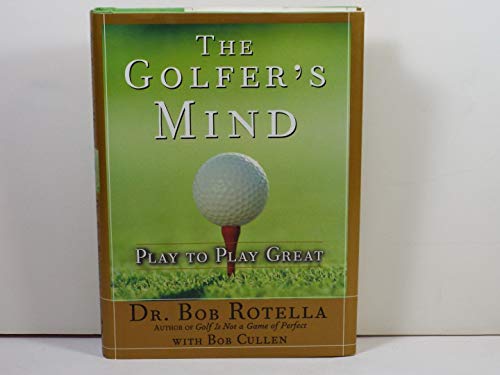
With his signature “phenomenal” (The New York Times), golf expert and New York Times bestselling author Dr. Bob Rotella offers an eye-opening guide to overcoming the mental challenges of golf.
The Golfer’s Mind was actually first suggested by Davis Love, Jr.—Davis Love III’s dad—who encouraged Dr. Bob Rotella to write an instruction book on golf’s mental challenges, organized by topic. Love thought that golfers could keep the book with them, or at least nearby, at all times. When they needed a refresher on a certain issue, they could consult the book, read for a few minutes, and take away solid guidance regarding their difficulties. Rotella heard what Love said, and twenty years later, The Golfer’s Mind is that book. From his Ten Commandments (Commandment I. Play to play great. Don’t play not to play poorly) to just about any topic a golfer might imagine, this is the ideal way for players to get all of Rotella's teachings. He covers topics including:
-Butterflies
-Practicing to Play Great
-The Rhythm of the Game
-Routine
-Setbacks
-How Winning Happens
In the perfect format for the busy golfer, The Golfer’s Mind is the concise and convenient quick-reference tool to appeal to Rotella’s millions of followers and is sure to become a golf classic.
Die Inhaltsangabe kann sich auf eine andere Ausgabe dieses Titels beziehen.
Über die Autorin bzw. den Autor
Dr. Bob Rotella is the bestselling author of a dozen books, including Golf Is Not a Game of Perfect, The Unstoppable Golfer, and How Champions Think. He was the director of sport psychology for twenty years at the University of Virginia, where his reputation grew as the expert champions talked to him about the mental aspects of their game. Rotella was a consultant multiple times to the United States Ryder Cup Team. His golf client list includes Hall of Famers Pat Bradley, Tom Kite, Davis Love III, and Nick Price, as well as many of today’s stars, such as Justin Thomas, Darren Clarke, Jim Furyk, Padraig Harrington, Brad Faxon, and Rory McIlroy. A long-time consultant to Golf Digest, he lives in Virginia with his wife, Darlene.
Auszug. © Genehmigter Nachdruck. Alle Rechte vorbehalten.
One: A Golfing Philosophy
The greatest pleasure is obtained by improving.
-- Ben Hogan
Why does my first session with a player usually last two days? I take this much time in part because I prefer not to jump right into a discussion of the particular problem that brought the player to me. I like to have a general discussion of the client's and my own basic ideas about the game of golf. In my less modest moments, I think of these ideas as a philosophy of the game.
I don't care if my client thinks of them as a philosophy or merely as a set of ideas. I do care whether he or she subscribes to them. If we can't come to agreement on these fundamental principles, it's much less likely that I can help the client. If we do see the game in roughly the same way, it becomes much easier to solve the specific issue that's troubling the player.
To begin with, I believe golf is a game of both confidence and competence. I am not about to tell anyone that a player who lacks physical skills can transform himself overnight into a winner by changing his thinking. If you trust a bad swing, it's still going to produce bad shots. (Though it will produce fewer of them than it will if you don't trust it.) You have to attain a level of physical competence to play well.
Having said that, though, I believe it's impossible to overestimate the importance of the mind in golf. There is no such thing as "muscle memory." Your muscles have no capacity to remember anything. Memory resides in your head. Therefore, no matter how long you practice a golf swing, no matter how skilled you become at it, your muscles alone can't remember it and execute it when the need arises on the golf course. Your muscles and the rest of your body are controlled by your mind. Unless your mind is functioning well when you play golf, your muscles are going to flounder. If your head is filled with bad thoughts, your scorecard is going to be full of bad strokes.
I'm not sure, actually, where the body ends and the mind begins, and I don't believe anyone is. I don't know where the soul and the spirit are located in a human being, but I know they exist. I think it's more useful to consider a human being, and a golfer, as a seamless organism. Your golf swing will not work well if it employs only the torso and not the legs. The torso and the legs are part of an integrated system, and all the parts of that system have to function in order to hit a golf ball. In the same way, what we refer to for the sake of convenience as your body and your mind are in reality parts of an integrated system. All the parts of that system must function properly in order to play golf well.
Golf is a game. It's not a science experiment that can be completed in accordance with immutable physical laws. It's not a jigsaw puzzle where the pieces are designed to fit together and yield a perfect picture. It's a game, and it must be played.
Because it's a game played by human beings on God's green earth, golf is a game of mistakes and unpredictable fortune. If it were not, no one would ever miss a fairway, a green, or a putt. On top of that, there would be no sudden gusts of wind, no unfortunate bounces, no imperfections in the turf. Every ball would go exactly where you wanted it to go, and the winning score in a golf tournament would be something like 50 strokes per round.
If you truly love golf, you must love the fact that no one shoots 50, that golf is an inherently imperfect game. If you spend your time fighting the fact that golf is a game of mistakes and trying to make it a game of perfect shots, you're really saying that you don't like golf. You want it to be some other game -- billiards, maybe. No one has ever perfected golf -- not Ben Hogan, not Jack Nicklaus, not Annika Sorenstam. I don't believe anyone ever will.
The players I see trying to force perfection into golf don't look to me as if they're having a very good time. They think that when they finally get the game down perfectly, they'll be recognized and adored for it. I envision them as 90-year-olds, still wondering when the game will come together perfectly. In the meantime, they've played countless rounds with scowls on their faces. They walk off the course looking frightened, unhappy, frustrated -- looking like anything but an individual who's just spent four or five hours playing a beloved game. They look like they've just stepped out of a Siberian prison camp instead of a golf course.
These might be people who will spend hours talking about how much they love the game. But when they get honest about their feelings, they'll admit that while they might love reading about golf, swapping stories about golf, even practicing golf, they don't actually love playing golf, at least not while they're doing it. After a round, they're still consumed by tension and anxiety. They're unpleasant to be with.
If this is your attitude toward golf, why would you make it your hobby? Still more, why would you make it your profession?
Golfers who truly understand and love the game accept it, rather than fight it. They realize that the essence of golf is reacting well to its inevitable mistakes and misfortunes. They know that they can separate themselves from their competition, not by perfecting their games, but by constantly striving to improve and reacting well to mistakes. I remind players that if there's one thing they should always be proud of in their golf games, it's how well they react to mistakes. I tell them that they will never have complete control of the golf ball. But they can control their attitudes.
The biggest mistake most people make is to respond passively to what happens on the golf course. They let how they play dictate their attitude. If the ball is going where they want it to go, they have a good attitude. If it isn't, their attitude is bad. They start thinking badly. When you're playing well, it's fine to go with the flow. But when you're playing badly, you need the discipline to control your thoughts and think only about the way you want to play.
Mastering this concept goes a long way in determining two critical outcomes. One is how good a player is going to get at golf. The second is how much fun he'll have along the way.
Golfers who have fun along the way understand that golf is first a game you play within yourself. You win that game by resisting all the mental temptations and pitfalls I'll be discussing in more detail later in this book. You win it by bringing both your mind and your body to bear on the test of golf as well as you possibly can.
Golf is the most honest of games in that you can't lie to yourself about how well you're doing in that personal game. The great players I work with are usually brutally honest about what went on in their minds during a round. I sometimes have happy professional clients talk to me after they've shot 75. Of course, they understand that 75 isn't a good score for a professional golfer. But they're happy with the way they played. By "the way they played," I don't mean how many strokes they took. I mean that they're happy with the attitude they maintained during the round, with their concentration, their focus, their thoughts. A player can control those things. He can't control his score.
Conversely, I've had clients shoot 65 and tell me very candidly that they were exceedingly lucky to do so. It can happen for a round or two. Maybe a player gets good bounces. Maybe he sinks some putts with less-than-trusting strokes because he misread the green. For a round or two, a player might get away with thinking poorly, but he knows that it will catch up with him. So it's quite possible that a player who shot 75 will be cheerfully optimistic about his game, and a player who shot 65 might be concerned.
I'm particularly impressed when this happens because another part of my philosophy is...
„Über diesen Titel“ kann sich auf eine andere Ausgabe dieses Titels beziehen.
Suchergebnisse für Golfer's Mind: Golfer's Mind (A Guide for Golfers)

Foto des Verkäufers
Golfer's Mind: Golfer's Mind (A Guide for Golfers)
Anbieter: Dream Books Co., Denver, CO, USA
Verkäuferbewertung 5 von 5 Sternen

Zustand: very_good. Pages are clean with no markings. May show minor signs of wear or cosmetic defects marks, cuts, bends, or scuffs on the cover, spine, pages, or dust jacket. May have remainder marks on edges. Artikel-Nr. DBV.0743269756.VG
Gebraucht kaufen
EUR 5,37
Versand gratis
Versand innerhalb von USA
Versand innerhalb von USA
Anzahl: 1 verfügbar
Beispielbild für diese ISBN
The Golfer's Mind: Play to Play Great
Anbieter: World of Books (was SecondSale), Montgomery, IL, USA
Verkäuferbewertung 5 von 5 Sternen
Hardback. Zustand: Good. The best-selling author of Golf Is Not a Game of Perfect returns with a quick reference guide to the essential elements of golf, drawing on his guiding principles and teaching techniques to help readers enhance their discipline of the mental game. 75,000 first printing. Artikel-Nr. 00103844143
Gebraucht kaufen
EUR 5,58
Versand gratis
Versand innerhalb von USA
Versand innerhalb von USA
Anzahl: 11 verfügbar
Beispielbild für diese ISBN
The Golfer's Mind: Play to Pla
Anbieter: World of Books (was SecondSale), Montgomery, IL, USA
Verkäuferbewertung 5 von 5 Sternen
Zustand: Acceptable. Item in acceptable condition! Textbooks may not include supplemental items i.e. CDs, access codes etc. Artikel-Nr. 00097190464
Gebraucht kaufen
EUR 5,58
Versand gratis
Versand innerhalb von USA
Versand innerhalb von USA
Anzahl: 2 verfügbar
Foto des Verkäufers
Golfer's Mind: Golfer's Mind (A Guide for Golfers)
Anbieter: Dream Books Co., Denver, CO, USA
Verkäuferbewertung 5 von 5 Sternen
Zustand: good. Gently used with minimal wear on the corners and cover. A few pages may contain light highlighting or writing, but the text remains fully legible. Dust jacket may be missing, and supplemental materials like CDs or codes may not be included. May be ex-library with library markings. Ships promptly! Artikel-Nr. DBV.0743269756.G
Gebraucht kaufen
EUR 6,20
Versand gratis
Versand innerhalb von USA
Versand innerhalb von USA
Anzahl: 1 verfügbar
Beispielbild für diese ISBN
Golfer's Mind: Golfer's Mind
Anbieter: ThriftBooks-Atlanta, AUSTELL, GA, USA
Verkäuferbewertung 5 von 5 Sternen
Hardcover. Zustand: Very Good. No Jacket. Former library book; May have limited writing in cover pages. Pages are unmarked. ~ ThriftBooks: Read More, Spend Less. Artikel-Nr. G0743269756I4N10
Gebraucht kaufen
EUR 6,70
Versand gratis
Versand innerhalb von USA
Versand innerhalb von USA
Anzahl: 1 verfügbar
Beispielbild für diese ISBN
Golfer's Mind: Golfer's Mind
Anbieter: ThriftBooks-Phoenix, Phoenix, AZ, USA
Verkäuferbewertung 5 von 5 Sternen
Hardcover. Zustand: Very Good. No Jacket. May have limited writing in cover pages. Pages are unmarked. ~ ThriftBooks: Read More, Spend Less. Artikel-Nr. G0743269756I4N00
Gebraucht kaufen
EUR 6,70
Versand gratis
Versand innerhalb von USA
Versand innerhalb von USA
Anzahl: 3 verfügbar
Beispielbild für diese ISBN
Golfer's Mind: Golfer's Mind
Anbieter: ThriftBooks-Atlanta, AUSTELL, GA, USA
Verkäuferbewertung 5 von 5 Sternen
Hardcover. Zustand: Very Good. No Jacket. May have limited writing in cover pages. Pages are unmarked. ~ ThriftBooks: Read More, Spend Less. Artikel-Nr. G0743269756I4N00
Gebraucht kaufen
EUR 6,70
Versand gratis
Versand innerhalb von USA
Versand innerhalb von USA
Anzahl: 3 verfügbar
Beispielbild für diese ISBN
Golfer's Mind: Golfer's Mind
Anbieter: ThriftBooks-Atlanta, AUSTELL, GA, USA
Verkäuferbewertung 5 von 5 Sternen
Hardcover. Zustand: Good. No Jacket. Pages can have notes/highlighting. Spine may show signs of wear. ~ ThriftBooks: Read More, Spend Less. Artikel-Nr. G0743269756I3N00
Gebraucht kaufen
EUR 6,70
Versand gratis
Versand innerhalb von USA
Versand innerhalb von USA
Anzahl: 4 verfügbar
Beispielbild für diese ISBN
Golfer's Mind: Golfer's Mind
Anbieter: ThriftBooks-Dallas, Dallas, TX, USA
Verkäuferbewertung 5 von 5 Sternen
Hardcover. Zustand: Good. No Jacket. Former library book; Pages can have notes/highlighting. Spine may show signs of wear. ~ ThriftBooks: Read More, Spend Less. Artikel-Nr. G0743269756I3N10
Gebraucht kaufen
EUR 6,70
Versand gratis
Versand innerhalb von USA
Versand innerhalb von USA
Anzahl: 1 verfügbar
Beispielbild für diese ISBN
Golfer's Mind: Golfer's Mind
Anbieter: ThriftBooks-Phoenix, Phoenix, AZ, USA
Verkäuferbewertung 5 von 5 Sternen
Hardcover. Zustand: Good. No Jacket. Missing dust jacket; Pages can have notes/highlighting. Spine may show signs of wear. ~ ThriftBooks: Read More, Spend Less. Artikel-Nr. G0743269756I3N01
Gebraucht kaufen
EUR 6,70
Versand gratis
Versand innerhalb von USA
Versand innerhalb von USA
Anzahl: 1 verfügbar