
Verwandte Artikel zu First Among Equals: How to Manage a Group of Professionals
Inhaltsangabe
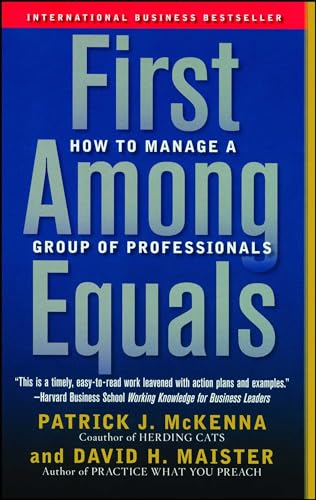
Professional service gurus David Maister and Patrick McKenna have created a practical handbook on how to lead professional colleagues or peers when you lack formal authority. Harvard Business School’s Working Knowledge calls it “a timely, easy to read work leavened with action plans and examples.”
Whether you have recently been appointed as a group leader or are a battle-scarred veteran, you know that managing professional people is difficult! In this unique handbook, Patrick J. McKenna and David H. Maister argue that leaders will best enable their people to achieve peak performance not by managing them, not by leading them, but by inspiring them.
The authors show you how to actually add value as a group leader or induce people to accept your guidance, even with intelligent professionals who are often free-agents accustomed to having automony to work on grueling assignments with little supervision. They also give advice on how to handle those oh-so-talented but oh-so-annoying professionals who exhibit attitude problems or are just exceedingly difficult to work with, when you need them but they tend to needle you.
The lessons and learning presented here will give you insights and action tips to help you provoke and inspire your people to their full potential.
Die Inhaltsangabe kann sich auf eine andere Ausgabe dieses Titels beziehen.
Über die Autorinnen und Autoren
Patrick J. McKenna is a widely recognized expert on managing professional service firms and a partner in Edge International in Edmonton, Canada, a consulting firm serving professional service firms throughout the world. Mr. McKenna is the coauthor of two Canadian Top 10 management bestsellers, Beyond Knowing and Herding Cats.
David H. Maister, one of the world's leading authorities on the management of professional service firms, is the author of several successful books, including Managing the Professional Service Firm, True Professionalism, and Practice What You Preach, and coauthor of The Trusted Advisor.
Auszug. © Genehmigter Nachdruck. Alle Rechte vorbehalten.
Chapter One: Clarify Your Role
How, exactly, do you add value as a group leader?
Benjamin Haas is the managing partner in the Chicago office of the human resource consulting firm Towers Perrin, which has about 8,500 employees in seventy offices worldwide. He articulated the core truth about being a group leader:
The reality is that a leadership role is fundamentally different from the individual contributor role. A leader has fundamentally got to be somebody who is effective at making things happen for other people.
It's a real different mind-set in terms of what you do and how you impact the business. A leader has to bring a certain energy and optimism to the business. Part of our job is to build energy and enthusiasm. A leader must create a sense of shared ownership. The kinds of people we're managing want to feel like they are owners and not employees.
Another key ability is to assess people and determine what's going to be the right role for each individual that meets their needs and also allows them to contribute effectively to the organization.
We could not agree more with these comments. Your job as a group leader is to help your people, and your team, win.
Prior to becoming a group head, many people will have been asked to spend their whole working lives focusing on their own individual performance. The transition to being responsible for the performance of others is a difficult one for many to make, particularly since, in all likelihood, they still carry some client-service or production responsibilities. There is an issue here both of attitude (willingness to focus on other people and their success) and of skill (the ability to win influence over other people without being domineering). Skills can be taught; attitudes are harder to change.
John Schoenewald, CEO of AFSM International, noted:
To be effective, a leader must show he truly cares about others -- not only caring what the employee does but, as important, how he does it. I have seen leaders who are consumed with themselves and their personal goals. This is especially common in high-tech services. They don't have time nor do they take the time for coaching, as they are goal-oriented and desire results through technical solutions. In the high-tech services industry, technicians as well as managers, for the most part, fall into the category of loners. They are individuals who would rather work independently. That's why they choose a technical field and not the sales profession. This situation creates a challenge for effective teaming. Most technical teams I've managed have all the correct ingredients for success, but they try to achieve team results through individual efforts.
The best group leaders see themselves as catalysts. They expect to achieve a great deal, but know that they can do little without the efforts of others. It is challenging to manage a group of people with different skills, diverse experiences, a variety of work styles, and sometimes, conflicting priorities. Casey Stengel, the renowned former manager of the New York Yankees, once said, "Getting good players is one thing. The harder part is getting them to play together." As we shall see, it requires commitment, curiosity, and courage.
In order to help other people succeed, you will need a willingness to get most of your fulfillment from the success of others and a special set of skills: the ability to influence other people's emotions, feelings, attitudes, and their determination.
Jack Newman, now retired from managing a substantial and well-integrated group at global law megafirm, Morgan, Lewis & Bockius, clearly understood his role:
It's significant that I have two business cards. One is mine. The other is the group's. There are twenty lawyers on that group card, and it fits into the client's pocket just as easily as mine does. On that card, the client can find the right lawyer for the right question. Subliminally, the very existence of the card sends a message about the importance of the group as a group.
So, how do you help other people succeed (and play as a team)? Part of the answer may be about substance or content (they don't know what to do or how to do it), but this is rarely the biggest issue. Most often, you will be working with highly talented people who do know what to do and how to do it, but just aren't doing it. The causes may be numerous (fear, suspicion, lack of drive, attitudes, problems at home, or structural firm impediments) and you will find that most of the barriers have to do with feelings, attitudes, and emotions.
Your role, therefore, and your essential skill, will be to help people fulfill their potential by influencing these feelings, attitudes, and emotions. If you accomplish this, the raised performance level will result (among other things) in greater financial success for your people, you and your firm.
Note, however, that while money (or profitability) may be your goal, it is not what you must manage. What you must manage in order to get money is the energy, drive, enthusiasm, excitement, passion, and ambition of your people. Your primary skill (and the test of all your activities) must be whether or not you are able to raise the level of commitment and drive of those you influence.
Among the contributions you can make are the following:
a. Create energy and excitement
b. Be a source of creative ideas, and stimulate creativity in others
c. Forge teamwork
d. Help develop a common purpose that everyone can buy into
e. Help to solve problems and break down barriers for team members -- make it easier for them to succeed
f. Act as a sounding board -- help people think through their issues
g. Enforce standards (deal gently, promptly, but firmly with noncompliance)
h. Be a conscience ("gentle pressure") when self-discipline fails
i. Be a constant source of encouragement to improve effectiveness, quality, and efficiency
How would you rate yourself at each of these? How would those you lead rate you?
What a Leader Spends Time On
So, you are the leader of your group! Your goal is to help, but what do you actually do to accomplish this? Which of the following possible activities are you expected to do? Do your team members expect you to do these things? Do those you report to agree that you should be doing them?
1. Spend unscheduled, informal time with individual people (senior and/ or junior), serving as coach, to help them develop themselves and their practice.
2. Be knowledgeable about the development of junior people and be ready to suggest reassignments between projects in order to build skills and advance their careers.
3. Be in touch with other group members' clients to help them grow relationships, and to monitor client satisfaction and act as a conscience for everyone to excel at client satisfaction.
4. Help members of the team differentiate themselves from other competitors in a meaningful way that clients recognize and value.
5. Help people to stay current with the trends affecting the client industries they serve, the changes that will affect these clients, and their demand for the group's services.
6. Monitor the profitability of assignments conducted by group members and discuss results with them.
7. Devise methodologies to capture and share knowledge acquired while serving clients both within the group and across the firm.
8. Help the group explore new and innovative ways of using technology to better deliver services and reduce costs to clients.
9. Spend time recruiting, interviewing, and attracting potential recruits (junior and senior).
10. Spend time following up and actively helping members of the group execute their planned activities.
11. Initiate and...
„Über diesen Titel“ kann sich auf eine andere Ausgabe dieses Titels beziehen.
Suchergebnisse für First Among Equals: How to Manage a Group of Professionals

Beispielbild für diese ISBN
First Among Equals: How to Manage a Group of Professionals
Anbieter: World of Books (was SecondSale), Montgomery, IL, USA
Verkäuferbewertung 5 von 5 Sternen

Paperback. Zustand: Good. Professional service gurus David Maister and Patrick McKenna have created a practical handbook on how to lead professional colleagues or peers when you lack formal authority. Harvard Business School's Working Knowledge calls it "a timely, easy to read work leavened with action plans and examples." Whether you have recently been appointed as a group leader or are a battle-scarred veteran, you know that managing professional people is difficult! In this unique handbook, Patrick J. McKenna and David H. Maister argue that leaders will best enable their people to achieve peak performance not by managing them, not by leading them, but by inspiring them. The authors show you how to actually add value as a group leader or induce people to accept your guidance, even with intelligent professionals who are often free-agents accustomed to having automony to work on grueling assignments with little supervision. They also give advice on how to handle those oh-so-talented but oh-so-annoying professionals who exhibit attitude problems or are just exceedingly difficult to work with, when you need them but they tend to needle you. The lessons and learning presented here will give you insights and action tips to help you provoke and inspire your people to their full potential. Artikel-Nr. 00102102629
Gebraucht kaufen
EUR 3,78
Versand gratis
Versand innerhalb von USA
Versand innerhalb von USA
Anzahl: 4 verfügbar
Beispielbild für diese ISBN
First Among Equals: How to Manage a Group of Professionals
Anbieter: World of Books (was SecondSale), Montgomery, IL, USA
Verkäuferbewertung 5 von 5 Sternen
Paperback. Zustand: Very Good. Professional service gurus David Maister and Patrick McKenna have created a practical handbook on how to lead professional colleagues or peers when you lack formal authority. Harvard Business School's Working Knowledge calls it "a timely, easy to read work leavened with action plans and examples." Whether you have recently been appointed as a group leader or are a battle-scarred veteran, you know that managing professional people is difficult! In this unique handbook, Patrick J. McKenna and David H. Maister argue that leaders will best enable their people to achieve peak performance not by managing them, not by leading them, but by inspiring them. The authors show you how to actually add value as a group leader or induce people to accept your guidance, even with intelligent professionals who are often free-agents accustomed to having automony to work on grueling assignments with little supervision. They also give advice on how to handle those oh-so-talented but oh-so-annoying professionals who exhibit attitude problems or are just exceedingly difficult to work with, when you need them but they tend to needle you. The lessons and learning presented here will give you insights and action tips to help you provoke and inspire your people to their full potential. Artikel-Nr. 00084721264
Gebraucht kaufen
EUR 3,78
Versand gratis
Versand innerhalb von USA
Versand innerhalb von USA
Anzahl: 5 verfügbar
Beispielbild für diese ISBN
First Among Equals: How to Manage a Group of Professionals
Anbieter: World of Books (was SecondSale), Montgomery, IL, USA
Verkäuferbewertung 5 von 5 Sternen
Paperback. Zustand: Fair. Professional service gurus David Maister and Patrick McKenna have created a practical handbook on how to lead professional colleagues or peers when you lack formal authority. Harvard Business School's Working Knowledge calls it "a timely, easy to read work leavened with action plans and examples." Whether you have recently been appointed as a group leader or are a battle-scarred veteran, you know that managing professional people is difficult! In this unique handbook, Patrick J. McKenna and David H. Maister argue that leaders will best enable their people to achieve peak performance not by managing them, not by leading them, but by inspiring them. The authors show you how to actually add value as a group leader or induce people to accept your guidance, even with intelligent professionals who are often free-agents accustomed to having automony to work on grueling assignments with little supervision. They also give advice on how to handle those oh-so-talented but oh-so-annoying professionals who exhibit attitude problems or are just exceedingly difficult to work with, when you need them but they tend to needle you. The lessons and learning presented here will give you insights and action tips to help you provoke and inspire your people to their full potential. Artikel-Nr. 00099402215
Gebraucht kaufen
EUR 3,78
Versand gratis
Versand innerhalb von USA
Versand innerhalb von USA
Anzahl: 1 verfügbar
Beispielbild für diese ISBN
First Among Equals: How to Manage a Group of Professionals
Anbieter: ThriftBooks-Atlanta, AUSTELL, GA, USA
Verkäuferbewertung 5 von 5 Sternen
Paperback. Zustand: Good. No Jacket. Pages can have notes/highlighting. Spine may show signs of wear. ~ ThriftBooks: Read More, Spend Less. Artikel-Nr. G0743267583I3N00
Gebraucht kaufen
EUR 6,07
Versand gratis
Versand innerhalb von USA
Versand innerhalb von USA
Anzahl: 1 verfügbar
Beispielbild für diese ISBN
First among Equals : How to Manage a Group of Professionals
Anbieter: Better World Books, Mishawaka, IN, USA
Verkäuferbewertung 5 von 5 Sternen
Zustand: Very Good. Reprint. Pages intact with possible writing/highlighting. Binding strong with minor wear. Dust jackets/supplements may not be included. Stock photo provided. Product includes identifying sticker. Better World Books: Buy Books. Do Good. Artikel-Nr. 9128499-75
Gebraucht kaufen
EUR 6,19
Versand gratis
Versand innerhalb von USA
Versand innerhalb von USA
Anzahl: 2 verfügbar
Beispielbild für diese ISBN
First Among Equals: How to Manage a Group of Professionals
Anbieter: Wonder Book, Frederick, MD, USA
Verkäuferbewertung 5 von 5 Sternen
Zustand: Good. Good condition. A copy that has been read but remains intact. May contain markings such as bookplates, stamps, limited notes and highlighting, or a few light stains. Artikel-Nr. X11F-01702
Gebraucht kaufen
EUR 6,43
Versand gratis
Versand innerhalb von USA
Versand innerhalb von USA
Anzahl: 1 verfügbar
Beispielbild für diese ISBN
First Among Equals: How to Manage a Group of Professionals
Anbieter: WorldofBooks, Goring-By-Sea, WS, Vereinigtes Königreich
Verkäuferbewertung 5 von 5 Sternen
Paperback. Zustand: Good. The book has been read but remains in clean condition. All pages are intact and the cover is intact. Some minor wear to the spine. Artikel-Nr. GOR007727522
Gebraucht kaufen
EUR 13,43
EUR 6,69 Versand
Versand von Vereinigtes Königreich nach USA
Versand von Vereinigtes Königreich nach USA
Anzahl: 1 verfügbar
Beispielbild für diese ISBN
First Among Equals: How to Manage a Group of Professionals
Anbieter: WorldofBooks, Goring-By-Sea, WS, Vereinigtes Königreich
Verkäuferbewertung 5 von 5 Sternen
Paperback. Zustand: Very Good. The book has been read, but is in excellent condition. Pages are intact and not marred by notes or highlighting. The spine remains undamaged. Artikel-Nr. GOR006704120
Gebraucht kaufen
EUR 13,43
EUR 6,69 Versand
Versand von Vereinigtes Königreich nach USA
Versand von Vereinigtes Königreich nach USA
Anzahl: 1 verfügbar
Beispielbild für diese ISBN
First Among Equals: How to Manage a Group of Professionals
Anbieter: AwesomeBooks, Wallingford, Vereinigtes Königreich
Verkäuferbewertung 5 von 5 Sternen
Paperback. Zustand: Very Good. First Among Equals: How to Manage a Group of Professionals This book is in very good condition and will be shipped within 24 hours of ordering. The cover may have some limited signs of wear but the pages are clean, intact and the spine remains undamaged. This book has clearly been well maintained and looked after thus far. Money back guarantee if you are not satisfied. See all our books here, order more than 1 book and get discounted shipping. Artikel-Nr. 7719-9780743267588
Gebraucht kaufen
EUR 15,39
EUR 4,92 Versand
Versand von Vereinigtes Königreich nach USA
Versand von Vereinigtes Königreich nach USA
Anzahl: 2 verfügbar
Beispielbild für diese ISBN
First Among Equals: How to Manage a Group of Professionals
Anbieter: Bahamut Media, Reading, Vereinigtes Königreich
Verkäuferbewertung 4 von 5 Sternen

Paperback. Zustand: Very Good. This book is in very good condition and will be shipped within 24 hours of ordering. The cover may have some limited signs of wear but the pages are clean, intact and the spine remains undamaged. This book has clearly been well maintained and looked after thus far. Money back guarantee if you are not satisfied. See all our books here, order more than 1 book and get discounted shipping. Artikel-Nr. 6545-9780743267588
Gebraucht kaufen
EUR 15,12
EUR 8,33 Versand
Versand von Vereinigtes Königreich nach USA
Versand von Vereinigtes Königreich nach USA
Anzahl: 2 verfügbar