
Verwandte Artikel zu The Grand Idea: George Washington's Potomac and...
Inhaltsangabe
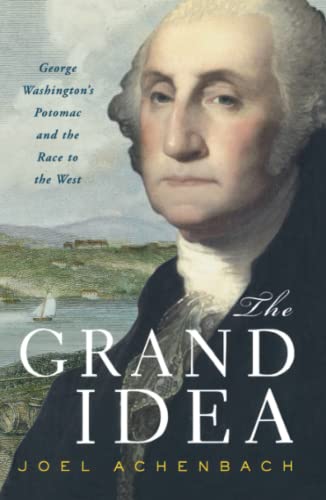
The Grand Idea follows George Washington in the critical period immediately after the War of Independence. The general had great hopes for his young nation, but also grave fears. He worried that the United States was so fragmented politically and culturally that it would fall apart, and that the "West," beyond the Appalachian mountains, would become a breakaway republic. So he came up with an ambitious scheme: He would transform the Potomac River into the nation's premier commercial artery, binding East and West, bolstering domestic trade, and staving off disunion. This was no armchair notion. Washington saddled up and rode west on a 680-mile trek to the raucous frontier of America.
Achenbach captures a Washington rarely seen: rugged frontiersman, real estate speculator, shrewd businessman. Even after his death, Washington's grand ambition inspired heroic engineering feats, including an audacious attempt to build a canal across the mountains to the Ohio River. But the country needed more than commercial arteries to hold together, and in the Civil War, the general's beloved river became a battlefield between North and South.
Like such classics as Undaunted Courage and Founding Brothers, Achenbach's riveting portrait of a great man and his grand plan captures the imagination of the new country, the passions of an ambitious people, and the seemingly endless beauty of the American landscape.
Die Inhaltsangabe kann sich auf eine andere Ausgabe dieses Titels beziehen.
Über die Autorin bzw. den Autor
Joel Achenbach is a reporter for The Washington Post, and the author of seven books, including The Grand Idea, Captured by Aliens, and Why Things Are. A Washington Post staff writer since 1990, Achenbach writes about science and politics. He started the newspaper's first online column, "Rough Draft", and started the Washington Post's first blog, Achenblog. He regularly contributes science articles to National Geographic. A native of Gainesville, Florida and a graduate of Princeton University, he lives in Washington, DC with his wife and three children.
Auszug. © Genehmigter Nachdruck. Alle Rechte vorbehalten.
Chapter 2: The Race to the West
When Washington looked at a map, he saw that the major rivers between Virginia and New England were like the splayed fingers of his right hand, turned palm-down. The Connecticut and the Hudson and the Delaware and the Susquehanna ran generally north-south, in parallel -- but the Potomac was down here, on the left, low on his hand, a curved thumb jutting toward the western frontier. He couldn't miss the obvious message: The Potomac wasn't just a southern river, it was a western river.
The seaboard of the mid-Atlantic states didn't run north-south, after all, but rather from northeast to southwest. Georgetown, at the fall line of the Potomac, could claim to be the westernmost port on any of these rivers. Washington had spent his life taking the measure of things, and he could easily see that the village of Pittsburgh, at the Forks of the Ohio -- the Gateway to the West -- was closer to Georgetown on the Potomac than it was to Philadelphia. In a logical and orderly world, the Potomac would unquestionably become the highway between the Atlantic and the Ohio River watershed.
For Washington and many others of his generation, geography was destiny. To know the future you had to study maps. You had to look at the land, follow the rivers in their courses, gauge the difficulty of the mountains and the possibilities of portage. You had to know not only distances and elevations, but also the soils, the annual rainfall, the drainage, the predominant trees, the availability of forage and game, the presence of minerals, the proximity of salt, the date when a river would close with ice and when it would open in the spring -- all the practical data embedded in the environment. The enterprising American had to abide faithfully by the commandment of John Adams: "Really there ought not to be a state, a city, a promontory, a river, a harbor, an inlet or a mountain in all America, but what should be intimately known to every youth who has any pretensions to liberal education."
The Potomac's rivals among American rivers had some geographical virtues of their own. The Susquehanna, marred by falls and rapids near its mouth, was nonetheless the largest river system along the seaboard, with a watershed extending from upstate New York to the Chesapeake. The hazardous lower reaches could be circumvented by roads, in theory. The western branch of the Susquehanna, like the Potomac, emerged from deep within the Alleghenies.
The Hudson loomed as an even more formidable competitor. The Hudson is a fjord, splitting the mountains, and carrying the pulse of tide all the way to Albany, 150 miles from New York Harbor. From the west the Hudson is joined by the Mohawk. A traveler moving up the Mohawk would discover some falls and rapids and difficult portages, but no mountains, for the Alleghenies were off to the south and the Adirondacks off to the north. There was a broad gap in the Appalachians, screaming for a commercial artery to the west.
The St. Lawrence River, far to the north, provided another western passage, for it flowed from the Great Lakes to the Atlantic behind the Appalachian chain. It gave the French the perfect entry to the fur-rich continental interior in the early seventeenth century. The glaciers that gouged the Great Lakes left only a modest berm along the southern shore of the lakes, and the Indians taught the French how easily they could portage to the rivers flowing into the Ohio and Mississippi.
The Potomac had another competitor on its southern flank, the James, running east-west through central Virginia. Some Virginians had envisioned a link between the James and the New, the river known downstream as the Great Kanawha. The New flows across the mountains in the opposite direction from the other transappalachian rivers, almost as if providing a Newtonian counter-reaction to the flow of the Potomac. But the New is an ornery, vicious mountain river that runs through impassable gorges. Washington gave lip service to the James and the New only to keep his southern Virginia friends happy.
One final river entered the picture, and it was a monster: the Mississippi. Compared with the Mississippi, the Potomac was just a millrace. The Mississippi clearly had the potential to be the major artery of commerce in the West, but for the moment, it wasn't open for business. Spain controlled the Lower Mississippi, including New Orleans, and in 1784 closed the river to American commerce. That move created no distress for Washington, who didn't want Spain to lure the western settlers into its orbit. Keep the Mississippi closed, Washington thought, until we have time to bind the westerners to the East.
And that's where the Potomac came in. It showed a way through the mountains. It blasted through stone. With a little improvement the Potomac would make those westerners forget about the Mississippi and the Hudson and the Susquehanna and every other competing route.
Washington's idea about the natural superiority of the Potomac had grown into something like a faith. He was prepared to gamble a great deal on this river -- his time, his money, his reputation. He had bought large tracts of land along the Potomac and Ohio river corridors, and that itself was a gamble, a wager that this was the right strip of America for a rich man's investment. The Potomac route wasn't an abstract issue for him. He'd bet the farm.
Washington didn't have to rely entirely on his own geographical analysis. He had a crucial ally, a fellow Revolutionary, geographer, surveyor, Virginia planter, and thinker of big ideas: Thomas Jefferson.
The Potomac brought them together in a way that the Revolution itself (and the War of Independence -- which was not quite the same thing, as Jefferson and John Adams pointed out in their old age) never could. Though Washington and Jefferson could both boast of being Revolutionaries in a formal sense, Jefferson had made his greatest contribution with his pen. He had camped comfortably by the hearth of Monticello while Washington and his men gnashed their teeth at Valley Forge.
Jefferson and Washington began corresponding about the Potomac in the spring of 1784. In their individual ways, both had spent many years thinking about the West, and now their interests converged. The two men had recently spent time together at Annapolis -- Washington's final address to Congress, explaining his decision to retire, may have been partially scripted by the younger Virginian. (When a person needs a speechwriter in a pinch, it's always nice to hear that Thomas Jefferson is in the building.)
They had certain traits in common. Both men knew their dirt. To be a planter in Virginia required an intimate understanding of soil, climate, pests, weeds, and as their land grew barren under the harshness of tobacco cultivation, they kept searching for new ground to cultivate. Jefferson owned 10,000 acres, including a tract at a separate plantation called Poplar Forest, though he was never in the same league as Washington, who by the end of his life would be among the largest landowners in the country. They each had a natural engineering impulse, always thinking of ways to improve their farms and the tools for wringing food from the soil. Washington had his fishing nets, distillery, barns, and fine breed of jackasses; Jefferson invented a new kind of plow.
Jefferson brought to the discussion an Olympian certitude about what was right and wrong in the race to the West. This is the way it must be done, he would say. This is the course that nature dictates. This is what an enlightened and rational person should think.
"[T]he Ohio, and it's branches which head up against the Patowmac," Jefferson wrote fellow Virginian James Madison, another Potomac promoter, "affords the shortest water communication by 500. miles of any which can ever be got between the Western waters...
„Über diesen Titel“ kann sich auf eine andere Ausgabe dieses Titels beziehen.
Suchergebnisse für The Grand Idea: George Washington's Potomac and...

Beispielbild für diese ISBN
The Grand Idea: George Washington's Potomac and the Race to the West
Anbieter: World of Books (was SecondSale), Montgomery, IL, USA
Verkäuferbewertung 5 von 5 Sternen

Paperback. Zustand: Good. The Grand Idea follows George Washington in the critical period immediately after the War of Independence. The general had great hopes for his young nation, but also grave fears. He worried that the United States was so fragmented politically and culturally that it would fall apart, and that the "West," beyond the Appalachian mountains, would become a breakaway republic. So he came up with an ambitious scheme: He would transform the Potomac River into the nation's premier commercial artery, binding East and West, bolstering domestic trade, and staving off disunion. This was no armchair notion. Washington saddled up and rode west on a 680-mile trek to the raucous frontier of America. Achenbach captures a Washington rarely seen: rugged frontiersman, real estate speculator, shrewd businessman. Even after his death, Washington's grand ambition inspired heroic engineering feats, including an audacious attempt to build a canal across the mountains to the Ohio River. But the country needed more than commercial arteries to hold together, and in the Civil War, the general's beloved river became a battlefield between North and South. Like such classics as Undaunted Courage and Founding Brothers, Achenbach's riveting portrait of a great man and his grand plan captures the imagination of the new country, the passions of an ambitious people, and the seemingly endless beauty of the American landscape. Artikel-Nr. 00099619735
Gebraucht kaufen
EUR 4,57
Versand gratis
Versand innerhalb von USA
Versand innerhalb von USA
Anzahl: 2 verfügbar
Beispielbild für diese ISBN
The Grand Idea: George Washington's Potomac and the Race to the West
Anbieter: World of Books (was SecondSale), Montgomery, IL, USA
Verkäuferbewertung 5 von 5 Sternen
Paperback. Zustand: Fair. The Grand Idea follows George Washington in the critical period immediately after the War of Independence. The general had great hopes for his young nation, but also grave fears. He worried that the United States was so fragmented politically and culturally that it would fall apart, and that the "West," beyond the Appalachian mountains, would become a breakaway republic. So he came up with an ambitious scheme: He would transform the Potomac River into the nation's premier commercial artery, binding East and West, bolstering domestic trade, and staving off disunion. This was no armchair notion. Washington saddled up and rode west on a 680-mile trek to the raucous frontier of America. Achenbach captures a Washington rarely seen: rugged frontiersman, real estate speculator, shrewd businessman. Even after his death, Washington's grand ambition inspired heroic engineering feats, including an audacious attempt to build a canal across the mountains to the Ohio River. But the country needed more than commercial arteries to hold together, and in the Civil War, the general's beloved river became a battlefield between North and South. Like such classics as Undaunted Courage and Founding Brothers, Achenbach's riveting portrait of a great man and his grand plan captures the imagination of the new country, the passions of an ambitious people, and the seemingly endless beauty of the American landscape. Artikel-Nr. 00105874980
Gebraucht kaufen
EUR 4,57
Versand gratis
Versand innerhalb von USA
Versand innerhalb von USA
Anzahl: 2 verfügbar
Beispielbild für diese ISBN
The Grand Idea: George Washington's Potomac and the Race to the West
Verlag:
Simon & Schuster (edition First Edition), 2005
ISBN 10: 0743263006
ISBN 13: 9780743263009
Gebraucht
Paperback
Erstausgabe
Anbieter: BooksRun, Philadelphia, PA, USA
Verkäuferbewertung 5 von 5 Sternen
Paperback. Zustand: Very Good. First Edition. It's a well-cared-for item that has seen limited use. The item may show minor signs of wear. All the text is legible, with all pages included. It may have slight markings and/or highlighting. Artikel-Nr. 0743263006-11-1
Gebraucht kaufen
EUR 5,39
Versand gratis
Versand innerhalb von USA
Versand innerhalb von USA
Anzahl: 1 verfügbar
Beispielbild für diese ISBN
The Grand Idea: George Washington's Potomac and the Race to the West
Anbieter: ThriftBooks-Dallas, Dallas, TX, USA
Verkäuferbewertung 5 von 5 Sternen
Paperback. Zustand: Very Good. No Jacket. May have limited writing in cover pages. Pages are unmarked. ~ ThriftBooks: Read More, Spend Less. Artikel-Nr. G0743263006I4N00
Gebraucht kaufen
EUR 6,28
Versand gratis
Versand innerhalb von USA
Versand innerhalb von USA
Anzahl: 1 verfügbar
Beispielbild für diese ISBN
The Grand Idea: George Washington's Potomac and the Race to the West
Anbieter: ThriftBooks-Atlanta, AUSTELL, GA, USA
Verkäuferbewertung 5 von 5 Sternen
Paperback. Zustand: As New. No Jacket. Pages are clean and are not marred by notes or folds of any kind. ~ ThriftBooks: Read More, Spend Less. Artikel-Nr. G0743263006I2N00
Gebraucht kaufen
EUR 6,28
Versand gratis
Versand innerhalb von USA
Versand innerhalb von USA
Anzahl: 1 verfügbar
Beispielbild für diese ISBN
The Grand Idea : George Washington's Potomac and the Race to the West
Anbieter: Better World Books, Mishawaka, IN, USA
Verkäuferbewertung 5 von 5 Sternen
Zustand: Good. Pages intact with minimal writing/highlighting. The binding may be loose and creased. Dust jackets/supplements are not included. Stock photo provided. Product includes identifying sticker. Better World Books: Buy Books. Do Good. Artikel-Nr. 3432260-6
Gebraucht kaufen
EUR 6,33
Versand gratis
Versand innerhalb von USA
Versand innerhalb von USA
Anzahl: 1 verfügbar
Beispielbild für diese ISBN
The Grand Idea : George Washington's Potomac and the Race to the West
Anbieter: Better World Books, Mishawaka, IN, USA
Verkäuferbewertung 5 von 5 Sternen
Zustand: Good. Former library copy. Pages intact with minimal writing/highlighting. The binding may be loose and creased. Dust jackets/supplements are not included. Includes library markings. Stock photo provided. Product includes identifying sticker. Better World Books: Buy Books. Do Good. Artikel-Nr. 45880117-6
Gebraucht kaufen
EUR 6,33
Versand gratis
Versand innerhalb von USA
Versand innerhalb von USA
Anzahl: 1 verfügbar
Beispielbild für diese ISBN
The Grand Idea: George Washington's Potomac and the Race to the West
Anbieter: Wonder Book, Frederick, MD, USA
Verkäuferbewertung 5 von 5 Sternen
Zustand: Good. Good condition. A copy that has been read but remains intact. May contain markings such as bookplates, stamps, limited notes and highlighting, or a few light stains. Bundled media such as CDs, DVDs, floppy disks or access codes may not be included. Artikel-Nr. D05L-00548
Gebraucht kaufen
EUR 6,40
Versand gratis
Versand innerhalb von USA
Versand innerhalb von USA
Anzahl: 2 verfügbar
Beispielbild für diese ISBN
The Grand Idea: George Washington's Potomac and the Race to the West
Anbieter: Wonder Book, Frederick, MD, USA
Verkäuferbewertung 5 von 5 Sternen
Zustand: Very Good. Very Good condition. A copy that may have a few cosmetic defects. May also contain light spine creasing or a few markings such as an owner's name, short gifter's inscription or light stamp. Artikel-Nr. J11C-01535
Gebraucht kaufen
EUR 6,40
Versand gratis
Versand innerhalb von USA
Versand innerhalb von USA
Anzahl: 1 verfügbar
Beispielbild für diese ISBN
The Grand Idea: George Washington's Potomac And The Race To The West
Anbieter: Revaluation Books, Exeter, Vereinigtes Königreich
Verkäuferbewertung 5 von 5 Sternen
Paperback. Zustand: Brand New. reprint edition. 367 pages. 8.00x5.25x1.00 inches. In Stock. Artikel-Nr. x-0743263006
Neu kaufen
EUR 30,26
EUR 14,67 Versand
Versand von Vereinigtes Königreich nach USA
Versand von Vereinigtes Königreich nach USA
Anzahl: 2 verfügbar