
Verwandte Artikel zu Sound and Fury: Two Powerful Lives, One Fateful Friendship
Inhaltsangabe
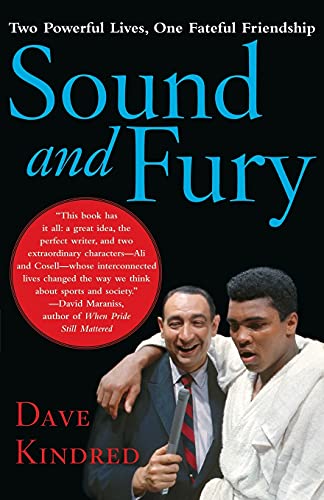
Muhammad Ali and Howard Cosell were must-see TV long before that phrase became ubiquitous. Individually interesting, together they were mesmerizing. They were profoundly different -- young and old, black and white, a Muslim and a Jew, Ali barely literate and Cosell an editor of his university's law review. Yet they had in common forces that made them unforgettable: Both were, above all, performers who covered up their deep personal insecurities by demanding -- loudly and often -- public acclaim. Theirs was an extraordinary alliance that produced drama, comedy, controversy, and a mutual respect that helped shape both men's lives.
Dave Kindred -- uniquely equipped to tell the Ali-Cosell story after a decades-long intimate working relationship with both men -- re-creates their unlikely connection in ways never before attempted. From their first meeting in 1962 through Ali's controversial conversion to Islam and refusal to be inducted into the U.S. Army (the right for him to do both was publicly defended by Cosell), Kindred explores both the heroics that created the men's upward trajectories and the demons that brought them to sadness in their later lives. Kindred draws on his experiences with Ali and Cosell, fresh reporting, and interviews with scores of key personalities -- including the families of both. In the process, Kindred breaks new ground in our understanding of these two unique men. The book presents Ali not as a mythological character but as a man in whole, and it shows Cosell not in caricature but in faithful scale. With vivid scenes, poignant dialogue, and new interpretations of historical events, this is a biography that is novelistically engrossing -- a richly evocative portrait of the friendship that shaped two giants and changed sports and television forever.
Die Inhaltsangabe kann sich auf eine andere Ausgabe dieses Titels beziehen.
Über die Autorin bzw. den Autor
David Kindred has been a newspaper and magazine columnist for thirty-six years and has written seven books, including Around the World in 18 Holes (Doubleday 1994), a chronicle of a 37,000-mile golf trip. For his newspaper work, Kindred received the Associated Press Sports Editors Red Award and is a three-time Pulitzer nominee. The National Sportscasters and Sportswriters Association named him the national sportswriter of the year in 1997 and he is a member of the U.S. Basketball Writers Hall of Fame.
Auszug. © Genehmigter Nachdruck. Alle Rechte vorbehalten.
Prologue: They Charmed and Bedeviled Us
One afternoon in Las Vegas, while in bed with Muhammad Ali, I asked him to name the members of his entourage and list their duties. He took my pencil and held my reporter's spiral notebook inches above his pretty face. In childlike block letters, he printed a dozen names. Alongside the names he wrote dollar figures in estimate of each person's weekly salary. We lay there, shoulder to shoulder, one of us wearing clothes. Here's what I thought: Are we nuts, or what?
Years later I told New York Times columnist Dave Anderson, "I was in bed with Ali."
Anderson said, "We all were."
"No," I said, "I was in bed with Ali."
"Oh," he said.
It happened in a hotel suite three or four days before some fight. The suite was the usual Ali Circus madhouse of perfumed women, pimp-dressed hangers-on, sycophants, con artists, sportswriters, and other reprobates. Through an open door at one side of the suite's central space, I saw Ali in bed with the sheets pulled up to his chin. On eye contact, he shouted, "My man. Louisville, come in here."
I worked for the Courier-Journal, his hometown newspaper, and first spent a day with him in 1966. Already famous and infamous as the heavyweight champion and loud-mouthed draft resister, he had come to Louisville to visit his parents and fight an exhibition bout for charity. I was a young reporter in my first year at the great newspaper and eager to do anything the editors asked. When one said, "Clay's in town, go find him," I did. We drove around the city, stopping now and then to do some business. My son, Jeff, four years old, rode with us, and Ali occasionally put Jeff on his lap as if he were steering the car. I thought: a nice guy.
Now, in his bedroom in 1973, the noise from the central suite was maddening. Ali lifted a corner of the bedsheet and said, "C'mon, get in." Over the years I had talked with him in shower stalls and toilets, in funeral homes, log cabins, mosques, and once in a Cadillac at eighty-five miles per hour on a logging road through a forest. And now -- this was a reporter getting close to his subject -- I took off my shoes and put myself under the sheets with the once and future heavyweight champion of the world. I wore golf slacks and a polo shirt. More than most men, if not more than most narcissists, Ali loved to show off his body. He was beautiful, six foot three and 210 pounds, with proportions so powerful and so perfectly in balance that he might have sprung to life from a Michelangelo sketch. On the off-chance that you didn't notice, he often repeated what a nurse had said on prepping his groin for hernia surgery. "She took one look," Ali said, "and she went, 'You are the greatest!'"
Like schoolboys on a sleepover hiding their mischief, we pulled the sheets over our heads. Ali made a tent by raising his knees. Shadows danced inside our hiding place. The suite's noise seemed distant. On my back I did an interview that ended with Ali saying, "Tell the people in Louisville this will be noooo contest because I am the greatest of alllllll times." Then I asked for my notebook back.
The strangest aspect of the undercover interview was that it wasn't strange. For Ali, it was characteristic. Whatever he wanted to do, he did it as soon as possible. C'mon, get in. Anything could happen around Ali and often did.
I saw him naked. I am not sure I ever saw him clearly.
Howard Cosell was in his underwear.
I sat at a breakfast table in his beach house on Long Island in Westhampton, New York. The sun streamed in over a marshland. I saw in the shadows across the room a ghostly shape that on inspection turned out to be my host shuffling barefoot from his bedroom, skeletal in a white undershirt and white boxer briefs. He was bleary-eyed. He had not yet found his toupee. As Cosell noticed me, he raised his arms and struck a bodybuilder's biceps-flexing pose. Then he spoke, and this is what he said: "A killing machine the likes of which few men have ever seen."
On this morning in September 1989, I had known Cosell for twelve years. Our relationship began the day I wrote a column in the Washington Post praising him as a sports-broadcasting journalist without peer. I wrote that, while his excesses invited criticism, he deserved better than to be the target of mean-spirited punks, among them a Denver bar owner who allowed patrons to throw a brick at a television set carrying Cosell's image. The day the column ran, I answered my office phone.
"David Kindred," the caller said, not bothering to identify himself, "you are a perspicacious and principled young man, and it will be my honor to meet you this next week when I am at RFK for another of these Monday Night Football tortures."
Sounded like Cosell.
"David, this is Howard Cosell," he said.
"Well, it sounded like you," I said.
Twelve years later, he wanted me to write his fourth memoir. We met at his place in the Hamptons. There in the kitchen, he demonstrated the complete repertoire of his domestic skills. He found the refrigerator, extracted a carton, and without injuring himself or witnesses he poured a glass full of orange juice. His sainted wife, Emmy, said, "Took forty-five years to teach him that."
Cosell that morning also pleased his daughter, Hilary. Yes, he said. Yes, a man should walk down to the beach and see the ocean on a morning this beautiful. "We'll talk," he said to me, "after we examine Hilary's beloved beach." He put himself together. Toupee. Slacks. Boating shoes. Sunglasses. Short-sleeved shirt. He was ready. "To the beach," he said. He might have been MacArthur about to wade ashore in the Philippines.
From Cosell's deck at the edge of marshy Moniebog Bay, we walked maybe a hundred yards to the beach. The Atlantic glimmered in the rising sun. The obedient father of Hilary Cosell stood at the water's edge, though not so near as to allow water to stain his shoes. He looked to the horizon. He watched a wave lap against the shore. He gave the lovely beach and the ocean's wonders thirty seconds of his time. Then he said, "Well, Hil, we saw it."
Whereupon he retraced his steps to the comfort of a deck chair shaded by an umbrella. There he talked about the book. He was certain it would make America sit up and take notice. "We will excoriate the executives in charge of network sports broadcasts," he said. "They are people without scruples, without morality, without standards, without principle, and therefore without journalism. It is far past time for someone of integrity to expose the unholy alliances between promoters, broadcasters, and the sports industry."
He was a master of excoriation. He had excoriated most everyone in his third book. I was not in favor of more excoriation. That was not the book I wanted to write. But before I could say so, Cosell was in full cry about miscreants real and imagined, past and future. At that point, I did what millions of Americans had learned to do with Howard Cosell. I gave up and I listened.
We had no choice, really, except to listen to Ali and Cosell. Across much of the last half of the twentieth century, they were major players in American sports. Had they been practitioners of traditional humility, their extraordinary talents alone would have demanded that attention be paid. But there was nothing traditional about Ali and Cosell. A thimble would have contained their humility with room left over for an elephant.
Ali's shortest poem served as the foundation for most of his wakeful thinking. It went . . .
"Me,
"Whee!"
Cosell was a lawyer and thus inoculated against such brevity. He once wrote, "Arrogant, pompous, obnoxious, vain, persecuting, distasteful, verbose, a show-off. I have been called all of these....
„Über diesen Titel“ kann sich auf eine andere Ausgabe dieses Titels beziehen.
Suchergebnisse für Sound and Fury: Two Powerful Lives, One Fateful Friendship

Beispielbild für diese ISBN
Sound and Fury: Two Powerful Lives, One Fateful Friendship
Anbieter: World of Books (was SecondSale), Montgomery, IL, USA
Verkäuferbewertung 5 von 5 Sternen

Paperback. Zustand: Good. Synopsis coming soon. Artikel-Nr. 00092906037
Gebraucht kaufen
EUR 3,94
Versand gratis
Versand innerhalb von USA
Versand innerhalb von USA
Anzahl: 3 verfügbar
Beispielbild für diese ISBN
Sound and Fury: Two Powerful Lives, One Fateful Friendship
Anbieter: Wonder Book, Frederick, MD, USA
Verkäuferbewertung 5 von 5 Sternen
Zustand: Good. Good condition. A copy that has been read but remains intact. May contain markings such as bookplates, stamps, limited notes and highlighting, or a few light stains. Bundled media such as CDs, DVDs, floppy disks or access codes may not be included. Artikel-Nr. T05O-00832
Gebraucht kaufen
EUR 6,41
Versand gratis
Versand innerhalb von USA
Versand innerhalb von USA
Anzahl: 1 verfügbar
Beispielbild für diese ISBN
Sound and Fury: Two Powerful Lives, One Fateful Friendship
Anbieter: ThriftBooks-Dallas, Dallas, TX, USA
Verkäuferbewertung 5 von 5 Sternen
Paperback. Zustand: Good. No Jacket. Pages can have notes/highlighting. Spine may show signs of wear. ~ ThriftBooks: Read More, Spend Less. Artikel-Nr. G0743262123I3N00
Gebraucht kaufen
EUR 6,60
Versand gratis
Versand innerhalb von USA
Versand innerhalb von USA
Anzahl: 1 verfügbar
Beispielbild für diese ISBN
Sound and Fury : Two Powerful Lives, One Fateful Friendship
Anbieter: Better World Books, Mishawaka, IN, USA
Verkäuferbewertung 5 von 5 Sternen
Zustand: Very Good. Reprint. Former library copy. Pages intact with possible writing/highlighting. Binding strong with minor wear. Dust jackets/supplements may not be included. Includes library markings. Stock photo provided. Product includes identifying sticker. Better World Books: Buy Books. Do Good. Artikel-Nr. 13041891-75
Gebraucht kaufen
EUR 7,19
Versand gratis
Versand innerhalb von USA
Versand innerhalb von USA
Anzahl: 1 verfügbar
Beispielbild für diese ISBN
Sound and Fury : Two Powerful Lives, One Fateful Friendship
Anbieter: Better World Books, Mishawaka, IN, USA
Verkäuferbewertung 5 von 5 Sternen
Zustand: Good. Reprint. Former library copy. Pages intact with minimal writing/highlighting. The binding may be loose and creased. Dust jackets/supplements are not included. Includes library markings. Stock photo provided. Product includes identifying sticker. Better World Books: Buy Books. Do Good. Artikel-Nr. GRP90086021
Gebraucht kaufen
EUR 7,19
Versand gratis
Versand innerhalb von USA
Versand innerhalb von USA
Anzahl: 1 verfügbar
Beispielbild für diese ISBN
Sound and Fury: Two Powerful Lives, One Fateful Friendship
Anbieter: Ria Christie Collections, Uxbridge, Vereinigtes Königreich
Verkäuferbewertung 5 von 5 Sternen
Zustand: New. In English. Artikel-Nr. ria9780743262125_new
Neu kaufen
EUR 27,15
EUR 13,46 Versand
Versand von Vereinigtes Königreich nach USA
Versand von Vereinigtes Königreich nach USA
Anzahl: Mehr als 20 verfügbar
Beispielbild für diese ISBN
Sound and Fury: Two Powerful Lives, One Fateful Friendship
Anbieter: Revaluation Books, Exeter, Vereinigtes Königreich
Verkäuferbewertung 5 von 5 Sternen
Paperback. Zustand: Brand New. reprint edition. 368 pages. 8.50x5.50x1.25 inches. In Stock. Artikel-Nr. x-0743262123
Neu kaufen
EUR 29,89
EUR 14,90 Versand
Versand von Vereinigtes Königreich nach USA
Versand von Vereinigtes Königreich nach USA
Anzahl: 2 verfügbar