
Verwandte Artikel zu Why You Crying?: My Long, Hard Look at Life, Love,...
Inhaltsangabe
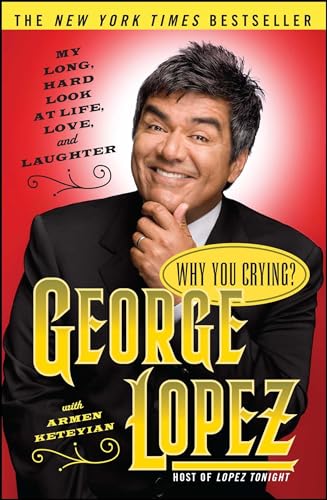
Cowritten by Emmy Award–winning writer and sportscaster Armen Keteyian, the darkly funny narrative of Why You Crying? riffs on the importance of family, the stark, often hysterical differences between Chicano and gringo culture, and the inspirational message that anybody can become Somebody. Read it and weep!
When George Lopez gives a comic performance, there’s not a dry eye or empty seat in the house, and for six years, millions of viewers tuned in to get their weekly G-Lo fix with ABC’s The George Lopez Show. Now, George is back, and he’s made the switch from prime-time family guy to late-night talk show host. Lopez Tonight combines George’s irreverent and very opinionated humor with spontaneous celebrity interactions to create a party of a show; with George, the audience knows the conversation will be high-energy, low-formality, and 100 percent unpredictable.
But while he can make his audiences cry with laughter, Lopez’s own life—before becoming one of America’s most popular Latino personalities—was anything but funny. Abandoned by his California migrant-worker father at the tender age of two months and deserted by his own mother at the age of ten years, Lopez was raised by grandparents who viewed “love” as a different four-letter word.
Co-written by Emmy Award-winning writer and sportscaster Armen Keteyian, the darkly funny narrative of Why You Crying? riffs on the importance of family, the stark, often hysterical differences between Chicano and gringo culture, and the inspirational message that anybody can become Somebody. Read it and weep!
Die Inhaltsangabe kann sich auf eine andere Ausgabe dieses Titels beziehen.
Über die Autorinnen und Autoren
George Lopez is the cocreator, writer, producer, and star of the acclaimed ABC sitcom George Lopez. A current cast member of HBO's Inside the NFL, he has appeared on The Tonight Show with Jay Leno, Late Night with Conan O'Brien, and Good Morning America, among others. A recipient of many prestigious awards and honors, Lopez lives with his family in California.
Armen Keteyian is a CBS News correspondent based in New York and a longtime contributing correspondent to 60 Minutes. An eleven-time Emmy Award winner, he is widely regarded as one of the finest investigative journalists in the country. A former writer-reporter at Sports Illustrated, he is also the author or coauthor of ten previous books, including the New York Times bestsellers Raw Recruits and The System. Born and raised in Michigan, he now lives with his wife, Dede, in Fairfield, Connecticut, and San Clemente, California.
Auszug. © Genehmigter Nachdruck. Alle Rechte vorbehalten.
from Me and Ernie and Freddie
The kid from Home Alone had nothing on me.
I didn't know there was a name for children like me until one day I saw a commercial about a latchkey kid letting himself into an empty house after school. Every day, around three, that was me, letting myself in the kitchen door or slipping through an open window.
When you're home alone you find love in other forms and faces. Some kids talk to their toys. Some make up imaginary friends. Others live in imaginary worlds populated with people who don't argue or drink, folks who think nothing of giving you a hug or a kiss or a compliment or a smile. The people I interacted with on those lonely afternoons lived in a box. My electronic family -- variety show hosts like Mike Douglas, Merv Griffin, and Dinah Shore -- were always inviting funny and interesting people over to their place. Jimmie "JJ" Walker, Richard Pryor, and George Carlin were some of my early favorites, guys me and Ernie would sprint home from school to see.
Consequently, we got the comedy bug young, and we knew all the comics -- the famous and the not so famous. One day we were cruising Laurel Canyon Boulevard in North Hollywood, and we passed this car going in the other direction. We both shouted, "That's Johnny Dark!" You have to really know your comics to remember -- much less to have recognized -- Johnny Dark, but he was a fixture at the Comedy Store in the late seventies with the likes of David Letterman, Elayne Boosler, Jay Leno, Steve Landesberg, and Pryor. We whipped a U-turn in the middle of Laurel Canyon and followed Johnny Dark all the way home. I jumped out and approached him in his driveway. "I am George Lopez," I said, "and I want to be a comedian, too." He told us to wait outside, went in his house, came back with two eight-by-tens, autographed one for each of us, and just hung out and talked shop. He was so cool, and it was cool to be in the presence of a professional comedian.
It was in that electronic box in the summer of 1974 that I met my new best friend. Over time he would become my guardian angel, the one who watched over my career from above. And today, in the strangest of ways, I have become the keeper of his flame.
I was all of thirteen when the promotion came on, a classic sixty-four Chevy with pom-poms and the antenna and the little dog in the back window followed by the words "Coming this fall." From then on I'd sit in front of the TV, watching it like a hawk, waiting, hoping just to see the promo again, to see the kid, this Chico with the bedroom eyes, who wore denim like we did, cool as shit with that droopy mustache, long hair, and lover-boy body.
My idol...Freddie Prinze.
Think Robin Williams in the eighties or Chris Rock today, and that was Freddie Prinze Sr. in the early 1970s. Words like "creative genius" get tossed around a lot in my business, but they're actually on target when it comes to the comedic talents of one Frederick Karl Pruetzel, born June 22, 1954, to a Puerto Rican mother and E. Karl Pruetzel, the Hungarian taskmaster Freddie never really liked.
He grew up up in Washington Heights, New York -- "a slum with trees," he called it -- studied music and karate, and dreamed of fame and fortune. His idol was Lenny Bruce. Eventually Freddie got his break earning stand-up shots at New York landmarks like the Improv and Catch a Rising Star, mesmerizing people with his comedic and imitative talents. Before long he got the call every comedian died for back then -- a guest spot on The Tonight Show starring Johnny Carson. Freddie laid Johnny out that night, so much so that he was offered a coveted seat on Carson's couch. That contributed to his meteoric rise and led to an audition in the summer of 1974 that would change -- and eventually help end -- his life.
Other Voices -- Ron De Blasio,Freddie Prinze's manager
I am on the road with Pryor and we're going to Chicago and we finish a show and Richie says, "C'mon, we're going to a club tonight."
I say, "I'm not going to a club."
He says, "No, you're going to come to a club. We're going to Mr. Kelly's to see this guy, a friend of mine, a comic."
I say, "Who's this guy?"
He says, "Motherfucker, just c'mon."
"What's he like?"
"He's Spanish, sort of, from New York -- he's like me."
"He's like you?"
"Yeah."
"Hmmm."
So we walk into Mr. Kelly's, and I know the club pretty well. Bette Midler broke out there. Streisand played there. Mr. Kelly's was one of those places you had to play.
So I see Freddie and he's funny. His language is a little salty for a nineteen-year-old kid, but the jazz people like him -- it's an old crowd, old Chicago patrons, drinking, couples, some not with their wives, Frank's Chicago. So I sorta liked him, and we go outside, and Freddie says to me, "So, you saw my act, would you consider representing me?"
Without batting an eye I say, "Represent you? I don't even know if I like you." And that was the end of that.
Then the show gets on the air and he's out here. I pick up a copy of Time magazine and the title of the article is "The Prinze of Prime Time."
So I start to ask around about Freddie, and hear there're lots of problems, the least of which is his manager. Freddie calls me up once more and we chat, but again nothing really comes of it. Then one night, late at night, Freddie says, "Listen, I have an attorney, David Braun. Do you know him?"
I say, "Yeah, good guy, straight shooter."
"Listen, I've worked it out whereby for the length of the contract I have with my manager I will pay him what I have to pay him, so I have to have a reduced commission on what I pay you. But just as soon as that obligation is over, I'll pay your full management commission."
"Okay," I say, "sounds fine."
*
Freddie Prinze was the thing that really brought me and Ernie together. We had both seen Freddie perform on the Midnight Special. He was wearing bell-bottom jeans and a rhinestone shirt, and me and Ernie were both bitten. Up to that point, the only Latino on TV we could relate to was Pepino on The Real McCoys. Freddie Prinze was our Beatles, and that show was our Ed Sullivan Show.
To me, Freddie was the second-generation Desi Arnaz. Desi was the brains behind I Love Lucy, the man Bob Hope once described as one of the smartest people he'd met in Hollywood. Desi invented the three-camera format that sitcoms still use today, but because of the language barrier -- not to mention the color barrier -- never got the recognition he deserved.
Given Hollywood history, it's no surprise that the star of Chico and the Man wasn't Freddie but rather veteran Oscar-winning actor Jack Albertson, who played Ed Brown. A crotchety old man, Ed was the cantankerous owner of an auto garage in a run-down -- or overrun, in Ed's mind -- East LA barrio. Freddie played this wisecracking Chicano named Chico Rodriguez, Ed's eventual partner in the garage.
At least that was the premise on paper. No different from a hundred other oil-and-water sitcoms. Except in this case you had James Komack as the executive producer and an actor like Albertson who was willing to share the stage with a comet like Freddie that streaks across the sky once every decade or so.
The show premiered on September 13, 1974. The first words I heard were, "Chico...don't be discouraged...the man he ain't so hard to understand," written and sung by the incomparable José ("Light My Fire") Feliciano. In the very first scene, a rumpled Albertson is mumbling and grumbling his way down the stairs from his room above the garage. He kicks a water can out of the way for good measure. The world was changing, and Ed Brown wanted nothing to do with it.
He shuffles over to the cash register where, it turns out, he keeps...
„Über diesen Titel“ kann sich auf eine andere Ausgabe dieses Titels beziehen.
Suchergebnisse für Why You Crying?: My Long, Hard Look at Life, Love,...

Beispielbild für diese ISBN
Why You Crying?: My Long, Hard Look at Life, Love, and Laughter
Anbieter: World of Books (was SecondSale), Montgomery, IL, USA
Verkäuferbewertung 5 von 5 Sternen

Paperback. Zustand: Good. A sitcom star and comedian recounts his rise from a hard-luck background to celebrity, describing such life experiences as his fatherless upbringing, his struggles with alcohol and depression, the inspirations that motivated his career, and his devotion to his family. Reprint. 75,000 first printing. Artikel-Nr. 00106927165
Gebraucht kaufen
EUR 4,52
Versand gratis
Versand innerhalb von USA
Versand innerhalb von USA
Anzahl: 1 verfügbar
Beispielbild für diese ISBN
Why You Crying?: My Long, Hard Look at Life, Love, and Laughter
Verlag:
Touchstone (edition Reprint), 2005
ISBN 10: 0743259955
ISBN 13: 9780743259958
Gebraucht
Paperback
Anbieter: BooksRun, Philadelphia, PA, USA
Verkäuferbewertung 5 von 5 Sternen
Paperback. Zustand: Very Good. Reprint. It's a well-cared-for item that has seen limited use. The item may show minor signs of wear. All the text is legible, with all pages included. It may have slight markings and/or highlighting. Artikel-Nr. 0743259955-11-1
Gebraucht kaufen
EUR 4,82
Versand gratis
Versand innerhalb von USA
Versand innerhalb von USA
Anzahl: 2 verfügbar
Beispielbild für diese ISBN
Why You Crying? : My Long, Hard Look at Life, Love, and Laughter
Anbieter: Better World Books: West, Reno, NV, USA
Verkäuferbewertung 5 von 5 Sternen
Zustand: Good. Reprint. Former library copy. Pages intact with minimal writing/highlighting. The binding may be loose and creased. Dust jackets/supplements are not included. Includes library markings. Stock photo provided. Product includes identifying sticker. Better World Books: Buy Books. Do Good. Artikel-Nr. 9792335-75
Gebraucht kaufen
EUR 6,09
Versand gratis
Versand innerhalb von USA
Versand innerhalb von USA
Anzahl: 1 verfügbar
Beispielbild für diese ISBN
Why You Crying? : My Long, Hard Look at Life, Love, and Laughter
Anbieter: Better World Books, Mishawaka, IN, USA
Verkäuferbewertung 5 von 5 Sternen
Zustand: Good. Reprint. Pages intact with minimal writing/highlighting. The binding may be loose and creased. Dust jackets/supplements are not included. Stock photo provided. Product includes identifying sticker. Better World Books: Buy Books. Do Good. Artikel-Nr. 2905189-6
Gebraucht kaufen
EUR 6,09
Versand gratis
Versand innerhalb von USA
Versand innerhalb von USA
Anzahl: 1 verfügbar
Beispielbild für diese ISBN
Why You Crying?: My Long, Hard Look At Life, Love, And Laughter
Anbieter: Wonder Book, Frederick, MD, USA
Verkäuferbewertung 5 von 5 Sternen
Zustand: As New. Like New condition. A near perfect copy that may have very minor cosmetic defects. Artikel-Nr. P08N-01289
Gebraucht kaufen
EUR 6,33
Versand gratis
Versand innerhalb von USA
Versand innerhalb von USA
Anzahl: 1 verfügbar
Beispielbild für diese ISBN
Why You Crying?: My Long, Hard Look at Life, Love, and Laughter
Anbieter: ThriftBooks-Dallas, Dallas, TX, USA
Verkäuferbewertung 5 von 5 Sternen
Paperback. Zustand: Good. No Jacket. Pages can have notes/highlighting. Spine may show signs of wear. ~ ThriftBooks: Read More, Spend Less. Artikel-Nr. G0743259955I3N00
Gebraucht kaufen
EUR 6,39
Versand gratis
Versand innerhalb von USA
Versand innerhalb von USA
Anzahl: 1 verfügbar
Beispielbild für diese ISBN
Why You Crying?: My Long, Hard Look at Life, Love, and Laughter
Anbieter: ThriftBooks-Dallas, Dallas, TX, USA
Verkäuferbewertung 5 von 5 Sternen
Paperback. Zustand: Very Good. No Jacket. May have limited writing in cover pages. Pages are unmarked. ~ ThriftBooks: Read More, Spend Less. Artikel-Nr. G0743259955I4N00
Gebraucht kaufen
EUR 6,39
Versand gratis
Versand innerhalb von USA
Versand innerhalb von USA
Anzahl: 1 verfügbar
Beispielbild für diese ISBN
Why You Crying?: My Long, Hard Look at Life, Love, and Laughter
Anbieter: Ria Christie Collections, Uxbridge, Vereinigtes Königreich
Verkäuferbewertung 5 von 5 Sternen
Zustand: New. In English. Artikel-Nr. ria9780743259958_new
Neu kaufen
EUR 18,37
EUR 10,89 Versand
Versand von Vereinigtes Königreich nach USA
Versand von Vereinigtes Königreich nach USA
Anzahl: Mehr als 20 verfügbar
Beispielbild für diese ISBN
Why You Crying?: My Long, Hard Look At Life, Love, And Laughter
Anbieter: Revaluation Books, Exeter, Vereinigtes Königreich
Verkäuferbewertung 5 von 5 Sternen
Paperback. Zustand: Brand New. reprint edition. 194 pages. 8.50x5.50x0.50 inches. In Stock. Artikel-Nr. x-0743259955
Neu kaufen
EUR 18,00
EUR 11,63 Versand
Versand von Vereinigtes Königreich nach USA
Versand von Vereinigtes Königreich nach USA
Anzahl: 2 verfügbar
Foto des Verkäufers
Why You Crying? : My Long, Hard Look at Life, Love, and Laughter
Anbieter: AHA-BUCH GmbH, Einbeck, Deutschland
Verkäuferbewertung 5 von 5 Sternen
Taschenbuch. Zustand: Neu. Neuware - Cowritten by Emmy Awardwinning writer and sportscaster Armen Keteyian, the darkly funny narrative of Why You Crying riffs on the importance of family, the stark, often hysterical differences between Chicano and gringo culture, and the inspirational message that anybody can become Somebody. Read it and weep!When George Lopez gives a comic performance, there's not a dry eye or empty seat in the house, and for six years, millions of viewers tuned in to get their weekly G-Lo fix with ABC's The George Lopez Show. Now, George is back, and he's made the switch from prime-time family guy to late-night talk show host. Lopez Tonight combines George's irreverent and very opinionated humor with spontaneous celebrity interactions to create a party of a show; with George, the audience knows the conversation will be high-energy, low-formality, and 100 percent unpredictable. But while he can make his audiences cry with laughter, Lopez's own lifebefore becoming one of America's most popular Latino personalitieswas anything but funny. Abandoned by his California migrant-worker father at the tender age of two months and deserted by his own mother at the age of ten years, Lopez was raised by grandparents who viewed "love" as a different four-letter word. Co-written by Emmy Award-winning writer and sportscaster Armen Keteyian, the darkly funny narrative of Why You Crying riffs on the importance of family, the stark, often hysterical differences between Chicano and gringo culture, and the inspirational message that anybody can become Somebody. Read it and weep! Artikel-Nr. 9780743259958
Neu kaufen
EUR 26,14
EUR 35,00 Versand
Versand von Deutschland nach USA
Versand von Deutschland nach USA
Anzahl: 2 verfügbar