
Inhaltsangabe
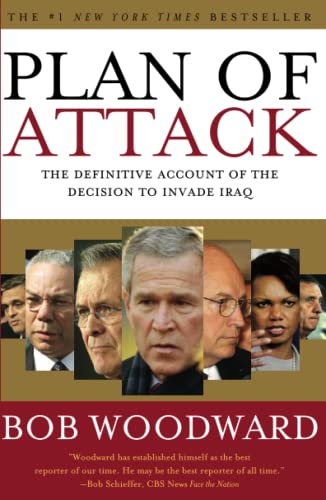
Plan of Attack is the definitive account of how and why President George W. Bush, his war council, and allies launched a preemptive attack to topple Saddam Hussein and occupy Iraq. Bob Woodward's latest landmark account of Washington decision making provides an original, authoritative narrative of behind-the-scenes maneuvering over two years, examining the causes and consequences of the most controversial war since Vietnam.
Based on interviews with 75 key participants and more than three and a half hours of exclusive interviews with President Bush, Plan of Attack is part presidential history charting the decisions made during 16 critical months; part military history revealing precise details and the evolution of the Top Secret war planning under the restricted codeword Polo Step; and part a harrowing spy story as the CIA dispatches a covert paramilitary team into northern Iraq six months before the start of the war. This team recruited 87 Iraqi spies designated with the cryptonym DB/ROCKSTARS, one of whom turned over the personnel files of all 6,000 men in Saddam Hussein's personal security organization.
What emerges are astonishingly intimate portraits: President Bush in war cabinet meetings in the White House Situation Room and the Oval Office, and in private conversation; Dick Cheney, the focused and driven vice president; Colin Powell, the conflicted and cautious secretary of state; Donald Rumsfeld, the controlling war technocrat; George Tenet, the activist CIA director; Tommy Franks, the profane and demanding general; Condoleezza Rice, the ever-present referee and national security adviser; Karl Rove, the hands-on political strategist; other key members of the White House staff and congressional leadership; and foreign leaders ranging from British Prime Minister Blair to Russian President Putin.
Plan of Attack provides new details on the intelligence assessments of Iraq's alleged weapons of mass destruction and the planning for the war's aftermath.
Die Inhaltsangabe kann sich auf eine andere Ausgabe dieses Titels beziehen.
Über die Autorin bzw. den Autor
Bob Woodward is an associate editor at The Washington Post, where he has worked for fifty-five years. He has shared in two Pulitzer Prizes, one for his Watergate coverage with Carl Bernstein and the other for coverage of the 9/11 terrorist attacks. He has authored twenty-four bestselling books, sixteen of which have been #1 New York Times bestsellers.
Auszug. © Genehmigter Nachdruck. Alle Rechte vorbehalten.
Chapter 1
In early January 2001, before George W. Bush was inaugurated, Vice President-elect Dick Cheney passed a message to the outgoing secretary of defense, William S. Cohen, a moderate Republican who served in the Democratic Clinton administration.
"We really need to get the president-elect briefed up on some things," Cheney said, adding that he wanted a serious "discussion about Iraq and different options." The president-elect should not be given the routine, canned, round-the-world tour normally given incoming presidents. Topic A should be Iraq. Cheney had been secretary of defense during George H. W. Bush's presidency, which included the 1991 Gulf War, and he harbored a deep sense of unfinished business about Iraq. In addition, Iraq was the only country the United States regularly, if intermittently, bombed these days.
The U.S. military had been engaged in a frustrating low-grade, undeclared war with Iraq since the Gulf War when Bush's father and a United Nations-backed coalition had ousted Saddam Hussein and his army from Kuwait after they had invaded that country. The United States enforced two designated no-fly zones, meaning the Iraqis could fly neither planes nor helicopters in these areas, which comprised about 60 percent of the country. Cheney wanted to make sure Bush understood the military and other issues in this potential tinderbox.
Another element was the standing policy inherited from the Clinton administration. Though not widely understood, the baseline policy was clearly "regime change." A 1998 law passed by Congress and signed by President Bill Clinton authorized up to $97 million in military assistance to Iraqi opposition forces "to remove the regime headed by Saddam Hussein" and "promote the emergence of a democratic government."
On Wednesday morning, January 10, ten days before the inauguration, Bush, Cheney, Rumsfeld, Rice and the designated secretary of state, Colin L. Powell, went to the Pentagon to meet with Cohen. Afterward, Bush and his team went downstairs to the Tank, the secure domain and meeting room for the Joint Chiefs of Staff.
Bush sauntered in like Cool Hand Luke, flapping his arms slightly, cocky but seeming also ill at ease.
Two generals briefed them on the state of the no-fly zone enforcement. Operation Northern Watch enforced the no-fly zone in the northernmost 10 percent of Iraq to protect the minority Kurds. Some 50 U.S. and United Kingdom aircraft had patrolled the restricted airspace on 164 days of the previous year. In nearly every mission they had been fired on or threatened by the Iraqi air defense system, including surface-to-air missiles (SAMs). U.S. aircraft had fired back or dropped hundreds of missiles and bombs on the Iraqis, mostly at antiaircraft artillery.
In Operation Southern Watch, the larger of the two, the U.S. patrolled almost the entire southern half of Iraq up to the outskirts of the Baghdad suburbs. Pilots overflying the region had entered Iraqi airspace an incredible 150,000 times in the last decade, nearly 10,000 in the last year. In hundreds of attacks not a single U.S. pilot had been lost.
The Pentagon had five graduated response options when Iraqis fired on a U.S. aircraft. Air strike counterattacks were automatic; the most serious ones, involving multiple strikes against more important targets or sites outside the no-fly zones, required notification or direct approval of the president. No-fly zone enforcement was dangerous and expensive. Multimillion-dollar jets were put at risk bombing 57-millimeter antiaircraft guns. Saddam had warehouses of them. As a matter of policy, was the Bush administration going to keep poking Saddam in the chest? Was there a national strategy behind this or was it just a static tit-for-tat?
An operation plan called Desert Badger was the response if a U.S. pilot were to be shot down. It was designed to disrupt the Iraqis' ability to capture the pilot by attacking Saddam's command and control in downtown Baghdad. It included an escalating attack if a U.S. pilot were captured. Another operation plan called Desert Thunder was the response if the Iraqis attacked the Kurds in the north.
Lots of acronyms and program names were thrown around -- most of them familiar to Cheney, Rumsfeld and Powell, who had spent 35 years in the Army and been chairman of the Joint Chiefs of Staff from 1989 to 1993.
President-elect Bush asked some practical questions about how things worked, but he did not offer nor hint at his desires.
The JCS staff had placed a peppermint at each place. Bush unwrapped his and popped it into his mouth. Later he eyed Cohen's mint and flashed a pantomime query, Do you want that? Cohen signaled no, so Bush reached over and took it. Near the end of the hour-and-a-quarter briefing, the chairman of the Joint Chiefs, Army General Henry "Hugh" Shelton, noticed Bush eyeing his mint, so he passed it over.
Cheney listened but he was tired and closed his eyes, conspicuously nodding off several times. Rumsfeld, who was sitting at a far end of the table, paid close attention though he kept asking the briefers to please speak up, or please speak louder.
"We're off to a great start," one of the chiefs commented privately to a colleague after the session. "The vice president fell asleep and the secretary of defense can't hear."
Cohen, who was leaving the Defense Department in 10 days, believed that the new administration would soon see the reality about Iraq. They would not find much, if any, support among other countries in the region or the world for strong action against Saddam, which would mean going it alone in any large-scale attack. What could they accomplish with air strikes? Not much, he thought. Iraq was treacherous. When everything was weighed, Cohen predicted the new team would soon back off and find "reconciliation" with Saddam, who he felt was effectively contained and isolated.
In interviews nearly three years later, Bush said of the pre-9/11 situation, "I was not happy with our policy." It wasn't having much impact on changing Saddam's behavior or toppling him. "Prior to September 11, however, a president could see a threat and contain it or deal with it in a variety of ways without fear of that threat materializing on our own soil." Saddam was not yet a top priority.
Bush received a second critical national security briefing a few days later. CIA Director George Tenet and his deputy for operations, James L. Pavitt, gave Bush, Cheney and Rice the so-called secrets briefing. For two and one-half hours, the two ran through the good, bad and ugly about covert operations, the latest technical surveillance and eavesdropping, the "who" and "how" of the secret payroll.
When all the intelligence was sorted, weighed and analyzed, Tenet and Pavitt agreed there were three major threats to American national security. One was Osama bin Laden and his al Qaeda terrorist network, which operated out of a sanctuary in Afghanistan. Bin Laden terrorism was a "tremendous threat" which had to be considered "immediate," they said. There was no doubt that bin Laden was going to strike at United States interests in some form. It was not clear when, where, by what means. President Clinton had authorized the CIA in five separate intelligence orders to try to disrupt and destroy al Qaeda.
A second major threat was the increasing proliferation of weapons of mass destruction, WMD -- chemical, biological and nuclear. This was of immense concern, they said. Third was the rise of China, especially its military, but that problem was 5 to 15 or more years away.
Iraq was barely mentioned. Tenet did not have an agenda for Iraq as he did for bin Laden and al Qaeda.
On the 17th day of the Bush presidency, Monday, February 5, Rice chaired a principals committee meeting that included Cheney, Powell and Rumsfeld. Deputy...
„Über diesen Titel“ kann sich auf eine andere Ausgabe dieses Titels beziehen.
Weitere beliebte Ausgaben desselben Titels

Suchergebnisse für Plan of Attack

Beispielbild für diese ISBN
Plan of Attack: The Definitive Account of the Decision to Invade Iraq
Anbieter: World of Books (was SecondSale), Montgomery, IL, USA
Verkäuferbewertung 5 von 5 Sternen

Zustand: Good. Item in good condition. Textbooks may not include supplemental items i.e. CDs, access codes etc. Artikel-Nr. 00066158272
Gebraucht kaufen
EUR 3,27
Versand gratis
Versand innerhalb von USA
Versand innerhalb von USA
Anzahl: 10 verfügbar
Beispielbild für diese ISBN
Plan of Attack: The Definitive Account of the Decision to Invade Iraq
Verlag:
Simon & Schuster (edition Reprint), 2004
ISBN 10: 0743255488
ISBN 13: 9780743255486
Gebraucht
Paperback
Anbieter: BooksRun, Philadelphia, PA, USA
Verkäuferbewertung 5 von 5 Sternen
Paperback. Zustand: Very Good. Reprint. It's a well-cared-for item that has seen limited use. The item may show minor signs of wear. All the text is legible, with all pages included. It may have slight markings and/or highlighting. Artikel-Nr. 0743255488-11-1
Gebraucht kaufen
EUR 5,54
Versand gratis
Versand innerhalb von USA
Versand innerhalb von USA
Anzahl: 1 verfügbar
Beispielbild für diese ISBN
Plan of Attack
Anbieter: ThriftBooks-Dallas, Dallas, TX, USA
Verkäuferbewertung 5 von 5 Sternen
Paperback. Zustand: As New. No Jacket. Pages are clean and are not marred by notes or folds of any kind. ~ ThriftBooks: Read More, Spend Less. Artikel-Nr. G0743255488I2N00
Gebraucht kaufen
EUR 5,79
Versand gratis
Versand innerhalb von USA
Versand innerhalb von USA
Anzahl: 1 verfügbar
Beispielbild für diese ISBN
Plan of Attack
Anbieter: Better World Books, Mishawaka, IN, USA
Verkäuferbewertung 5 von 5 Sternen
Zustand: Good. attack Edition. Pages intact with minimal writing/highlighting. The binding may be loose and creased. Dust jackets/supplements are not included. Stock photo provided. Product includes identifying sticker. Better World Books: Buy Books. Do Good. Artikel-Nr. GRP102233604
Gebraucht kaufen
EUR 6,57
Versand gratis
Versand innerhalb von USA
Versand innerhalb von USA
Anzahl: 1 verfügbar
Beispielbild für diese ISBN
Plan of Attack
Anbieter: Better World Books: West, Reno, NV, USA
Verkäuferbewertung 5 von 5 Sternen
Zustand: Very Good. attack Edition. Former library copy. Pages intact with possible writing/highlighting. Binding strong with minor wear. Dust jackets/supplements may not be included. Includes library markings. Stock photo provided. Product includes identifying sticker. Better World Books: Buy Books. Do Good. Artikel-Nr. 9655237-6
Gebraucht kaufen
EUR 6,57
Versand gratis
Versand innerhalb von USA
Versand innerhalb von USA
Anzahl: 1 verfügbar
Beispielbild für diese ISBN
Plan of Attack
Anbieter: Better World Books, Mishawaka, IN, USA
Verkäuferbewertung 5 von 5 Sternen
Zustand: Very Good. attack Edition. Pages intact with possible writing/highlighting. Binding strong with minor wear. Dust jackets/supplements may not be included. Stock photo provided. Product includes identifying sticker. Better World Books: Buy Books. Do Good. Artikel-Nr. GRP102243048
Gebraucht kaufen
EUR 6,57
Versand gratis
Versand innerhalb von USA
Versand innerhalb von USA
Anzahl: 1 verfügbar
Beispielbild für diese ISBN
Plan of Attack: The Definitive Account of the Decision to Invade Iraq
Anbieter: Wonder Book, Frederick, MD, USA
Verkäuferbewertung 5 von 5 Sternen
Zustand: Good. Good condition. A copy that has been read but remains intact. May contain markings such as bookplates, stamps, limited notes and highlighting, or a few light stains. Bundled media such as CDs, DVDs, floppy disks or access codes may not be included. Artikel-Nr. Q14E-00813
Gebraucht kaufen
EUR 6,98
Versand gratis
Versand innerhalb von USA
Versand innerhalb von USA
Anzahl: 1 verfügbar
Beispielbild für diese ISBN
Plan of Attack: The Definitive Account of the Decision to Invade Iraq
Anbieter: Wonder Book, Frederick, MD, USA
Verkäuferbewertung 5 von 5 Sternen
Zustand: Very Good. Very Good condition. A copy that may have a few cosmetic defects. May also contain a few markings such as an owner's name, short gifter's inscription or light stamp. Artikel-Nr. K11M-00321
Gebraucht kaufen
EUR 6,98
Versand gratis
Versand innerhalb von USA
Versand innerhalb von USA
Anzahl: 1 verfügbar
Beispielbild für diese ISBN
Plan of Attack
Anbieter: AwesomeBooks, Wallingford, Vereinigtes Königreich
Verkäuferbewertung 5 von 5 Sternen
paperback. Zustand: Very Good. Plan of Attack This book is in very good condition and will be shipped within 24 hours of ordering. The cover may have some limited signs of wear but the pages are clean, intact and the spine remains undamaged. This book has clearly been well maintained and looked after thus far. Money back guarantee if you are not satisfied. See all our books here, order more than 1 book and get discounted shipping. Artikel-Nr. 7719-9780743255486
Gebraucht kaufen
EUR 5,93
EUR 5,77 Versand
Versand von Vereinigtes Königreich nach USA
Versand von Vereinigtes Königreich nach USA
Anzahl: 2 verfügbar
Beispielbild für diese ISBN
Plan of Attack
Anbieter: WorldofBooks, Goring-By-Sea, WS, Vereinigtes Königreich
Verkäuferbewertung 5 von 5 Sternen
Paperback. Zustand: Very Good. The book has been read, but is in excellent condition. Pages are intact and not marred by notes or highlighting. The spine remains undamaged. Artikel-Nr. GOR001969429
Gebraucht kaufen
EUR 3,84
EUR 9,02 Versand
Versand von Vereinigtes Königreich nach USA
Versand von Vereinigtes Königreich nach USA
Anzahl: 7 verfügbar