
Verwandte Artikel zu The Price of Loyalty: George W. Bush, the White House,...
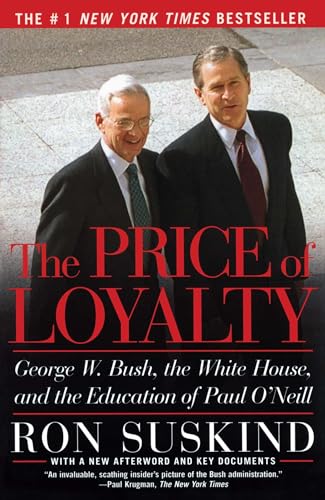
The Price of Loyalty: George W. Bush, the White House, and the Education of Paul O'Neill - Softcover
Inhaltsangabe
Updated with a new afterword and including a selection of key documents, this is the explosive account of how the Bush administration makes policy on war, taxes, and politics -- its true agenda exposed by a member of the Bush cabinet.
This vivid, unfolding narrative is like no other book that has been written about the Bush presidency. At its core are the candid assessments of former Secretary of the Treasury Paul O'Neill, the only member of Bush's cabinet to leave and speak frankly about how and why the administration has come to its core policies and decisions -- from cutting taxes for the rich to conducting preemptive war.
O'Neill's account is supported by Pulitzer Prize-winning journalist Ron Suskind's interviews with numerous participants in the administration, by transcripts of meetings, and by voluminous documents. The result is a disclosure of breadth and depth unparalleled for an ongoing presidency. As readers are taken to the very epicenter of government, Suskind presents an astonishing picture of a president so carefully managed in his public posture that he is a mystery to most Americans. Now, he is revealed.
Die Inhaltsangabe kann sich auf eine andere Ausgabe dieses Titels beziehen.
Über die Autorin bzw. den Autor
Ron Suskind is the author of the # 1 New York Times bestseller The Price of Loyalty: George W. Bush, the White House, and the Education of Paul O'Neill. He is also the author of the critically acclaimed A Hope in the Unseen. He has been senior national affairs reporter for The Wall Street Journal, where he won the Pulitzer Prize for Feature Writing. Visit the author's website at www.ronsuskind.com.
Auszug. © Genehmigter Nachdruck. Alle Rechte vorbehalten.
from Chapter 2: A Way to Do It
Paul O'Neill arrived at 6:15 A.M. on his first morning in office.
The President, he understood, was also an early riser -- in his office by 7 A.M. -- and O'Neill mused that maybe this would be part of what defined this administration: people of fortitude and clarity, always first to work. At the very least, this was one thing the President and he had in common.
His secretary, Annabella Mejia, was already there. "You're late," she chided. "Mr. Secretary, it's practically afternoon."
"Thanks, I'll get my own coffee," he said with a chuckle. "Can I get you anything, Annabella?"
Before almost anyone else had arrived, O'Neill had drafted a strategic memo to the President. By midmorning, it was ready. He had his secret pact with Greenspan. But the goal of pushing forward the President's plan was central to his job description. A core responsibility. O'Neill decided he could be a team player and still feel like himself. Good policy could make good politics -- at least, it was possible. With a surplus number of $5 trillion -- a number O'Neill understood from a friend at the Congressional Budget Office would soon rise to $5.6 trillion -- he needed to help the President set the right priorities.
Memorandum to the PresidentFrom: Paul H. O'Neill
Subject: Tax Reform
Date: January 22, 2001
I believe there is an opportunity to get quick action on your tax proposal if we move now.
You have won the general argument on the desirability of a tax cut and the opposition has been cornered into arguing how large the cut should be, and, their numbers are moving toward your numbers and scope....
O'Neill knew that special interests, with their congressional advocates, were already lined up at the White House door, pushing for midsize proposals -- abolishing inheritance taxes or offering a tax credit for each legitimate child -- along with perennials like tax incentives for ethanol production or inner-city fix-ups. Bundling everyone's favorite items would create "a working majority" and "a way to get a quick victory in the tax arena," O'Neill wrote, aware that this was something that the President's political team found attractive. Considering the election results, any show of strength, or weakness, would be read as a trend. A quick victory was crucial. The problem, he wrote the President, was that his proposed across-the-board reductions in marginal tax rates might be left behind.
O'Neill had made his own decision about priorities. The bundle of many targeted credits and exemptions, with their myriad schedules and provisions, would be difficult to rein in with a trigger. A broad tax rate reduction would have a kind of simple, manageable clarity. It would progress, year by year, on a schedule, depending on whether there was a surplus. If the excess were to be used up, the rate reductions would halt.
Now, he had to help the President see that this was also the strategically sound move. One of the keys was speed. "Growing agreement, even alarm in some quarters, with regard to the slowing economy," O'Neill wrote, could justify swift action on this one defining issue, provided they could get a proposal to Congress in a few weeks and push through marginal rate cuts -- most likely through a tweak of withholding -- retroactive to January 1.
The only congressional argument to counter this "insurance policy against the slowing economy," he noted, would be that "it doesn't fit their process." Failure to act, moreover, would expose members to blame if the economy slipped into recession.
Embrace reality, he suggested. This plan would take us out of the "morass about the theology of economics" -- a shot at anyone who might be whispering about supply-side concepts -- and stress that "we care about taking practical action right now." Meanwhile, it would leverage the current economic uncertainties. "We know the real economy has slowed and the official statistics will reflect the slowing over the next quarter, at least. If the current slowness starts moving toward re-acceleration late in the second quarter, it would weaken the argument for quick action."
After a few paragraphs about the need to stress how this rate reduction would benefit low- and middle-income Americans and "stop the drumbeat about a tax cut for the rich," O'Neill unsheathed the blade.
In order to stay within your total tax reduction numbers and provide early implementation for marginal rates we will have to stretch out implementation of some of the other initiatives. We should argue that we will revisit implementation dates for other features, if the economy permits us to do so.
He read it, satisfied -- the meat of fiscal reality, with a dash of conditionality, between two slices of political strategy -- and typed in, "cc: Vice President Cheney, Larry Lindsey." Of course, the current proposal -- even if it were retroactive to January -- wouldn't provide much actual stimulus. But if they hitched their wagon to the need for stimulus, they'd be obligated to actually create something that resembles a stimulus...at some point.
• • •
"Pablo?"
"Mr. President."
"Let's get comfortable," George Bush said as O'Neill entered the Oval Office.
The President moved toward the wing chair near the fireplace, tucked between one of two sofa-and-chair clusters in the thirty-nine-by-twenty-two-foot oval. Bush sat in the wing chair facing the clock, where presidents always sit -- and O'Neill sat on the near end of the small adjacent mustard-colored couch, where someone sits if he or she is the only visitor. As O'Neill navigated all this -- he'd been here many times and knew the complex seating rules -- his mind raced back to a conversation with George W. Bush just before the mid-December press conference in Austin, where the President-elect had announced his nomination...yes, there may have been a "Pablo" thrown in among the "Paul"s. O'Neill didn't think anything of it. He didn't know, back then, about Bush's odd enthusiasm for nicknames.
He knew now and settled into the couch...and his new identity: a sixty-five-year-old man named Pablo.
"So, whatta ya got?" the President barked, all business.
It was the afternoon of Wednesday, January 24, the third day of the Bush administration. The President calls the meetings. It is traditional protocol. One might suggest the need for a meeting to an Andy Card or Cheney, who would then pass it along, but the President issues the summons.
Bush had O'Neill's memo -- Paul figured they'd talk about that -- and then they'd discuss whatever came up. Cheney had said to him at one point that it might be valuable for Bush at the start of his presidency to have these meetings. To range around a bit.
O'Neill, as Treasury Secretary, institutionally designated to be the President's leading voice on the economy, offered a fifteen-minute overview on what he considered the informed opinion (that is, his and Greenspan's) and said that they were in the early stages of either an apparently mild recession or a pronounced inventory correction. The key was to remain sober. To watch the numbers. If we look concerned and talk up recession too much, he said, it will depress spending and encourage a downturn. O'Neill explained that the major problem was not the "encumbrances on capital" -- there was plenty of low-cost capital out there, unable to find a profitable home. The problem was on the consumption side. The real numbers, he assured the President, did not support the bleakness of some "economic theorists."
O'Neill referred to items of his memo. Marginal rate cuts, if they were affordable, should be the priority. He said the tax cut plan, under almost any permutation thus far proposed, wouldn't provide...
„Über diesen Titel“ kann sich auf eine andere Ausgabe dieses Titels beziehen.
Suchergebnisse für The Price of Loyalty: George W. Bush, the White House,...

Beispielbild für diese ISBN
The Price of Loyalty: George W. Bush, the White House, and the Education of Paul O'Neill
Anbieter: World of Books (was SecondSale), Montgomery, IL, USA
Verkäuferbewertung 5 von 5 Sternen

Paperback. Zustand: Fair. The Pulitzer Prize-winning journalist provides a provocative odyssey behind the scenes of the White House to reveal the inner operations of the administration of George W. Bush, furnishing a close-up view of the president and his advisors as they develop key domestic policies and global strategies d. Artikel-Nr. 00102895473
Gebraucht kaufen
EUR 3,76
Versand gratis
Versand innerhalb von USA
Versand innerhalb von USA
Anzahl: 4 verfügbar
Beispielbild für diese ISBN
The Price of Loyalty: George W. Bush, the White House, and the Education of Paul O'Neill
Anbieter: World of Books (was SecondSale), Montgomery, IL, USA
Verkäuferbewertung 5 von 5 Sternen
Paperback. Zustand: Very Good. The Pulitzer Prize-winning journalist provides a provocative odyssey behind the scenes of the White House to reveal the inner operations of the administration of George W. Bush, furnishing a close-up view of the president and his advisors as they develop key domestic policies and global strategies d. Artikel-Nr. 00096515074
Gebraucht kaufen
EUR 3,76
Versand gratis
Versand innerhalb von USA
Versand innerhalb von USA
Anzahl: 1 verfügbar
Beispielbild für diese ISBN
The Price of Loyalty: George W. Bush, the White House, and the Education of Paul O'Neill
Anbieter: World of Books (was SecondSale), Montgomery, IL, USA
Verkäuferbewertung 5 von 5 Sternen
Paperback. Zustand: Good. The Pulitzer Prize-winning journalist provides a provocative odyssey behind the scenes of the White House to reveal the inner operations of the administration of George W. Bush, furnishing a close-up view of the president and his advisors as they develop key domestic policies and global strategies d. Artikel-Nr. 00093254839
Gebraucht kaufen
EUR 3,76
Versand gratis
Versand innerhalb von USA
Versand innerhalb von USA
Anzahl: 10 verfügbar
Beispielbild für diese ISBN
The Price of Loyalty: George W. Bush, the White House, and the Education of Paul O'Neill
Verlag:
Simon & Schuster (edition Reprint), 2004
ISBN 10: 0743255461
ISBN 13: 9780743255462
Gebraucht
Paperback
Anbieter: BooksRun, Philadelphia, PA, USA
Verkäuferbewertung 5 von 5 Sternen
Paperback. Zustand: Fair. Reprint. The item might be beaten up but readable. May contain markings or highlighting, as well as stains, bent corners, or any other major defect, but the text is not obscured in any way. Artikel-Nr. 0743255461-7-1
Gebraucht kaufen
EUR 4,66
Versand gratis
Versand innerhalb von USA
Versand innerhalb von USA
Anzahl: 1 verfügbar
Beispielbild für diese ISBN
The Price of Loyalty: George W. Bush, the White House, and the Education of Paul O'Neill
Anbieter: ThriftBooks-Dallas, Dallas, TX, USA
Verkäuferbewertung 5 von 5 Sternen
Paperback. Zustand: As New. No Jacket. Pages are clean and are not marred by notes or folds of any kind. ~ ThriftBooks: Read More, Spend Less. Artikel-Nr. G0743255461I2N00
Gebraucht kaufen
EUR 5,98
Versand gratis
Versand innerhalb von USA
Versand innerhalb von USA
Anzahl: 1 verfügbar
Beispielbild für diese ISBN
The Price of Loyalty: George W. Bush, the White House, and the Education of Paul O'Neill
Anbieter: ThriftBooks-Atlanta, AUSTELL, GA, USA
Verkäuferbewertung 5 von 5 Sternen
Paperback. Zustand: As New. No Jacket. Pages are clean and are not marred by notes or folds of any kind. ~ ThriftBooks: Read More, Spend Less. Artikel-Nr. G0743255461I2N00
Gebraucht kaufen
EUR 5,98
Versand gratis
Versand innerhalb von USA
Versand innerhalb von USA
Anzahl: 1 verfügbar
Beispielbild für diese ISBN
The Price of Loyalty: George W. Bush, the White House, and the Education of Paul O'Neill
Anbieter: ThriftBooks-Atlanta, AUSTELL, GA, USA
Verkäuferbewertung 5 von 5 Sternen
Paperback. Zustand: Good. No Jacket. Pages can have notes/highlighting. Spine may show signs of wear. ~ ThriftBooks: Read More, Spend Less. Artikel-Nr. G0743255461I3N00
Gebraucht kaufen
EUR 5,98
Versand gratis
Versand innerhalb von USA
Versand innerhalb von USA
Anzahl: 1 verfügbar
Beispielbild für diese ISBN
The Price of Loyalty : George W. Bush, the White House, and the Education of Paul O'Neill
Anbieter: Better World Books: West, Reno, NV, USA
Verkäuferbewertung 5 von 5 Sternen
Zustand: Very Good. Reprint. Pages intact with possible writing/highlighting. Binding strong with minor wear. Dust jackets/supplements may not be included. Stock photo provided. Product includes identifying sticker. Better World Books: Buy Books. Do Good. Artikel-Nr. 2448517-6
Gebraucht kaufen
EUR 6,18
Versand gratis
Versand innerhalb von USA
Versand innerhalb von USA
Anzahl: 1 verfügbar
Beispielbild für diese ISBN
The Price of Loyalty : George W. Bush, the White House, and the Education of Paul O'Neill
Anbieter: Better World Books, Mishawaka, IN, USA
Verkäuferbewertung 5 von 5 Sternen
Zustand: Good. Reprint. Pages intact with minimal writing/highlighting. The binding may be loose and creased. Dust jackets/supplements are not included. Stock photo provided. Product includes identifying sticker. Better World Books: Buy Books. Do Good. Artikel-Nr. GRP102240335
Gebraucht kaufen
EUR 6,18
Versand gratis
Versand innerhalb von USA
Versand innerhalb von USA
Anzahl: 1 verfügbar
Beispielbild für diese ISBN
The Price of Loyalty: George W. Bush, the White House, and the Education of Paul O'Neill
Anbieter: Wonder Book, Frederick, MD, USA
Verkäuferbewertung 5 von 5 Sternen
Zustand: Very Good. Very Good condition. A copy that may have a few cosmetic defects. May also contain light spine creasing or a few markings such as an owner's name, short gifter's inscription or light stamp. Artikel-Nr. B02B-02925
Gebraucht kaufen
EUR 6,42
Versand gratis
Versand innerhalb von USA
Versand innerhalb von USA
Anzahl: 3 verfügbar