
Inhaltsangabe
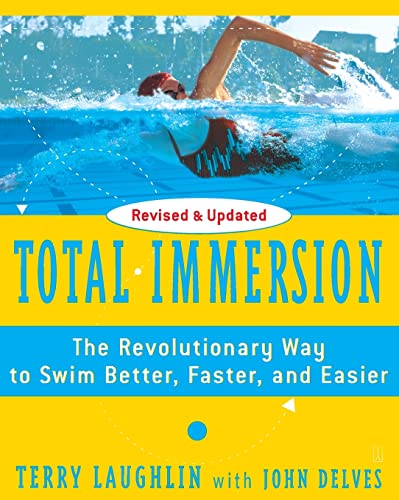
Swim better—and enjoy every lap—with Total Immersion, a guide to improving your swimming from an expert with more than thirty years of experience in the water.
Terry Laughlin, the world’s #1 authority on swimming success, has made his unique approach even easier for anyone to master. Whether you’re an accomplished swimmer or have always found swimming to be a struggle, Total Immersion will show you that it’s mindful fluid movement—not athletic ability—that will turn you into an efficient swimmer. This new edition of the bestselling Total Immersion features:
-A thoughtfully choreographed series of skill drills—practiced in the mindful spirit of yoga—that can help anyone swim more enjoyably
-A holistic approach to becoming one with the water and to developing a swimming style that’s always comfortable
-Simple but thorough guidance on how to improve fitness and form
-A complementary land-and-water program for achieving a strong and supple body at any age
Based on more than thirty years of teaching, coaching, and research, Total Immersion has dramatically improved the physical and mental experience of swimming for thousands of people of all ages and abilities.
Die Inhaltsangabe kann sich auf eine andere Ausgabe dieses Titels beziehen.
Über die Autorin bzw. den Autor
Terry Laughlin was a competitive swimmer in college and went on to coach college swim teams for 20 years. While watching his teams grind out lap after endless lap, he realized that a few people were "natural" swimmers while others struggled through a workout. Hoping to teach this "natural" ability, Laughlin left college coaching in 1988 to teach swim technique to adult swimmers.
Laughlin went on to become the director of Total Immersion Adult Swim Camps and Clubs, which are held all over the world. His revolutionary swimming program is used by professional athletes and recreational swimmers alike. He passed away at age 66 after a battle with prostate cancer.
Auszug. © Genehmigter Nachdruck. Alle Rechte vorbehalten.
Excerpt
Chapter 1
Swimming Laps and Going Nowhere
It's no mystery why people have trouble swimming as fast or as far or as smoothly as they'd like - most of them are doing it backward. "Don't worry if your form's not perfect," coaches and instructors have always assured us. "Just get those laps in. Eventually, you'll be fit enough to develop a smoother, stronger stroke." It really works the other way around, but that's not how it's been taught.
Until now. Let me tell you how I came to discover what good swimming is really all about, and what this means to anyone who would rather spend his or her time growing faster and smoother instead of just growing tired - and who wants to do it all as quickly as possible.
But first, a confession. I'm addicted to the sport of swimming. I leave my house at 6:00 most mornings to keep my daily swimming "appointment," I compete in meets whenever I can, and, last but not least, I earn my living teaching other adults how to become addicted too.
Hard to imagine it any other way because, in my opinion, swimming is more fun than anything else you can do with your clothes on. It feels great and, no matter how hard the workout, you're left so refreshed, so energized, that for the rest of the day no challenge seems too great.
Name one other workout that can do that. After running, I ache all day long and often into the next. Cycling is fun and is certainly fine exercise, but only as long as the sun's up and it's not cold or wet out. Weight training is excellent, but by the time I'm done, it's all I can do to carry my gym bag back to the car.
Swimming's different. I always feel better after my workout than I did before. That's what makes it so easy to leave a comfortable bed even before sunup on a frosty morning, or on a sultry summer predawn, to get to the pool on time.
Perhaps calling swimming "the ideal exercise" is a little strong, but it would be hard to find a better contender for the title. It makes your heart and lungs work more efficiently, enhances muscle strength and endurance, improves flexibility, and helps reduce stress. Yet swimming is easier on the joints than anything else that gets your heart rate up. Unless you count cross-country skiing, swimming uses more muscles than all other exercises. And it's the only one that can legitimately make you feel weightless and free.
Tired of the battle scars of other aerobic sports? Swimming is about as injury-free as they come. Gone are the bone-jarring shocks of land sports, so gone too are the joint and back injuries that plague so many joggers and cyclists. The water is also kinder to your muscles. Its massaging effect and the steady, even resistance it provides eliminate much of the postworkout muscle soreness so common in land sports.
Overheating is also nearly impossible in swimming. Water conducts heat from the body 20 times better than air does, so you can train at much higher intensities - in summer particularly - without the dehydration and potential heat exhaustion common "ashore."
And swimming is an equal-opportunity sport. Even if your weight, a physical handicap, or an injury would normally keep you out of action on land, you can probably swim. In fact, many land athletes use swimming to regain strength and fitness after an injury, far sooner than they could by returning to their main sport.
Joints growing stiffer with time? One of the most important reasons for an adult to swim is to increase flexibility, because this sport promotes joint mobility better than any other aerobic exercise. And while swimming's no fountain of cardiological youth, a 1988 study by cardiologists and exercise physiologists at the University of Texas Health Science Center in Dallas showed that inactive adults improved their heart function significantly within just three months of beginning a swim-training program. Their hearts beat more slowly and powerfully and circulated blood more effectively. Regular swimmers have also been shown to have lower blood pressures, slower pulse rates, and much greater exercise tolerance than other people their age. On top of all this, the aerobic benefits of swimming one mile are equal to those of running four miles.
None of this mattered - since little of it was known anyway - when I swam in college. Swim training was simple then: You stepped up and took your medicine. Take enough of it as often as possible, and you'd win the race you were training for. It was supposed to hurt, or you had no business calling yourself a competitive swimmer. And who could ask questions when your heart was always pounding and your muscles never stopped aching?
But the time for questions was coming, and it finally started during a 20-year coaching stint after college. At last, I could watch other swimmers from the pool deck as only a coach can. What an eye-opener! I finally realized that somehow, for some reason, a gifted few were able to swim extremely well without even breathing hard. It turned out to be no illusion. During some personal coaching, I was astounded to find they could, in fact, swim that well with comparatively little effort. And apparently it was that efficiency, not any unusual capacity for grueling work, that kept them consistently ahead of their competitors.
Was this an inbred gift or could it be taught, I wondered. Too soon to know for sure, but the signs were already there. Time after time, average swimmers would suddenly start improving when I stopped them from doing nothing but beating themselves up with hard training and started them on drills and exercises that let them use their existing power better.
Truth to tell, I enjoyed "cheating the system." By teaching my athletes to be more efficient than their rivals, I gave them an edge they could use to outperform swimmers who trained for many more hours - all of which saved me a lot of time on deck. Let's be honest: Even a dedicated swim coach doesn't relish countless hours watching people grind out endless laps. And as I became a "stroke teacher" more than a workout monitor, I no longer had to.
Then, in 1988, everything began to fall into place and the real secrets of successful swimming became more obvious. That was the fateful year I met Bill Boomer and subsequently left college coaching to work exclusively with adults. Boomer, whom I refer to so often in my workshops that some campers probably think they've met him, was swimming coach at the University of Rochester in upstate New York. Though relatively unknown in the wider world of American swimming, Boomer had a cult following among other college coaches in the region, coaches whose teams regularly faced his - and not often successfully. His ideas about swimming were considered radical, even revolutionary, and obviously worth listening to.
One memorable day, Boomer addressed a coaches' clinic I happened to be attending. Speaker after speaker had gone on and on about how they trained their swimmers by "building the engine and fuel tank," so to speak - throwing enough hard work at them that their bodies had no choice but to build endurance.
Then Boomer took the podium and dropped his bomb. He posed an obvious question, but one I'd never heard in two decades of attending such meetings: "How can we teach people to swim, at any given speed, with less effort?" His answer was just as disarming, and just as radical: "By reshaping the vessel." After all, swimmers had a lot in common with boats, and like a naval architect Boomer knew there were ways to improve the efficiency of their "hull designs."
Detroit had been doing it with cars since the price of fuel shot out of sight in the early 1970s, but no one, until Boomer, had thought of visualizing swimming the same way. Apparently he simply had the advantage of fresh eyes and an open mind, since he hadn't even been a swimmer...
„Über diesen Titel“ kann sich auf eine andere Ausgabe dieses Titels beziehen.
Weitere beliebte Ausgaben desselben Titels

Suchergebnisse für Total Immersion: The Revolutionary Way To Swim Better,...

Beispielbild für diese ISBN
Total Immersion: The Revolutio
Anbieter: World of Books (was SecondSale), Montgomery, IL, USA
Verkäuferbewertung 5 von 5 Sternen

Zustand: Good. Item in good condition. Textbooks may not include supplemental items i.e. CDs, access codes etc. Artikel-Nr. 00035483847
Gebraucht kaufen
EUR 4,16
Versand gratis
Versand innerhalb von USA
Versand innerhalb von USA
Anzahl: Mehr als 20 verfügbar
Beispielbild für diese ISBN
Total Immersion: The Revolutio
Anbieter: World of Books (was SecondSale), Montgomery, IL, USA
Verkäuferbewertung 5 von 5 Sternen
Zustand: Acceptable. Item in acceptable condition! Textbooks may not include supplemental items i.e. CDs, access codes etc. Artikel-Nr. 00105061295
Gebraucht kaufen
EUR 4,16
Versand gratis
Versand innerhalb von USA
Versand innerhalb von USA
Anzahl: 4 verfügbar
Beispielbild für diese ISBN
Total Immersion: The Revolutionary Way to Swim Better, Faster, and Easier
Anbieter: ThriftBooks-Reno, Reno, NV, USA
Verkäuferbewertung 5 von 5 Sternen
Paperback. Zustand: Very Good. No Jacket. May have limited writing in cover pages. Pages are unmarked. ~ ThriftBooks: Read More, Spend Less. Artikel-Nr. G0743253434I4N00
Gebraucht kaufen
EUR 5,84
Versand gratis
Versand innerhalb von USA
Versand innerhalb von USA
Anzahl: 4 verfügbar
Beispielbild für diese ISBN
Total Immersion: The Revolutionary Way to Swim Better, Faster, and Easier
Anbieter: ThriftBooks-Dallas, Dallas, TX, USA
Verkäuferbewertung 5 von 5 Sternen
Paperback. Zustand: Very Good. No Jacket. May have limited writing in cover pages. Pages are unmarked. ~ ThriftBooks: Read More, Spend Less. Artikel-Nr. G0743253434I4N00
Gebraucht kaufen
EUR 5,84
Versand gratis
Versand innerhalb von USA
Versand innerhalb von USA
Anzahl: 4 verfügbar
Beispielbild für diese ISBN
Total Immersion: The Revolutionary Way to Swim Better, Faster, and Easier
Anbieter: ThriftBooks-Dallas, Dallas, TX, USA
Verkäuferbewertung 5 von 5 Sternen
Paperback. Zustand: Very Good. No Jacket. Former library book; May have limited writing in cover pages. Pages are unmarked. ~ ThriftBooks: Read More, Spend Less. Artikel-Nr. G0743253434I4N10
Gebraucht kaufen
EUR 5,84
Versand gratis
Versand innerhalb von USA
Versand innerhalb von USA
Anzahl: 1 verfügbar
Beispielbild für diese ISBN
Total Immersion: The Revolutionary Way to Swim Better, Faster, and Easier
Anbieter: ThriftBooks-Atlanta, AUSTELL, GA, USA
Verkäuferbewertung 5 von 5 Sternen
Paperback. Zustand: Very Good. No Jacket. May have limited writing in cover pages. Pages are unmarked. ~ ThriftBooks: Read More, Spend Less. Artikel-Nr. G0743253434I4N00
Gebraucht kaufen
EUR 5,84
Versand gratis
Versand innerhalb von USA
Versand innerhalb von USA
Anzahl: 5 verfügbar
Beispielbild für diese ISBN
Total Immersion: The Revolutionary Way to Swim Better, Faster, and Easier
Anbieter: ThriftBooks-Phoenix, Phoenix, AZ, USA
Verkäuferbewertung 5 von 5 Sternen
Paperback. Zustand: Very Good. No Jacket. May have limited writing in cover pages. Pages are unmarked. ~ ThriftBooks: Read More, Spend Less. Artikel-Nr. G0743253434I4N00
Gebraucht kaufen
EUR 5,84
Versand gratis
Versand innerhalb von USA
Versand innerhalb von USA
Anzahl: 4 verfügbar
Beispielbild für diese ISBN
Total Immersion: The Revolutionary Way to Swim Better, Faster, and Easier
Anbieter: ThriftBooks-Dallas, Dallas, TX, USA
Verkäuferbewertung 5 von 5 Sternen
Paperback. Zustand: Very Good. No Jacket. Missing dust jacket; May have limited writing in cover pages. Pages are unmarked. ~ ThriftBooks: Read More, Spend Less. Artikel-Nr. G0743253434I4N01
Gebraucht kaufen
EUR 5,84
Versand gratis
Versand innerhalb von USA
Versand innerhalb von USA
Anzahl: 1 verfügbar
Beispielbild für diese ISBN
Total Immersion: The Revolutionary Way to Swim Better, Faster, and Easier
Anbieter: ThriftBooks-Atlanta, AUSTELL, GA, USA
Verkäuferbewertung 5 von 5 Sternen
Paperback. Zustand: Very Good. No Jacket. Former library book; May have limited writing in cover pages. Pages are unmarked. ~ ThriftBooks: Read More, Spend Less. Artikel-Nr. G0743253434I4N10
Gebraucht kaufen
EUR 5,84
Versand gratis
Versand innerhalb von USA
Versand innerhalb von USA
Anzahl: 1 verfügbar
Beispielbild für diese ISBN
Total Immersion: The Revolutionary Way to Swim Better, Faster, and Easier
Anbieter: ThriftBooks-Reno, Reno, NV, USA
Verkäuferbewertung 5 von 5 Sternen
Paperback. Zustand: Very Good. No Jacket. Former library book; May have limited writing in cover pages. Pages are unmarked. ~ ThriftBooks: Read More, Spend Less. Artikel-Nr. G0743253434I4N10
Gebraucht kaufen
EUR 5,84
Versand gratis
Versand innerhalb von USA
Versand innerhalb von USA
Anzahl: 1 verfügbar