
Verwandte Artikel zu The Know-it-all (Rough Cut)
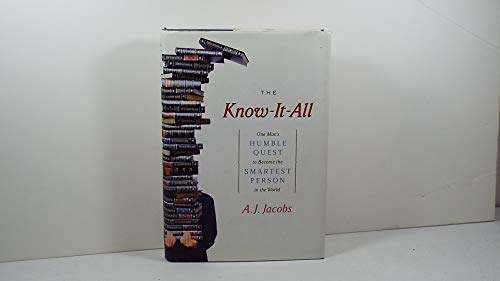
Inhaltsangabe
33,000 pages
44 million words
10 billion years of history
1 obsessed man
Part memoir and part education (or lack thereof), The Know-It-All chronicles NPR contributor A.J. Jacobs's hilarious, enlightening, and seemingly impossible quest to read the Encyclopaedia Britannica from A to Z.
To fill the ever-widening gaps in his Ivy League education, A.J. Jacobs sets for himself the daunting task of reading all thirty-two volumes of the Encyclopaedia Britannica. His wife, Julie, tells him it's a waste of time, his friends believe he is losing his mind, and his father, a brilliant attorney who had once attempted the same feat and quit somewhere around Borneo, is encouraging but, shall we say, unconvinced.
With self-deprecating wit and a disarming frankness, The Know-It-All recounts the unexpected and comically disruptive effects Operation Encyclopedia has on every part of Jacobs's life -- from his newly minted marriage to his complicated relationship with his father and the rest of his charmingly eccentric New York family to his day job as an editor at Esquire. Jacobs's project tests the outer limits of his stamina and forces him to explore the real meaning of intelligence as he endeavors to join Mensa, win a spot on Jeopardy!, and absorb 33,000 pages of learning. On his journey he stumbles upon some of the strangest, funniest, and most profound facts about every topic under the sun, all while battling fatigue, ridicule, and the paralyzing fear that attends his first real-life responsibility -- the impending birth of his first child.
The Know-It-All is an ingenious, mightily entertaining memoir of one man's intellect, neuroses, and obsessions and a soul-searching, ultimately touching struggle between the all-consuming quest for factual knowledge and the undeniable gift of hard-won wisdom.
Die Inhaltsangabe kann sich auf eine andere Ausgabe dieses Titels beziehen.
Über die Autorin bzw. den Autor
A.J. Jacobs is the author of The New York Times bestsellers The Year of Living Biblically, My Life as an Experiment and The Know-It-All. He has been called "inspired and inspiring" (Vanity Fair), "entertaining" (New York Times) and "hilarious" (Time). He is the editor at large of Esquire magazine, a contributor to NPR, and has written for The New York Times, The Washington Post, and Entertainment Weekly. He lives in New York City with his wife Julie and their children. Visit him at AJJacobs.com and follow him on Twitter @ajjacobs.
Auszug. © Genehmigter Nachdruck. Alle Rechte vorbehalten.
Chapter One: A
a-ak
That's the first word in the Encyclopaedia Britannica. "A-ak." Followed by this write-up: "Ancient East Asian music. See gagaku."
That's the entire article. Four words and then: "See gagaku."
What a tease! Right at the start, the crafty Britannica has presented me with a dilemma. Should I flip ahead to volume 6 and find out what's up with this gagaku, or should I stick with the plan, and move on to the second word in the AA section? I decide to plow ahead with the AAs. Why ruin the suspense? If anyone brings up "a-ak" in conversation, I'll just bluff. I'll say, "Oh, I love gagaku!" or, "Did you hear that Madonna's going to record an a-ak track on her next CD?"
a cappella
A lovely surprise. I know exactly what this is -- an ex-girlfriend of mine belonged to an a cappella group in college. They sang songs from Def Leppard and called it Rockapella. One for two. Not bad.
Aachen
The next few entries destroy my average. I don't recognize the names of any Chinese generals or Buddhist compendiums. And I've never heard of Aachen, the German city that's home to Schwertbad-Quelle, the hottest sulfur spring in the country. I try to memorize the information. If my goal is to know everything, I can't discriminate, even against obscure Teutonic landmarks.
Aaron
I move on to Aaron, the brother of Moses. Seems he was sort of the Frank Stallone of ancient Judaism. The loser brother, the one Mom didn't talk about too much. "Oh, Aaron? He's doing okay. Still finding his way. But back to Moses. Did you hear about the Red Sea?"
This is good stuff. I'm Jewish, but I never got any religious training, never got a bar mitzvah. I know most of my Jewish lore from Charlton Heston movies, and I wouldn't call myself observant, though I do have a light lunch on Yom Kippur. So the Britannica will be my savior, my belated Hebrew school.
Abbott, Bud, and Costello, Lou
After a bunch of Persian rulers named Abbas, I get to these two familiar faces. But any sense of relief fades when I learn about their sketchy past. Turns out that the famed partnership began when Costello's regular straight man fell ill during a gig at the Empire Theater in New York, and Abbott -- who was working the theater's box office -- offered to substitute. It went so well, Abbott became Costello's permanent partner. This is not a heartwarming story; it's a cautionary tale. I'm never calling in sick again. I don't want to come back after a twenty-four-hour flu and find Robbie from the mail room volunteered to be the senior editor. It's a tough world.
ABO blood group
Stomach cancer is 20 percent more common in people with type A blood than those with type B or type O. That's me, type A. This is even more disturbing than the tale of the backstabbing Costello. Clearly, I have to be prepared to learn some things I don't like.
Absalom
Absalom, a biblical hero, has the oddest death so far in the encyclopedia. During a battle in the forest, Absalom got his flowing hair caught in the branches of an oak tree, which allowed his enemy, Joab, to catch him and slay him. This, I figure, is exactly why the army requires crew cuts.
Acoemeti
A group of monks who provided nonstop choral singing in the 5th century. They did it with a relay system -- every few hours, a fresh monk would replace the exhausted monk. I love this image, though I am glad I wasn't their neighbor. We're talking twenty-four-hour entertainment long before MTV went on the air. Quite possibly before Mick Jagger was born.
Addled Brain Syndrome
Okay, I made that up. There's no such thing as addled brain syndrome. But I'm definitely suffering from something. As I vacuum up this information hour after hour, I find myself so overwhelmed that I have to take frequent breaks to walk around the office. Walk it off, as my gym teachers used to say. You only sprained that brain. It's not a fracture. Walk it off, son.
The reading is much, much harder than I expected. But at the same time, in some ways, it's strangely easier. In some ways, it's the perfect book for someone like me, who grew up with Peter Gabriel videos, who has the attention span of a gnat on methamphetamines. Each essay is a bite-sized nugget. Bored with Abilene, Texas? Here comes abolitionism. Tired of that? Not to worry, the Abominable Snowman's lurking right around the corner (by the way, the mythical Snowman's footprints are actually produced by running bears). Reading the Britannica is like channel surfing on a very highbrow cable system, one with no shortage of shows about Sumerian cities.
The changes are so abrupt and relentless, you can't help but get mental whiplash. You go from depressing to uplifting, from tiny to cosmic, from ancient to modern. There's no segue, no local news anchor to tell you, "And now, on the lighter side." Just a little white space, and boom, you've switched from theology to worm behavior. But I don't mind. Bring on the whiplash -- the odder the juxtapositions, the better. That's the way reality is -- a bizarre, jumbled-up Cobb salad. I love seeing the prophet Abraham rub elbows with Karl Abraham, a German shrink who theorized about the anal expulsive and phallic stages.
Oh yes, that's another thing. Sex. This came as a pleasant surprise to me. The Britannica may not be Cinemax, but it's got its fair share of randiness. I've learned, for instance, that Eskimos swap wives. Plus, the Achagua men have three to four spouses and flowers in the Acanthaceae family are bisexual. Yowza! That's some racy stuff. Hot. Hotter than the Schwertbad-Quelle sulfur spring. I expected the Britannica to be prudish, but it seems quite happy to acknowledge the seamy world below the belt.
And speaking of titillating R-rated material, my God -- the violence! It's extraordinary how blood-soaked our history is. One Persian politician was strangled by servants, another suffocated in a steam bath. Or consider poor Peter Abelard, an 11th-century Christian theologian who, judging from his miniature portrait, looks a bit like Steve Buscemi. Abelard came up with some interesting ideas -- namely that deeds don't matter, only intentions; in other words, the road to heaven is paved with good intentions. But how can I give much deep thought to that idea when the entry also discusses Abelard's love affair with his student Heloise, which ended rather badly: Abelard suffered castration at the order of Heloise's outraged uncle. Sweet Jesus! I'm guessing Heloise didn't get asked on a whole lot of dates after that one.
Sex, violence, MTV pacing -- all this makes my quest much more palatable. But I don't mean to give the wrong idea. As I said, it's hard. Excruciatingly hard. First, the vastness of it. I knew there was an ocean of information out there. But I didn't really comprehend what I was up against until I started trying to drink that ocean cup by cup. I'll be reading about Addis Ababa, the capital of Ethiopia, and I'll get a list of the seven different ethnicities that comprise that city: Gallas, Gurages, Hareris, Tigres, Walamos, Somalis, and Dorses. Should I even try to memorize those? Six ethnicities I could handle, but seven? That's daunting.
The Britannica is not a book you can skim. This is a book you have to hunch over and pay full attention to, like needlepoint or splinter removal. It hurts my poor little head. Until now, I didn't realize quite how out of shape my brain had become. It's just not accustomed to this kind of thinking. I feel like I'm making it run a triathlon in ninety-degree heat when it's used to sitting in a hammock drinking mojitos. The math and science parts of my brain have gone particularly flabby since college. At most, I have to calculate the number of subway rides I have remaining on my little electronic...
„Über diesen Titel“ kann sich auf eine andere Ausgabe dieses Titels beziehen.
Suchergebnisse für The Know-it-all (Rough Cut)

Beispielbild für diese ISBN
The Know-It-All: One Man's Humble Quest to Become the Smartest Person in the World
Anbieter: World of Books (was SecondSale), Montgomery, IL, USA
Verkäuferbewertung 5 von 5 Sternen

Zustand: Good. Item in good condition. Textbooks may not include supplemental items i.e. CDs, access codes etc. Artikel-Nr. 00083148794
Gebraucht kaufen
EUR 3,78
Versand gratis
Versand innerhalb von USA
Versand innerhalb von USA
Anzahl: 9 verfügbar
Beispielbild für diese ISBN
The Know-It-All: One Man's Humble Quest to Become the Smartest Person in the World
Anbieter: ThriftBooks-Phoenix, Phoenix, AZ, USA
Verkäuferbewertung 5 von 5 Sternen
Hardcover. Zustand: Very Good. No Jacket. May have limited writing in cover pages. Pages are unmarked. ~ ThriftBooks: Read More, Spend Less. Artikel-Nr. G0743250605I4N00
Gebraucht kaufen
EUR 6,04
Versand gratis
Versand innerhalb von USA
Versand innerhalb von USA
Anzahl: 1 verfügbar
Beispielbild für diese ISBN
The Know-It-All: One Man's Humble Quest to Become the Smartest Person in the World
Anbieter: ThriftBooks-Dallas, Dallas, TX, USA
Verkäuferbewertung 5 von 5 Sternen
Hardcover. Zustand: Very Good. No Jacket. May have limited writing in cover pages. Pages are unmarked. ~ ThriftBooks: Read More, Spend Less. Artikel-Nr. G0743250605I4N00
Gebraucht kaufen
EUR 6,04
Versand gratis
Versand innerhalb von USA
Versand innerhalb von USA
Anzahl: 1 verfügbar
Beispielbild für diese ISBN
The Know-It-All: One Man's Humble Quest to Become the Smartest Person in the World
Anbieter: ThriftBooks-Reno, Reno, NV, USA
Verkäuferbewertung 5 von 5 Sternen
Hardcover. Zustand: Very Good. No Jacket. May have limited writing in cover pages. Pages are unmarked. ~ ThriftBooks: Read More, Spend Less. Artikel-Nr. G0743250605I4N00
Gebraucht kaufen
EUR 6,04
Versand gratis
Versand innerhalb von USA
Versand innerhalb von USA
Anzahl: 1 verfügbar
Beispielbild für diese ISBN
The Know-It-All: One Man's Humble Quest to Become the Smartest Person in the World
Anbieter: ThriftBooks-Atlanta, AUSTELL, GA, USA
Verkäuferbewertung 5 von 5 Sternen
Hardcover. Zustand: Very Good. No Jacket. May have limited writing in cover pages. Pages are unmarked. ~ ThriftBooks: Read More, Spend Less. Artikel-Nr. G0743250605I4N00
Gebraucht kaufen
EUR 6,04
Versand gratis
Versand innerhalb von USA
Versand innerhalb von USA
Anzahl: 1 verfügbar
Beispielbild für diese ISBN
The Know-It-All : One Man's Humble Quest to Become the Smartest Person in the World
Anbieter: Better World Books, Mishawaka, IN, USA
Verkäuferbewertung 5 von 5 Sternen
Zustand: Good. Former library copy. Pages intact with minimal writing/highlighting. The binding may be loose and creased. Dust jackets/supplements are not included. Includes library markings. Stock photo provided. Product includes identifying sticker. Better World Books: Buy Books. Do Good. Artikel-Nr. GRP64889960
Gebraucht kaufen
EUR 6,26
Versand gratis
Versand innerhalb von USA
Versand innerhalb von USA
Anzahl: 1 verfügbar
Beispielbild für diese ISBN
The Know-It-All : One Man's Humble Quest to Become the Smartest Person in the World
Anbieter: Better World Books, Mishawaka, IN, USA
Verkäuferbewertung 5 von 5 Sternen
Zustand: Good. Pages intact with minimal writing/highlighting. The binding may be loose and creased. Dust jackets/supplements are not included. Stock photo provided. Product includes identifying sticker. Better World Books: Buy Books. Do Good. Artikel-Nr. GRP66349223
Gebraucht kaufen
EUR 6,26
Versand gratis
Versand innerhalb von USA
Versand innerhalb von USA
Anzahl: 1 verfügbar
Beispielbild für diese ISBN
The Know-It-All : One Man's Humble Quest to Become the Smartest Person in the World
Anbieter: Better World Books: West, Reno, NV, USA
Verkäuferbewertung 5 von 5 Sternen
Zustand: Very Good. Pages intact with possible writing/highlighting. Binding strong with minor wear. Dust jackets/supplements may not be included. Stock photo provided. Product includes identifying sticker. Better World Books: Buy Books. Do Good. Artikel-Nr. 5998386-75
Gebraucht kaufen
EUR 6,26
Versand gratis
Versand innerhalb von USA
Versand innerhalb von USA
Anzahl: 1 verfügbar
Beispielbild für diese ISBN
The Know-It-All: One Man's Humble Quest to Become the Smartest Person in the World
Anbieter: Wonder Book, Frederick, MD, USA
Verkäuferbewertung 5 von 5 Sternen
Zustand: As New. Like New condition. Like New dust jacket. A near perfect copy that may have very minor cosmetic defects. Artikel-Nr. L15C-01782
Gebraucht kaufen
EUR 6,33
Versand gratis
Versand innerhalb von USA
Versand innerhalb von USA
Anzahl: 1 verfügbar
Beispielbild für diese ISBN
The Know-It-All: One Man's Humble Quest to Become the Smartest Person in the World
Anbieter: Wonder Book, Frederick, MD, USA
Verkäuferbewertung 5 von 5 Sternen
Zustand: Very Good. Very Good condition. Good dust jacket. A copy that may have a few cosmetic defects. May also contain light spine creasing or a few markings such as an owner's name, short gifter's inscription or light stamp. Artikel-Nr. R08B-02810
Gebraucht kaufen
EUR 6,33
Versand gratis
Versand innerhalb von USA
Versand innerhalb von USA
Anzahl: 3 verfügbar