
Verwandte Artikel zu The Master: A Novel
Inhaltsangabe
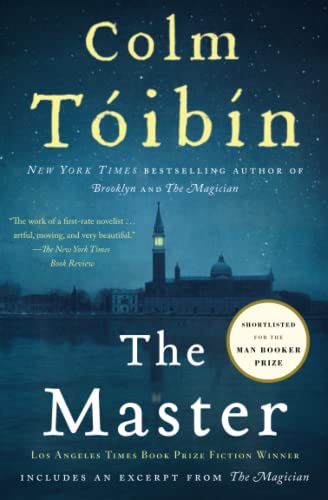
“Colm Tóibín’s beautiful, subtle illumination of Henry James’s inner life” (The New York Times) captures the loneliness and hope of a master of psychological subtlety whose forays into intimacy inevitably fail those he tried to love.
Beautiful and profoundly moving, The Master tells the story of Henry James, a man born into one of America’s first intellectual families who leaves his country in the late nineteenth century to live in Paris, Rome, Venice, and London among privileged artists and writers. With stunningly resonant prose, “The Master is unquestionably the work of a first-rate novelist: artful, moving, and very beautiful” (The New York Times Book Review). The emotional intensity of this portrait is riveting.
Die Inhaltsangabe kann sich auf eine andere Ausgabe dieses Titels beziehen.
Über die Autorin bzw. den Autor
Colm Tóibín is the author of ten novels, including The Magician, winner of the Rathbones Folio Prize; The Master, winner of the Los Angeles Times Book Prize; Brooklyn, winner of the Costa Book Award; The Testament of Mary; and Nora Webster, as well as two story collections and several books of criticism. He is the Irene and Sidney B. Silverman Professor of the Humanities at Columbia University and has been named as the Laureate for Irish Fiction for 2022–2024 by the Arts Council of Ireland. Three times shortlisted for the Booker Prize, Tóibín lives in Dublin and New York.
Auszug. © Genehmigter Nachdruck. Alle Rechte vorbehalten.
Chapter One
January 1895
Sometimes in the night he dreamed about the dead -- familiar faces and the others, half-forgotten ones, fleetingly summoned up. Now as he woke, it was, he imagined, an hour or more before the dawn; there would be no sound or movement for several hours. He touched the muscles on his neck which had become stiff; to his fingers they seemed unyielding and solid but not painful. As he moved his head, he could hear the muscles creaking. I am like an old door, he said to himself.
It was imperative, he knew, that he go back to sleep. He could not lie awake during these hours. He wanted to sleep, enter a lovely blackness, a dark, but not too dark, resting place, unhaunted, unpeopled, with no flickering presences.
When he woke again, he was agitated and unsure where he was. He often woke like this, disturbed, only half remembering the dream and desperate for the day to begin. Sometimes when he dozed, he would bask in the hazy, soft light of Bellosguardo in the early spring, the distances all misty, feeling the sheer pleasure of sunlight on his face, sitting in a chair, close to the wall of the old house with the smell of wisteria and early roses and jasmine. He would hope when he woke that the day would be like the dream, that traces of the ease and the color and the light would linger at the edge of things until night fell again.
But this dream was different. It was dark or darkening somewhere, it was a city, an old place in Italy like Orvieto or Siena, but nowhere exact, a dream-city with narrow streets, and he was hurrying; he was uncertain now whether he was alone or with somebody, but he was hurrying and there were students walking slowly up the hill too, past lighted shops and cafés and restaurants, and he was eager to get by them, finding ways to pass them. No matter how hard he tried to remember, he was still not sure if he had a companion; perhaps he did, or perhaps it was merely someone who walked behind him. He could not recall much about this shadowy, intermittent presence, but for some of the time there seemed to be a person or a voice close to him who understood better than he did the urgency, the need to hurry, and who insisted under his breath in mutterings and mumbles, cajoled him to walk faster, edge the students out of his path.
Why did he dream this? At each long and dimly lit entrance to a square, he recalled, he was tempted to leave the bustling street, but he was urged to carry on. Was his ghostly companion telling him to carry on? Finally, he walked slowly into a vast Italian space, with towers and castellated roofs, and a sky the color of dark blue ink, smooth and consistent. He stood there and watched as though it were framed, taking in the symmetry and texture. This time -- and he shivered when he recalled the scene -- there were figures in the center with their backs to him, figures forming a circle, but he could see none of their faces. He was ready to walk towards them when the figures with their backs to him turned. One of them was his mother at the end of her life, his mother when he had last seen her. Near her among the other women stood his aunt Kate. Both of them had been dead for years; they were smiling at him and moving slowly towards him. Their faces were lit like faces in a painting. The word that came to him, he was sure that he had dreamt the word as much as the scene, was the word "beseeching." They were imploring him or somebody, asking, yearning, and then putting their hands out in front of them in supplication, and as they moved towards him he woke in cold fright, and he wished that they could have spoken, or that he could have offered the two people whom he had loved most in his life some consolation. What came over him in the aftertaste of the dream was a wearying, gnawing sadness and, since he knew that he must not go back to sleep, an overwhelming urge to start writing, anything to numb himself, distract himself, from the vision of these two women who were lost to him.
He covered his face for a moment when he remembered one second in the dream which had caused him to wake abruptly. He would have given anything now to forget it, to prevent it from following him into the day: in that square he had locked eyes with his mother, and her gaze was full of panic, her mouth ready to cry out. She fiercely wanted something beyond her reach, which she could not obtain, and he could not help her.
In the days coming up to the New Year he had refused all invitations. He wrote to Lady Wolseley that he sat all day at rehearsals in the company of several fat women who made the costumes. He was uneasy and anxious, often agitated, but sometimes, too, he was involved in the action on the stage as though it were all new to him, and he was moved by it. He asked Lady Wolseley and her husband to unite in prayers for him on the opening night of his play, not far away now.
In the evening he could do nothing, and his sleep was fitful. He saw nobody except his servants, and they knew not to speak to him or trouble him beyond what was entirely necessary.
His play Guy Domville, the story of a rich Catholic heir who must choose whether to carry on the family line or join a monastery, would open on January 5. All the invitations to the opening night had gone out and he had already received many replies of acceptance and thanks. Alexander, the producer and lead actor, had a following among theatergoers, and the costumes -- the play was set in the eighteenth century -- were sumptuous. Yet, despite his new enjoyment of the society of actors and the glitter and the daily small changes and improvements in the production, he was, he said, not made for the theater. He sighed as he sat at his desk. He wished it were an ordinary day and he could read over yesterday's sentences, spend a slow morning making corrections, and then start out once more, filling the afternoon with ordinary work. And yet he knew that his mood could change as quickly as the light in the room could darken, and he easily could feel only happiness at his life in the theater and begin again to hate the company of his blank pages. Middle age, he thought, had made him fickle.
His visitor had arrived promptly at eleven o'clock. He could not have refused to see her; her letter had been carefully insistent. Soon she would be leaving Paris for good, she said, and this would be her last visit to London. There was something oddly final and resigned in her tone, a tone so alien to her general spirit that he was quickly alerted to the seriousness of her situation. He had not seen her for many years, but over these years he had received some letters from her and news from others about her. That morning, however, still haunted by his dream, and so full of concern about his play, he saw her as merely a name in his diary, stirring an old memory sharp in its outlines and faded in its detail.
When she came into the room, her old face smiling warmly, her large-boned frame moving slowly and deliberately, her greeting so cheerful, open and affectionate, and her voice so beautiful and soft, almost whispering, it was easy to put aside his worries about his play and the time he was wasting by not being in the theater. He had forgotten how much he liked her and how easy it was to be taken instantly back to those days when he was in his twenties and lingered as much as he could in the company of French and Russian writers in Paris.
Somehow, in the years that followed, the shadowy presences interested him as much as the famous ones, the figures who had not become known, who had failed, or who had never planned to flourish. His visitor had been married to the Prince Oblisky. The prince had a reputation for being stern and distant; the fate of Russia and his purposeful exile concerned him more than the evening's amusement and the glamorous company who stood around. The...
„Über diesen Titel“ kann sich auf eine andere Ausgabe dieses Titels beziehen.
Suchergebnisse für The Master: A Novel

Beispielbild für diese ISBN
The Master
Anbieter: World of Books (was SecondSale), Montgomery, IL, USA
Verkäuferbewertung 5 von 5 Sternen

Paperback. Zustand: Fair. WINNER OF THE LOS ANGELES TIMES BOOK PRIZE * WINNER OF THE INTERNATIONAL DUBLIN LITERARY AWARD * SHORTLISTED FOR THE BOOKER PRIZE "Colm Tóibín's beautiful, subtle illumination of Henry James's inner life" (The New York Times) captures the loneliness and hope of the celebrated American writer in this profoundly moving historical novel about art, desire, and the elusive nature of intimacy. Beautiful and profoundly moving, The Master tells the story of Henry James, a man born into one of America's first intellectual families who leaves his country in the late nineteenth century to live in Paris, Rome, Venice, and London among privileged artists and writers. The emotional intensity of Tóibín's portrait of James is riveting. Time and again, James, a master of psychological subtlety in his fiction, proves blind to his own heart and incapable of reconciling his dreams of passion with his own fragility. With stunningly resonant prose, "The Master is unquestionably the work of a first-rate novelist: artful, moving, and very beautiful" (The New York Times Book Review). Artikel-Nr. 00083680915
Gebraucht kaufen
EUR 4,05
Versand gratis
Versand innerhalb von USA
Versand innerhalb von USA
Anzahl: Mehr als 20 verfügbar
Beispielbild für diese ISBN
The Master
Anbieter: World of Books (was SecondSale), Montgomery, IL, USA
Verkäuferbewertung 5 von 5 Sternen
Paperback. Zustand: Good. WINNER OF THE LOS ANGELES TIMES BOOK PRIZE * WINNER OF THE INTERNATIONAL DUBLIN LITERARY AWARD * SHORTLISTED FOR THE BOOKER PRIZE "Colm Tóibín's beautiful, subtle illumination of Henry James's inner life" (The New York Times) captures the loneliness and hope of the celebrated American writer in this profoundly moving historical novel about art, desire, and the elusive nature of intimacy. Beautiful and profoundly moving, The Master tells the story of Henry James, a man born into one of America's first intellectual families who leaves his country in the late nineteenth century to live in Paris, Rome, Venice, and London among privileged artists and writers. The emotional intensity of Tóibín's portrait of James is riveting. Time and again, James, a master of psychological subtlety in his fiction, proves blind to his own heart and incapable of reconciling his dreams of passion with his own fragility. With stunningly resonant prose, "The Master is unquestionably the work of a first-rate novelist: artful, moving, and very beautiful" (The New York Times Book Review). Artikel-Nr. 00098432111
Gebraucht kaufen
EUR 4,05
Versand gratis
Versand innerhalb von USA
Versand innerhalb von USA
Anzahl: Mehr als 20 verfügbar
Beispielbild für diese ISBN
The Master
Anbieter: ThriftBooks-Reno, Reno, NV, USA
Verkäuferbewertung 5 von 5 Sternen
Paperback. Zustand: Good. No Jacket. Pages can have notes/highlighting. Spine may show signs of wear. ~ ThriftBooks: Read More, Spend Less. Artikel-Nr. G0743250419I3N00
Gebraucht kaufen
EUR 6,04
Versand gratis
Versand innerhalb von USA
Versand innerhalb von USA
Anzahl: 2 verfügbar
Beispielbild für diese ISBN
The Master
Anbieter: ThriftBooks-Phoenix, Phoenix, AZ, USA
Verkäuferbewertung 5 von 5 Sternen
Paperback. Zustand: Good. No Jacket. Pages can have notes/highlighting. Spine may show signs of wear. ~ ThriftBooks: Read More, Spend Less. Artikel-Nr. G0743250419I3N00
Gebraucht kaufen
EUR 6,04
Versand gratis
Versand innerhalb von USA
Versand innerhalb von USA
Anzahl: 2 verfügbar
Beispielbild für diese ISBN
The Master
Anbieter: ThriftBooks-Atlanta, AUSTELL, GA, USA
Verkäuferbewertung 5 von 5 Sternen
Paperback. Zustand: Good. No Jacket. Pages can have notes/highlighting. Spine may show signs of wear. ~ ThriftBooks: Read More, Spend Less. Artikel-Nr. G0743250419I3N00
Gebraucht kaufen
EUR 6,06
Versand gratis
Versand innerhalb von USA
Versand innerhalb von USA
Anzahl: 2 verfügbar
Beispielbild für diese ISBN
The Master
Anbieter: ThriftBooks-Atlanta, AUSTELL, GA, USA
Verkäuferbewertung 5 von 5 Sternen
Paperback. Zustand: Very Good. No Jacket. May have limited writing in cover pages. Pages are unmarked. ~ ThriftBooks: Read More, Spend Less. Artikel-Nr. G0743250419I4N00
Gebraucht kaufen
EUR 6,06
Versand gratis
Versand innerhalb von USA
Versand innerhalb von USA
Anzahl: 1 verfügbar
Beispielbild für diese ISBN
The Master
Anbieter: ThriftBooks-Dallas, Dallas, TX, USA
Verkäuferbewertung 5 von 5 Sternen
Paperback. Zustand: Good. No Jacket. Pages can have notes/highlighting. Spine may show signs of wear. ~ ThriftBooks: Read More, Spend Less. Artikel-Nr. G0743250419I3N00
Gebraucht kaufen
EUR 6,06
Versand gratis
Versand innerhalb von USA
Versand innerhalb von USA
Anzahl: 3 verfügbar
Beispielbild für diese ISBN
The Master
Anbieter: ThriftBooks-Dallas, Dallas, TX, USA
Verkäuferbewertung 5 von 5 Sternen
Paperback. Zustand: Very Good. No Jacket. May have limited writing in cover pages. Pages are unmarked. ~ ThriftBooks: Read More, Spend Less. Artikel-Nr. G0743250419I4N00
Gebraucht kaufen
EUR 6,06
Versand gratis
Versand innerhalb von USA
Versand innerhalb von USA
Anzahl: 1 verfügbar
Beispielbild für diese ISBN
The Master : A Novel
Anbieter: Better World Books: West, Reno, NV, USA
Verkäuferbewertung 5 von 5 Sternen
Zustand: Good. Former library copy. Pages intact with minimal writing/highlighting. The binding may be loose and creased. Dust jackets/supplements are not included. Includes library markings. Stock photo provided. Product includes identifying sticker. Better World Books: Buy Books. Do Good. Artikel-Nr. GRP95581750
Gebraucht kaufen
EUR 6,19
Versand gratis
Versand innerhalb von USA
Versand innerhalb von USA
Anzahl: 2 verfügbar
Beispielbild für diese ISBN
The Master : A Novel
Anbieter: Better World Books: West, Reno, NV, USA
Verkäuferbewertung 5 von 5 Sternen
Zustand: Good. Pages intact with minimal writing/highlighting. The binding may be loose and creased. Dust jackets/supplements are not included. Stock photo provided. Product includes identifying sticker. Better World Books: Buy Books. Do Good. Artikel-Nr. GRP101668282
Gebraucht kaufen
EUR 6,19
Versand gratis
Versand innerhalb von USA
Versand innerhalb von USA
Anzahl: 3 verfügbar